
Driven by surging demand for AI‑related storage, Seagate posted first‑quarter revenue of $4.23 billion, up 61% year over year, with both earnings and its next‑quarter guidance comfortably exceeding expectations. Thanks to disciplined cost management, gross margin surged past 57%, and cash flow remained robust. The company views HAMR technology as the cornerstone of its long-term growth. However, after a nearly 150% rally this year that had already elevated market expectations, the stock plunged more than 8% in after‑hours trading.
Seagate Technology reported a substantial increase in first-quarter profits, as the ongoing development of artificial intelligence infrastructure continues to drive demand for the company's data storage components.
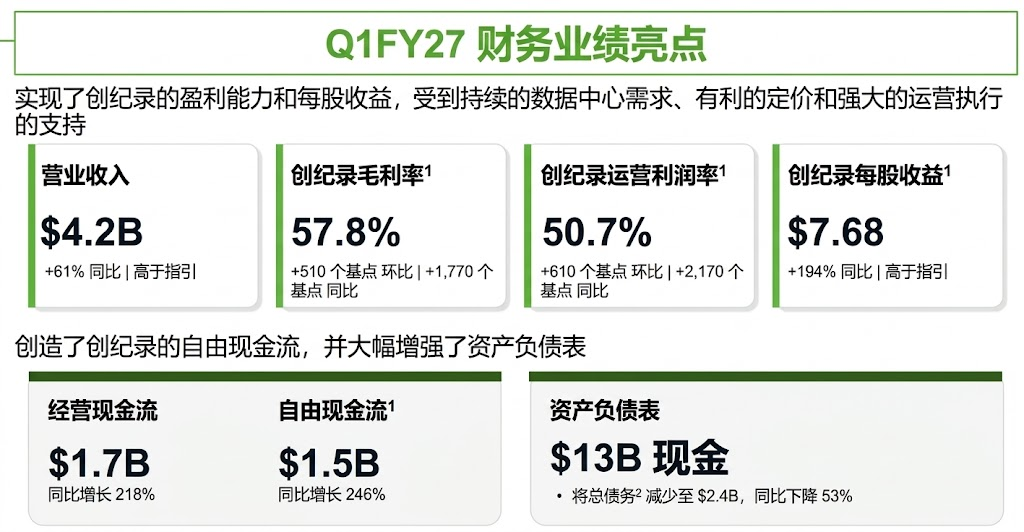
On October 27, after the U.S. stock market closed, Seagate Technology reported its fiscal first-quarter results for the year ending October 2, 2026. The company's revenue reached $4.23 billion, up approximately 61% year over year, surpassing analysts' average estimate of $4.11 billion. Adjusted earnings per share came in at $7.68, also exceeding the expected $7.39. The company also raised its quarterly dividend by about 3% to $0.76 per share.
 On the guidance front, Seagate expects second-quarter revenue of $4.8 billion, plus or minus $100 million, and adjusted earnings per share of $9.20, plus or minus $0.20—both significantly above analysts' prior estimates of $4.55 billion in revenue and $8.66 per share.
CEO Dave Mosley stated that the ongoing creation, retention, and reuse of data continue to drive robust growth in storage demand, while strong visibility into customers' long-term needs underpins the company's outlook for a multi-year growth cycle.
Despite earnings and guidance both coming in well above expectations, Seagate's stock fell more than 8% in after-hours trading. During the session, the shares had risen as much as 3.7%, closing at $667.85. Year-to-date, Seagate's stock has gained nearly 150%, leaving investors with increasingly stringent expectations for continued outperformance.
The HAMR and Mozaic roadmaps have become key drivers of long-term growth.
Seagate has repeatedly referenced its HAMR technology roadmap in its financial reports. HAMR, or Heat-Assisted Magnetic Recording, is a key pathway for increasing areal density and further boosting per‑drive capacity. The company also mentioned its Mozaic product, which is based on HAMR, in its forward‑looking statements.
Dave Mosley stated that the company's HAMR technology roadmap can meet the growing exabyte‑level demand by increasing areal density, while maintaining supply discipline.
He emphasized that, by combining a value‑driven pricing strategy with a continuously strengthened balance sheet, Seagate is poised to deliver sustained earnings growth, robust cash generation, and steadily improving shareholder returns over the long term.
In the AI and cloud‑infrastructure cycle, the market typically focuses on GPUs, HBM, and networking equipment, but backend data storage also stands to benefit as data volumes grow. Seagate's marked improvement in profit margins this quarter underscores that high‑capacity HDDs continue to deliver strong economic value within data‑center architectures.
Gross margin rose to over 57%, and operating profit margin surged.
The most noteworthy developments this quarter were the significant increases in both gross margin and operating profit margin.
In the first fiscal quarter, Seagate's GAAP gross margin was 57.3%, compared with 39.4% in the same period last year, up 17.9 percentage points year over year; its non-GAAP gross margin was 57.8%, versus 40.1% a year earlier. This means that for every dollar of revenue, nearly $0.58 translates into non-GAAP gross profit.
Operating margin improved markedly as well. GAAP operating income totaled $2.064 billion, compared with $694 million in the same period last year; GAAP operating margin rose from 26.4% to 48.8%. Non-GAAP operating income reached $2.147 billion, with a non-GAAP operating margin of 50.7%, up from 29.0% in the prior-year period.
The key lies in the fact that cost growth has lagged far behind revenue growth. In the first fiscal quarter, Seagate's revenue rose 61% year over year, while its cost of revenue increased only from $1.592 billion to $1.806 billion, a rise of roughly 13%. Meanwhile, the company's GAAP operating expenses—excluding cost of revenue—stood at $363 million, compared with $343 million in the same period last year, reflecting a modest increase.
In other words, as demand picked up, Seagate's expenses and manufacturing costs did not expand proportionately, resulting in substantial profit elasticity.
Free cash flow approached $1.5 billion, with a marked improvement in cash conversion efficiency.
Seagate's operating cash flow for the first fiscal quarter was $1.69 billion, compared to $532 million in the same period last year; free cash flow totaled $1.48 billion, up from $427 million a year earlier, representing a year-over-year increase of approximately 246%.
This quarter, the free cash flow margin was approximately 35%, and free cash flow accounted for roughly 84% of GAAP net profit, reflecting strong cash conversion quality. Despite a $283 million increase in accounts receivable and a $129 million rise in inventory—both of which tied up working capital—the company still generated robust operating cash flow, underscoring the solid quality of its earnings.
On the capital expenditure front, the company's cash outlays for property, equipment, and leasehold improvements totaled $211 million, compared with $105 million in the same period last year—nearly doubling. Despite this increase, capital spending remains manageable relative to the company's revenue of over $4.2 billion.
This is also in line with Seagate's current strategy: to continue investing in high-capacity and HAMR‑related product lines as demand improves, while refraining from undisciplined expansion to avoid repeating the oversupply cycles that have historically plagued the storage industry.
Q2 guidance is stronger: median revenue of $4.8 billion, with non-GAAP EPS expected to exceed $9.00.
Seagate expects second-quarter fiscal 2027 revenue of $4.8 billion, plus or minus $100 million, and non-GAAP diluted EPS of $9.20, plus or minus $0.20.
Compared with the actual figure for the first fiscal quarter:
The midpoint of the revenue guidance represents an approximately 13% quarter-over-quarter increase from $4.233 billion.
The midpoint of the non-GAAP EPS guidance represents an approximately 20% quarter-over-quarter increase from $7.68.
This guidance indicates that the company expects the trend of improving demand to persist, with profit expansion likely to continue outpacing revenue growth. Although the company did not provide a gross margin outlook for the next quarter, the operating‑profit elasticity implied by its EPS guidance remains robust.
It should be noted that the company stated its non-GAAP EPS guidance excludes the impact of known pre‑tax stock‑based compensation expenses, amounting to approximately $0.30 per share. Other items that could affect GAAP results—such as gains or losses on debt transactions, gains or losses on strategic investments, impairment charges, and tax adjustments—cannot currently be reasonably projected.
 Earnings Flash: AI Insights into Key Points, Build an Options Strategy in Three Steps! Open Futubull > Stock Page > Tap [Company] >Earnings Flash Report

Editor/rice