The Nasdaq rose 1.18%, and the chip index gained 3.60%. Broadcom advanced 4.00%. Shares of emerging cloud service providers surged, with Nebius up 11.22%. Storage and optical communications stocks also strengthened in tandem, with Western Digital climbing 7%, SanDisk rising 4%, and Coherent gaining 6%. After hours, Seagate fell 6% following its earnings report. U.S. Treasury yields remained relatively stable, with the 10-year yield hovering around 4.99%. Gold staged a V-shaped rebound, dipping as low as $3,989.16 at one point, while U.S. oil prices declined by about 1.8%.
With investment enthusiasm for artificial intelligence continuing to surge, coupled with falling oil prices and better-than-expected macroeconomic data, U.S. stocks extended their gains on Tuesday, led by the technology sector. Market attention has now shifted to this week's Federal Reserve interest-rate decision and the earnings reports of the three major tech giants.

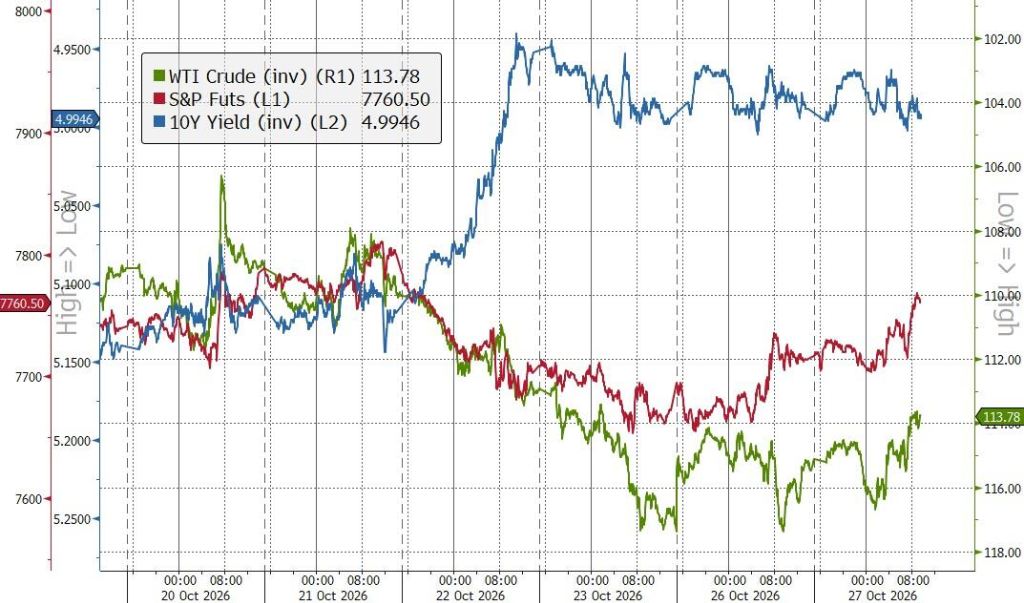
On Tuesday, the Nasdaq 100 closed up 1.3%, the S&P 500 gained 0.6%, and the Dow Jones Industrial Average was virtually unchanged. The Philadelphia Semiconductor Index rebounded 3.6% in a single day. Meanwhile, WTI crude oil prices fell below $100 per barrel, while U.S. Treasury yields remained relatively stable, with the 10-year yield hovering around 4.99%, providing a steady external backdrop for the stock market's strength.
 The improvement in market sentiment has been driven by multiple catalysts.$Broadcom (AVGO.US)$Announced the completion of a $63 billion financing round for AI chips,$Oracle (ORCL.US)$Expand cloud service collaboration with OpenAI,$Meta Platforms (META.US)$The $25 billion share offering was oversubscribed by a factor of five.
Goldman Sachs' technology trading desk has identified the aforementioned events as the core drivers behind this round of strong rebound in the AI sector, while also noting that some individual stocks' bounce from oversold levels and the easing of rapid selling pressure have further fueled the rally. Bloomberg macro strategist Tatiana Darie stated:
U.S. stocks are digesting concerns about high borrowing costs, while earnings reports suggest that the resilience of the profit cycle has been underestimated.
Broadcom's $63 billion financing has closed, with tech stocks leading the U.S. stock market higher.
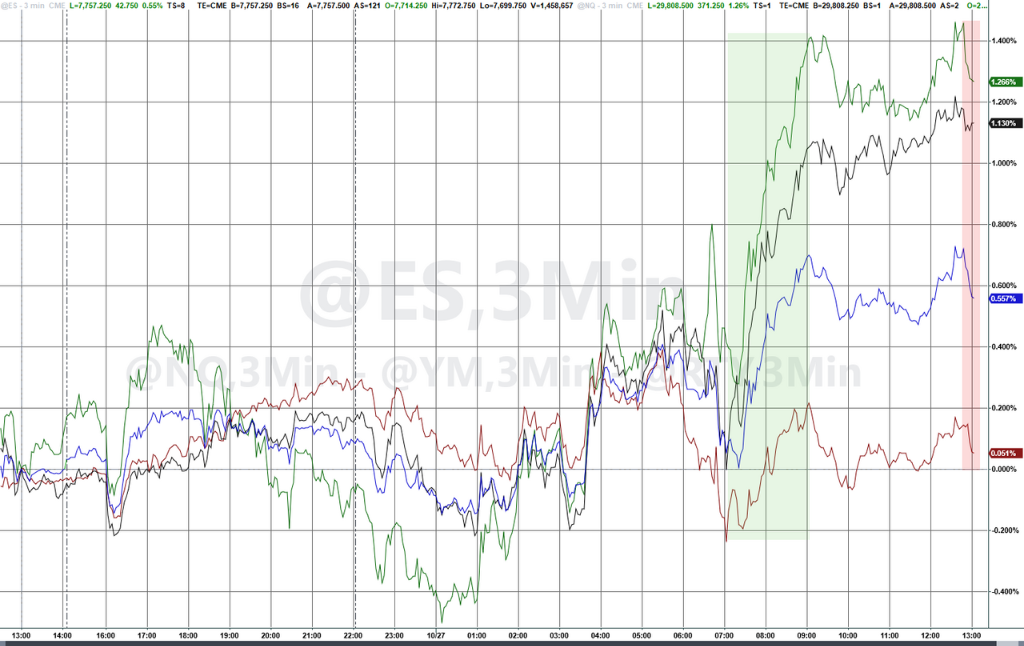
The three major U.S. stock indexes closed higher for the second consecutive trading day. The S&P 500 rose 0.60% to 7,722.65, the Nasdaq Composite gained 1.18%, and the Nasdaq 100 advanced 1.29%. The Dow Jones Industrial Average edged up 0.03%, while the Russell 2000 climbed 1.16%. The Philadelphia Semiconductor Index led gains with a 3.60% surge. Among sectors, technology stocks posted the strongest gains, while energy shares suffered the largest losses.
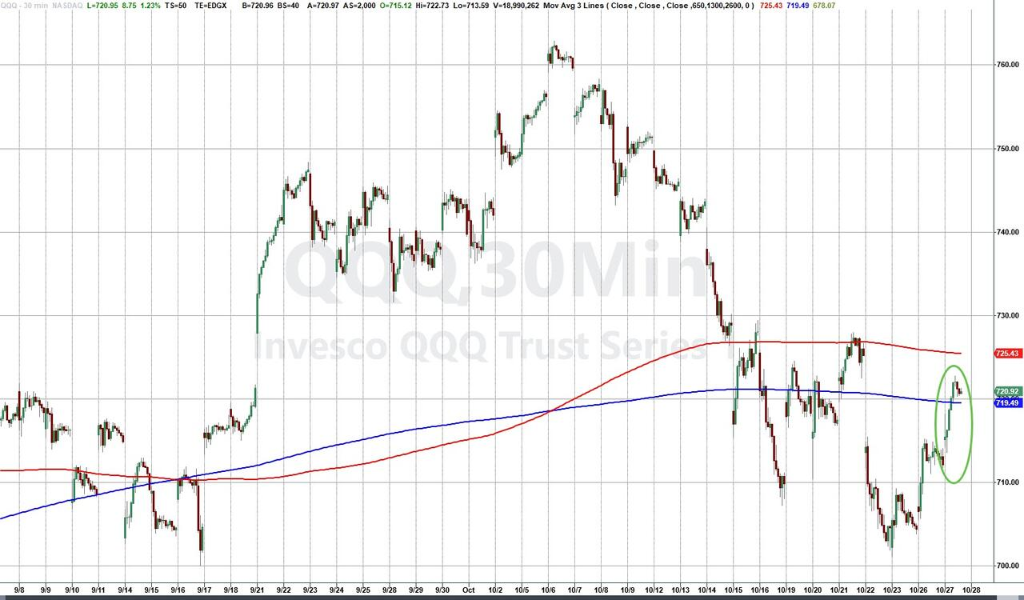
The Nasdaq 100 index has once again risen above its 100-day moving average.
Broadcom has teamed up with an institutional consortium comprising Bank of America, Citi, Morgan Stanley, and Blackstone to raise $63 billion. The funds will be used to procure Broadcom's AI accelerators and networking equipment, which will then be leased to Anthropic, a developer of large-scale AI models. Chip deliveries are expected to begin in 2027.
Broadcom rose 4.00% on Tuesday. Broadcom's trading boosted chip stocks, pulling them away from their July lows.$Advanced Micro Devices (AMD.US)$Up 5.45%,$Intel (INTC.US)$Up 3.61%,$Marvell Technology (MRVL.US)$Up 4.19%,$Micron Technology (MU.US)$Up 2.77%,$NVIDIA (NVDA.US)$Up 0.90%.
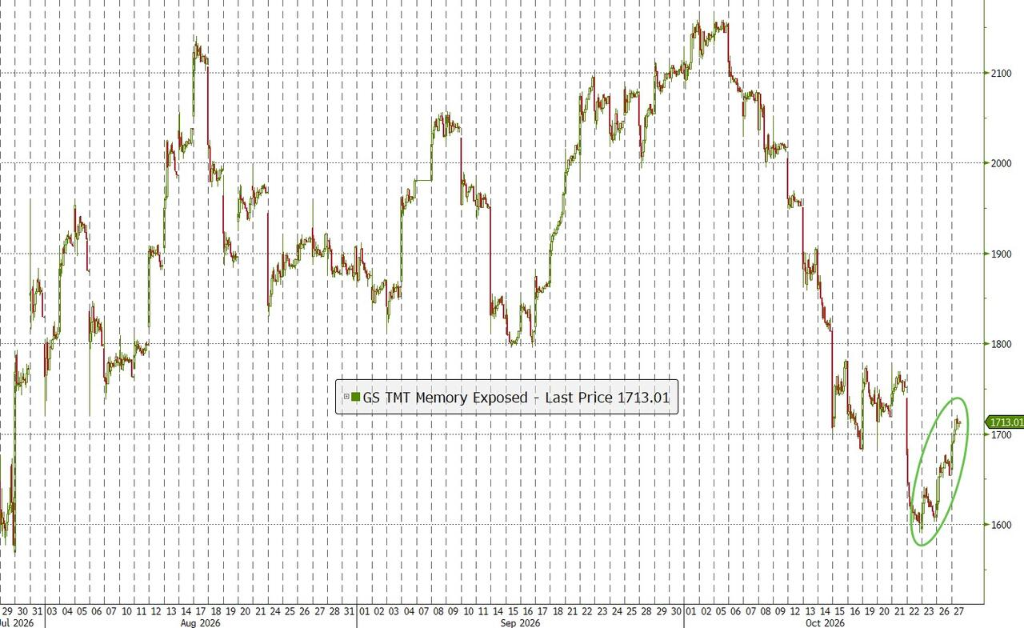
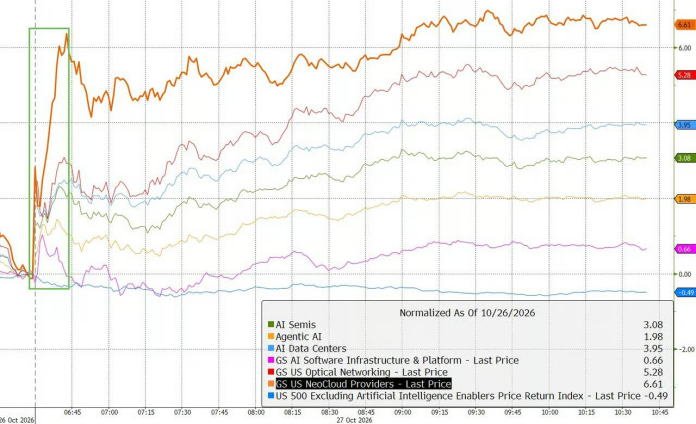
Emerging cloud service providers staged a sharp rebound today,$CoreWeave (CRWV.US)$Up 7.94%,$NEBIUS (NBIS.US)$Up 11.22%,$IREN Ltd (IREN.US)$It rose by 7.90%. Crusoe CEO Chase Lochmiller stated that the market has overreacted to the sell-off of companies like this.
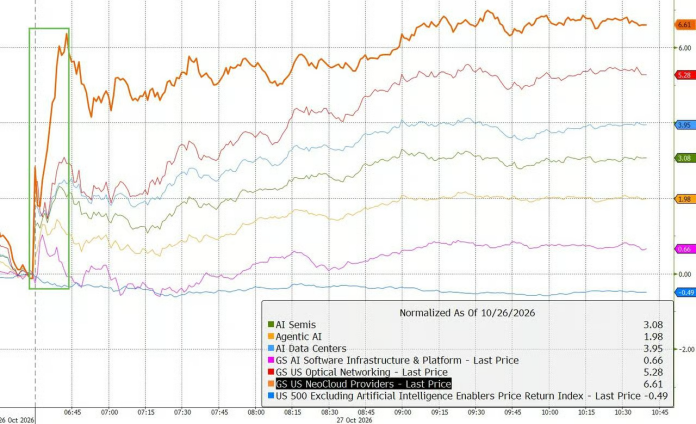
Storage and optical communications saw even sharper gains.$Western Digital (WDC.US)$Up 6.95%, Seagate up 3.67%,$SanDisk (SNDK.US)$Up 3.92%; Coherent up 6.45%,$Lumentum (LITE.US)$Up 5.88%, and Applied Optoelectronics up 6.96%.
Goldman Sachs' technology trading desk attributed the day's strength to three factors: easing financing concerns, earnings reports and capital expenditure expectations from ultra-large-cap companies, and oversold rallies in some stocks that beat expectations.
Goldman Sachs' U.S. Broad AI Index rose 5.08% on the day, while the S&P 500, excluding AI-enabled stocks, fell 0.32%.
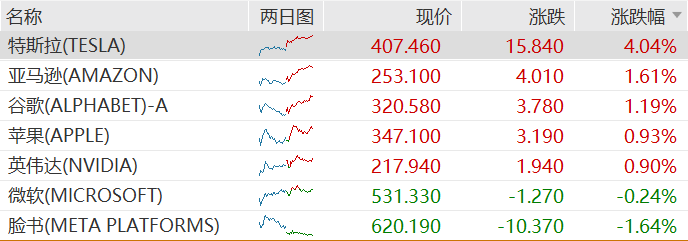
Among the seven major U.S. stocks, there is internal divergence; Amazon rose 1.61%,$Apple (AAPL.US)$It rose 0.93%, while Microsoft fell 0.24%.$Tesla (TSLA.US)$It rose 4.04%, hitting a three-month high during the session.
Barclays has upgraded Tesla's rating from Hold to Overweight, signaling confidence that it will outperform its peers. The 12-month price target has been raised from $370 to $450, citing improved growth prospects for its core automotive business, a turning point in its autonomous taxi service, and robust demand for energy storage.
Two consecutive declines in oil prices weighed on energy stocks,$Exxon Mobil (XOM.US)$Down 2.53%,$Chevron (CVX.US)$Down 1.63%. Power stocks advanced,$Constellation Energy (CEG.US)$Up 2.57%, Vistra up 3.48%.
The Federal Reserve's policy decision and a flurry of earnings reports from major corporations are set to follow one after another.
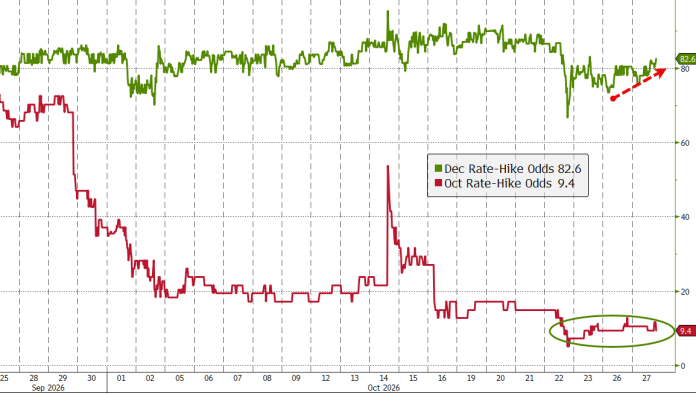
The Federal Reserve will announce its interest-rate decision on Wednesday afternoon, U.S. time. Market pricing currently holds steady at 3.75% to 4%, with a December rate hike remaining the dominant expectation, with odds exceeding 70%. Chair Powell has previously pledged not to provide forward guidance, meaning the Q&A session at the press conference could become a source of volatility.
After the market closed that day, Microsoft and Google were the first to release their earnings reports, followed by Amazon and Intel. The market will be testing whether the capital expenditures, recently bolstered by two rounds of financing, can translate into tangible results in the financial statements.
Tony Pasquariello, head of Goldman Sachs' hedge fund client business, said the bull market will persist but its momentum is waning; Mike Wilson, Morgan Stanley's chief U.S. equity strategist, believes the correction has entered its final stage and could still plunge further, with sharp declines actually presenting buying opportunities.
Bloomberg macro strategist Frank Monkam breaks the adjustment into three phases—rotation, contagion, and liquidation—and argues that the turning point will come when credit pressures begin to spread more broadly.
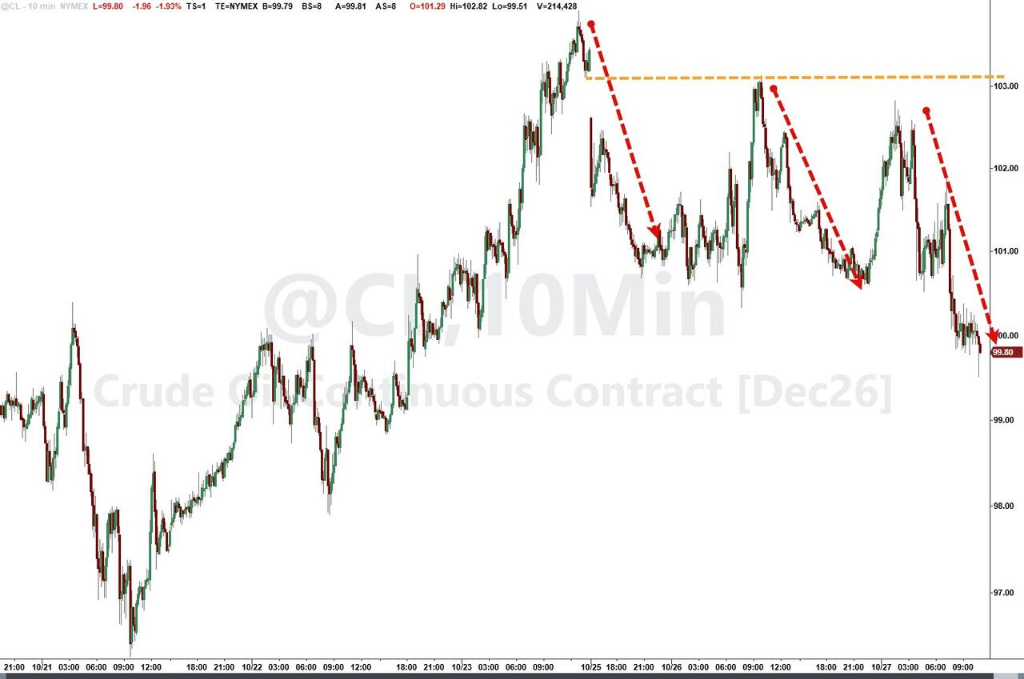
Crude oil has fallen for the second consecutive session, with WTI's settlement price dropping below $100, while the spot market remains even more tight.
As officials from Saudi Arabia, Turkey, and Pakistan traveled to Tehran for diplomatic talks, market expectations of a de-escalation in the Persian Gulf situation intensified, pushing WTI crude oil prices down by roughly 1.8% and below $100 per barrel, while Brent crude settled below $114 per barrel.
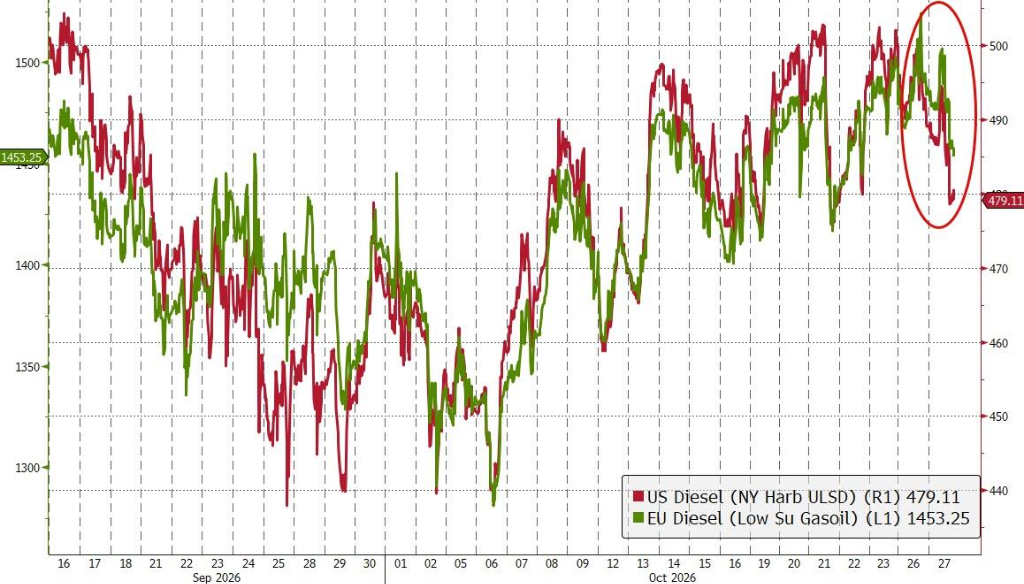
U.S. diesel prices stood at $479.11, while European diesel was quoted at $1,453.25, both retreating to one-week lows. Crude oil and refined product inventories remain about 76 million barrels below their seasonal averages, and the national average gasoline price has fallen to $4.266 per gallon.
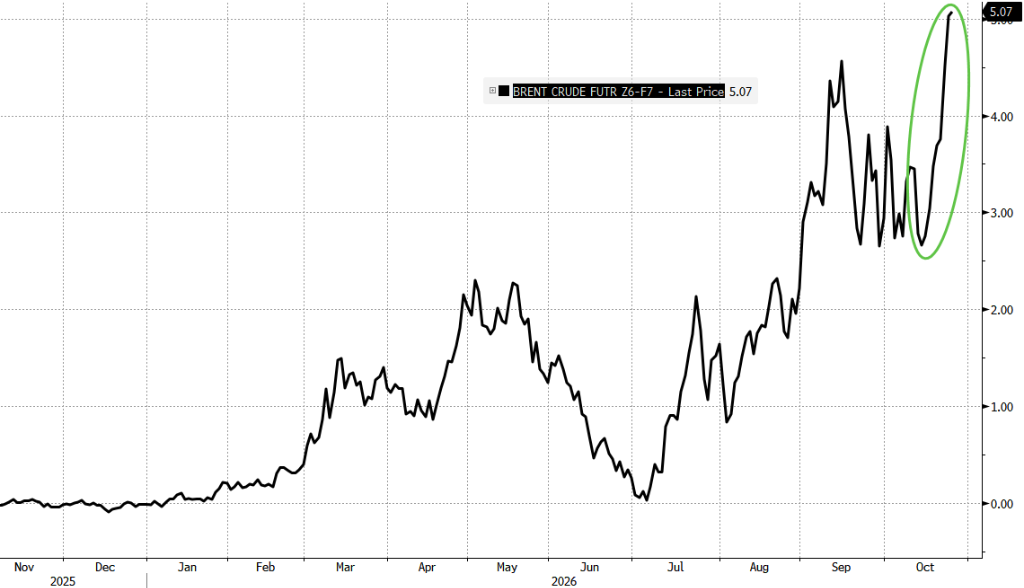
However, tightness in the spot market has not eased. The Brent December–January spread stands at $5.07, remaining in backwardation and widening from a week earlier.
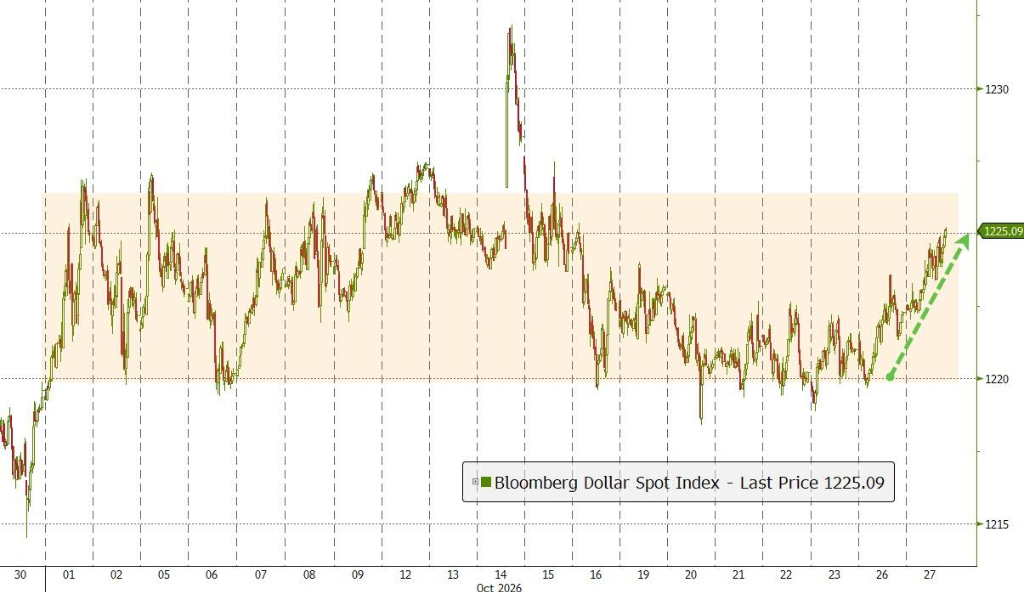
10-year U.S. Treasury yields are trading sideways, while the U.S. dollar rebounds.
The macroeconomic data released that day all exceeded expectations: in September, durable goods orders rose 1.8% month-on-month, marking the largest increase in five months; in October, the Conference Board's Consumer Confidence Index climbed to 91.7, well above the market consensus of 81.0; and in September, new-home sales totaled an annualized rate of 676,000 units, compared with the expected 651,000.
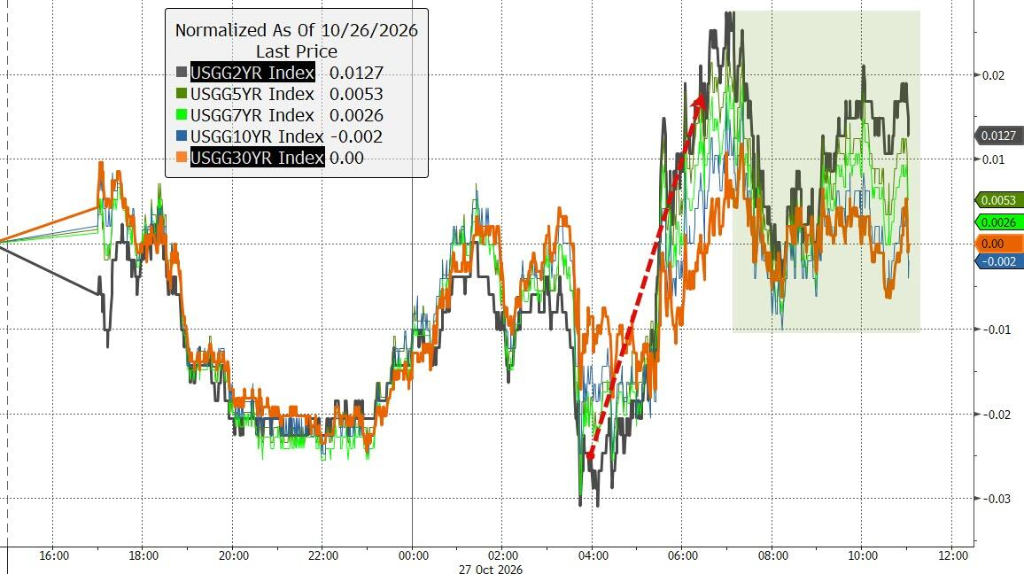
Stronger macroeconomic data offset the impact of weaker oil prices, leaving U.S. Treasury yields largely unchanged. The 10-year Treasury yield stood at 4.9843%, down 0.41 basis points, after climbing as high as 4.997% during the session, with the day's range between 4.9595% and 5.0050%.
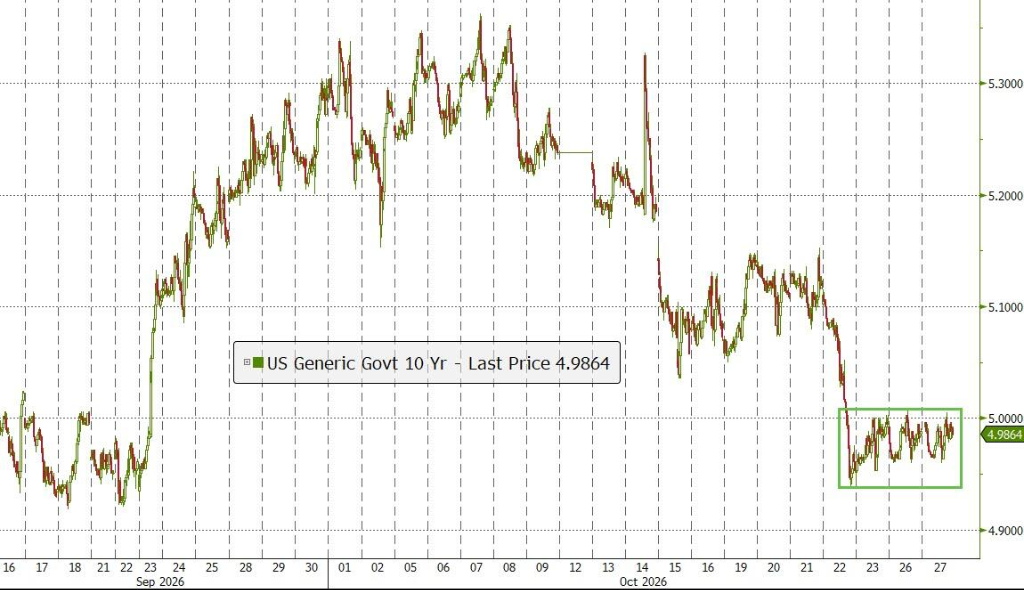
The 2-year yield stood at 4.7286%, up 1.27 basis points, while the 30-year yield was 5.2975%, down 0.53 basis points. The 2-year–10-year yield spread narrowed by 1.25 basis points to 25.36 basis points.
The U.S. dollar found support, with the U.S. Dollar Index, which measures the greenback against six major currencies, closing at 102.319 in late trading, up 0.35%. The euro fell to $1.1135, while the dollar rose to 157.95 per Japanese yen.
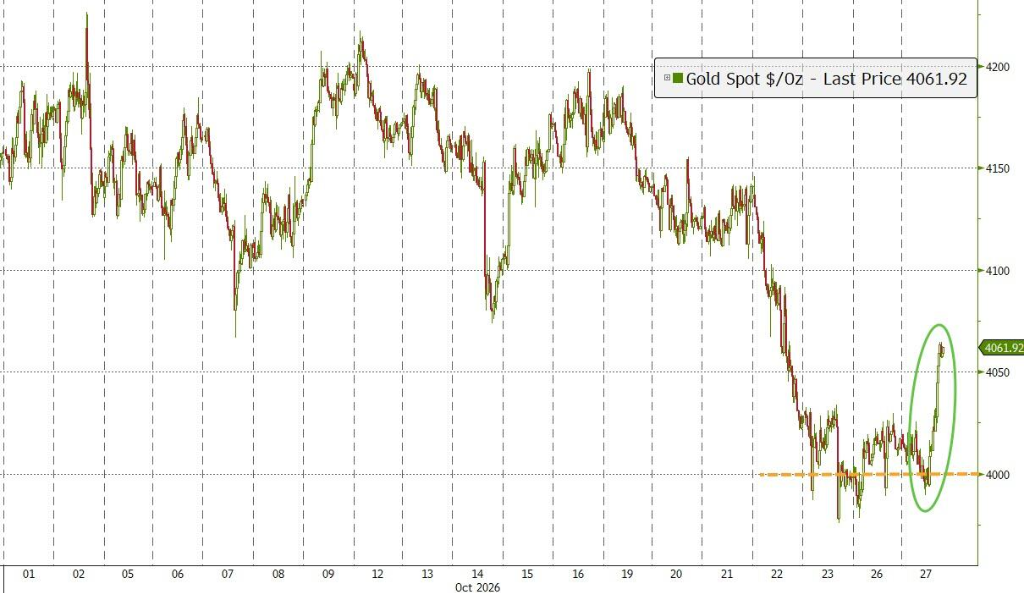
Despite the strengthening U.S. dollar, gold prices staged a sharp rebound from the $4,000 support level. Spot gold traded at $4,061.92 in New York, up 1.11%, after briefly dipping below $4,000 earlier in pre‑market trading to a low of $3,989.16.
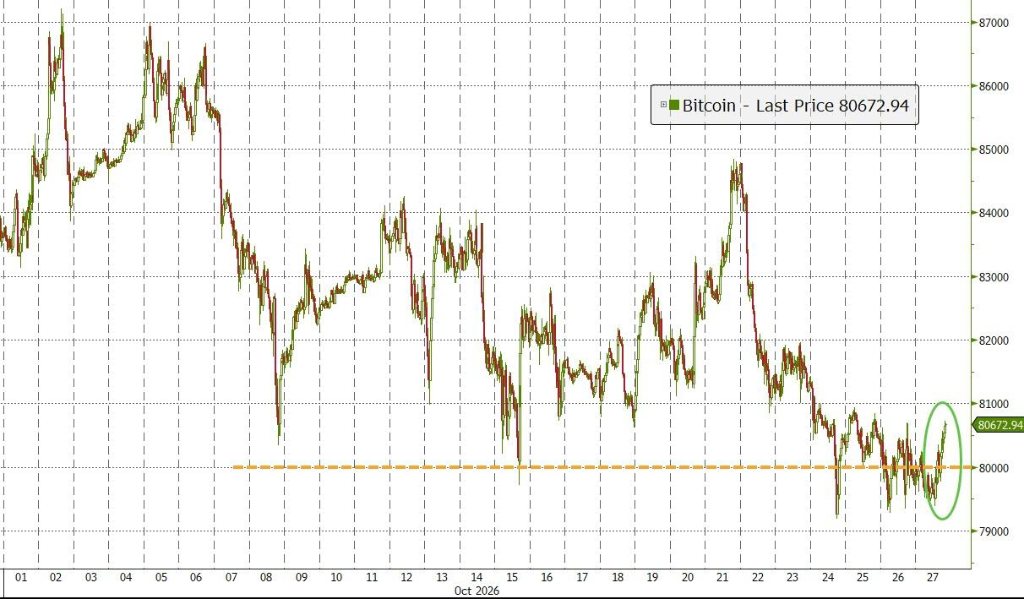
Spot silver is trading at $54.26, up 0.87%. Bitcoin has climbed above $80,000, at $80,672.94, up 0.80%.
Market conditions can be highly volatile. Rather than rushing to sell once the trend becomes clear, it's better to prepare for both scenarios in advance. OCO (One Cancels the Other) orders let you place two linked orders simultaneously: when one is executed, the other is automatically canceled, giving you the flexibility to adapt to a wide range of market movements.

Editor/stephen