Inflation has surged beyond expectations, yet the market remains confident that the Federal Reserve will hold steady on the eve of the midterm elections. Tonight's decision could see several hawkish dissenting votes, but the real eye of the storm lies in Chairman Powell's press conference: can he clarify the rationale behind "skipping a rate hike" and prevent a repeat of the July communication debacle?
Inflation data continue to exceed expectations, yet the Federal Reserve is all but certain to hold steady this week. This paradoxical situation is placing all the pressure on tonight's 2:00 a.m. press conference—how will Powell explain to the market why he has chosen to pause rate hikes despite inflation running well above target, while simultaneously safeguarding the Fed's policy credibility?
According to the latest Reuters survey, 94 out of 100 economists polled expect the Federal Reserve to keep interest rates unchanged at 3.75%–4.00% tonight. CME Fed Funds futures imply a roughly 10% probability of a rate hike this time, while Goldman Sachs' equity volatility team estimates the swap‑implied probability is even lower, at just 7%.
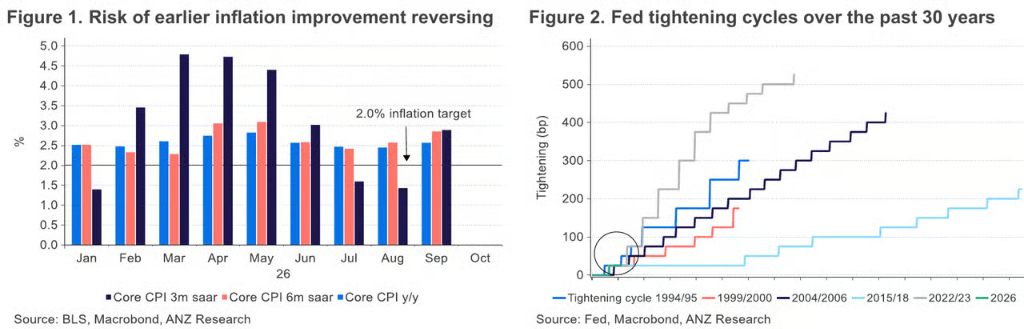
 However, inflation data do not support this stance: in September, core CPI rose 0.3% month-on-month, exceeding the market's expectation of 0.2%, with the year-on-year rate climbing to 2.6%; the three‑month annualized pace of core CPI surged from 2.0% to 3.4%. Following the release of September CPI figures, the probability of a rate hike in October briefly spiked to around 50%—a sharp swing that, in itself, underscores the market's profound uncertainty about the Fed's policy trajectory.
Bank of America Securities is currently the most outspoken dissenter on Wall Street, with its team of economists maintaining their forecast for a rate hike in October, arguing that inflation data provide ample justification. In a report, Bank of America rates strategist Mark Cabana cautioned that if Powell opts to pause without offering a clear rationale, there is a risk of repeating the "dovish misstep" seen at the July press conference, which could place significant pressure on the U.S. dollar and the Treasury yield curve. For investors, the real suspense tonight lies not in the decision itself, but in every word uttered by Powell.
Consensus Building: The "tacit understanding" of raising interest rates at every other meeting.
The core rationale behind the expectation of this pause stems from the flurry of signals released by Federal Reserve officials on the sidelines of the meeting. According to Goldman Sachs Chief U.S. Economist David Mericle's FOMC preview report, the remarks of FOMC members point to a consensus: tightening will proceed at a pace of "raising rates every other meeting"—that is, a rate hike in September, skipping October, and another hike in December.
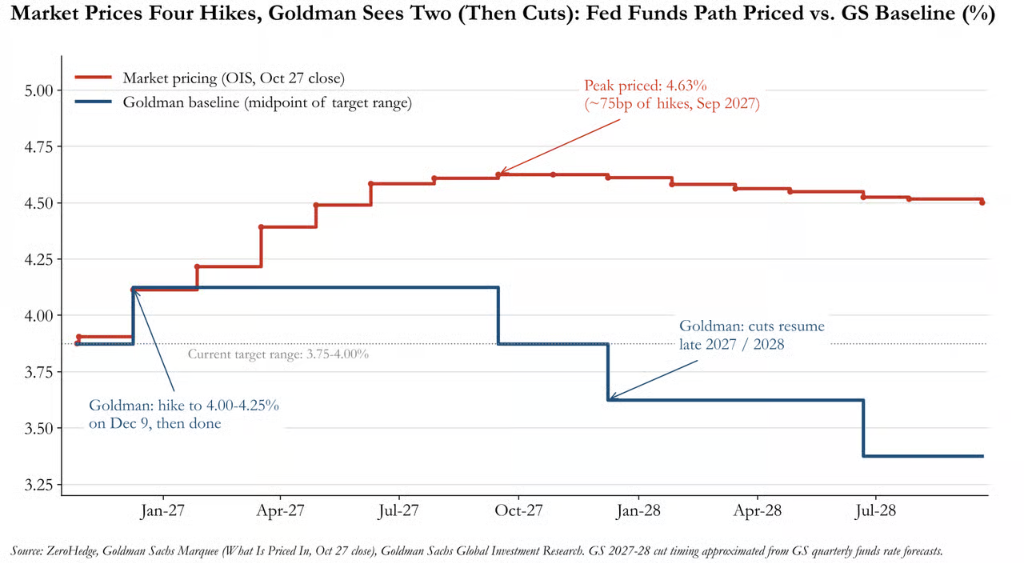
New York Fed President John Williams stated clearly that "there is no urgent need for action in October," and hinted that there is only one rate hike left this year, with no further tightening planned for 2027. Federal Reserve Vice Chair Philip Jefferson said policymakers may need more time to assess the data. Meanwhile, Board Member Waller summarized this stance as follows: rate hikes "do not need to be implemented at consecutive meetings, but should be brought to fruition within a reasonable timeframe."
The FOMC minutes likewise confirmed this framework: all 19 policymakers supported a rate hike in September, and "most" deemed another increase within the year to be appropriate. This suggests that a December hike represents the point of compromise, while October was never seriously on the table—though Mr. Wash's earlier public remarks did not explicitly rule out that possibility.
Hawkish Dissent: Three Votes Against May Reappear
Holding steady does not necessarily reflect internal consensus. Several institutions expect that this meeting will see multiple dissenting votes from hawkish policymakers.
Both Rabobank and Natixis expect that the three hawkish policymakers who voted against the pause in July—Beth Hammack, president of the Federal Reserve Bank of Cleveland; Lorie Logan, president of the Federal Reserve Bank of Dallas; and Neel Kashkari, president of the Federal Reserve Bank of Minneapolis—will once again join forces to oppose the move and support a 25-basis-point rate hike this time. Meanwhile, Michael Feroli, JPMorgan's chief U.S. economist, forecasts at least two dissenting votes—Hammack and Logan—with the possibility that Kashkari may also follow suit.
The hawkish case is well‑supported. Logan argues that interest rates need to be raised by "another 50 basis points or more"; Hamaker stresses that "policy should be tightened to a restrictive stance as quickly as possible, with smaller but more rapid steps"; and Boston Fed President Susan Collins—though not a member of this voting committee—also notes that the probability of inflation remaining significantly above the 2% target is increasing.
ANZ economist Brian Martin emerged as the most prominent hawk on Wall Street this week, citing in his report the benchmark set by Chairman Jerome Powell himself in his Jackson Hole speech: "The FOMC must be confident that underlying inflation is moving toward its target at a clear and sufficient pace; otherwise, our work is far from done." He argues that the September CPI data failed to instill such confidence, suggesting that the market has significantly underestimated the likelihood of another rate hike.
Bank of America Goes Against the Trend: Betting All on a Rate Hike in October
Amid a market consensus that almost all institutions expect to pause, Bank of America is a rare outlier.
According to Bank of America's FOMC Outlook Report, the bank's economists maintain their forecast for a rate hike in October, arguing that persistent inflationary pressures should prompt the Federal Reserve to continue tightening monetary policy—though the team also acknowledges that market pricing reflects a Fed "willing to wait until after the election" and confident in its relatively dovish inflation projections.
Bank of America's research team notes that an unexpected rate hike by the Federal Reserve would represent the most hawkish surprise since 2009, when market pricing was at its lowest—around 3 basis points. Historically, in 90% of cases where the market delivered a hawkish surprise, pre‑hike pricing had been at least this level. Bank of America believes such a move would push the 2-year Treasury yield sharply higher by 15–20 basis points, leading to a substantial flattening of the yield curve.
Bank of America is maintaining its short‑term trade on 2‑year Treasury bonds and the flattening of the 2s‑30s yield curve. Even if the outcome ultimately amounts to a pause, the team believes that, should Powell's press conference fall short of clarity, the 2s‑30s curve could steepen by 5–7 basis points—roughly half the 12.5‑basis‑point steepening seen after the July FOMC meeting.
Goldman Sachs: The rate-hike cycle will end in December.
Goldman Sachs economists are among the most dovish on Wall Street; their baseline scenario still envisages ending this round of tightening after one more rate hike in December. Analysts believe that the market's pricing of a cumulative 75 basis points of rate hikes by 2027 is overly aggressive.
Goldman Sachs's core argument is that the sources of inflation overshoot are temporary. According to David Mericle's estimates, tariffs, the Iranian energy shock, and statistical errors in AI-related prices together account for the entire 1.1 percentage points by which the current core PCE has deviated from the 2% target. As these factors gradually subside, Goldman Sachs expects the core PCE to fall back to around 2.2% by the end of 2027.
However, the latest data from the Federal Reserve Bank of San Francisco challenge the logic of "waiting for inflation to subside on its own."
According to Torsten Slok, chief economist at Apollo Global Management, who cited this data, demand-driven and supply-driven factors currently account for half of the 3% core PCE inflation—whereas in 2022, supply-side factors were the dominant force. Slok emphasized that interest-rate policy can cool demand-side inflation but has limited impact on supply shocks, implying that half of today's inflation may not be resolved simply by waiting.
On the upside risk front, Goldman Sachs is particularly focused on energy prices. Currently, oil prices are higher than Goldman Sachs' own forecasts, reflecting market concerns about a further deterioration in the Middle East situation. If oil prices follow the futures curve, core PCE inflation would rise by an additional approximately 0.1 percentage point before March next year, while headline inflation would increase by about 0.4 percentage points. Accordingly, Goldman Sachs does not rule out the possibility of a rate hike in March, though it does not regard this as its baseline forecast.
Wash's Dilemma: The Press Conference Is the Real Exam Room
The outcome of this meeting was hardly in doubt; the market's real focus was on William Dudley's performance at the press conference. At the July press briefing, when pressed on why interest rates had not been raised, Dudley replied that data's influence on policy decisions was "not much," in just two words—prompting the first wave of sharp sell-offs in long-term bonds.
Natixis expects this to be a "brief press conference with no Q&A session and no in-depth explanations"; Goldman Sachs economists likewise "do not anticipate gaining any substantive new information from the briefing." Will Marshall, head of U.S. rates strategy at Goldman Sachs, notes that the key lies in how much time Walsh allocates to inflation versus financial conditions: emphasizing inflation more would reinforce yield curve flattening and push front-end rates higher, while placing greater emphasis on tightening financial conditions could lead to a steeper yield curve.
Michael Feroli provided a plausible script for Wash: "The committee is inclined to raise rates but would like more time to assess the economic impact of last month's hike." Feroli then pointed out the contradiction: this amounts to forward guidance, which Wash has explicitly ruled out. His warning is telling: a decision to hold rates steady—made less than a week before the midterm elections and against a backdrop of persistently high inflation—will, if inadequately explained, inevitably lead markets to suspect that policy is being swayed by non‑economic factors.
In its statement, Goldman Sachs expects the FOMC to draw on Vice Chair Jefferson's recent remarks, adopting language along the lines of "any further interest-rate adjustments will depend on data trends, the evolution of the outlook, and the balance of risks." If Wash believes this is too close to forward guidance, another option would be to remain entirely silent on the policy path.
 Stay ahead of the financial news and spot investment opportunities early! Open Futubull > Market > U.S. Stocks >Economic Calendar/Selected Macroeconomic Data, seize the investment opportunity!

Editor/lambor