Following the three dissenting votes at the July meeting, this rate-setting decision once again revealed divisions, with two of the 12 voting members opposing. By contrast, hawkish dissent has eased. Among the dissenters, Harker had already voted against holding rates steady in July, citing his support for a hike, while Cook's dissent was seen as a "middle finger" to Trump, who seeks her removal. This statement revised the description of economic expansion from "steady" to "strong," while reiterating that inflation remains elevated. It also added new language: "accumulating information will help determine the policy stance needed to ensure that inflation returns to its target in a timely manner." According to the "New Fed News Agency," the Fed's decision to hold rates steady is intended to buy time to assess whether further rate hikes are warranted.
As widely expected, the Federal Reserve held steady, but it revealed internal divisions: the rate decision did not receive unanimous support from the voting members of the Federal Open Market Committee.
On Wednesday, October 28, Eastern Time, the Federal Reserve announced that the Federal Open Market Committee (FOMC) decided to keep the target range for the federal funds rate unchanged at 3.75% to 4.00%. This marks a pause in the Fed's tightening cycle after it raised rates for the first time in three years in September. However, this does not rule out the possibility of further rate hikes later this year.
 The updated dot plot released at the September meeting indicated that most Fed policymakers expect another rate hike within the year. Moreover, the resolution statement revealed that two voting members supported raising rates at this meeting, thereby rebuffing U.S. President Trump, who has repeatedly urged the Fed to cut rates this year. Coincidentally, among the dissenters was Federal Reserve Governor Cook, whom Trump recently sought to have removed from his post.
This rate decision was entirely in line with Wall Street expectations. As of Tuesday's close, CME Group data indicated that the federal funds futures market assigns nearly a 91% probability to the Fed holding rates steady this week, while the likelihood of at least a 25-basis-point hike at the next meeting in December exceeds 82%.
Nick Timiraos, a journalist known as the "New Fed News Agency," noted in an article that Fed officials had previously signaled the possibility of a rate hike in December. By holding rates steady this time, the Fed aims to buy time to assess whether further increases are warranted, thereby averting broader inflationary pressures stemming from energy costs and the AI‑related investment boom.
The Federal Reserve's hawkish divergence on interest-rate policy has narrowed compared to July, while Cook gave Trump the middle finger.
Compared with the statement from the previous meeting, released in mid-September, the most significant difference in this post-meeting statement lies in the interest-rate decision. At the last meeting, all 12 voting members of the FOMC voted in favor of a 25-basis-point rate hike; this time, the FOMC chose to keep rates unchanged. However, two of the 12 voters opposed the decision, while the remaining ten supported it.
Judging from the voting results, this was the second FOMC meeting since Jerome Powell became Fed chair in which the decision did not command unanimous support among the voting members. The previous instance occurred at the end of July, when three regional Fed presidents opposed keeping interest rates unchanged and instead favored a 25-basis-point hike. That marked the first time since 2016 that three voting members cast dissenting votes on a policy adjustment.
The number of dissenting votes at this meeting was lower than at the previous one. According to the resolution statement, the votes against were cast by Federal Reserve Governor Cook and Cleveland Fed President Beth Hammack.
Notably, in July, Harker also voted against the rate hike. However, the two other dissenters from that meeting—Minneapolis Fed President Neel Kashkari and Dallas Fed President Lorie K. Logan—have now rejoined the mainstream camp favoring a pause in rate increases. From this perspective, the internal hawkish divide within the Federal Reserve has narrowed compared to July.
Some commentators have said that Cook's dissenting vote was nothing more than a middle finger to U.S. President Trump, who has long advocated for interest-rate cuts.
As reported by Wallstreetcn, in June this year, the U.S. Supreme Court ruled that Trump could not remove Cook without granting him a full opportunity to defend himself, though it did not ultimately determine whether the charges were valid. This month, Trump once again moved to dismiss Cook from his position on the board.
On October 9, the White House announced the establishment of a special investigative committee to examine allegations that Cook allegedly made false statements in mortgage-related documents, and scheduled a related hearing at the White House for November 5. In a memorandum issued at the time, Trump stated that, as president, he has a responsibility to ensure that the law is faithfully enforced, adding that the committee would review the evidence and accusations against Cook to determine whether grounds for dismissal exist.
Economic expansion has shifted from steady to robust, and the accumulation of new information will help ensure that inflation reaches its target in a timely manner.
On the economic front, the statement issued at this meeting largely echoed the language of the previous one, with just one change: whereas the earlier statement described the U.S. economy as expanding steadily, the current version replaced "steadily" with "strongly."
This statement once again underscores the Federal Reserve's commitment to price stability and reiterates that employment growth is keeping pace with labor force expansion, with the unemployment rate remaining broadly unchanged. It also reaffirms the earlier assessment that "productivity growth remains robust and capital investment is on a solid footing."
As in the previous statement, this one notes regarding the uncertainties facing the economy: "Although uncertainty remains elevated, partly owing to developments in the geopolitical landscape, domestic spending has demonstrated resilience."
This statement also reaffirms that the Federal Reserve will continue to pursue a policy of maintaining ample reserves in the banking system.
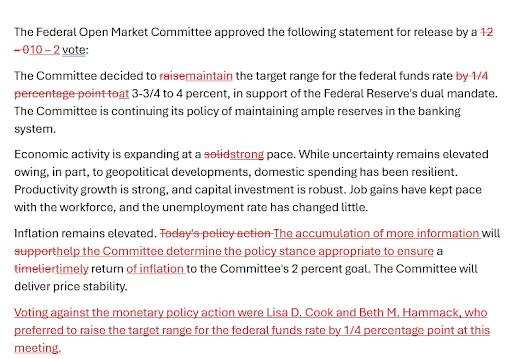
The statement issued at this meeting once again reaffirmed that "inflation remains elevated," and immediately following this remark, it revised its language regarding interest-rate policy. Previously, it had stated that raising rates "would help bring inflation back to the Committee's 2% target in a more timely manner." This time, that sentence was removed, and a new one was added:
"Accumulating additional information will help the FOMC committee determine an appropriate policy stance to ensure that inflation returns promptly to the committee's 2% target."
The red text below highlights the deletions and additions made to this resolution compared with the previous version.
Editor/Liam