SanDisk's earnings call highlighted that AI inference demand is reshaping the NAND market, with customers placing large, long‑term orders due to "underestimating the required flash memory capacity," and NBM order backlogs now extending through 2030. On the technology front, a new HBF memory architecture has completed tape‑out, and the market is exploring the use of SLC NAND to replace some of the more expensive DRAM. Management expects PC sales to remain down by a single digit next year, but PC storage capacity—measured in exabytes—will continue to grow.
Driven by a surge in AI inference demand, SanDisk's revenue for the first fiscal quarter of 2027 jumped 378% year over year. Backed by long-term NBM contracts deeply tied to hyperscale cloud providers and its innovative HBF technology, NAND flash memory is now making a full-scale push into the core layer of AI infrastructure.
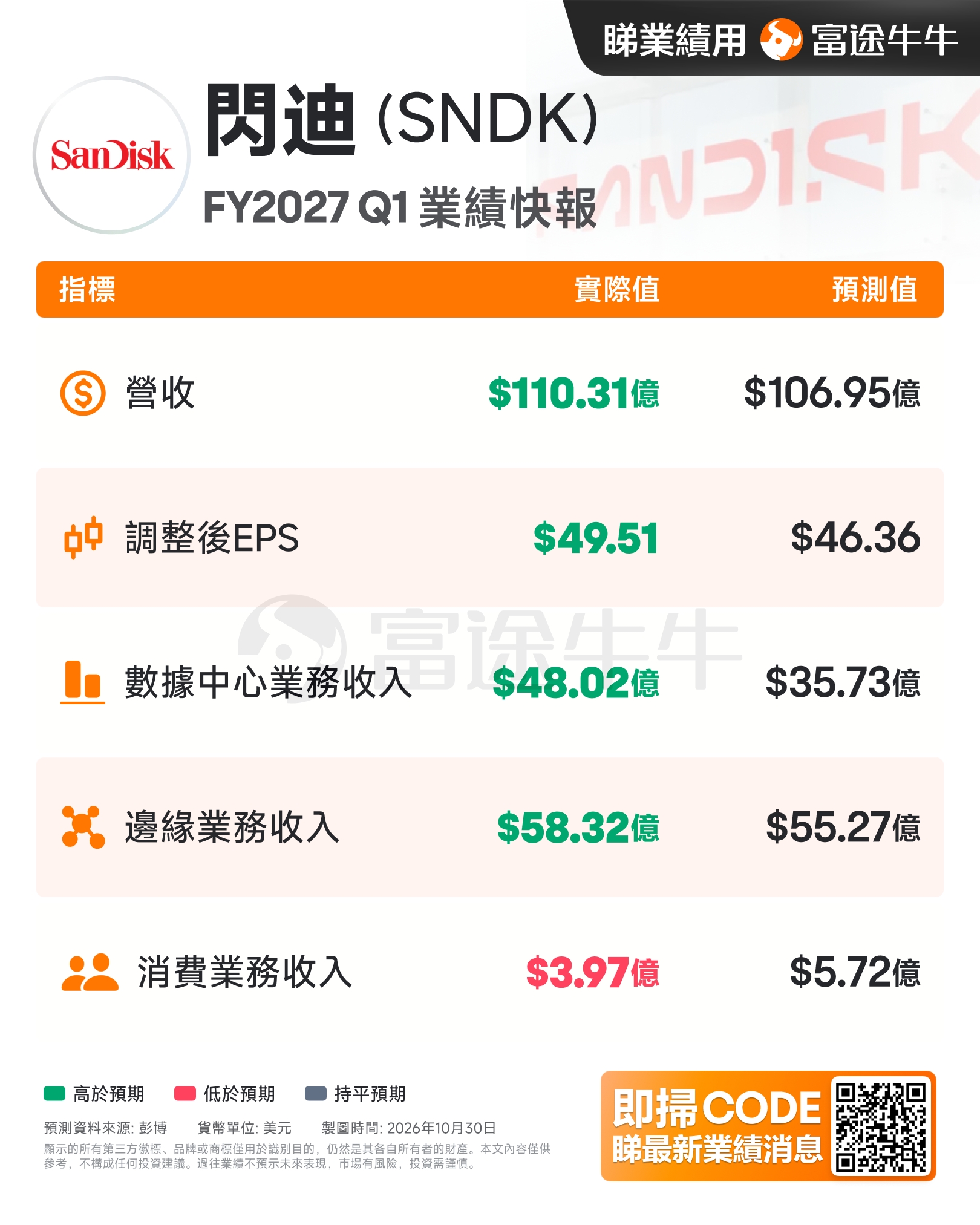
On October 30, after the U.S. stock market closed$SanDisk (SNDK.US)$The company delivered a highly robust Q1 FY2027 earnings report, posting revenue of $11.0 billion—up 23% quarter over quarter and a staggering 378% year over year. Non-GAAP gross margin reached 85.1%, and adjusted free cash flow totaled $5.7 billion.
 During the subsequent earnings call, management disclosed that, in this quarter's revenue growth, "approximately 60% was driven by volume expansion, while 40% stemmed from price increases." Supported by robust order visibility, SanDisk expects second-quarter revenue to range between $12.2 billion and $12.6 billion. Meanwhile, the company reaffirmed its commitment to returning 100% of excess cash to shareholders, having already deployed $5 billion on share repurchases this fiscal quarter.
Data center business surges: "Customers have underestimated the flash storage capacity required to run their infrastructure."
Data centers were undoubtedly the standout highlight of this quarter's financial results. In the first quarter, SanDisk's data center business generated $4.8 billion in revenue, a substantial 61% increase quarter over quarter.
As large AI models evolve, inference workloads are undergoing structural changes. Director and CEO David Goeckeler noted at the event: "Longer prompts, more complex reasoning, multimodal inputs, and persistent user context all significantly increase storage requirements. HBM and DRAM support the highest performance tiers, while flash memory provides the capacity needed to efficiently retain broader contexts and avoid costly recomputation."
This enhancement in strategic positioning is directly reflected in customers' order anxieties. SanDisk's newly launched long-term partnership model—the New Business Module (NBM)—is highly sought after by hyperscale cloud providers. Goeckeler stated plainly: "We've learned from our customers that they underestimated the NAND flash memory capacity required to operate their infrastructure. As a result, many of our customers are placing repeat orders, while we're also working hard to onboard new clients."
The market landscape is undergoing an irreversible shift. According to management estimates, "the data center business has grown from accounting for roughly 20% of the industry ten years ago to nearly half today." Looking ahead, the company projects that by 2027, data centers will command more than 55% of the market share, with tender demand expanding at an annual rate of approximately 40%. Goeckeler even ventures a bold forecast: "By the end of this decade, key-value (KV) cache will capture about one-third of the AI‑data‑center flash memory market, while the overall size of the AI‑data‑center market will approach that of today's NAND flash memory market."
NBM long-term contracts lock in future supply and demand.
Behind the surge in performance, SanDisk's newly launched New Business Module (NBM) has emerged as a critical competitive moat that secures long-term profitability. This contract‑based model, anchored by long‑term commitments, helps smooth out the pronounced cyclical fluctuations typical of the traditional storage industry.
Chief Financial Officer Luis Felipe Visoso revealed that "95% of NBM's current partner companies are investment-grade, generating approximately $130 billion in operating cash flow." At present, about 50% of SanDisk's supply for 2027 and roughly two-thirds of its supply for 2028 have already been committed under the NBM program.
Addressing the genuine needs of downstream customers, Goeckeler offered a thought‑provoking remark during the Q&A session: "Overall, we've learned from our customers that they have underestimated the NAND flash capacity required to operate their infrastructure." He added that not only are many existing customers placing additional orders, but new customers are also steadily coming on board. "We now have a robust supply pipeline extending well into 2030—and beyond," he said.
Currently, approximately 50% of SanDisk's fiscal 2027 production capacity is committed to NBM projects, a share that will rise to about two-thirds in 2028. Management expects the backlog of NBM projects to exceed the company's supply capacity by the end of this decade.
The first HBF chip has completed tape-out, and SLC is sparking a new wave of architectural thinking.
If TLC and QLC form the current mainstream, then next-generation storage technologies tailored for AI are opening up new possibilities in the market.
At this earnings call, SanDisk announced a major milestone: the first high-bandwidth flash (HBF) memory chip has completed tape-out. Goeckeler explained, "HBF is a new storage architecture designed for inference, offering read bandwidth comparable to HBM while providing greater capacity… It is intended to complement HBM by bringing NAND‑level capacity closer to the processor." The first customer samples are expected to be delivered next year.
In addition, the market is closely watching the potential of ultra‑durable SLC (single‑level cell) flash memory in AI architectures. When asked whether this would erode TLC's market share, Goeckeler firmly dismissed the concern: "This does not represent cannibalization of other NAND products; rather, it expands the TAM—total addressable market. The key question is: can NAND operating in SLC mode deliver sufficient endurance and performance to replace certain DRAM use cases? After all, the cost gap between the two is substantial, roughly 20 to 40 times."
Edge and the PC Market: Short-Term Bottoming Out, with Single-Unit Capacity Expected to Rise Next Year
Compared with the rapid growth of its cloud business, the edge computing segment—encompassing smartphones and PCs—posted relatively steady performance, generating $5.8 billion in revenue in the first quarter, up 7% quarter over quarter. Meanwhile, the consumer business, weighed down by soaring prices, declined 29% quarter over quarter to $397 million.
Facing short-term weakness in the PC market, Goeckeler offered a measured outlook. He acknowledged that the current two quarters represent a sales trough and projected that PC shipments could still decline by a single-digit percentage next year. However, he underscored the rationale behind growing device storage capacity: "We expect PC storage capacity—measured in exabytes—to expand next year. According to our internal models, all segments of the NAND flash memory market are poised for positive growth across the board." Meanwhile, automotive electronics is rapidly gaining momentum and is viewed by SanDisk as one of the largest emerging segments in the edge computing space.
The full transcript of the conference call is as follows:
Operator: Good afternoon, and welcome to the SanDisk Fiscal Year 2027 First Quarter Earnings Call. All participants are in listen-only mode. (Instructions) Please note that this call is being recorded. I will now turn the floor over to Mr. Ivan Donaldson, Vice President of Investor Relations.
Vice President of Investor Relations, Ivan Donaldson:
Before we begin, please note that today's discussion will include forward-looking statements based on management's current assumptions and expectations, which are subject to a variety of risks and uncertainties. These forward-looking statements encompass our expectations regarding the company's technology, energy and product portfolio, business plans and performance, capital allocation priorities, market trends and opportunities, and financial results. We undertake no obligation to update these statements. For additional information on the risks and uncertainties that could cause actual results to differ materially from those projected, please refer to our Annual Report on Form 10‑K and other filings we have submitted with the U.S. Securities and Exchange Commission.
We will also refer to non-GAAP financial measures today. A reconciliation of non-GAAP financial measures to the comparable GAAP financial measures is included in the written materials posted under the "Investor Relations" section of our website.
Next, I will hand the phone to David.
Chairman and CEO David Goeckeler:
Thank you, Ivan. Good afternoon, and thank you all for joining SanDisk's fiscal 2027 first-quarter earnings call. At the start of fiscal 2027, we delivered another strong quarter, creating value for our customers and shareholders and achieving results that exceeded expectations. Our strategy is proving effective, and our execution has yielded substantial outcomes.
This quarter, revenue totaled $11.0 billion, with a non-GAAP gross margin of 85.1% and non-GAAP earnings per share of $49.51. We generated $5.7 billion in adjusted free cash flow and returned $5.0 billion to shareholders through share repurchases.
Our confidence in the company's long-term growth prospects stems from three core strengths: technological leadership, deep customer partnerships, and disciplined financial management. The rise of artificial intelligence, coupled with signals from customers—via our new business model, the NBM Partnership—that they are planning to extend their operations beyond fiscal year 2030, further reinforces the structural growth in NAND flash demand. Together, these advantages enable us to invest confidently in our technology roadmap, strengthen and expand customer relationships, generate consistently growing free cash flow, and deliver attractive returns to shareholders.
Technological Leadership
It all begins with our technological leadership. BiCS 8 lies at the heart of our current product portfolio, setting industry benchmarks for both performance and density in both TLC and QLC flash memory. By introducing CMOS technology directly bonded to the array—our CBA architecture—BiCS 8 delivers the performance demanded by AI‑centric data center customers while laying the groundwork for future generations of products. BiCS 9 combines the proven BiCS 8 array with next‑generation CMOS technology, significantly enhancing interface performance while preserving a mature memory architecture. BiCS 10 features a comprehensive overhaul of the node architecture across both TLC and QLC flash, introducing a 1Tb TLC chip tailored for high‑performance workloads and a 2Tb QLC chip that boasts industry‑leading density and read/write bandwidths twice those of BiCS 8. The convergence of these technologies will extend the foundational architecture of BiCS 8, meeting the ever‑growing performance and capacity demands of next‑generation infrastructure.
Advances in High-Bandwidth Flash (HBF)
In addition to the core roadmap, High-Bandwidth Flash (HBF) achieved a significant milestone in the first fiscal quarter: our first HBF memory chip has completed tape-out, and manufacturing is currently underway. As outlined at our Investor Day, HBF is a next‑generation storage architecture designed for inference, offering read bandwidth comparable to HBM while providing greater capacity—enabling support for larger models, longer context lengths, and ever‑growing key‑value caches. HBF is intended to complement HBM by bringing NAND‑level capacity closer to the processor, and we remain on track to deliver the first HBF‑based product samples next year.
HBF remains a forward-looking innovation and has not been incorporated into the long-term financial model we presented at our Investor Day. As customer adoption, product demand, and manufacturing readiness become clearer, we expect to provide further insights into market opportunities.
Customers recognize our innovative capabilities and increasingly view SanDisk as a key partner in achieving their growth objectives. Through our New Business Module (NBM), we will continue to evolve customer relationships into long-term partnerships built on innovation, collaboration, and shared commitment. Recent engagements with leading global AI companies demonstrate that market demand for our technologies remains poised for further expansion. Our market‑leading technologies, diversified product portfolio, and strong customer partnerships underpin our robust financial position, enabling us to reinvest in maintaining technological leadership and expand supply through R&D‑focused capital expenditures.
AI-Driven Demand Growth
The rapid advancement of artificial intelligence has further strengthened our competitive advantages. As inference workloads grow, the demand for scalable memory and storage continues to expand, making NAND flash an increasingly critical component of AI infrastructure. During inference, each generated token must reference its preceding context, creating a continuously expanding key‑value cache that serves as the model's working memory. Longer prompts, more complex reasoning tasks, multimodal inputs, and persistent user contexts all significantly drive up these storage requirements. HBM and DRAM deliver top‑tier performance, while flash provides the capacity needed to efficiently retain broader contextual information and avoid costly recomputation. We believe this represents a long‑term trend that is broadening NAND's role across the entire AI technology stack.
The memory hierarchy defines the role of each NAND architecture. TLC delivers lower latency, higher throughput, and greater endurance, meeting the demands of active datasets, checkpoints, and latency‑sensitive key‑value caching workloads. In the AI Lab benchmark we presented at Investor Day, systems equipped with SSDs achieved roughly three times the token throughput of comparable systems relying solely on volatile memory, while reducing power consumption by about 75%. QLC further boosts storage density, making it well suited for capacity‑intensive applications such as data lakes and vector databases that power AI‑driven search and retrieval. Between these tiers, an increasingly robust persistent context ensures that data can be preserved and retrieved rather than regenerated.
As inference costs continue to decline, we expect both adoption and utilization rates to rise steadily, reinforcing our view that by the end of this decade, key-value caching will account for roughly one-third of the AI data center flash memory market—while the overall size of the AI data center market will approach that of today's NAND flash memory market.
Terminal Market Overview
Next, let's turn to the end‑market. In the data center segment, our product portfolio addresses a wide range of AI‑infrastructure needs, from high‑performance enterprise‑grade SSDs to high‑capacity platforms. Demand remains robust and continues to grow; we estimate that the data center business has expanded from roughly 20% of the industry total a decade ago to nearly half today. This shift in customer mix is reshaping the industry's economic landscape and lies at the heart of SanDisk's ongoing transformation. During this quarter, the data center business delivered strong growth once again, continuing to outpace the broader market, driven by increased supply to meet the rising demand from this end‑market.
Edge computing represents a large‑scale, strategically significant market for SanDisk, encompassing smartphones, personal computers, in‑vehicle tablets, and an expanding array of physical‑AI applications. The automotive sector is increasingly becoming a key growth driver for our edge‑computing business and a substantial long‑term growth opportunity. Our deepening collaborations with leading customers have bolstered our confidence that the automotive industry will emerge as one of the largest markets in the edge‑computing space.
Our consumer business remains a differentiated strategic asset, combining direct brand engagement with hundreds of millions of end users and extensive shelf presence across leading global channel partners. The consumer‑end market provides a solid foundation for our operations, while its direct connection to the market informs product development and enables us to anticipate shifts in end‑user needs at an early stage.
In summary, these results further reinforce the resilience of the business model we outlined at Investor Day. We have delivered strong profitability and robust cash flow; going forward, our priority is to ensure the consistent and disciplined execution across all our businesses.
Next, I will transfer the call to Luis so he can provide a detailed overview of the company's latest business developments and outlook.
Executive Vice President and Chief Financial Officer Luis Felipe Visoso:
Thank you, David. We are executing the strategies and plans we outlined at Investor Day and have delivered solid financial results.
In the first quarter, we finalized two NBM partnerships. As both transactions were completed prior to our fourth-quarter earnings call, we announced these collaborations during that call. We are actively engaging with existing NBM customers who are evaluating the possibility of extending their current agreements, while also pursuing new clients who are assessing potential NBM engagements. These long-term relationships enable us to gain deeper insights into market demand and financial performance, helping us build a more robust financial model. We will remain patient and disciplined in selecting the right long-term partners and determining the optimal allocation ratio for NBM— a ratio that may exceed our current level.
First-Quarter Financial Results
First-quarter revenue reached $11.0 billion, up 23% quarter over quarter and 378% year over year. This performance significantly exceeded our prior guidance of $10.3 billion to $10.8 billion. Both volume growth and price increases drove the revenue expansion, with approximately 60% of the increase attributable to higher volumes and 40% to price hikes.
Data center revenue reached $4.8 billion, up 61% quarter over quarter, surpassing the market's consensus growth forecast for the quarter. Our industry-leading products and strong customer‑partner relationships—including collaborations with three U.S. hyperscale data center operators—underpin our continued expansion in this rapidly growing end market.
Edge computing revenue reached $5.8 billion, up 7% quarter over quarter, reflecting resilience in both the high-end and mainstream segments, though partially offset by a contraction in the low‑end market. In the edge computing space, we benefited from strong growth among automotive and IoT customers. Consumer‑business revenue totaled $397 million, down 29% sequentially, primarily as the market adjusts to higher pricing. We remain committed to serving all three major end markets and continue to optimize performance through a diversified product portfolio.
In the first quarter, non-GAAP gross margin was 85.1%, up from 84.6% in the prior quarter, primarily driven by higher sales volumes and pricing. This performance exceeded our previous guidance of 83% to 85%. Non-GAAP operating expenses totaled $513 million, or 4.7% of revenue. Non-GAAP operating margin was 80.4%, compared with 79.2% in the prior quarter. Non-GAAP diluted earnings per share were $49.51, surpassing both the prior quarter's $39.25 and the same period last year's $1.22. This result also outpaced our earlier forecast range of $44 to $46 per share. At the end of the quarter, the company had 154 million diluted shares outstanding.
Key GAAP and non-GAAP financial metric adjustments include: $91 million in share-based compensation expense, representing 0.8% of revenue; and $513 million in gains on equity securities, primarily attributable to our investments in South Asia.
This quarter, we repurchased approximately 3.2 million shares of common stock, totaling $5.0 billion. Over the past two quarters, we have repurchased a total of 6.0 million shares, representing about 4% of our outstanding shares. These buybacks reflect our confidence in the company's long-term value and our disciplined capital allocation strategy. We will continue to make prudent investments in the business while returning 100% of excess cash to our shareholders.
Free cash flow
Cash flow from operating activities totaled $6.4 billion. Total capital expenditures amounted to $378 million, representing 3.4% of revenue. We expect total capital spending to increase over the remainder of the year and to account for a low-single-digit percentage of fiscal 2027 revenue. This quarter, we generated $5.7 billion in adjusted free cash flow, with an adjusted free cash flow margin of approximately 52%. At quarter-end, we held $5.1 billion in cash and cash equivalents, with no outstanding debt.
Earnings Outlook
Our confidence in the market's long-term health stems from the structural growth of AI infrastructure and the increasingly critical role of NAND flash memory in inference workloads.
Before outlining our second-quarter results, I would like to announce that the SanDisk Director has approved a 41-for-1 stock split of the company's common stock. The additional shares are expected to be distributed on November 19, and trading of the adjusted shares is expected to commence on November 20.
We expect revenue for the second quarter of fiscal year 2027 to be between $12.2 billion and $12.6 billion. We anticipate a non-GAAP gross margin in the range of 84.5% to 85.5%, which includes moderate same-store price increases. Prior to the stock split, we project non-GAAP earnings per share to be between $55.00 and $57.00, assuming a fully diluted share count of 151 million shares. Adjusted for the 41-for-1 stock split, non-GAAP earnings per share are expected to be between $6.88 and $7.13, based on a fully diluted share count of approximately 1.208 billion shares.
For reference, we expect the market to maintain robust growth through 2027. Data centers are projected to once again serve as the primary growth engine, capturing more than 55% of the market share, with tender demand rising roughly 40% year over year, driven by increased AI‑driven capital expenditures. Earlier, in 2026, tender demand for data centers had already more than doubled. By the end of this decade, our NBM project pipeline is expected to exceed available supply.
Next, I will turn the conference call back over to David.
Chairman and CEO David Goeckeler:
Thank you, Louis. We will continue to execute the strategy we outlined at Investor Day, which has strengthened our confidence in SanDisk's long-term growth prospects. Leveraging our technological leadership, deep customer partnerships, and disciplined financial management—coupled with the structural growth in AI‑driven demand for NAND flash memory—we are well positioned to serve our customers, generate sustained free cash flow, and deliver value to our shareholders.
Over the past year, we have significantly enhanced the company's profitability and cash flow, laying a solid foundation for sustained future growth. We will remain focused on disciplined execution, ongoing value creation, and the achievement of our long-term financial objectives.
Ivan, next, please feel free to ask your questions.
Q&A Session
Vice President of Investor Relations, Ivan Donaldson:
Now, we will begin the Q&A session. (Instructions) The first question today is from Ben Reitzes of Melius.
Analyst Ben Reitzes:
Hello everyone, thank you very much. Dave, I'd like to ask two questions. The first is about the NBM (New Business Module). You signed two contracts prior to the last tender. My question is: will you be signing many more in the future? It seems your production capacity is already constrained, making it difficult to fulfill all of them. Additionally, if there are any changes to the contracts, could you please provide us with details on the specific terms for the coming years? I also have a follow-up question. Thank you.
Chairman and CEO David Goeckeler:
Thank you, Ben. I'll share some thoughts on NBM, and then Luis will add to the discussion.
We have a very robust pipeline of NBM projects. With subscription and commitment levels steadily rising, we've already reached the halfway point of this fiscal year and two-thirds of next year. Now is an excellent time to move forward with the next wave of projects, and our backlog remains exceptionally strong. As we noted last quarter, we would exercise patience and carefully evaluate our next cohort of clients—and that's exactly what we've been doing. We expect that, over the coming months and even quarters, as we continue to allocate the remaining portion of our portfolio, additional clients will come on board. Our pipeline is both substantial and growing, and it has become our primary approach to serving clients. I anticipate that, in the quarters ahead, the proportion of committed deals within our portfolio will continue to increase.
Luis, please add to this.
Executive Vice President and Chief Financial Officer Luis Felipe Visoso:
David has already covered most of the ground; I'd just like to add a few points. We're very pleased with the progress we've made on the NBM front. We've been extremely cautious and strategically minded in selecting our partners. After reviewing our existing portfolio, we found that 95% of our NBM partners are investment-grade companies, generating roughly $130 billion in operating cash flow. We believe we've made the right choices. We'll continue to exercise patience, carefully vet each opportunity, and we have an exceptionally strong pipeline of projects.
As I mentioned in my prepared remarks, we expect these projects to continue growing. As we have previously shared, by 2027 approximately 50% of our projects will be NBM‑related, and by 2028 about two-thirds will be NBM‑related; we anticipate this proportion will rise slightly from two-thirds.
Chairman and CEO David Goeckeler:
Ben, let me add one more point. We are indeed working hard to balance the demands of customers who are placing repeat orders. Overall, we've learned from our customers that they underestimated the NAND flash capacity required to run their infrastructure. As a result, we have many customers placing repeat orders while also striving to onboard new ones. There's a lot to manage—these are very complex, large-scale agreements—but we remain highly confident in our current R&D pipeline and product portfolio, which has been well-received. Over the next few quarters, we will continue to provide updates on the latest developments in our NBM product lineup.
Analyst Ben Reitzes:
Alright, that's great. One more follow-up question. As you may have seen, Intel has lowered its earnings forecast for the next quarter due to a slump in the PC business and a memory segment impact that turned out to be larger than expected.
I'm just curious—have you noticed a growing interest in NBM within the PC market? If so, do you think this segment could evolve into a full-fledged NBM market for certain device manufacturers, or is it simply becoming more attractive because they're willing to pay higher prices? Given that they seem to have limited offerings and poor sales in this space, how should we interpret this situation?
Executive Vice President and Chief Financial Officer Luis Felipe Visoso:
We cannot discuss specific customers. As we've previously stated, our data center business does include NBM—centered on the data center—but we also serve customers in the edge computing space. We offer this model to any customer with relevant needs and initiate the corresponding processes when appropriate. We are not seeking to restrict any customer; we welcome collaboration.
Chairman and CEO David Goeckeler:
On this point, our own analysis corroborates the findings. We know that sales have declined this year and are expected to fall slightly again next year, by around a single-digit percentage. At present, these two quarters represent the deepest year-over-year declines, and from a volume perspective, we are experiencing the most pronounced year-over-year market contraction. Even so, we anticipate that PC storage capacity—measured in exabytes—will grow next year. According to our internal models, all segments of the NAND flash memory market—including PCs, smartphones, and data centers—are projected to post positive growth next year, driven by the continued increase in per‑device storage requirements, partly fueled by the growing adoption of high‑end products. The market has already adjusted; in terms of unit sales, we are at the trough of year-over-year decline, but we expect conditions to improve going forward.
Analyst Ben Reitzes:
Thank you, everyone.
Operator: The next question comes from Joe Moore of Morgan Stanley.
Analyst Joe Moore:
That's excellent—thank you. Beyond favorable market conditions, the deeper reason seems to lie in your company's strategic positioning in the data center space. Your market share has grown nearly 20-fold year over year and by 61% quarter over quarter. Clearly, the market is strong, but your market share has also expanded significantly. Is this due to BiCS 8 certification, or simply a shift in the broader market environment? What specific factors have enabled your company to achieve such a high level of market penetration? And if, in the future, data center traffic were to account for half of total data traffic, could your company replicate that same level of growth within its own product portfolio?
Chairman and CEO David Goeckeler:
Joe, we are very pleased with the current state of development in the data center market. The strong growth reflected in our annual financial results is the result of multiple factors working in concert. First and foremost, it stems from the foundational process node for NAND flash memory. BiCS 8 is an exceptionally advanced node, and the CBA process delivers remarkably clean CMOS, enabling extremely high interface speeds. We have also developed the right products—our TLC offerings have been on the market for several years—and only a few quarters ago did we begin selling QLC products while achieving profitability. We anticipate rapid volume growth for QLC, which is already materializing. In short, we've deployed the right technologies at the right time to bring the right products to market.
Over the past quarter or so, AI inference architectures have seen further enhancements. As we analyze the market and conduct internal segmentation, we've observed that customers now have a more nuanced understanding of how to leverage technologies such as NAND flash, TLC flash, and QLC flash—spanning stages from key-value caching to staging areas and even fast data lakes—and encompassing all sub‑segments within these markets, including inference in proxy orchestration, model pre‑training, and post‑training. Overall, we're seeing increasingly sophisticated use cases for NAND flash.
In the past, QLC flash was well suited to a wide range of use cases, and some of its downstream customers even deployed it in scenarios like key‑value caching when technology permitted. On the other hand, we're seeing SLC flash being incorporated into architectural designs as well—though it has not yet entered mainstream commercial deployment; most discussions remain at the conceptual stage. Moreover, these discussions are less focused on performance and more on endurance under proxy workloads, as well as the potential to replace DRAM with NAND flash.
We believe this type of architecture will become highly popular over time. Once the transition is complete, given the price differential, users will stick with it. These NBM solutions enable us to engage in in-depth strategic discussions with our customers, gaining insights into how they deploy our products, while also facilitating detailed technical dialogues with our engineers to address specific challenges across diverse use cases. All of this has significantly advanced the evolution of our product portfolio. As I mentioned, we have already signed a second batch of NBM agreements with our largest customers and are currently in negotiations with others. The overall architecture is exceptionally robust, and we are very pleased with it.
Analyst Joe Moore:
How do you think this hybrid product portfolio will evolve over the long term?
Chairman and CEO David Goeckeler:
We are working hard to align our portfolio composition with the overall market level. We will continue this effort throughout 2027. We'll assess whether we can truly achieve this goal by the end of the quarter, but looking back at fiscal year 2026, our portfolio mix will be significantly higher than it is today. We will keep making progress on this front.
Operator: The next question is from Mark Newman of Bernstein.
Analyst Mark Newman:
Thank you very much. First, I'd like to discuss your guidance on pricing and volume. In the first-quarter results you just reported, you noted that 60% of revenue growth came from volume and 40% from price. My question is: how do you expect these proportions to shift in your guidance? Do you have any additional comments on pricing? I understand that these new NBM models account for a significant share of sales, but I'd still like to learn more about the pricing dynamics—specifically, I recall you mentioned a modest improvement in prices for the second quarter. Could you provide further details on this?
Then I have a follow-up question regarding HBF and some new NAND technologies.
Chairman and CEO David Goeckeler:
Let me address the first question first. You're right—our report indicates that in the first quarter, roughly 60% of revenue growth came from volume and 40% from price. We expect both factors to continue contributing in the next quarter. While we typically do not break down these figures, as noted in our prepared remarks, we anticipate a modest price increase. Accordingly, we expect both volume and pricing to contribute this quarter, and we project that prices will continue to rise slightly over the full year.
Analyst Mark Newman:
This is very helpful and well explained. My next question concerns HBF and other emerging NAND technologies in the data center space. I understand that some progress has been made with HBF, which is encouraging, but I'd like to know if there's any additional information on this progress and on ongoing discussions with partners and customers.
Dave, you just mentioned several emerging NAND technologies in data centers, such as Storage Next and the CMX context‑aware memory. What are your thoughts on these new NAND innovations? Do you think they'll all ultimately succeed? It would be great if you could share your insights on how these technologies interact with one another, their respective roles, SanDisk's position in this landscape, and the timing of their deployment. Thank you.
Chairman and CEO David Goeckeler:
Of course. Mark, our discussions with potential customers about HBF are very thorough and ongoing—we'll keep engaging with them until we've delivered product samples, enabling them to start using the solution and see how it integrates into their systems. We'll continue to provide updates as needed, but this is essentially an endless communication process.
Regarding your second question, I believe this is highly beneficial for the advancement of AI inference, as the architecture must continually be optimized to enhance cost efficiency as its scale grows. This has led to broader adoption of NAND flash across various layers of the architecture, given that NAND is the most scalable semiconductor technology. A few years ago, the focus was entirely on increasing density—moving from TLC to QLC—and we're still pursuing that approach today; it remains a key strategic pillar. However, the trajectory has now shifted in some respects: how can NAND flash be leveraged to improve the endurance of specific architectural components? Is NAND flash's endurance and performance sufficient to meet the demands of particular use cases within the architecture? And in those scenarios, does it offer a clear advantage over competing technologies that are more expensive or harder to procure?
I believe this is a highly dynamic area of discussion, with many ideas currently being explored—and I expect there will continue to be plenty. I'm confident that all these ideas will be taken into consideration. Most importantly, it's crucial to maintain close communication with those who are investing in infrastructure expansion, as they will ultimately make the most informed decisions based on the large-scale use cases they need to address and the priorities for their capital allocation.
We are actively engaged in these discussions, and I expect them to deepen further, generating a wealth of diverse ideas on how to extend our technologies in new directions to meet an expanding array of application scenarios. Throughout the product development process, one principle remains constant: deliver the right technology—at the right time, with the right level of performance, and at the right cost—no more, no less, just what's needed. This is the essence of product development, because only by bringing products to market at an appropriate price can we achieve commensurate returns. In the field of AI inference architectures, we work closely with our customers to drive this effort forward across the board.
Analyst Mark Newman:
That's great—thanks for the information.
Operator: The next question is from David Gibson of MST Financial.
Analyst David Gibson:
Thank you, everyone—this quarter has been truly excellent! I have a brief question: Are you considering accelerating the transition of BiCS from 8‑bit to 9‑bit, 10‑bit, and beyond, in order to boost bit growth in the near term and meet some very strong customer demand?
Chairman and CEO David Goeckeler:
No, we remain committed to achieving the capacity‑growth targets we previously discussed—namely, an increase of roughly 10% to 20%. Realizing these key milestones will require extensive planning, equipment procurement, and the setup of new production lines. We have already finalized our plant‑expansion plans to support the capacity growth we have been discussing for some time. At this point, there are no changes to our plan.
Analyst David Gibson:
Thank you. I have one follow-up question. You previously mentioned that more resources would be allocated to data centers in the first quarter. Are there any constraints on this increased resource allocation?
Chairman and CEO David Goeckeler:
In some respects, that is indeed the case. After wafers leave the fab, you end up with a certain mix of TLC, QLC, and specific chip configurations, so we must continuously fine-tune our processes to deliver the right products to the right customers. Moreover, Louis's organizational structure incorporates extensive strategic planning; he works closely with the sales team to track current inventory levels, fab shipment schedules, product‑mix dynamics, and ultimately, the direction of sales.
Louis, would you like to add a few more words?
Executive Vice President and Chief Financial Officer Luis Vizoso:
I think the only point worth adding is that this will clearly vary depending on the time horizon we're considering. In the short term, it's virtually impossible to do anything—producing a single wafer takes about 120 days. But if we look further ahead, there's considerably more room for action.
Analyst David Gibson:
Okay, thank you very much.
Operator: The next question is from CJ Muse of Cantor Fitzgerald.
Analyst CJ Muse:
Good afternoon, and thank you for addressing this question. I'd like to ask about your comment on the slide that NBM pipeline supply will exceed demand by the end of this decade. Could you elaborate on that? How would this change your outlook on the industry's bit‑supply dynamics over the next few years? Are you adjusting your capital‑expenditure plans, and if so, by how much? I understand you mentioned an increase in the mid‑single digits, which implies total capex of roughly $2.5 billion to $3.0 billion—a relatively modest figure. I'd be interested to hear how this level of visibility is shaping your views on Bitcoin's growth and supply dynamics.
Chairman and CEO David Goeckeler:
On this point, the first thing I'd like to emphasize is that the CJ model is working. Just two or three quarters ago, we were still debating whether to adopt this business approach; we had a handful of like-minded clients and made very good progress. Now, several quarters later—following our Investor Day—we've revisited the topic: customers are proactively reaching out to us for NBM services, and this is no longer our sole business model. We serve a diverse portfolio of clients, with varying scales and product portfolios, and we're committed to tailoring our offerings to meet their specific needs—there's no question about that.
Encouragingly, we now have a robust supply pipeline extending through 2030 and beyond—many of our customers are willing to share their demand signals and financial commitments. As for the issues mentioned earlier, while factors such as ultimately adjusting the supply‑demand balance could make a difference, we have not yet reached that stage. We still need to negotiate on all these fronts, secure firm commitments, and ensure seamless coordination across every link in the chain.
At present, the process is progressing smoothly, and we are very satisfied with the current status, which has given us a clearer understanding of our future plans. The process is still ongoing, and over the next few quarters, we will keep you updated as work advances.
Analyst CJ Muse:
Louis, I have one follow-up question. Regarding these contracts, given that some of them include deposits, can those deposits be used for share repurchases, or are there restrictions on how this portion of the funds may be utilized?
Executive Vice President and Chief Financial Officer Luis Vizoso:
In theory, we can, CJ. But as we explained on Analyst Day, the vast majority are financial guarantees held by third-party financial institutions, so they do not appear on my balance sheet. The only item included on the balance sheet is an advance payment, and that amount is minimal. However, there are no legal restrictions in this regard.
Analyst CJ Muse:
That's great, thank you very much.
Operator: The next question is from Carl Ackerman of BNP Paribas.
Analyst Carl Ackerman:
Thank you. It's encouraging to see the NAND flash capacity of each XPU and AI server steadily increasing to meet the demands of key‑value caching. I believe this stands in stark contrast to the declining memory capacities and the downsizing of certain server SKUs. David, could you share your perspective on how enterprise‑grade SSD capacity per server is likely to evolve by 2027, given the growing adoption of AI—especially since AI is undoubtedly becoming an increasingly central part of your product portfolio?
Chairman and CEO David Goeckeler:
Carl, this is indeed a significant issue. At present, as far as agent‑orchestration‑based inference is concerned, our products are closely tied to the CPU requirements of such workloads. We have a clear understanding of the expected per‑CPU demand; for these types of applications, the typical requirement is roughly 60 to 90 GB per CPU. I haven't yet quantified the elasticity between the server's total addressable market (TAM) and these two factors, but we can follow up on that.
As I mentioned earlier, we're seeing NAND flash increasingly deployed across various components of inference architectures in a range of configurations. TLC, QLC—and, as I noted before, users seeking high‑endurance solutions are now turning to these types of NAND flash to meet the demands of workloads where DRAM is unnecessary. All of this is very encouraging; we'll continue to monitor the situation closely and begin analyzing both the market size of these two NAND technologies and the trade-offs between them.
Analyst Carl Ackerman:
If I may, I'd like to ask a follow-up question. Do you have any recent updates or outlook on your target for market share in the enterprise SSD segment? Given your currently very strong performance, do you believe you can achieve a 10% to 15% market share by 2027? Thank you.
Chairman and CEO David Goeckeler:
Many years ago, we set certain allocation targets, but I have always sought to avoid doing so, as it can sometimes lead the portfolio to make suboptimal decisions. Our goal is to maximize portfolio value across all time horizons—short-, medium-, and long-term—so we aim to maintain a well-balanced portfolio.
Clearly, we will increase the proportion of our data center capacity—something you've already seen. As we've discussed before, I believe we've achieved 17-fold year-over-year growth—a level of expansion rarely seen in a business of this scale. I expect this figure to keep rising through 2027. Ultimately, the balance will depend on our quarterly performance and the NBM agreements we sign, which will give us a clearer picture of how the market landscape evolves over the coming years. So, while this number will certainly continue to climb, I won't set a specific target.
Analyst Carl Ackerman:
Thank you.
Operator: The next question is from Vijay Rakesh of Mizuho Bank.
Analyst Vijay Rakesh:
Hello, David. This is a truly excellent quarterly report and outlook. Regarding data centers, you mentioned that demand will grow by 40% by 2027—quite remarkable. Do you think the transition to BiCS 9 and BiCS 10 will help drive some of this growth? I'd like to ask about the supply situation in this area. I have one follow-up question as well.
Chairman and CEO David Goeckeler:
BiCS 8 and BiCS 9 are key components of our data center strategy, enabling us to achieve faster interface speeds within the same storage cell. CBA is precisely what provides us with this flexibility, a point we also discussed at our Investor Day. In that sense, yes, they are undeniably vital to our strategy. The bottom line is delivering the right product to the right customer. Our TLC products have consistently delivered strong performance, and QLC is now gaining traction; similarly, BiCS 9 will gradually roll out, though widespread adoption is still some way off. We've unveiled BiCS 10, but its deployment remains phased, and we have a long road ahead before it sees broad application in future BiCS nodes.
Analyst Vijay Rakesh:
Understood. Regarding durability, as you mentioned, some industry peers are discussing SLC NAND flash memory. How do you anticipate the market will evolve over the next year? Beyond the overall demand growth you've observed, could the emergence of SLC NAND also intensify competition in the NAND market? Thank you.
Chairman and CEO David Goeckeler:
It is still too early to draw definitive conclusions. We are in discussions with several customers, who have signaled some demand for SLC. Clearly, once SLC begins to be used alongside other NAND types, a distinct conversion ratio will emerge—whether for TLC or QLC—likely around 3:1 or 4:1. Consequently, the volume of SLC usage and its actual deployment will influence overall market supply. However, it remains premature to make specific forecasts at this stage.
I believe this is an architecture‑level discussion, and the customer wants to gain a deeper understanding of the technology and how it can be applied across the various use cases in their inference‑architecture development. We'll continue to provide updates over the next few quarters to see how things unfold, but this is certainly worth keeping an eye on.
Analyst Vijay Rakesh:
Okay, thank you.
Operator: The next question comes from Jim Schneider of Goldman Sachs.
Analyst Jim Schneider:
Good afternoon, and thank you for addressing my questions. I'd like to delve into this from a more tactical perspective: your consumer business clearly exhibited seasonal fluctuations in the first quarter, as did the PC segment, while the data center business is currently in a sustained growth phase. Louis, based on the information you have at present, could you provide a rough forecast—do you expect third-quarter results to show quarter-over-quarter growth, decline, or remain flat?
Executive Vice President and Chief Financial Officer Luis Vizoso:
Are you referring to the third fiscal quarter? Historically, the third quarter is typically our weakest performing quarter. For example, last quarter our revenue declined 19% quarter over quarter. While we do not provide guidance for the third quarter, for modeling purposes I would adopt a conservative assumption regarding the quarter-over-quarter growth rate from the second to the third quarter.
Analyst Jim Schneider:
Thank you. Additionally, regarding the share repurchase program, it's encouraging to see that it continues to be implemented. I'm curious—given that the authorization period is approaching its end, do you anticipate the Director will renew the authorization on a quarterly basis? Alternatively, considering that the current stock price is significantly below expectations, could you elaborate on how you plan to execute the actual repurchases? Thank you.
Chairman and CEO David Goeckeler:
We have a very clear strategy: 100% of excess cash will be returned to shareholders. We will implement this strategy proactively and effectively, and we know how to communicate with the Director. We hold meetings every quarter, and I don't anticipate any resistance in the execution process. I expect we will remain committed to this strategy—returning 100% of excess cash to shareholders. Over the past few quarters, we've gotten off to a strong start—we've already repurchased shares equivalent to 4% of the initial market capitalization or outstanding shares, and we will continue to execute this plan prudently.
Analyst Jim Schneider:
Thank you.
Operator: The next question is from Krish Shankar of TD Cowen.
Analyst Steven (on behalf of Krish):
Hello everyone, thank you very much for answering my questions. I'm Steven, calling on behalf of Krish. My first question is for David: I'd like to understand your CSP customer base—what's the current demand like for TLC and QLC flash memory chips? And as NBM becomes more widespread, do you expect the mix between TLC and QLC flash to shift significantly in the latter half of this decade?
Chairman and CEO David Goeckeler:
Currently, the ratio of TLC to QLC remains around 70:30. TLC has consistently been the primary driver of our product portfolio. We are also increasingly hearing customer feedback expressing a desire to accelerate the development of QLC and explore new application scenarios. We will monitor how this dynamic evolves through the end of the decade. At present, the 70:30 split is quite favorable, with some quarterly fluctuations, but the overall ratio has remained broadly stable. We expect this trend to persist for at least the remainder of the fiscal year. We have set this timeframe and will continue engaging with customers to gauge their perspectives on QLC.
In addition, I'd like to highlight that the Stargate product—our QLC offering—is enjoying very strong market traction. Just a few quarters ago, we were still addressing product‑certification issues; today, certification is fully completed, and customers are steadily ramping up their orders. This product has consistently received high praise and remains a critical component of our portfolio.
Analyst Steven:
Understood. One more question about the mobile edge computing market: given that this year it has also experienced double-digit sales declines, albeit concentrated primarily in the entry‑level and mid‑range segments, I'm curious—based on demand signals from some of your customers in this space—can your mobile business still sustain overall growth next year?
Chairman and CEO David Goeckeler:
Let's start with the market. The low-end segment is indeed under pressure, which will lead to a decline in unit sales but an increase in average data per device. Overall, we expect the market's total data volume to grow in exabytes next year—despite a slight drop in unit sales. As for our product portfolio, it's somewhat akin to the data center business; I prefer not to make specific forecasts for individual segments. We will manage our portfolio with agility and flexibility. We have made it very clear that we aim to maintain a balanced portfolio, while optimizing short‑, medium‑, and long‑term financial outcomes and integrating these factors to achieve the best possible results. We will keep you updated on the composition of our mobile business at all times.
Analyst Steven:
That's great, thank you very much!
Operator: The next question comes from Wamsi Mohan of the Bank of America.
Analyst Wamsi Mohan:
Thank you very much. You mentioned in your slides that leading AI companies may signal future demand growth. I'd like to know whether these companies refer to AI research labs. Additionally, has the current credit issue at Neo Clouds had any impact on you? I have one follow-up question as well.
Chairman and CEO David Goeckeler:
We have not observed any such developments. On the contrary, we are seeing very strong customer demand. Looking at our largest clients—almost all of whom are investment-grade companies—they enjoy robust cash flows. As a result, we have not detected any impact from credit concerns, even though such issues do exist in the market, and our customers' demand has continued to strengthen compared with the previous quarter.
Analyst Wamsi Mohan:
Louis, in your slide you mentioned "leading AI companies"—are you referring to the AI lab?
Executive Vice President and Chief Financial Officer Luis Vizoso:
We sell our products across all business segments—we supply hyperscale data centers, we serve model manufacturers, and we sell to everyone.
Analyst Wamsi Mohan:
Thank you, Louis. Regarding this quarter, accounts receivable appear to have improved slightly. Is this expected, given that more bids are now being settled under NBM payment terms and payment conditions have accordingly tightened? Or are there other factors at play this quarter?
Executive Vice President and Chief Financial Officer Luis Vizoso:
We've essentially observed some shifts in our customer mix, which have had a modest impact on our accounts receivable—albeit only slight—but the primary driver has been the change in the customer mix.
Analyst Wamsi Mohan:
Okay, thank you very much.
Operator: The next question comes from Amit Daryanani of Evercore.
Analyst Amit Daryanani:
Thank you very much. David, I'd like to start with capital allocation. As you transition to a more predictable, NBM‑driven business model, will this alter your view of your capital structure? Historically, storage chips have been seen as highly cyclical, making balance‑sheet flexibility critical. But as the cyclicality of your business diminishes, might this encourage you to increase leverage in order to accelerate returns to shareholders? Or are you still comfortable with your current $5 billion per quarter share‑repurchase program? I'm simply wondering: when do you think we can safely ramp up leverage to capitalize on the reduced cyclicality of your business?
Chairman and CEO David Goeckeler:
We have already unveiled a financial model, which we discussed at length—three and a half hours—at our Analyst Day, and we've committed to projecting this model through the end of 2030. We plan to execute on this framework and remain highly confident in our strategy of maintaining zero net debt, sustaining a very strong balance sheet, and reinvesting earnings back into our business. Our operations are growing, and we see ample opportunities for internal innovation. We will continue to invest in initiatives such as HBF and 3D‑XPoint memory, alongside our BiCS roadmap and all the outstanding products we're developing. Once these priorities are addressed, we intend to return 100% of our free cash flow to shareholders—this is our plan, and we will stick to it for the foreseeable future, unless and until we announce a change. I don't anticipate any near-term shifts.
Analyst Amit Daryanani:
Alright. Regarding HBF, rather than asking about the total addressable market (TAM), could you instead discuss what the key scaling variables are as inference models and context windows continue to expand? Should we expect HBF's capacity to grow in tandem with GPU compute power, or even faster? Additionally, you mentioned that preliminary sample testing will begin in 2027—what are the critical milestones between now and achieving meaningful revenue growth? Thank you.
Chairman and Chief Executive Officer David Goeckeler:
Regarding your first question, it is still too early to draw any conclusions. As for your second question: once we have received the chip and completed the initial tape-out, we will integrate the controller with the base chip and deliver it to our customers, who will then begin evaluating its real-world performance within their infrastructure.
We have already conducted extensive modeling, but once we deliver the physical product to our customers and begin integration, their feedback will help us progressively address key questions—such as the size of the market opportunity, the pace of scaling, the total addressable market (TAM), and the specific use cases where our architecture will be deployed. We will continue to advance in alignment with our customers' needs.
The crucial next step is to deliver the product directly into the customer's hands. This will kick off a new series of conversations—moving beyond simulation to observe the product's real‑world performance within its intended infrastructure and assess whether it meets the customer's expectations. It will also help us continually expand the range of use cases for the product.
At this stage of the R&D process, it is important to exercise restraint and avoid overloading the engineering team with an overwhelming number of application ideas from clients. Once we have a tangible, deliverable product, we can open the door to broader discussions, which will in turn unlock additional use cases—though these remain to be defined.
Overall, once the critical milestone of "having a production‑ready product" is reached, many things will start to move forward—customers can begin using it in practice and assess its value in helping them achieve their objectives. Their goal is to build a world‑class inference architecture at the lowest possible cost, and we believe HBF is an outstanding technology for realizing that vision. However, the specifics will need to be confirmed when the time comes.
Amit Daryanani (Analyst): Thank you very much.
David Goeckeler (Director and Chief Executive Officer): Thank you.
Questioner: The next question comes from Mehdi Hosseini of SIG. Please go ahead.
Mehdi Hosseini (Analyst):
David, I'd like to return to a point you mentioned earlier—you noted that AI inference is undergoing continuous optimization and is driving increased demand for SLC, requiring more SLC. My question is: has this had any adverse impact on the adoption or growth of TLC? Or is the demand for SLC simply an additional complement to the market demand for both TLC and QLC?
David Goeckeler (Director and Chief Executive Officer):
I don't believe this constitutes cannibalization of other NAND products; rather, it reflects an expansion of the TAM—markets are increasingly demanding storage technologies with distinct characteristics, including higher endurance and enhanced performance. Our products offer sufficient flexibility to operate wafers in SLC mode. Customers are gradually discovering and understanding how to leverage this technology in ways that align with the specific requirements of their use cases. This represents a more nuanced appreciation of the architecture, not a threat to NAND product lines at any level.
Going a step further—and, of course, given that we're still in the early stages and should proceed with caution—the key question is this: Can NAND operating in SLC mode deliver sufficient endurance and performance to replace certain DRAM‑based use cases? After all, the cost gap between the two is substantial, roughly 20 to 40 times.
Wamsi Mohan (Analyst):
Mehdi, I believe this is a very positive sign in many respects. From the practical perspective of architectural scaling, when you expand the size of an architecture—
David Goeckeler (Director and CEO): You must achieve this in the most cost-effective way. NAND is the semiconductor technology with the greatest scalability, so it's hardly surprising that people keep finding more use cases for it. In a sense, scalable technologies tend to attract and expand the TAM, and that's exactly what's happening now—as these architectures become increasingly refined and mature.
Mehdi Hosseini (Analyst): Okay. Let's reframe the question: Given the market's demand for higher‑endurance SLC NAND and the time customers are waiting for HBF to commercialize, how much flexibility does the joint venture (JV) have to ramp up SLC capacity to meet short‑term needs?
David Goeckeler (Director and Chief Executive Officer):
I won't approach this issue from the perspective of "SLC capacity." Our storage cells are sufficiently flexible to operate in SLC, MLC, or TLC modes as needed. Therefore, we can align with the demands of the existing wafer supply market—this is our fundamental strategy.
I understand you'd like to dive straight into supply‑side issues, but it's still far too early at this stage. For now, we're primarily in the dialogue phase—customers are exploring how to apply the technology and beginning to formulate preliminary demand forecasts. This is an area worth keeping an eye on, and it will undoubtedly shape the market, given that a small share of SLC drives a much larger share of QLC. As for more details, Mehdi, I'll share them with you in due course.
Mehdi Hosseini (Analyst): Okay, I understand. Thank you for the detailed information.
Questioner: Ladies and gentlemen, that concludes today's Q&A session. Now, please welcome the management team to deliver their closing remarks.
David Goeckeler (Director and Chief Executive Officer): Thank you all for joining this conference call; we truly appreciate it. Today's discussion was very thorough, and we look forward to meeting with you again this quarter. Thank you.
Luis Visoso (Executive Vice President and Chief Financial Officer): Thank you.