
Market Snapshot
In pre-market trading on Friday, Nasdaq futures fell more than 2%, S&P 500 futures dropped about 1%, and Dow Jones futures remained largely flat. Sharp declines in Amazon and Intel following their earnings reports have intensified market concerns over the return on AI investments, potentially leading to a weekly decline for the Nasdaq.

International oil prices rose, with WTI crude up more than 2% to trade near $104 per barrel; Brent crude also climbed, poised for its fourth consecutive monthly gain. U.S. President Trump stated again: "The war with Iran will end soon, one way or another."
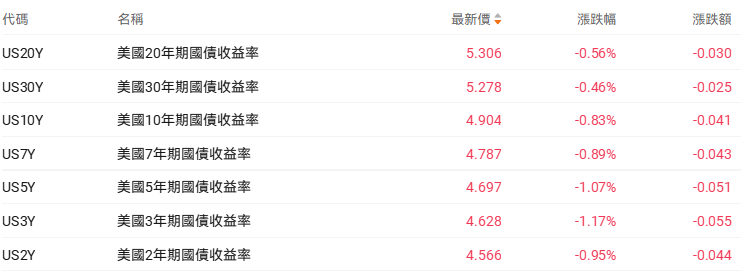
U.S. Treasury yields declined across the board.
 Bitcoin traded near $78,000. Precious metals weakened, with spot gold slipping slightly to fall below $4,000 per ounce.
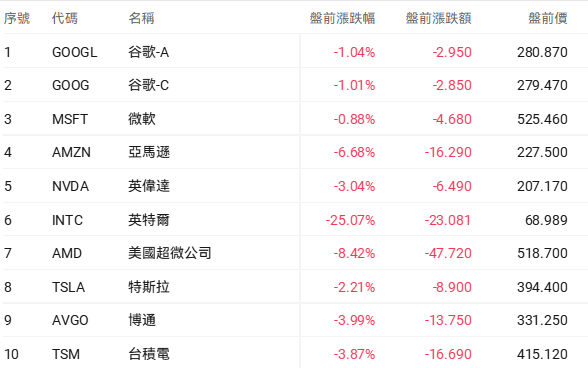
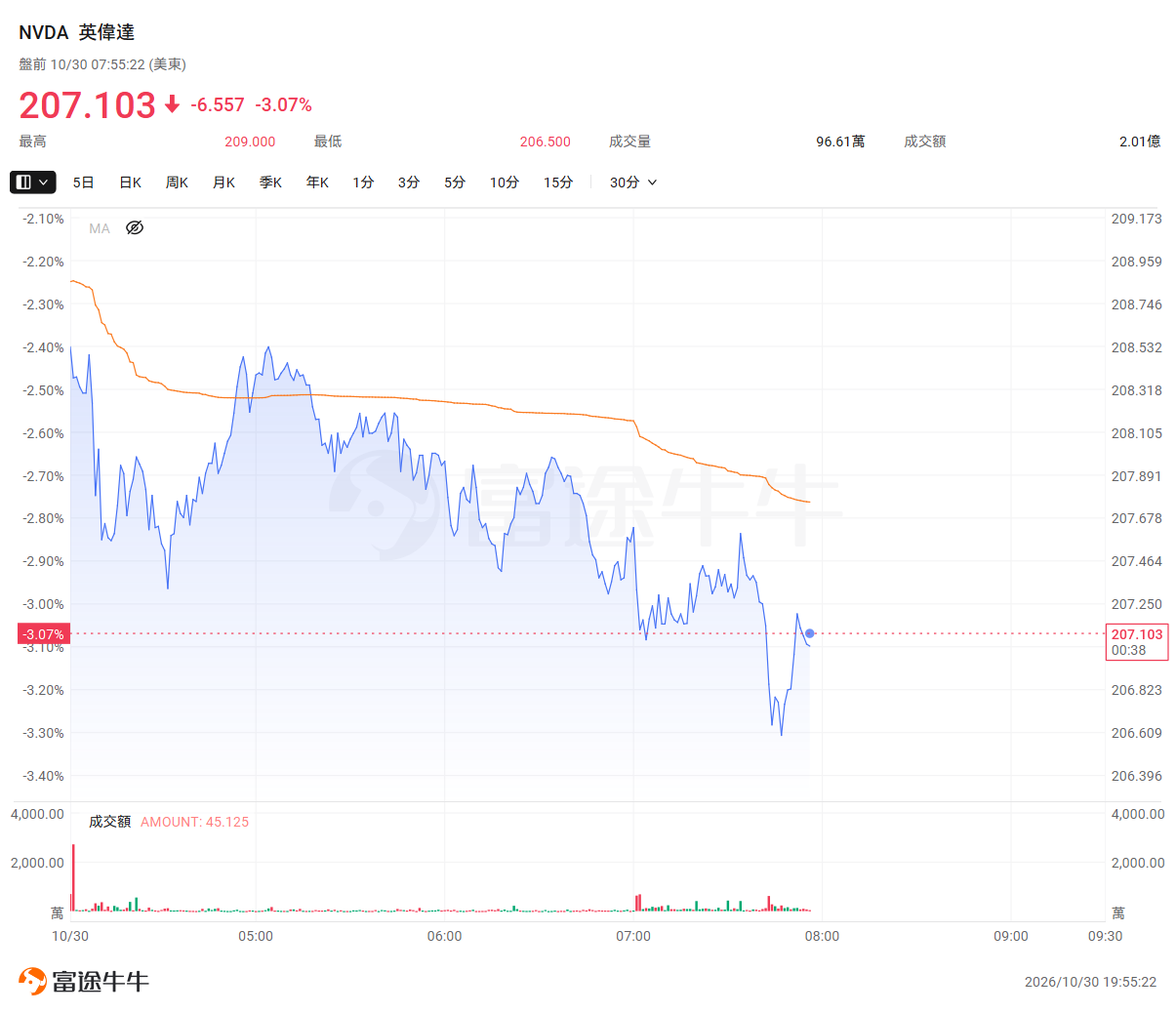
$AI Chips (LIST2548.US)$ Broad-based declines were seen, with Intel dropping nearly 25%, Arm falling more than 9%, AMD down nearly 9%, Micron down nearly 5%, Broadcom and Taiwan Semiconductor each down nearly 4%, and NVIDIA down nearly 3%.
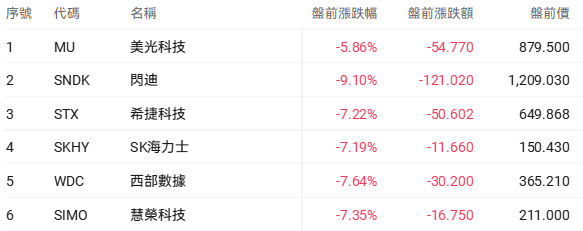
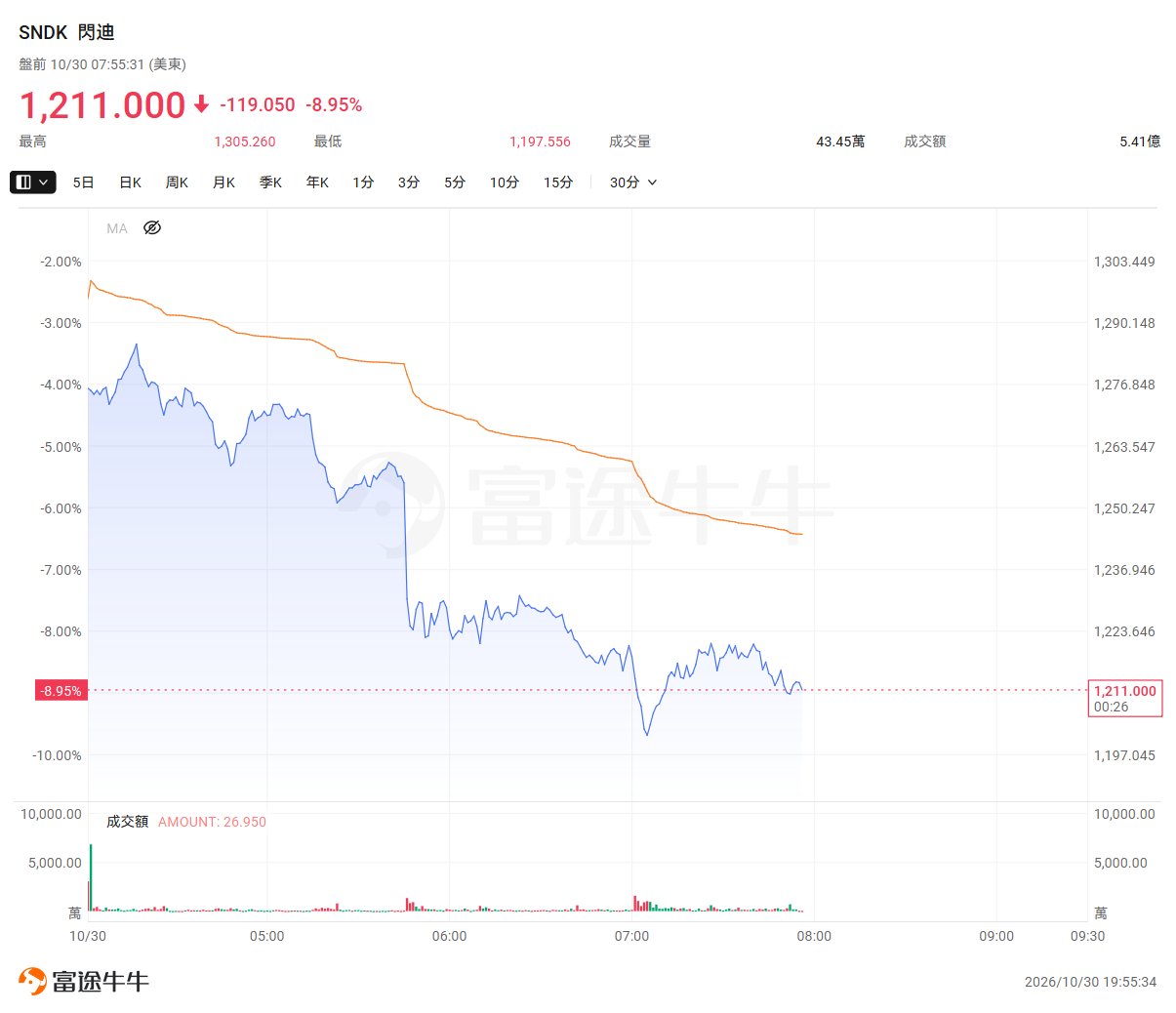
$Memory Concept Stocks (LIST23925.US)$ Storage stocks weakened, with SanDisk down nearly 9%, Western Digital falling more than 7%, and Seagate Technology down nearly 7%.
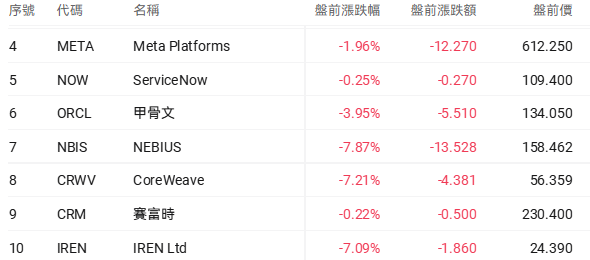
AI cloud stocks continued to decline, with NEBIUS and CoreWeave down more than 7%, and Oracle down nearly 4%.
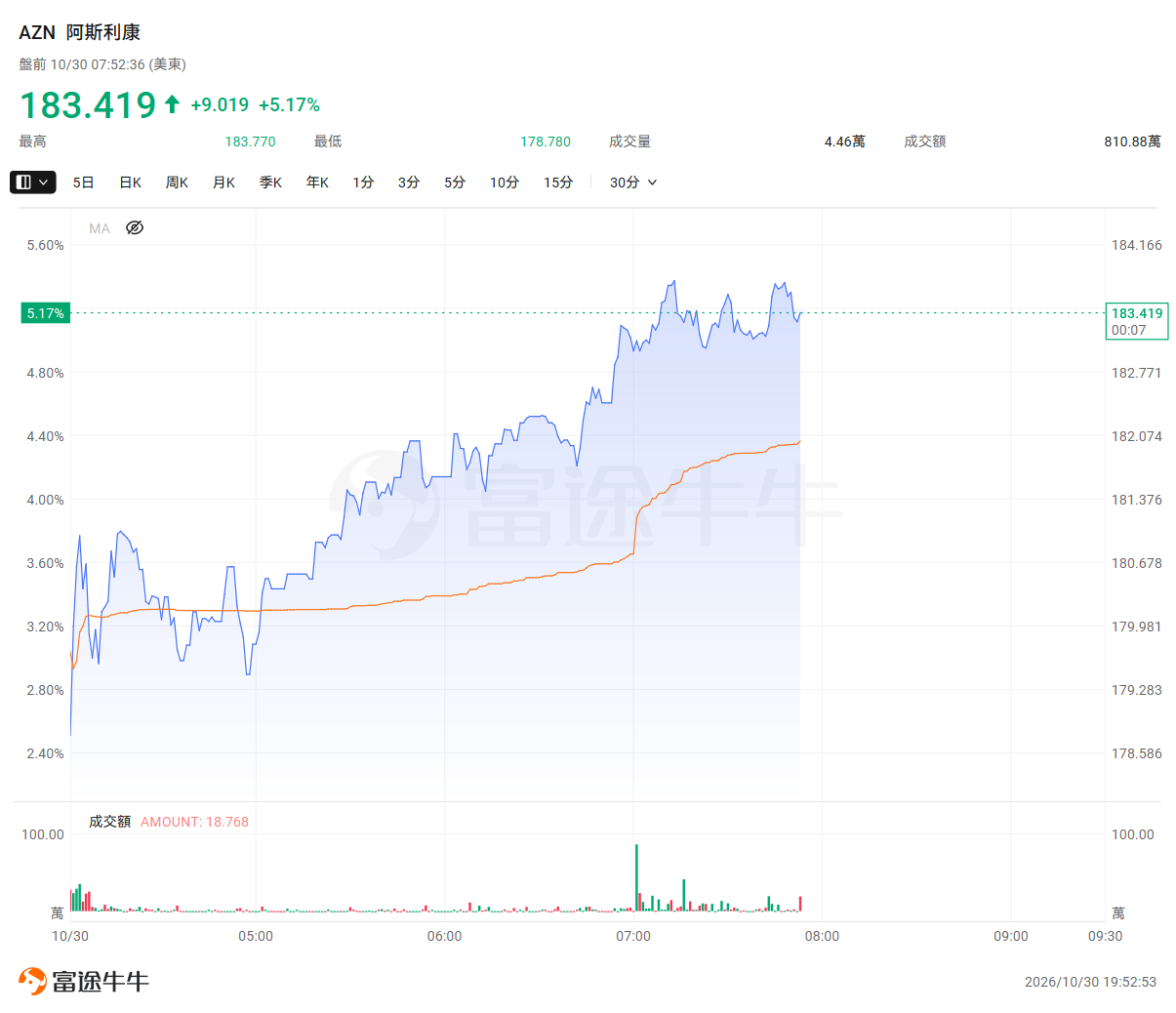
Post-earnings stock performance was mixed, $Reddit(RDDT.US)$ down nearly 20%, $Twilio(TWLO.US)$ fell nearly 18%, $Roblox (RBLX.US)$ dropped more than 17%; $AstraZeneca (AZN.US)$ rose more than 5%, $Rivian Automotive (RIVN.US)$ rose nearly 5%.
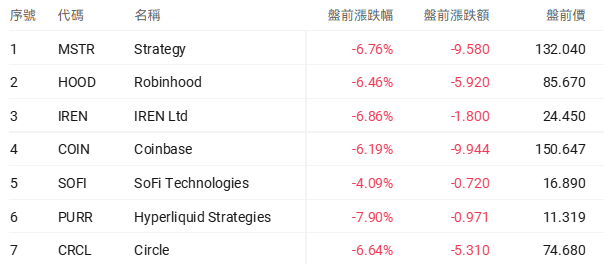
$Cryptocurrency Concept Stocks (LIST20010.US)$ under pressure, Strategy fell more than 6%, and Coinbase dropped more than 5%.
Company News
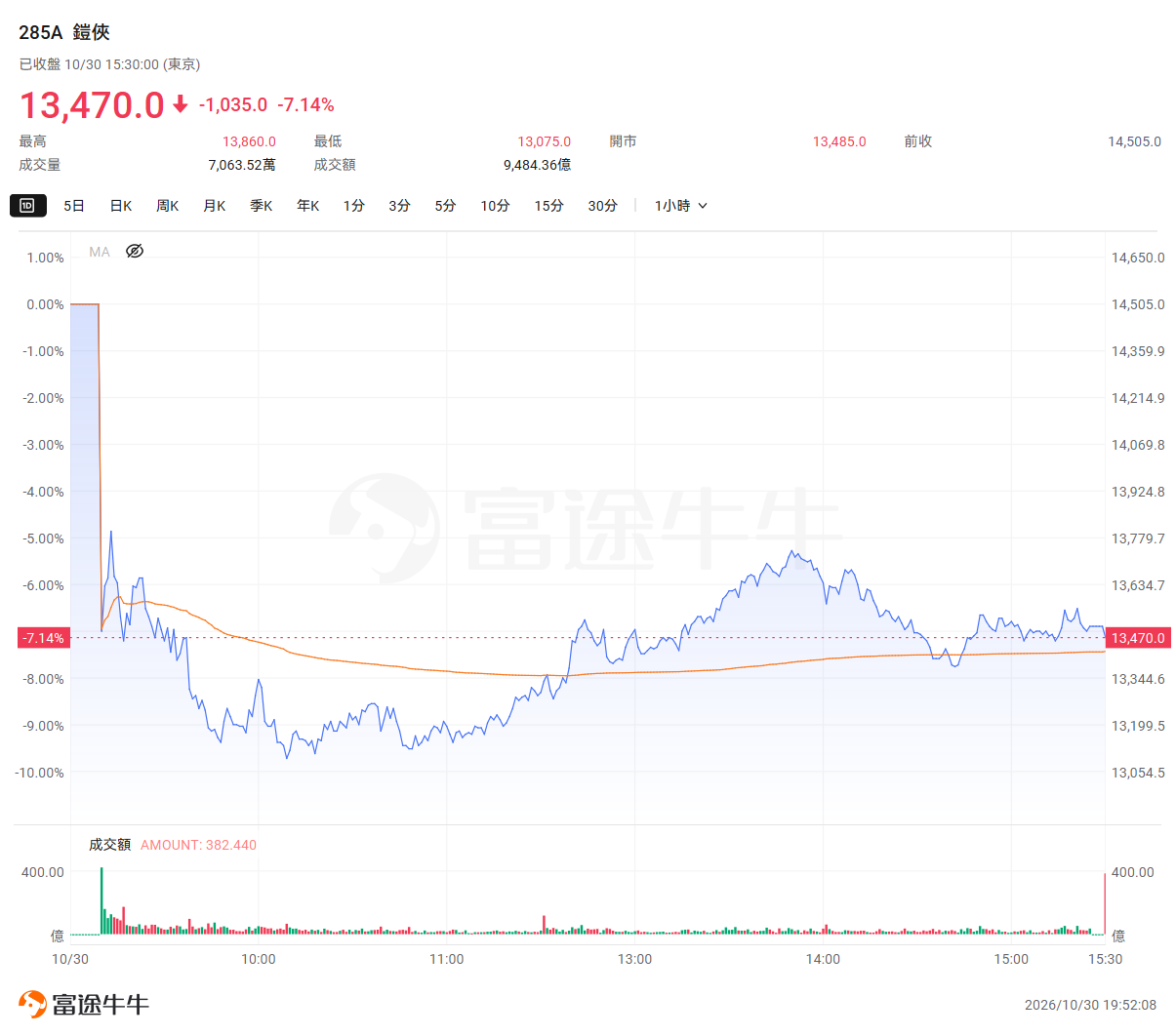
Kioxia's profit guidance for the third quarter missed expectations, with its stock price falling more than 7% ahead of the earnings report.
$Kioxia (285A.JP)$ / $Kioxia ADR (KXIAY.US)$ Operating profit for the second fiscal quarter was 1.99 trillion yen, slightly above the market expectation of 1.95 trillion yen; net profit was 1.36 trillion yen, basically in line with expectations. However, the company expects operating profit for the third fiscal quarter to be 2 trillion yen, significantly lower than the market expectation of 2.35 trillion yen, with projected revenue of 2.5 trillion yen. The company stated that demand from data centers will remain strong, but due to factors such as exchange rates, third-quarter revenue and profits will be roughly flat compared to the second quarter. Kioxia's stock price has fallen about 60% from its June high, closing down more than 7% in Tokyo on Friday.
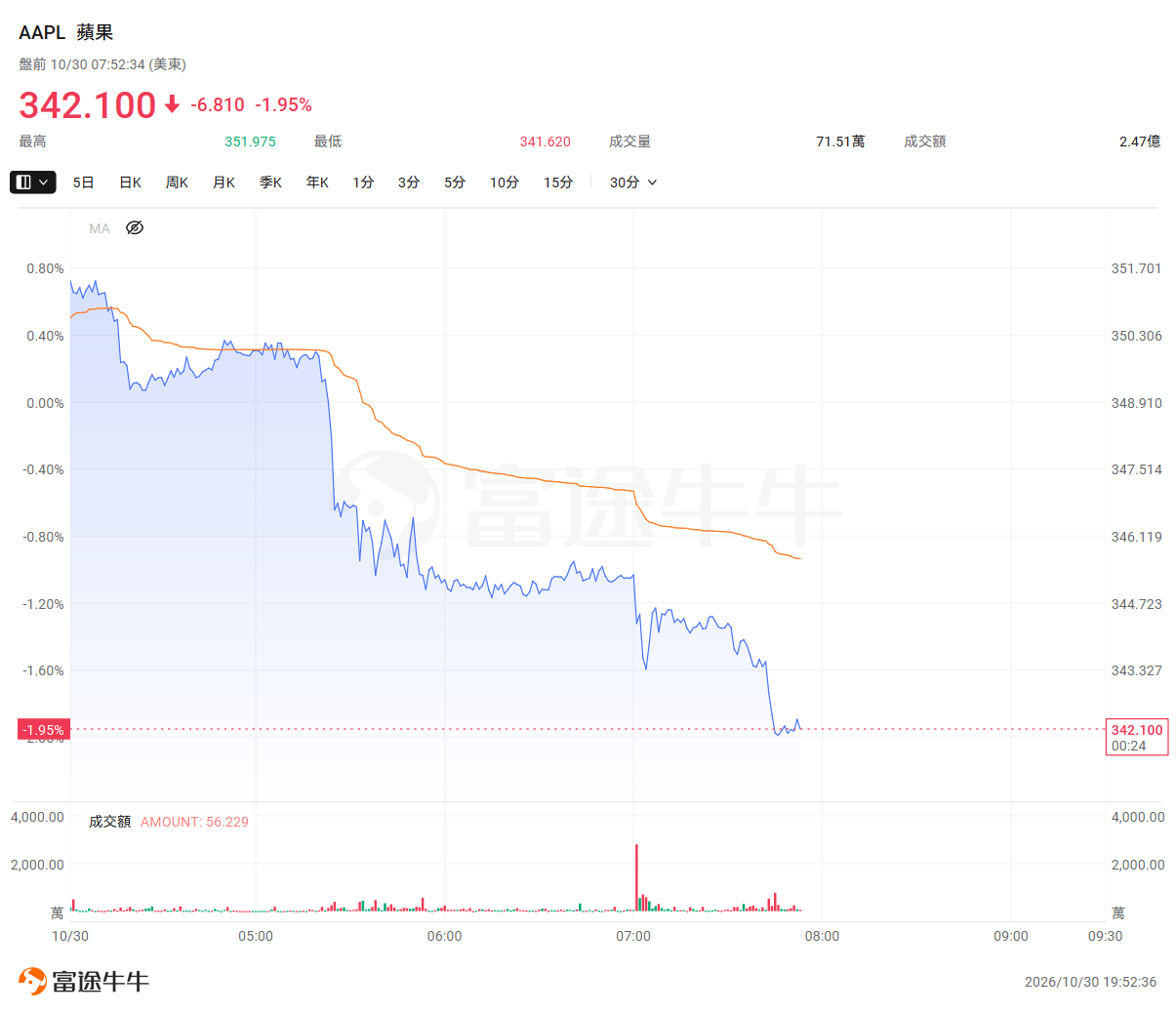
Apple iPhone Duo orders are booked until the end of January; Bank of America removes it from its preferred list.
According to Bloomberg, $Apple (AAPL.US)$ The inaugural foldable iPhone Duo, priced at $2,000, saw its offline inventory sell out rapidly. Some online orders are now scheduled for delivery only by late January, marking one of the longest delivery delays for a new Apple product in recent years. Foxconn, the primary contract manufacturer, stated it is "very confident" in meeting holiday season demand, leveraging its network of over 240 sites across 24 countries. Meanwhile, Bank of America has removed Apple from its U.S. stock preferred list. Apple closed at $348.91 on Thursday, setting a new record high. As of press time, Apple’s pre-market shares were down nearly 2%.
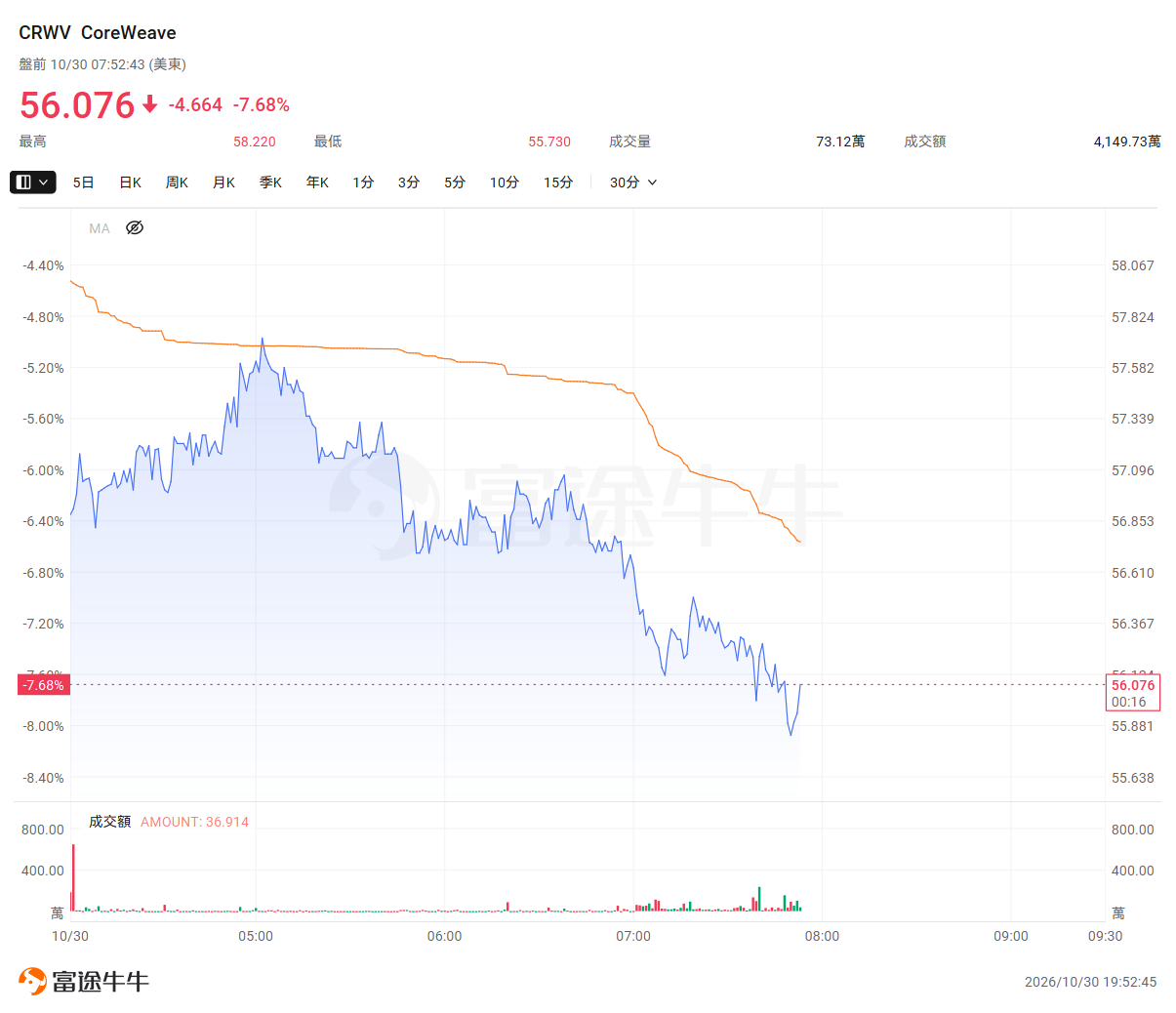
AI cloud stocks continue to decline: CoreWeave has fallen more than 30% this month amid growing concerns over debt financing.
$CoreWeave (CRWV.US)$ 、 $NEBIUS (NBIS.US)$ AI cloud stocks have cumulatively dropped more than 30% since the beginning of the month. Microsoft’s capital expenditure last quarter fell short of expectations, with CFO Amy Hood citing delays in the delivery of some third-party computing power. Following earnings releases from Google and Amazon, market skepticism regarding the return on AI investments has intensified. Additionally, Elon Musk warned that as debt markets tighten, more than 200 emerging cloud providers may face bankruptcy or consolidation. Analysts point out that emerging cloud vendors rely heavily on debt-funded expansion; financing pressures are significantly increasing amid rising expectations of Federal Reserve rate hikes and higher borrowing costs. Short sellers have already profited approximately $6 billion from related stocks in October. As of press time, CoreWeave’s pre-market shares were down more than 7%.
AstraZeneca’s Q3 core earnings per share exceeded expectations; full-year guidance reaffirmed.
$AstraZeneca (AZN.US)$ Total revenue for the third quarter grew 7% year-on-year to $16.209 billion at constant exchange rates, slightly above market expectations. Core earnings per share came in at $2.79, beating forecasts. Oncology drugs remained the primary growth driver, with alliance income surging 36%. The company reaffirmed its full-year 2026 guidance, projecting mid-to-high single-digit revenue growth at constant exchange rates and low double-digit growth in core earnings per share. It also plans to increase the annual dividend to $3.30 per share. AllianceBernstein maintained its "Buy" rating. As of press time, AstraZeneca’s pre-market shares were up more than 5%.
T-Mobile again rejects partnership with SpaceX, citing "no growth potential."
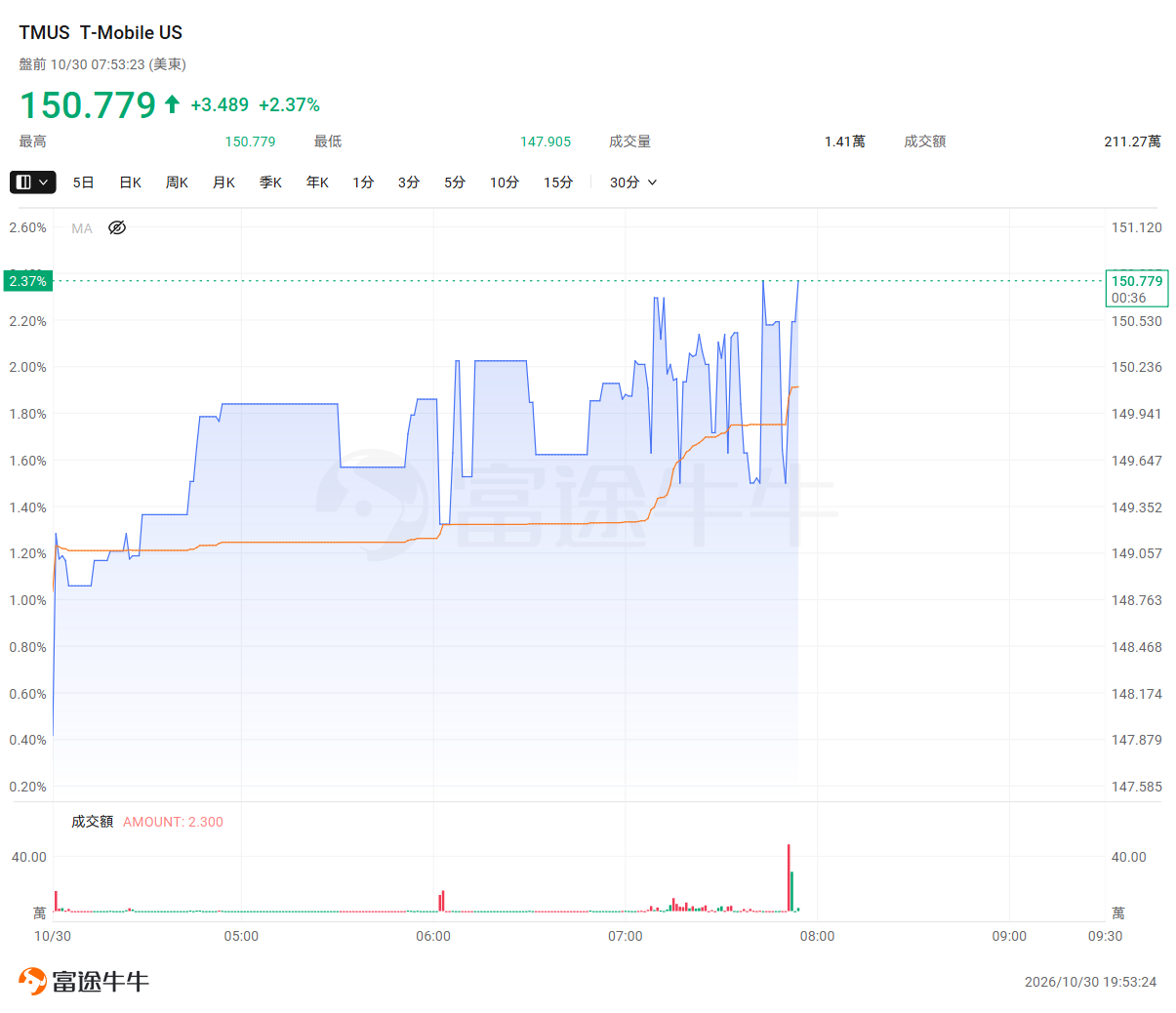
$T-Mobile US (TMUS.US)$ CEO Gopalan stated that partnering with $SpaceX (SPCX.US)$ SpaceX is entirely redundant for the company, describing satellite communications as an "inferior version" of Fixed Wireless Access (FWA). Satellite coverage in urban areas is very limited, yet two-thirds of T-Mobile’s FWA customers are located in cities. Currently, T-Satellite, backed by SpaceX, accounts for only 0.0002% of the company’s total network usage. All three major U.S. carriers have refused to partner with SpaceX due to the direct threat posed by its rapid expansion into cellular networks. Gopalan expressed greater optimism about 6G, stating that T-Mobile will become the first carrier in the U.S. to launch a 6G network. As of press time, T-Mobile’s pre-market shares were up more than 2%.
Intel conference call: PC weakness expected to persist until at least 2027; several major banks lower price targets.
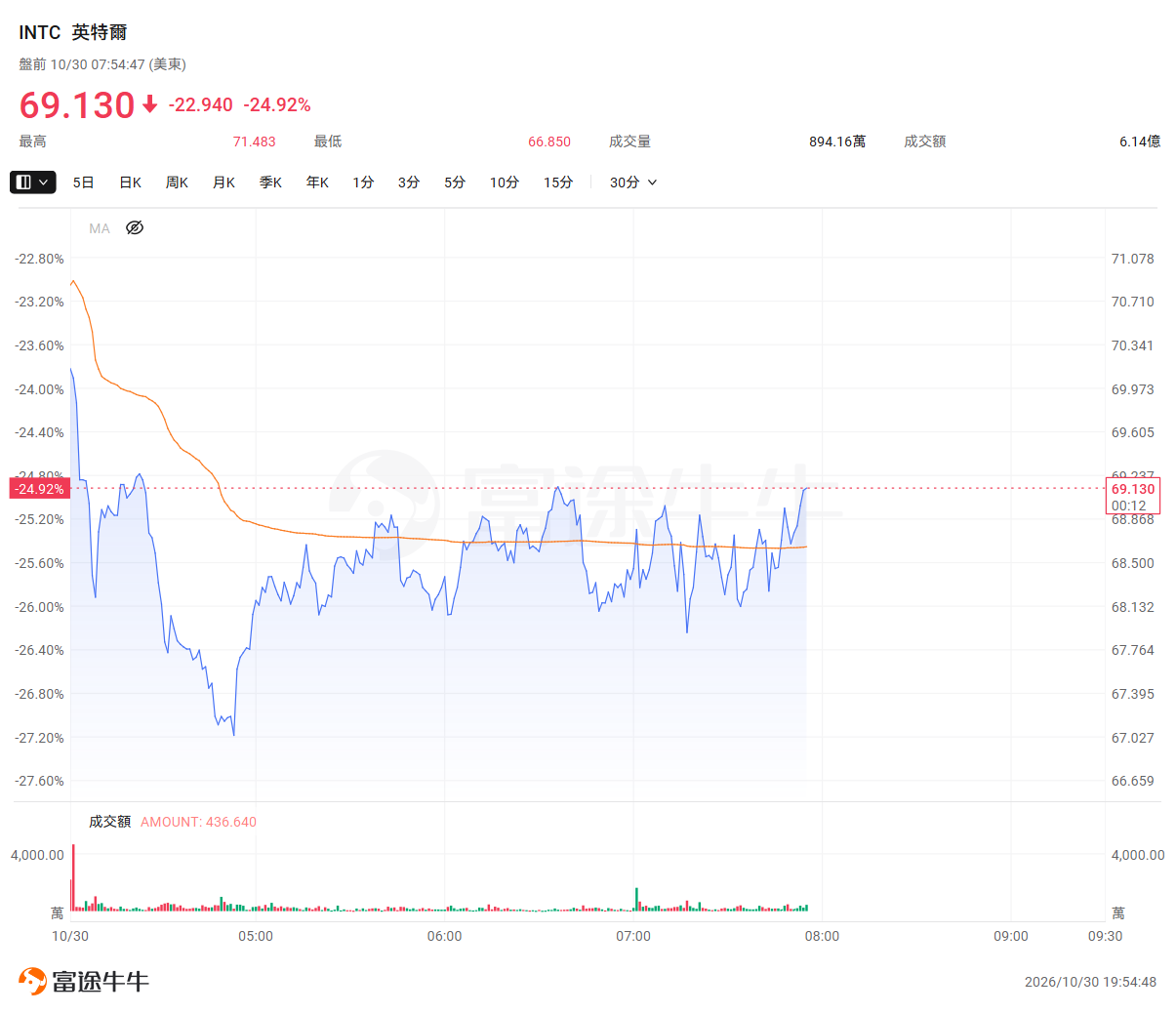
$Intel (INTC.US)$ Fourth-quarter revenue is projected at $15 billion to $16 billion, with adjusted earnings per share (EPS) of approximately $0.25, both falling significantly short of market expectations. Gross margin is expected to decline from 43% in the third quarter to 38%. CFO David Zinsner anticipates that the global PC market will drop by about 10% in 2027, following a 12% decline this year. CEO Lip-Bu Tan stated that rising memory prices have impacted the entire PC industry. Additionally, supply shortages for server chips due to raw material constraints, coupled with a roughly two-week production halt at an Israeli wafer fab, dragged down fourth-quarter revenue by approximately $300 million. Morgan Stanley lowered its price target from $84 to $75, HSBC from $200 to $160, and Baird from $125 to $83. As of press time, Intel’s pre-market shares were down nearly 25%.
Amazon faces sell-off after earnings: AWS growth misses buy-side expectations, ad revenue growth halves
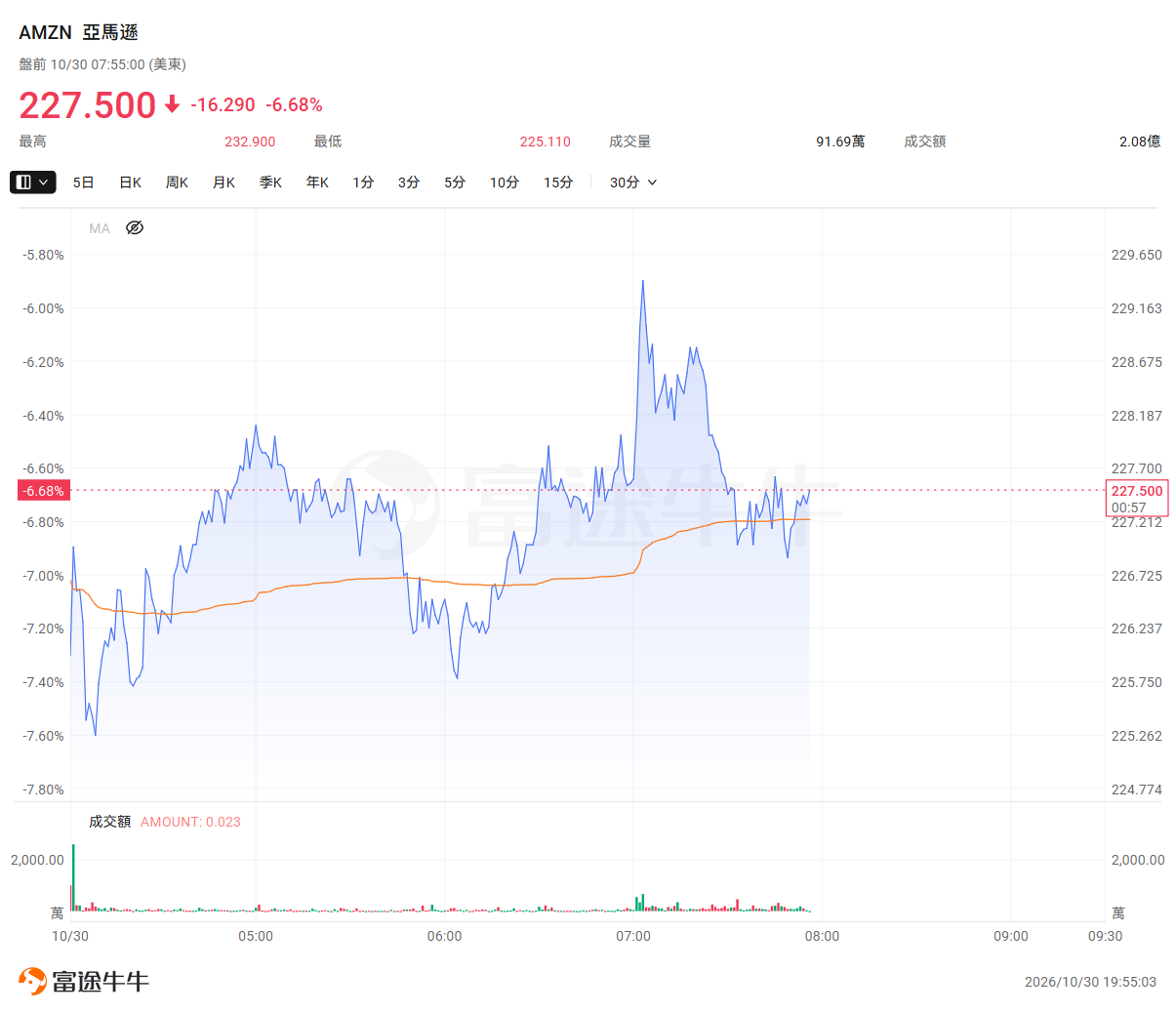
$Amazon (AMZN.US)$ AWS revenue grew 39.3% in the third quarter, slightly exceeding the Wall Street consensus but failing to meet the buy-side threshold of "over 40%." Advertising revenue growth plummeted to 12% from 26% in the previous quarter, well below the expected ~18%, which the company attributed to the rescheduling of Prime Day. During the conference call, CEO Andy Jassy projected that AWS would grow by more than 40% in both 2027 and 2028, potentially becoming a trillion-dollar business within five to ten years. AWS backlog increased 189% year-over-year to $578 billion. Goldman Sachs noted that the gap between AWS growth and buy-side expectations was the "most concerning issue." Jefferies maintained its "Buy" rating with a price target of $330. As of press time, Amazon’s pre-market shares were down over 6%.
NVIDIA in talks to provide billions in credit guarantees for Anthropic data center projects
According to reports from Bloomberg and The Information, $NVIDIA (NVDA.US)$ NVIDIA is negotiating to provide billions of dollars in credit guarantees for Nscale’s data center project in West Virginia, USA, to support power infrastructure and construction financing. This data center will be used by Anthropic. In August, Anthropic signed a computing power lease agreement worth approximately $45 billion with Nscale, and the two parties are discussing another deal of similar scale. NVIDIA is already an investor in Nscale. The agreement has not yet been signed, and terms remain subject to change. Reuters pointed out that NVIDIA-backed AI cloud providers such as CoreWeave have recently been hit by concerns over debt financing. As of press time, NVIDIA’s pre-market shares were down nearly 3%.
SanDisk continues to fall after earnings: Slowing sequential growth and concerns over peak gross margins overshadow the benefits of the 8-for-1 stock split
$SanDisk (SNDK.US)$ Data center business revenue reached $4.8 billion, a 61% sequential increase. Management stated that approximately 60% of the revenue growth came from shipments and 40% from price hikes. However, sequential revenue growth slowed to 23% from 51% in the previous quarter, while consumer revenue declined 29% sequentially. The market is concerned that the gross margin of 85.1% is nearing its peak. During the conference call, CEO Sanjay Mehrotra stated that customers had underestimated the NAND capacity required to run AI infrastructure, with long-term orders extending beyond 2030. The company announced an 8-for-1 stock split, with post-split trading set to begin on November 20. Bank of America maintained its "Buy" rating but lowered its price target to $2,000. As of press time, SanDisk’s pre-market shares were down nearly 9%.
Global Macro
Market no longer "rewards cash burn": AI spending swells as tech giants' cash cows lose momentum
This week, Google parent Alphabet and Amazon released quarterly results that disappointed the market. Alphabet’s search revenue growth slowed to 12%, with JPMorgan noting that Google is "answering more questions than ever, but earning less for each question." Amazon’s third-quarter free cash flow was approximately -$33.5 billion, far worse than the Bloomberg consensus expectation of -$7.7 billion, while its long-term debt rose from $65.6 billion to $173.1 billion. Goldman Sachs traders pointed out that the market is shifting from "rewarding capital expenditure growth" to "demanding evidence of returns."
Tech stocks endured a brutal October as hedge funds shifted to shorting the Nasdaq, amplifying volatility risks.
Tech stocks retreated approximately 8% in October, but hedge funds did not fully exit AI trades. Instead, they reduced short positions in individual stocks and turned to index instruments such as QQQ to short the Nasdaq, with short interest in QQQ rising significantly over the past two weeks. Bloomberg macro strategist Simon White noted that since 2024, the total exposure of long-short equity funds has increased by more than $5 trillion to over $8 trillion, while net exposure stands at only about $2 trillion. The rise in index-level hedging is driving up stock correlations, rendering the low-correlation buffer that previously suppressed the VIX ineffective. With crowded trades, leverage, and correlations all rising simultaneously, the next round of selling could be more severe.

Bank of America maintains hawkish expectations: The Federal Reserve will raise interest rates twice more by March next year.
Bank of America forecasts that the Federal Reserve will raise interest rates by 25 basis points in December this year and again in March 2027, pushing the federal funds rate to 4.25%-4.5%, where it will remain until the end of 2027. The bank had previously anticipated a rate hike in October, but this week the Fed voted 10-2 to keep rates unchanged at 3.75%-4%. Bank of America believes that if the Fed delays rate hikes, it may ultimately need to keep rates higher for longer. CME FedWatch indicates an approximately 86% probability of a 25-basis-point hike in December. The October non-farm payrolls report on November 6 and the CPI data on November 10 will serve as key references.
Trump on the war with Iran: It will end soon
U.S. President Trump stated again, "The war with Iran will end soon, one way or another," without specifying how, adding that he was "unsure who to talk to, as many Iranian leaders are no longer around." He reiterated, "Iran must reach an agreement. We need guarantees that Iran will never possess nuclear weapons." Trump had previously stated that the United States would not strike Iran before the election.
Wall Street bets on a landslide victory for Democrats in the midterm elections.
The U.S. midterm elections will be held next Tuesday, with Wall Street broadly expecting a decisive Democratic victory. Among 138 investors surveyed by Wolfe Research, 96% believe Democrats will retake the House of Representatives, and 58% believe they will capture the Senate; the firm itself assigns a 49% probability to this outcome. TD Securities has established a "Blue Wave" as its baseline scenario. Analysts suggest that if Congress and the White House are controlled by different parties, legislation may face gridlock. Markets typically welcome reduced policy volatility, but the risk associated with debt ceiling negotiations will rise. Paine Webber estimates that Democratic policy proposals could increase the deficit by $5 trillion over the next decade.

U.S.-Iran tensions evolve into a race against time: Trump eager to break the deadlock, Iran seeks to delay.
Qatari mediation representatives returned to Tehran on Friday, but significant differences remain between the U.S. and Iran on issues such as nuclear matters, sanction relief, and maritime blockades. The U.S. demands that nuclear issues be included from the outset of negotiations, while Iran insists that the U.S. first lift port blockades and cancel sanctions on oil exports. With the U.S. midterm elections approaching, Bloomberg analysis suggests the Trump administration hopes to quickly conclude the eight-month-long conflict, whereas Iran is more inclined to delay to buy time. Citing diplomats, the Associated Press reported that the U.S. has warned some Middle Eastern allies to prepare for potential military action against Iran after the midterms, although Trump has not yet made a final decision.
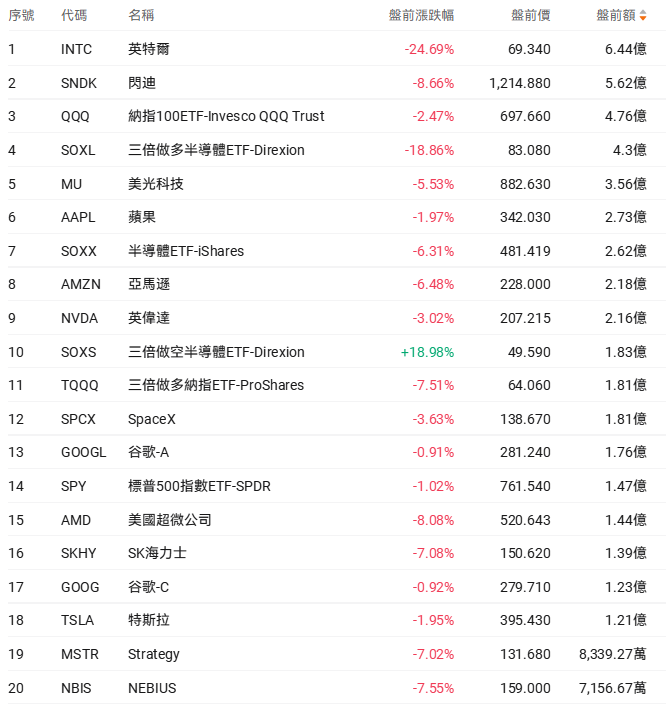
Top 20 U.S. Stocks by Premarket Trading Volume
U.S. Stock Market Macro Calendar Reminder
(Beijing Time below)
20:30 U.S. Employment Cost Index for the third quarter
21:45 US October Chicago PMI
 Looking to select or analyze stocks? Want to understand the opportunities and risks in your portfolio? For all investment-related questions,simply ask Futubull AI!

Editor / Rocky