Intel plunged 29% on Friday, marking its largest single-day drop on record, while the Nasdaq posted its worst month in more than a year. With Google's search growth slowing and Amazon posting a quarterly free cash flow outflow of $33.5 billion, the logic that tech giants can rely on profits to cushion them is beginning to falter.
$Alphabet-A (GOOGL.US)$ 、$Amazon (AMZN.US)$, Intel's earnings reports have repeatedly disappointed the market, and this week the cracks in AI-related stocks have widened significantly. On Friday (October 30), Intel's stock price plummeted 29%, marking its largest single-day drop on record;$Nasdaq Composite Index (.IXIC.US)$It fell 2.9%, marking its worst day since June, and October is set to become the Nasdaq's worst-performing month in more than a year.
In recent months, the risks of AI-driven trading were mainly concentrated in heavily indebted small companies, while the tech giants, buoyed by robust profits, kept Wall Street steady. This week, however, the situation has changed: Google's search advertising growth has slowed, Amazon's free cash flow has turned sharply negative, and Intel expects PC sales to remain sluggish for the long term. According to FactSet, the "Big Seven" are expected to post third-quarter earnings growth that falls short of the rest of the S&P 500 constituents.
 The question the market is now asking has shifted from how big the demand for AI is to who will foot the bill for AI. Rich Privorotsky, head of Goldman Sachs' Delta One, wrote:
"Capital costs have already been objectively repriced, and there is no obvious solution."
Major tech giants have repeatedly missed earnings expectations.
At the start of the week, Anthropic's IPO filing revealed a sharp surge in revenue, briefly boosting market sentiment, but subsequent earnings reports from major tech giants quickly dampened investor enthusiasm.
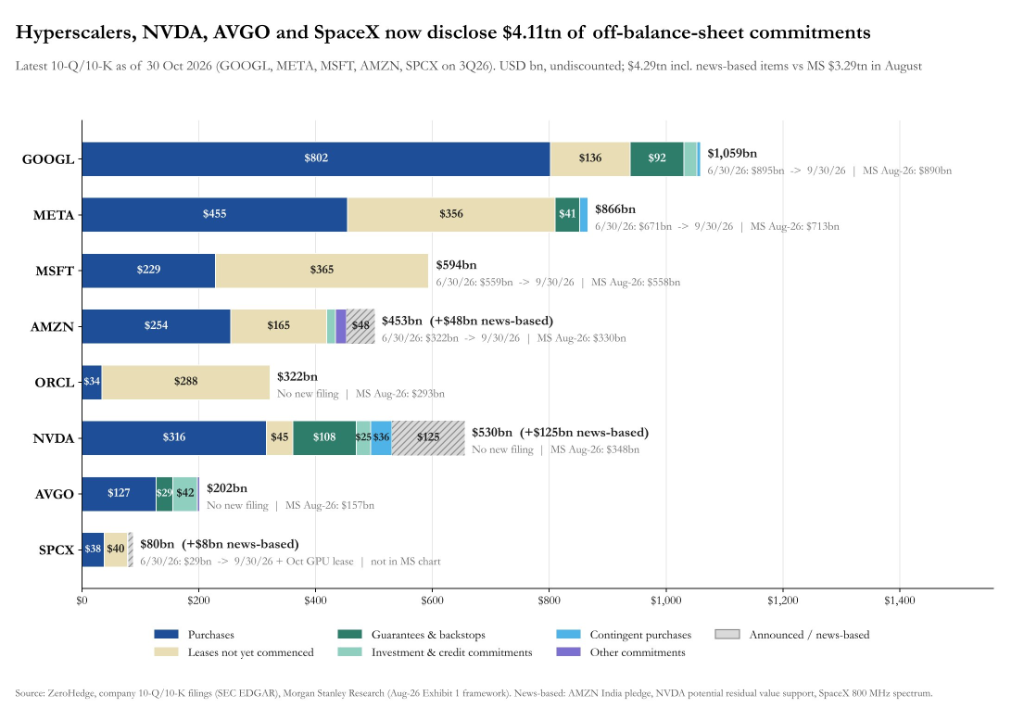
Alphabet's search advertising growth has slowed, partly due to the impact of "AI‑powered" queries, and the company also announced that its capital expenditures will rise "significantly" by 2027. On Thursday, its stock fell 13%, marking its worst single-day performance on record, wiping out roughly $489 billion in market value and inflicting heavy losses on major shareholders such as Berkshire Hathaway.
Amazon reported after hours on Thursday that its revenue fell short of expectations, with free cash flow for the quarter coming in at negative $33.5 billion—more than four times worse than anticipated. Capital expenditures surged to $77.3 billion, while the company added $48.1 billion in long-term debt over the same period. On Friday, its stock price dropped by 7%.
$Intel (INTC.US)$Revenue for the fourth quarter is expected to be between $15 billion and $16 billion, below the market's forecast of $17.29 billion, and the company stated that it will not achieve positive cash flow this year. The company also anticipates a long-term slowdown in PC sales, as the AI boom has driven up the prices of memory chips. Intel closed down 29% on Friday, with an intraday decline of as much as 29.7%, marking its largest single-day drop since Bloomberg began tracking such data in 1982. The two major shareholders, the U.S. government and$NVIDIA (NVDA.US)$The aggregate book value of its holdings has evaporated by more than $17 billion.
$Microsoft (MSFT.US)$Azure grew 48%, but commercial bookings declined 12%. Roughly 12 hours after the earnings report was released, the only tech company with an AAA credit rating launched a $25 billion bond offering—the first since 2017.
On Friday, the sell-off spread across the entire tech sector: all seven major players closed lower, with memory‑chip, semiconductor, and emerging cloud‑service providers (neocloud) seeing sharp declines in share prices.$Reddit (RDDT.US)$Down 26%,$Bitcoin (BTC.CC)$Down more than 5%. Peter Boockvar, Chief Investment Officer at OnePoint BFG Wealth Partners, said:
"The cracks may not be connected, but when there are enough of them, won't the pavement eventually collapse?"
From "demand-driven funding" to "who will foot the bill"
"Big players have been making plenty of money, and the market has long tolerated their heavy capital spending," said Paisley Nardini, head of investment strategy at Tema ETFs. "Previously, 'spending was seen as a sign of confidence in this round of expansion and would be rewarded,' but 'all of a sudden, spending is viewed as a headwind.'"
The turning point began with Meta. On October 21, Meta announced that its capital expenditures for the fourth quarter would range from $49 billion to $59 billion, with negative free cash flow after dividends, and warned in its filings that it might need to raise "tens of billions of dollars" as early as the fall of 2026. On October 26, …$Meta Platforms (META.US)$Launching an equity financing of up to $97.5 billion, NVIDIA,$Advanced Micro Devices (AMD.US)$and$Broadcom (AVGO.US)$It indicated an intention to subscribe for up to $5 billion. On the same day, Anthropic's S‑1 filing revealed that its computing‑power costs amounted to roughly $780 billion to $810 billion. According to Bloomberg, the four major tech giants are set to spend nearly $750 billion on capital expenditures this year, and "investors no longer accept returns at face value."
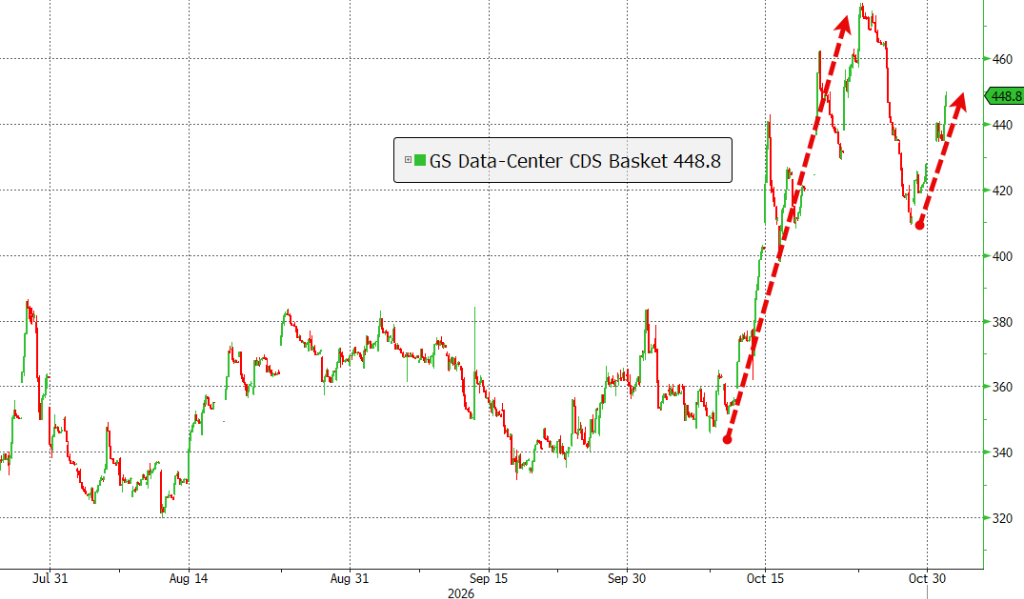
The credit market sent an early signal. From early September to mid-October, ultra-large cloud providers and AI‑related companies did not issue a single investment‑grade bond.$CoreWeave (CRWV.US)$Unsecured bond spreads have surged past 1,000 basis points. This week, CDS for ultra-large cloud providers hit new record highs; meanwhile, banks have put on hold the issuance of junk bonds for Anthropic's $15 billion Texas data center, as Texas has frozen new projects. Goldman Sachs credit strategists note that default risks in the AI sector have tripled since January.
Baird's equity strategist, Ted Mortonson, said that large-scale fundraising is good for Wall Street banks but has "scared the living daylights" out of fund managers, adding, "My advice is to stay away for now." Meanwhile, Keith Lerner, chief investment officer at Truist Advisory Services, noted, "The bearish case is that earnings peaks are closer than we've been assuming."
Sharp rotational shifts beneath the index
As of Thursday,$S&P 500 Index (.SPX.US)$This month, it's still up about 0.9%, just a few percentage points below its record high, but internal divergence is stark. The Nasdaq 100 has fallen roughly 3.3% this month, with the index's market capitalization shrinking by more than $1.2 trillion. The Big Seven have collectively dropped over 6% in October, while emerging cloud service providers are down 37%, whereas Goldman Sachs' "most AI‑vulnerable" stock basket has risen by more than 15%.
On October 29, a sharp drop in Google dragged the S&P 500 down 0.3%, despite 406 constituent stocks advancing that day. According to Bloomberg data dating back to 1996, on the previous 987 trading days when at least 400 stocks rose, the index closed higher without exception. UBS traders said funds are shifting from crowded AI and growth stocks into value stocks, small-cap stocks, consumer stocks, and interest-rate‑sensitive cyclical stocks, but they have not pulled out of the stock market.
Institutional positions are shrinking in tandem. According to Goldman Sachs' prime brokerage data, hedge funds have been selling tech stocks at the fastest two-week pace in more than a decade, and U.S. equity net leverage has fallen to a five-year low. Goldman Sachs' high-beta momentum portfolio has retraced 43% from its June peak, erasing all of its year-to-date gains. In Asia,$Samsung Electronics (005930.KR)$and$SK Hynix (000660.KR)$All declines this month have exceeded 16%.
Interest Rates, Iran, and the Midterm Elections
Following the Federal Reserve's rate hike in September, markets had expected further tightening; this month, the Fed paused rate increases, though two policymakers dissented in favor of further hikes. Federal Reserve Chair Kevin Warsh said this week, "Interest rates affect virtually everything, directly or indirectly… Market participants are now distinguishing between the investments they wish to pursue."
Geopolitical risks are also escalating. Trump has hinted that the U.S. may launch a new military operation against Iran after next week's midterm elections. Brent crude oil futures for the near month closed at $117.64 per barrel on Friday, nearing this year's high, and briefly touched $118 during the session. Meanwhile, U.S. Treasury bonds strengthened, with the 10-year yield falling below 4.9% to a six-week low, as the bond market increasingly views the surge in oil prices as a threat to economic growth. The midterm elections will also determine to what extent opposition to data centers across the country will translate into development restrictions.
Optimists are still here.$Founders 100 ETF (FFF.US)$Fund manager Michael Monaghan believes that if the situation in the Middle East stabilizes, the market will "rise sharply"; the upcoming Anthropic IPO "is the cornerstone that's holding up the entire AI sector." "We remain optimistic—this AI rally is far from over."
However, Privorotsky cautions that the risk lies in the fact that financing constraints could eventually compel major firms to rein in capital expenditures—"though this is not yet evident in their spending intentions."
Editor/Jeffy