
As AI giants frantically burn cash to expand, the credit market has sounded the alarm. Chipmakers such as Broadcom and NVIDIA have seen their CDS spreads surge by more than 170% in the past six months, while ten core AI companies—including Google and Amazon—though accounting for only 8% of the investment-grade index, bear 16% of its implied credit risk. Chip manufacturers are transforming from tech firms into "centralized lending institutions," with CDS trading volumes soaring by over 1,900% year over year.
Barclays released a comprehensive report on the credit default swap (CDS) market for AI-related companies, noting that with a substantial expansion in capital expenditures, the credit risk of AI-related firms has undergone significant repricing, and both CDS trading volumes and spreads have shown a sharp upward trend.
On October 29, Barclays reported that, including$Alphabet-A (GOOGL.US)$ 、$Amazon (AMZN.US)$、 $Meta Platforms (META.US)$ 、$Microsoft (MSFT.US)$、$Oracle (ORCL.US)$and hyperscale cloud service providers, as well as$Advanced Micro Devices (AMD.US)$ 、$Broadcom (AVGO.US)$、$NVIDIA (NVDA.US)$Ten core AI companies, including chipmakers, currently account for only 8% of the CDX Investment Grade Index's constituents, yet they already represent 16% of the index's implied credit risk.
 Barclays emphasized that, over the past six months, the credit risk of all ten companies has widened and currently stands near the upper end of their six-month volatility ranges.
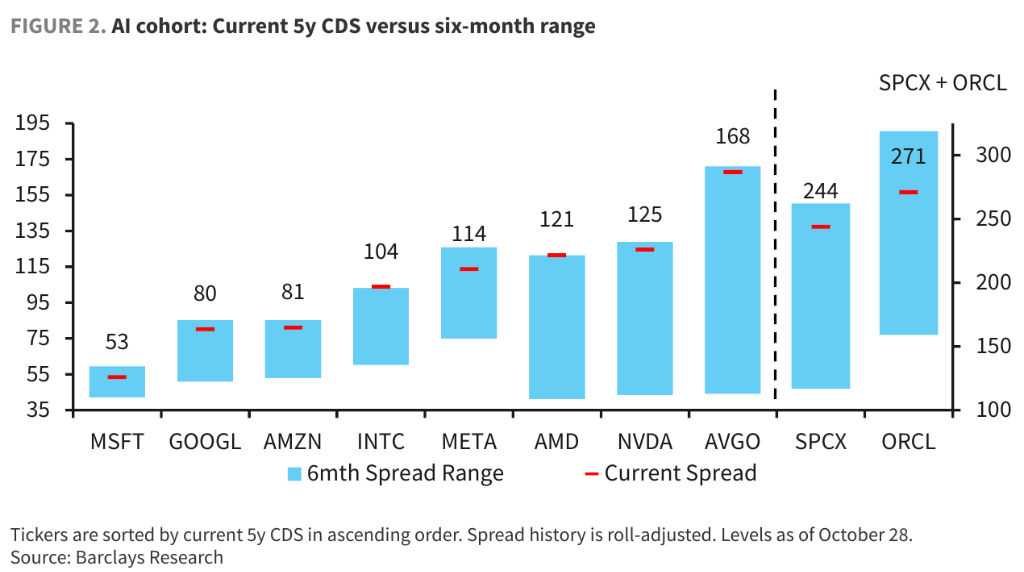
This means that investors holding this investment-grade index have passively assumed substantial volatility risk in the AI sector. Moreover, the basis between the CDS and cash bonds of these core AI companies has turned positive, indicating that the cost of purchasing credit default protection now exceeds the additional yield generated by holding these corporate bonds.
According to Bloomberg, this unusual phenomenon is largely driven by a surge in CDS purchases by institutions that do not hold the underlying bonds—such as equity hedge funds and banks—in order to hedge against substantial AI‑related capital expenditures and associated loan risks.
This round of technical moves, in terms of credit‑hedging dynamics and basis distortions, bears a striking resemblance to 2008. Back then, numerous institutions that did not hold subprime mortgage‑backed securities—such as hedge funds and investment banks—bet on default risk by purchasing CDS protection, driven by a bearish macro outlook or risk aversion. This concentrated "naked hedging" activity pushed CDS spreads sharply higher, even surpassing the credit spreads of the underlying cash bonds, thereby driving the CDS–cash bond basis into positive territory.
As Barclays released the report, the financing needs of leading tech companies are continuing to put pressure on the market. Recently, Microsoft launched a bond issuance exceeding $25 billion, Amazon added more than $48 billion in long-term debt in a single quarter, and Broadcom also plans to raise up to $21 billion early next year.
These massive financings have further fueled hedge demand in the market, driving the CDS costs of the relevant companies to record highs.
Credit characteristics of chipmakers have shifted, leading to a significant widening of credit spreads.
In this round of credit repricing, the CDS spreads of chipmakers have widened most markedly.
Six months ago, the CDS spreads of Broadcom, AMD, and NVIDIA were still at the lowest level in their peer group, hovering around 40 basis points.
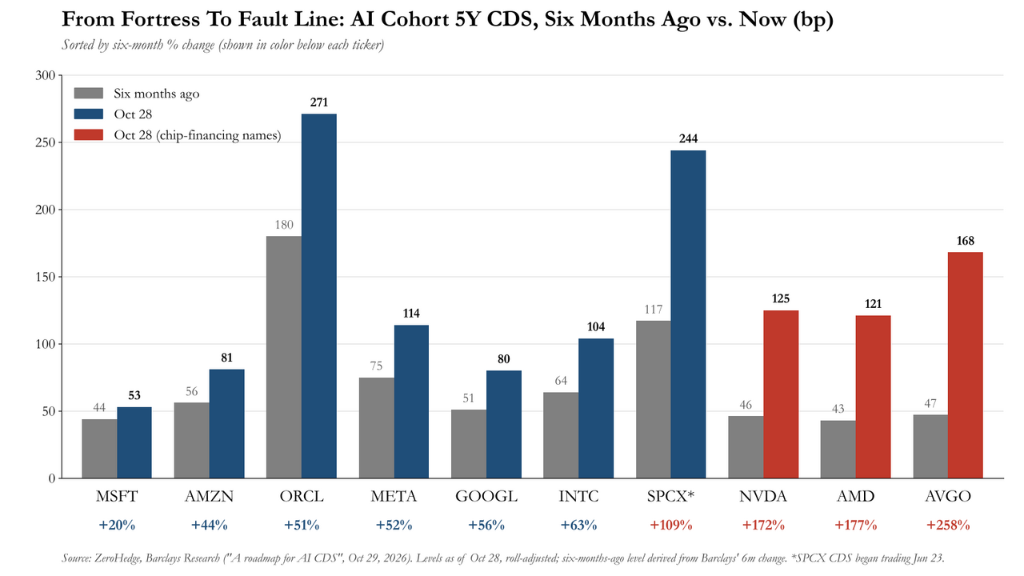
However, today the CDS spreads of these three companies have surged to the top, with Broadcom's 5-year CDS jumping 258% in six months, AMD rising 177%, and NVIDIA climbing 172%. By contrast, Microsoft, rated AAA, has increased by only 20%.
Barclays noted in its report that, as chip suppliers have begun extending loans to customers for the purchase of their chips—known as supplier financing—the credit market has started to treat these companies as lenders with highly concentrated loan portfolios.
For example, after banks raised concerns about Anthropic's $63 billion chip deal, Broadcom stepped in to provide a guarantee. Based on this, Barclays recommends purchasing five-year CDS protection on Broadcom as a macro strategy to hedge against broader AI financing pressures.
Basis normalization and hedging demand are driving a surge in trading volume.
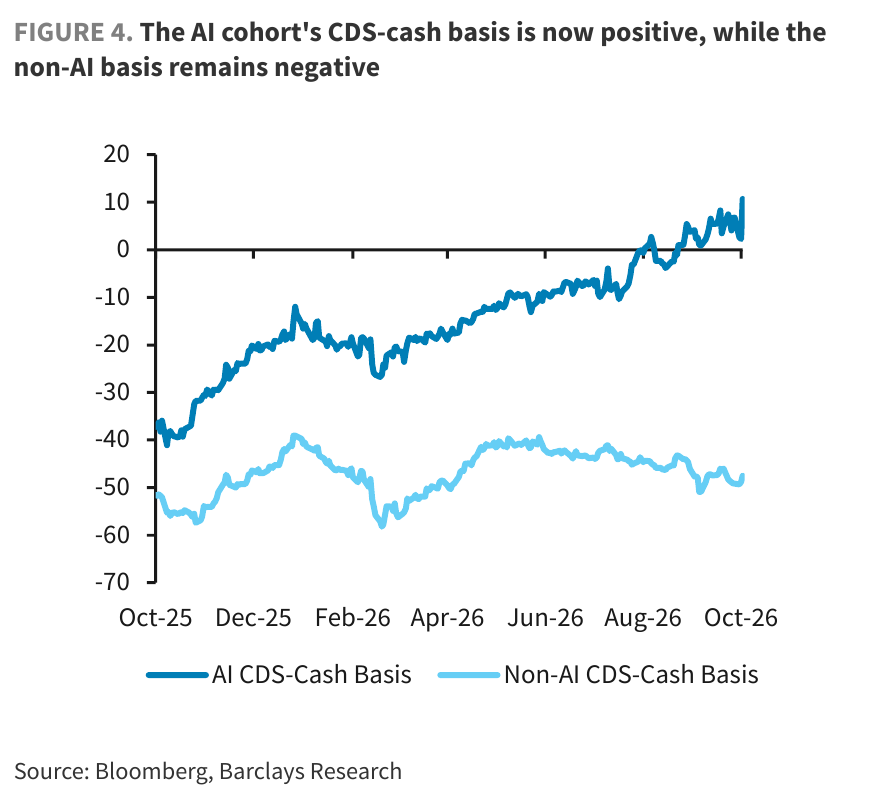
The positive basis between CDS and cash bonds is the most prominent technical feature of the current AI credit market.
Over the past year, the basis for non-AI companies in the CDX Investment Grade Index has remained largely negative—meaning CDS spreads have been lower than bond spreads—while the basis for the AI cohort has risen by roughly 50 basis points and turned positive. Among chipmakers and…$Oracle Corp Japan (4716.JP)$In this context, the positive basis is particularly pronounced.
This structural shift has been accompanied by an explosive surge in trading volume. As of October 23, the four‑week average weekly trading volume for hyperscale cloud service providers reached approximately $6 billion, up roughly 740% year over year; meanwhile, chipmakers' weekly trading volume hit $3 billion, a year‑over‑year jump of 1,900%.
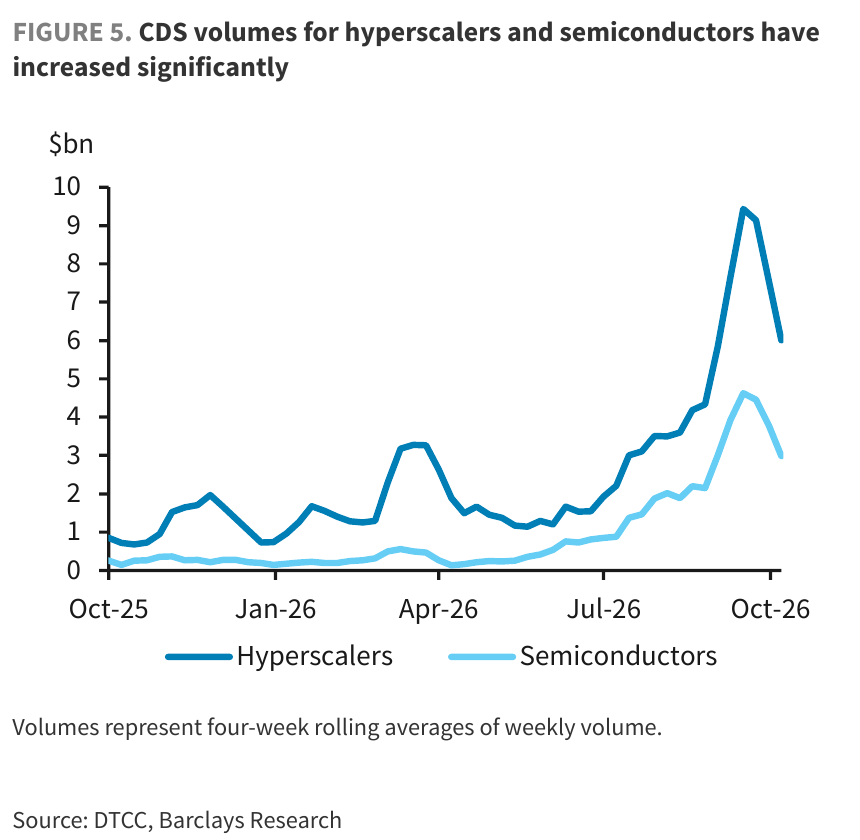
Open interest data likewise confirms the continued inflow of capital. For hyperscale cloud service providers, the notional value of net open interest has doubled from roughly $5 billion a year ago to $20 billion, while for chipmakers it has risen from about $1.9 billion to $8.6 billion.
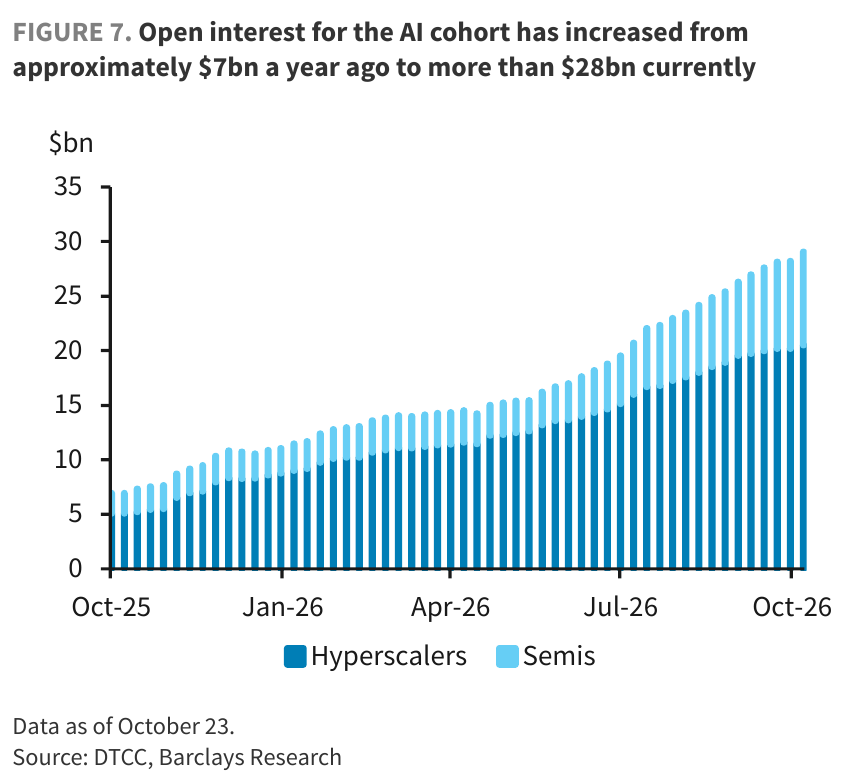
These 10 AI companies currently account for nearly 14% of all outstanding single-name CDS contracts in the Americas, significantly up from 4% a year ago.
Curve shapes are diverging, highlighting stock-specific differences in trading strategies.
By analyzing the spread between the 3-year and 5-year segments of the CDS curve, Barclays identified pricing anomalies at certain companies.
For example, Amazon's 5-year CDS spread is comparable to Google's (80–81 basis points), but Amazon's 3s5s curve (the 3-year–5-year yield spread) stands at only 18 basis points, appearing excessively flat.
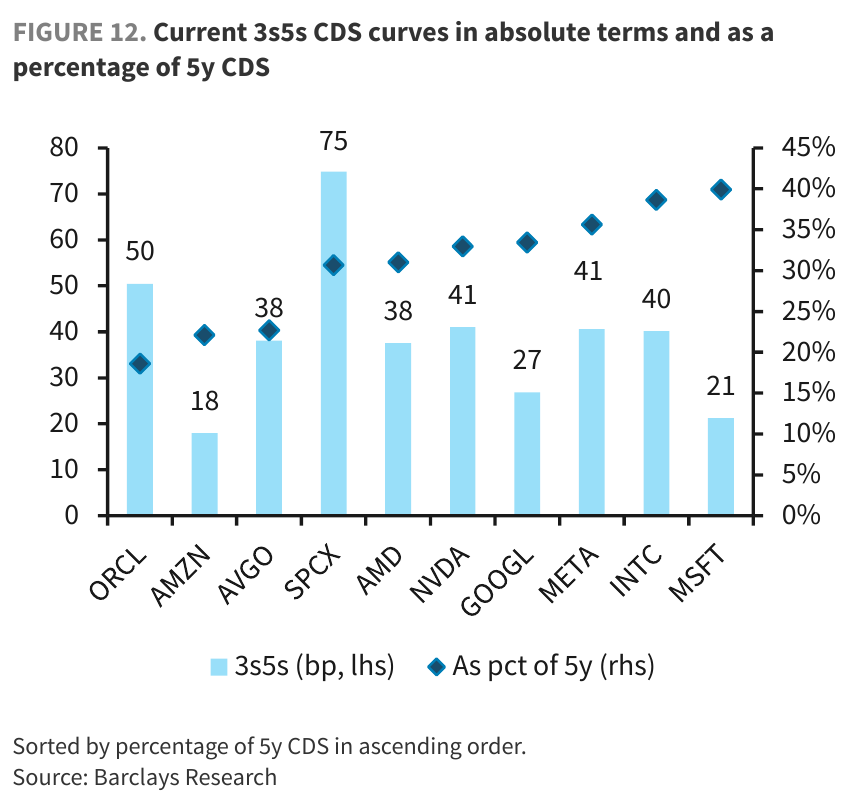
Barclays believes this may be related to the buying pressure caused by a term loan issued by Amazon in June, and recommends buying five-year protection on Amazon or constructing a steepening trade portfolio.
The financial report subsequently confirmed the necessity of hedging, as Amazon reported a third-quarter free cash flow burn of $33.5 billion and capital expenditures totaling $77.3 billion.
As the most liquid CDS underlying asset in the market, Oracle's basis is at a high level within the sample.
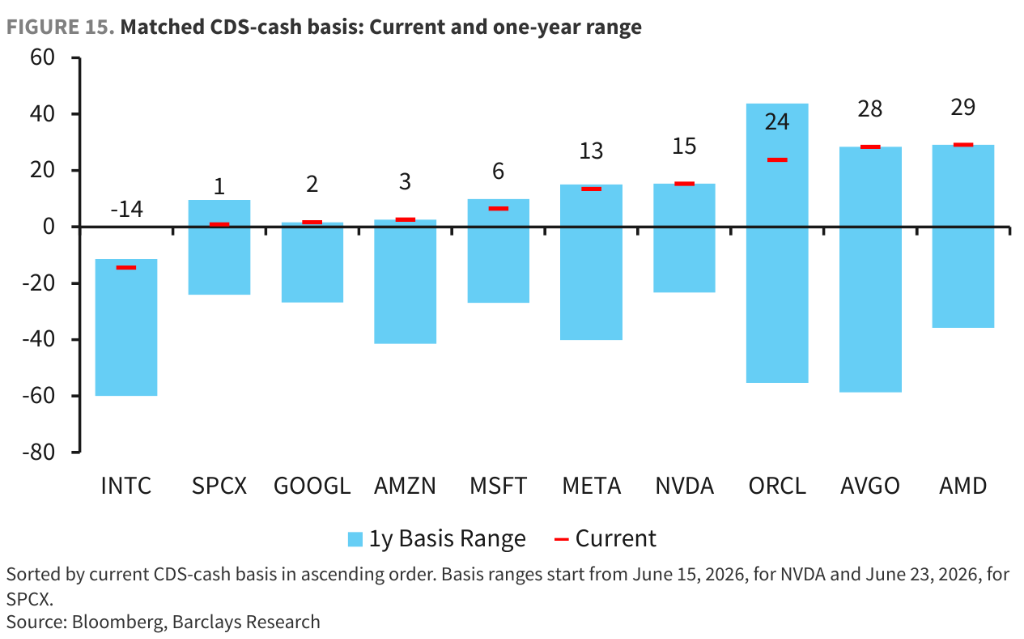
Barclays recommends selling the 5-year basis spread on Oracle, that is, shorting the bond maturing in 2032 while simultaneously selling CDS protection, in order to bet on the convergence of the basis. Earlier, Oracle announced that it would cap its additional financing over the next few years at US$20 billion.
In addition, Intel is the only company in the sample whose basis remains negative (-14 basis points) and whose yield curve is relatively steep, largely because it has not deeply engaged in its peers' supplier‑financing model. However, following the release of weak earnings guidance, its stock posted its largest single‑day decline since 1982.
A microcosm of the high-yield market: CoreWeave's default protection costs remain sky-high.
Outside the investment grade,$CoreWeave (CRWV.US)$As the only AI‑related company directly included in the CDX High Yield Index, CDS has become a unique lens for monitoring credit risks in the data center and next‑generation cloud services sectors.
Currently, CoreWeave's 5-year CDS has adopted a "points upfront" pricing structure, reaching 15.5 points—a pricing model typically used for distressed debt that underscores the market's heightened vigilance regarding its risks.
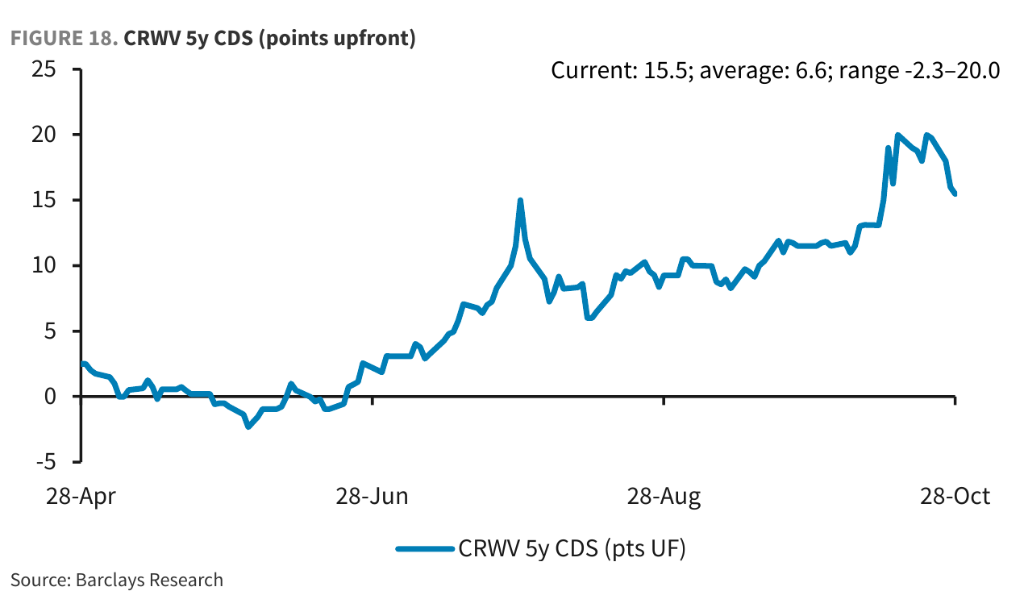
Data shows that CoreWeave's CDS weekly trading volume has risen from $32 million a year ago to $302 million, while open interest has increased to $850 million.
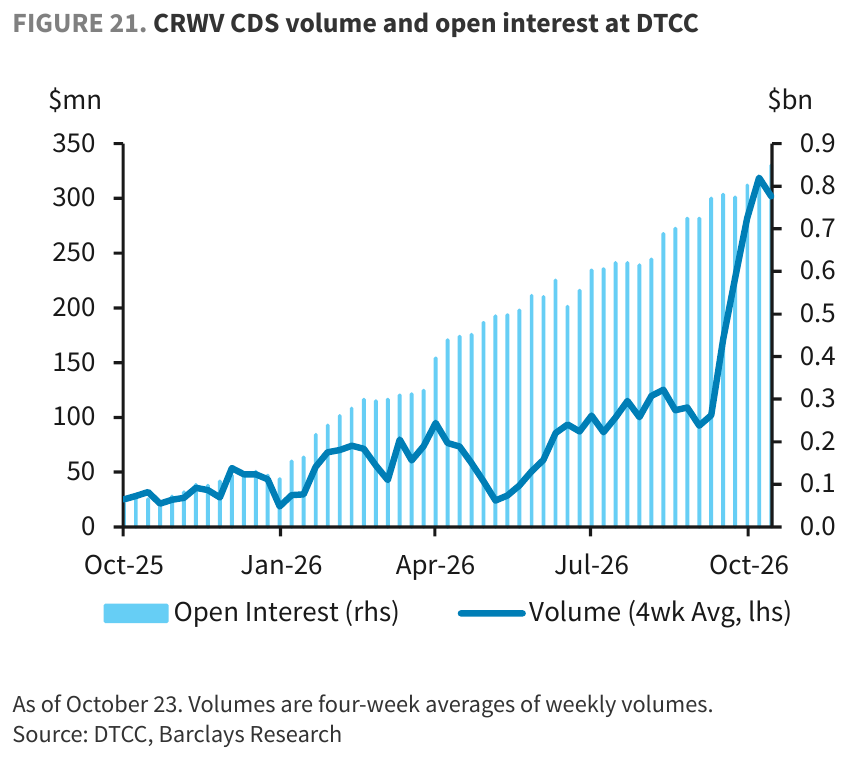
Despite analysts maintaining an "overweight" rating on CoreWeave bonds, the upfront cost of default protection as high as 15.5 basis points indicates that the CDS market is pricing in a more stringent assessment of the potential default risk associated with its business model.
Editor/Jeffy