
① Leapmotor has achieved monthly sales of 100,000 units for four consecutive months. ② Xpeng's monthly deliveries exceeded 50,000 for the first time, reaching a new all-time high. ③ Nio and Li Auto, meanwhile, remained around 30,000 units, both recording year-on-year declines.
On the morning of November 3, Hong Kong-listed new-energy vehicle stocks rose across the board.$XPENG-W (09868.HK)$Up over 5%,$LEAPMOTOR (09863.HK)$Up over 4%,$BYD COMPANY (01211.HK)$ 、 $LI AUTO-W (02015.HK)$Up more than 3%.
In early November, China's new EV makers successively released their October delivery figures. Leapmotor achieved monthly sales in the hundred-thousand-vehicle range for four consecutive months, Xpeng's single-month deliveries exceeded 50,000 units for the first time, hitting a record high, while Nio and Li Auto posted around 30,000 units each, both showing year-on-year declines.
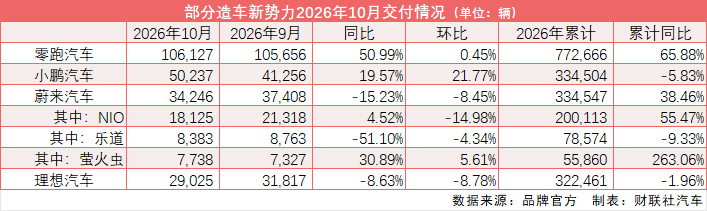
 In October, Leapmotor delivered 106,127 vehicles worldwide, a year-on-year increase of 50.99%. While continuing to lead the new‑car‑maker delivery rankings, it also ranks among the top three Chinese NEV brands and the top four globally.
As of the end of October 2026, Leapmotor has achieved cumulative global deliveries exceeding 1.9 million vehicles and is on track to roll off its 2-millionth vehicle in November. On October 16, Leapmotor's strategic partnership with the Stellantis Group reached a significant milestone: production of the Leapmotor B10 officially commenced at the Zaragoza plant in Spain. Leveraging Stellantis' manufacturing expertise, industrial know-how, and established European supply chain network, while capitalizing on Leapmotor's strengths in new‑energy vehicle technology, product development, and operational efficiency, the plant enables localized production of the Leapmotor B10.
In October, XPeng delivered 50,237 new vehicles, up 21.77% month-over-month and 19.57% year-over-year, marking a record-high monthly delivery volume. Among them, overseas deliveries reached 13,326 units, a year-on-year increase of 166%, also setting a new single-month record for the company's international market.
On the product front, XPeng's MONA L05 was officially launched in October, with a limited-time promotional price starting at RMB 139,800. After 5,000 nearly‑ready-to-deliver vehicles hit the market, they sold out within three minutes, and nationwide deliveries commenced on November 1. Over the two years since the MONA series' launch, cumulative deliveries have exceeded 360,000 units. Meanwhile, the XPeng GX has consistently ranked among the top performers in the large SUV segment priced above RMB 300,000; although its pricing in the Middle East remains undisclosed, it has already secured nearly 4,000 orders. "With four all‑new SUV models, including the GX and MONA L03, gradually rolling out, we expect fourth‑quarter sales to rise significantly, aiming to reach our monthly sales target of 60,000 vehicles," said He Xiaopeng, Chairman of XPeng Group, during the company's second‑quarter earnings call.
In October, Nio delivered 34,246 new vehicles, including 18,125 under the Nio brand, 8,383 under the Lantu brand, and 7,738 under the Firefly brand. From January to October, cumulative deliveries reached 334,547 units, up 38.5% year over year, marking a new all-time high. In the first three quarters, Nio's four large SUV models collectively delivered 188,800 units, capturing a 30.16% market share in the large SUV segment and an impressive 70.98% share in the pure‑electric large SUV category, firmly establishing its core position. However, under its multi‑brand strategy, Lantu and Firefly have yet to provide meaningful support to overall sales volume.
In October, Li Auto delivered 29,025 new vehicles, a year-on-year decline of 8.63%, marking the sixth consecutive monthly year-on-year drop and the second consecutive month of decline among the new EV makers that have disclosed their data, placing it toward the bottom of the rankings. Recently, Li Auto has launched several technological products, including the "Lianshan Battery." "Our long-term investment in technology is now translating into tangible product capabilities that both existing and new customers can feel," said Li Xiang, Chairman of Li Auto.
"The new-generation Li Auto MEGA has delivered over 3,000 units, ranking first in sales in the MPV segment above 500,000 yuan for two consecutive months. The 2026 model of the Li Auto i6 is equipped with the 'Lianshan Battery,' the Mach M100 chip, and more than twenty upgrades, with orders placed within 72 hours significantly surpassing last year's level at the same stage after launch," Li Xiang revealed. He added that the November OTA 9.2 update will begin rolling out, bringing the Mach VLA 2.5 and multiple cabin-agent upgrades.
BYD's Q3 2026 report shows that the company achieved operating revenue of RMB 566.304 billion in the first three quarters, essentially flat year over year. Quarterly performance was even more impressive: Q3 revenue reached RMB 221.488 billion, up 13.59% year over year; net profit attributable to parent company was RMB 10.020 billion, up 28.08%, accounting for nearly 45% of the total for the first three quarters, with net margin rebounding to 4.52%. China Merchants Securities International believes that the realization of profit margins in Q4 is key to assessing BYD's earnings trajectory next year.
Geely Auto is experiencing a simultaneous increase in volume, price, and profit. In the first three quarters, the company's total sales reached 2.235 million vehicles, up 3% year on year, setting a new record for the same period; total revenue was RMB 272.6 billion, up 13% year on year; excluding non-core gains and losses such as foreign exchange translation effects, core net profit attributable to owners of the parent was RMB 14.9 billion, up 41% year on year, with core net profit per vehicle rising 37% to RMB 6,664, and gross margin increasing to 18%. In the third quarter alone, revenue was RMB 99.0 billion and core net profit attributable to owners of the parent was RMB 5.21 billion, up 10% and 32% year on year, respectively.
Looking ahead to the fourth quarter, Cui Dongshu, secretary-general of the China Passenger Car Association, believes that leading automakers may see a turning point in profitability during this period. He also forecasts that domestic retail sales will reach approximately 18.5 million vehicles in 2026, with a potential bottoming out and recovery in 2027. Meanwhile, Chen Shihua, deputy secretary-general of the China Association of Automobile Manufacturers, stated that the 250 billion yuan fund for trade-in programs has been fully allocated, and, combined with local and corporate consumer‑stimulating initiatives, the decline in domestic sales is expected to narrow.
Looking at the broader industry picture, the auto market continued to show signs of a weak peak season in October. According to Cui Dongshu, the downturn in 2026 represents an "abnormal trough" caused by the combined impact of short-term factors such as policy fatigue, oil price shocks, and diminishing subsidy effects. As lithium carbonate prices fall and inventory reduction eases, the auto market is expected to bottom out and rebound in 2027.
Editor/rice