
OPEC+ has kept its December oil production target unchanged.
Zhitong Finance APP learned that seven member countries of the OPEC+ oil-producing group have agreed to keep their production quotas unchanged in December. Previously, these seven countries had completed the rollback of their last round of voluntary production cuts in September.
Although oil shipments through the Strait of Hormuz are recovering and Saudi Arabia's alternative export routes via the Red Sea also increased in October, OPEC+ member states in the Persian Gulf still face constraints in their ability to capitalize on higher production targets.
 Following the meeting held on Sunday, the December production targets for these seven countries are shown in the table below (in thousands of barrels per day), along with each country's actual output for September—the most recent month for which OPEC has published estimates based on secondary sources.
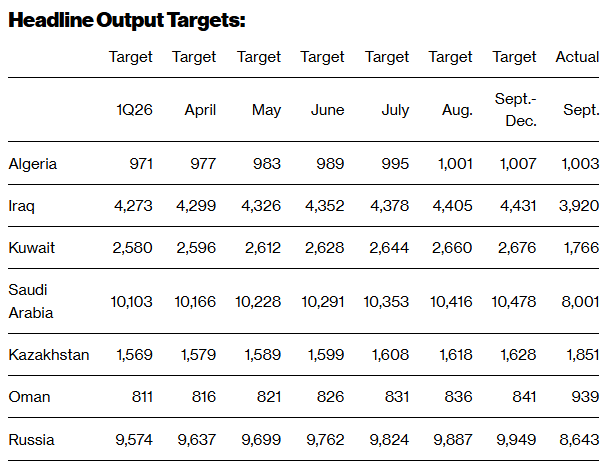
These seven countries will continue to hold monthly meetings to assess market conditions, with the next meeting scheduled for November 29—the same date as the OPEC+ full‑member meeting.
The table above does not reflect the additional production cuts undertaken by Kazakhstan and Oman to offset their previous overproduction. The most recent revision of these "compensatory cuts" was made on April 7, under which Kazakhstan's effective production quota was reduced by more than half, falling to just 710,000 b/d in May and 720,000 b/d in June. Oman's compensatory cuts were smaller, with its target lowered to 812,000 b/d in May and 806,000 b/d in June.
The deadline for compensating past overproduction has been extended to the end of the year, but as of now, no compensatory production cuts beyond June have been announced.
Oil price performance
On the trading day preceding this meeting—Friday, October 30—oil prices had just posted a sharp rally. The December Brent contract settled at $117.64 per barrel, up 2.40%, after touching $118 during the session, its highest level since April; the more actively traded January contract gained $2.63 to $113.43 per barrel. Meanwhile, the December WTI contract rose $2.12, or 2.08%, to $104.12 per barrel. Statistics show that over the week, WTI accumulated a 0.82% gain and Brent a 0.79% gain, marking the sixth consecutive weekly increase for both benchmarks.
Looking at the monthly picture, October saw a rare sharp rally in oil prices: WTI's front-month contract rose 15.15%, while Brent gained 13.63%. The upward momentum was attributed to geopolitical premiums, as traders braced for a potential escalation of hostilities involving Iran following the U.S. midterm elections. Meanwhile, Middle Eastern crude exports, supported by the Southern Oman route and escort services, climbed to 18.756 million barrels per day in September and held steady at 17.588 million b/d in October. However, the U.S. Strategic Petroleum Reserve had fallen to 283 million barrels by late October, narrowing its buffer capacity.
On the first trading day after the meeting—Monday, November 2—in early Asian trading, oil prices retreated. Brent crude fell by about 1.7% to around $111.60 per barrel.
What does this decision mean for oil prices?
The first layer is "no surprises." By keeping the quota within market expectations, it does not, in itself, generate any new price signals. Rystad Energy analyst Jorge Leon stated bluntly, "Today's decision was relatively straightforward," adding that it did not deliver any unexpected signals to the market. The real test will come at the full ministerial meeting on November 29, when the production framework for 2027 is set.
The second layer is the gap between paper‑based quotas and actual exportable volumes. This is illustrated by the quantitative implication that "the ability of Persian Gulf member states to utilize higher production targets remains constrained": according to the International Energy Agency's September report, in August the broader 18‑nation group collectively produced 27 million barrels per day, while its aggregate target stood at 34.27 million b/d, leaving a shortfall of over 7 million b/d; meanwhile, more than 10 million b/d of capacity in the Gulf region remains offline. On the OPEC+ side, secondary data show that in July total output was 24.3 million b/d, against a quota of 30.6 million b/d. As long as shipping through the Strait of Hormuz remains restricted, any adjustments to quotas will struggle to translate into an increase in physical supply—implying that short‑term price responsiveness to quota announcements is limited, with actual supply hinging on maritime traffic rather than conference outcomes.
The third layer involves the risk of oversupply and asymmetric pricing in 2027. The seven major oil‑producing countries completed their exit from the 1.65 million barrels per day voluntary production cut agreed in 2023 in September, while another round of cuts—covering most members and totaling roughly 2 million barrels per day—remains in place through the end of 2026. Before setting a baseline for 2027, member countries must first complete an assessment of their production capacity in the fourth quarter, with results expected by mid‑November. Agencies such as the International Energy Agency have warned that, should Gulf supply normalize, a supply glut could emerge in 2027. For crude oil, this poses an asymmetric risk: news of disruptions supports near‑term contango, whereas once normalization takes hold, geopolitical premiums will be pared back well before any surplus becomes evident in actual production data.
UBS Group strategist Giovanni Staunovo said that while traffic in the Middle East is improving, it has not yet fully normalized. According to Kpler data, as of September, crude oil flows through the region stood at about 44% of pre-war levels. In addition, Iran's Islamic Revolutionary Guard Corps stated on Sunday that two tankers had struck mines and exploded while transiting the strait without its authorization; this claim has not been independently verified.
Editor/Joe