
① When will the first batch of six national standards for humanoid robots be implemented, and which key technical dimensions do they cover? ② With institutions forecasting global shipments to exceed 100,000 units by 2027, how should we assess the pace of commercialization across the industry chain?
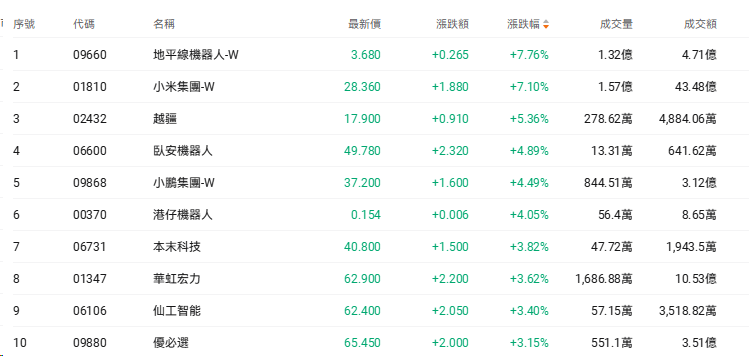
Benefiting from favorable policies, most Hong Kong‑listed robot‑related stocks have strengthened. As of press time,$HORIZONROBOT-W (09660.HK)$Up 7.76%,$DOBOT (02432.HK)$Up 5.36%,$ONEROBOTICS (06600.HK)$Up 4.89%.
On the news front, the Ministry of Industry and Information Technology and the Ministry of Finance recently officially released the draft standards for the first batch of domestically produced goods subject to government procurement, covering five product categories: reverse osmosis water treatment equipment, field-emission scanning electron microscopes, stationary multi‑joint industrial robots, and small and medium‑sized helicopters. This marks the first set of product‑specific standards to be publicly consulted since China clarified, in September 2025, the overarching eligibility criteria and supporting policies for government procurement of domestic products.
 Previously, the State Administration for Market Regulation officially released the first batch of six national standards for humanoid robots, which will come into force on April 1, 2027. This set of standards comprehensively covers six key areas: general requirements, environmental perception, decision-making and planning, motion control, task execution, and simulation testing.
Yuejiang ranks among the top performers.
Yuejiang posted strong performance, with its shares rising nearly 8% at one point during trading. The company played a key role in drafting two core standards—the "Technical Requirements for Humanoid Robots, Part 4: Motion Control" and the "Technical Requirements for Humanoid Robots, Part 5: Task Execution"—as part of the first batch of national standards for humanoid robots, focusing on standardizing whole-body coordination and precise task execution.
Currently, Yuejiang has established a comprehensive product portfolio spanning collaborative robots, bipedal humanoid robots, wheeled humanoid robots, and quadrupedal robotic dogs. To date, it has deployed over 100,000 robots worldwide, serving more than 100 Fortune Global 500 companies across 15 major industries and over 200 specific application scenarios. The company has cultivated more than 230 embodied‑intelligence customers, with numerous commercial partnerships now entering the stage of large‑scale, mass‑production deliveries.
The firm notes that Yuejiang is firmly advancing the practical application of Physical AI based on its "one brain, multiple bodies" technological architecture. As collaborative robots represent the most fundamental and mature physical platform for Physical AI, their continued penetration into high‑growth sectors such as automotive, new energy, 3C, and advanced equipment manufacturing is driving the company's revenue and gross profit to maintain a rapid growth trajectory.
How do institutions view the future of the robotics industry?
In its latest research report, the overseas firm Daiwa revised its outlook for humanoid robot shipments, adopting a more pragmatic pace. It now projects global shipments of 54,000 units in 2026 and 112,000 units in 2027, while noting that China will continue to be a key contributor to the global supply chain.
Yamato believes that, at present, AI algorithms for humanoid robots remain in the early stages of development, and in the short term, collecting real-world production‑line and environmental data continues to be the primary market demand. From the perspective of platform design and application scenarios, quadruped robotic dogs are gaining significant momentum, while companion robots are seeing rapidly expanding use cases. At this stage, commercial deployments are concentrated primarily in factory logistics, inspection, and entertainment, whereas caregiving and home‑based elderly companionship hold long‑term potential for broader adoption.
Editor/Joe