
Anthropic plans to raise up to $3.5 billion from Japanese investors through an initial public offering in the United States. This landmark stock offering by the AI startup will inject fresh momentum into a market that has seen few IPOs.
Zhitong Finance APP has learned that Anthropic, the strongest competitor to OpenAI and a global leader in AI applications, plans to raise up to $3.5 billion through an initial public offering (IPO) in the U.S., targeting investors in the Japanese market. At the same time, global demand for AI computing power continues to surge, yet the massive capital required to procure trillion-dollar‑scale AI computing resources and invest in AI infrastructure—coupled with soaring financing costs for new AI cloud companies like CoreWeave, and the fact that two major cloud giants—Alphabet, Google's parent company, and Amazon—have seen their AI‑related debt rise while their free cash flow has turned fully negative—has prompted the market to reassess the heavy financing burdens and extended cash recovery cycles faced by AI‑related tech firms.
AI computing power demand continues to expand robustly, but companies' ability to translate that demand into deliverables, profits, and free cash flow is becoming the basis for market re‑pricing. Google's parent company, Alphabet, saw its stock plunge nearly 13%—a record‑breaking rout—at the close of U.S. trading last Thursday, while U.S. CPU and chip‑manufacturing giant Intel posted its biggest single‑day drop in over four decades by Friday's close—both developments occurring at a time when the cash returns on AI investments are under closer scrutiny.
 The negative free cash flow pressure faced by Alphabet, Google's parent company, and Amazon, coupled with the growing financing needs of cloud giants such as Alphabet, Amazon, and Microsoft, is drawing greater market attention to the time lag between capital expenditures and cash recovery. Meanwhile, the robust growth of Google Cloud, Azure, and AWS is no longer sufficient on its own to sustain the lofty valuations of all AI‑related tech companies.
Against the backdrop of widening AI‑related credit spreads and mounting pressure on debt financing tied to AI computing power, Anthropic's expansion of subscription channels among Japanese investors is helping to substantially broaden its equity‑funding base, providing a cash buffer to support the company's ambitious plans to scale up AI‑computing capacity while significantly reducing its reliance on new U.S.-based debt issuance and broader dollar‑denominated financing.
Anthropic PBC plans to raise up to $3.5 billion from Japanese investors in its U.S. initial public offering, bringing this landmark stock offering by the AI startup to an Asian market where new‑issue activity has been scarce.
According to a regulatory filing submitted on Monday, Mizuho Securities will handle the Japanese portion of this stock offering, while Morgan Stanley, Mitsubishi UFJ Morgan Stanley Securities, and Morgan Stanley MUFG Securities will be responsible for processing investor subscriptions. Mizuho Financial Group and Mitsubishi UFJ Financial Group are also among the underwriters for this transaction.
This makes Japan one of the few markets where investors can directly participate in this mega‑IPO. Japan's new‑stock issuance activity has fallen to a 14‑year low. In addition to Japan, investors in Australia, Canada, and parts of Europe will also be able to take part in the initial public offering of the developer of the Claude AI chatbot.
Anthropic filed its highly anticipated IPO application last month, at a time when companies are racing to tap the stock market for funding. With Meta Platforms, the parent company of Facebook and Instagram, seeking to raise up to $95 billion through the issuance of common and preferred shares, and Alphabet, Google's parent company, planning equity financing of up to $85 billion, Anthropic's IPO will test investors' appetite for this wave of new AI-related IPOs.
Tech stocks face a cash-flow reassessment: As Anthropic heads to Japan to raise capital, AI financing costs are rising amid intensifying competition for investment.
As the foregoing illustrates, leading players in the global AI‑compute industry are simultaneously grappling with two forces: demand for AI‑compute infrastructure—driven by large AI models and cloud computing—continues to grow, yet the cash‑flow drain from compute procurement, infrastructure deployment, and capital expenditures is compelling investors to raise their return expectations.
Notably, Japan's fundraising is part of the international offering component of the U.S. IPO, rather than a separate listing in Japan; it will broaden the pool of potential investors, but whether it ultimately eases credit pressures will depend on the actual size of the offering, the proposed valuation, and the pace of capital expenditure. Reuters, citing filing documents, reported that proceeds from the Japanese offering will be used for working capital, operating expenses, and capital expenditures, though the filings have not yet disclosed the overall size or valuation of the IPO.
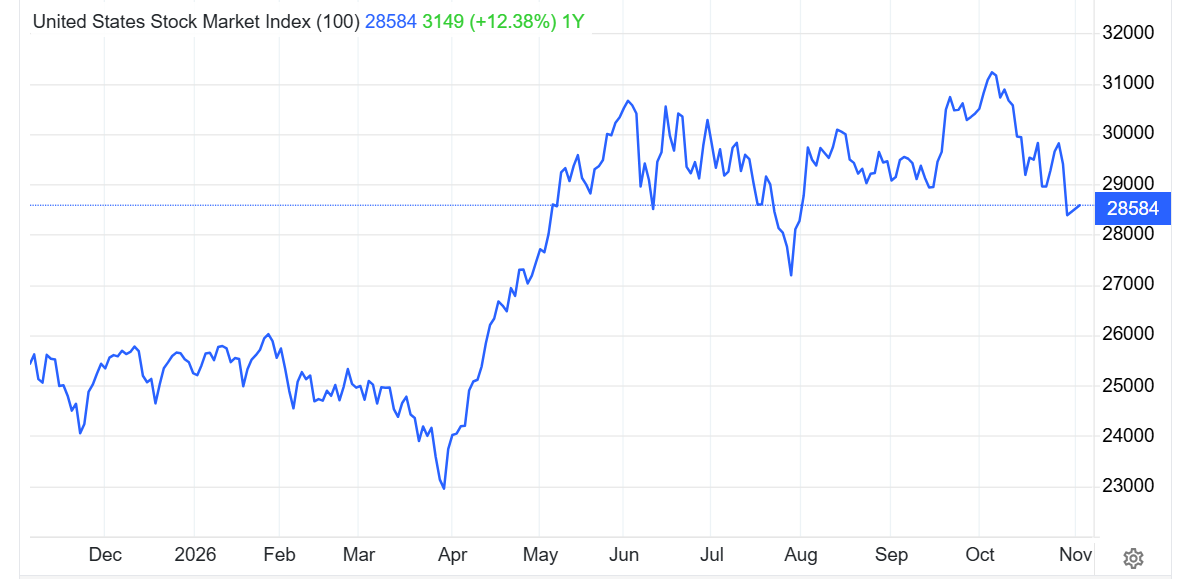
This financing arrangement comes amid a sharp global tech-stock correction, triggered by soaring AI‑related funding costs and the concurrent surge in debt‑service pressures and CDS spreads for AI‑focused cloud startups like CoreWeave, all set against the backdrop of negative cash flows at two major super‑cloud computing giants. On October 29 and 30, the Nasdaq 100 index fell 1.38% and 3.46%, respectively, with a cumulative decline of about 4.79%; the Philadelphia Semiconductor Index dropped 1.42% and 7.20%, respectively, for a total drop of roughly 8.52%. By the close of U.S. trading last Friday, the Nasdaq 100—often dubbed the "barometer of AI compute and tech stocks"—recorded its largest single‑day plunge since June 5, while the Philadelphia Semiconductor Index posted its most severe one‑day sell‑off since late June. Meanwhile, Intel tumbled about 28.6% on the day, marking its biggest single‑day decline in the daily data series dating back to 1980.
What the market is reassessing is how quickly robust revenue can be converted into cash returns after investment. Alphabet's third-quarter operating cash flow was $42.29 billion, below its capital expenditures of $51.36 billion, resulting in negative free cash flow of $9.07 billion; Amazon's AWS revenue grew 39% year over year, yet the group's free cash outflow over the past 12 months through the end of September reached $42.36 billion, even as its operating cash flow still increased by 29% during the same period. These figures indicate that capital spending exceeds current cash-generating capacity, though they do not directly prove that the cloud business itself is unprofitable. For newer cloud providers like CoreWeave, which rely more heavily on external financing, widening credit spreads may directly constrain expansion; for cloud giants with stronger cash-generating capabilities, the pressure manifests primarily as rising financing needs, longer investment payback periods, and higher discount rates in valuations.
US$3.5 billion may buy some breathing room for AI‑related financing, but in the long run, credit ratings and the trajectory of cash returns will determine the cost of scaling AI computing power.
Anthropic's expanded equity financing directly increases capital that does not require fixed interest payments, reducing its reliance on debt for certain future expenditures; however, being publicly listed does not automatically confer an investment-grade credit rating. Over the weekend, media outlets citing sources familiar with the matter reported that private-equity giant Blackstone has indicated to investors that, following its IPO, Anthropic may initially receive a higher‑tier speculative‑grade rating rather than the previously anticipated investment‑grade rating. It is worth noting that, at this stage, such media reports reflect only expected rating dynamics and do not equate to S&P, Moody's, or Fitch having formally designated Anthropic as "junk-rated." This distinction will inevitably affect funding sources: if the final rating falls below investment grade, certain insurance and pension funds face investment restrictions, and new financing typically requires higher credit compensation.
"Project North Star" revealed how this pressure is being passed upstream. Blackstone, along with Bank of America, Citi, and Morgan Stanley, announced that the $63 billion deal will involve a special-purpose vehicle (SPV) acquiring Broadcom‑led TPU/XPU AI accelerators and related high‑performance optical interconnect and networking infrastructure equipment, which will then be leased to Anthropic, with deliveries expected to begin in 2027.
Some media, citing sources familiar with the matter, reported that part of the senior financing is guaranteed by Broadcom, while the junior financing relies more directly on Anthropic's lease payments, indicating a clear credit hierarchy even within the same computing‑power project. Supplier guarantees can help secure project financing while aligning chip sales revenue more closely with customers' future payment capacity: the market no longer just tallies how many units are sold, but also assesses the contingent risks that suppliers assume to facilitate those sales.
This risk transfer is precisely the underlying mechanism driving the surge in AI‑related credit default swap (CDS) trading. According to a Barclays report dated October 29, the ten AI firms it tracks account for 8% of the constituents in the CDX Investment Grade Index yet contribute roughly 16% of the index's embedded credit spreads. Meanwhile, the four‑week average weekly trading volumes for hyperscale cloud providers and semiconductor companies stand at approximately $6 billion and $3 billion, respectively—up 740% and 1,900% year over year. As banks hedge their data‑center loans and investors hedge their equity and supplier exposures, demand for CDS protection is rising, potentially pushing CDS spreads above those of comparable cash bonds and generating positive basis. However, it is important to note that these CDS dynamics reflect both revaluations of credit risk and shifts in hedging supply and demand; therefore, the observed widening cannot yet be entirely attributed to a proportional increase in default probabilities.
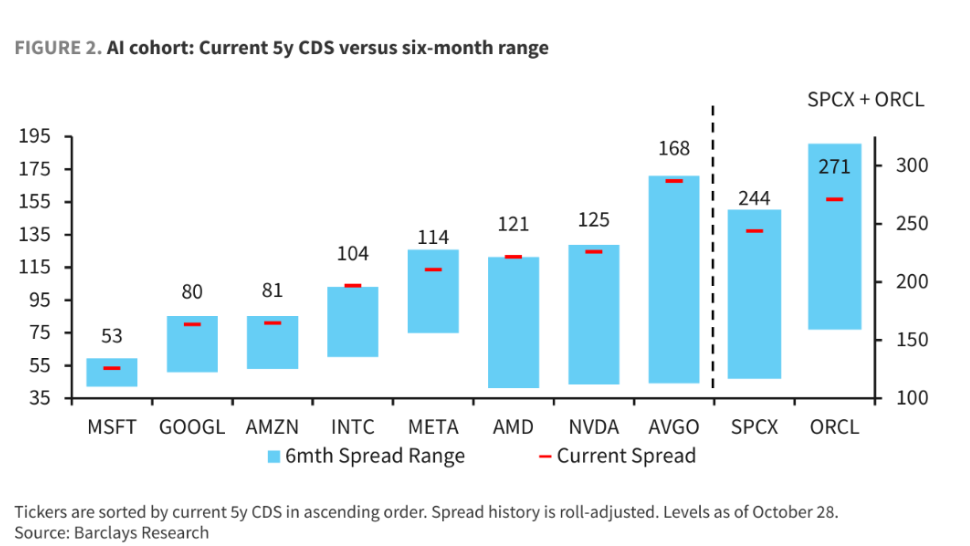
CoreWeave's five-year CDS, quoted at 15.5 points upfront, more vividly reflects the stratification of financing: it typically means paying $15.5 per $100 of notional principal in advance, while continuing to service the contractually agreed coupon—rather than implying a direct default probability of 15.5%. The similarity to 2008 lies in the divergence between derivative hedging needs and cash‑bond pricing; however, this alone is insufficient to demonstrate that a systemic crisis of comparable magnitude has yet materialized. As for Anthropic, the surge in AI agents driving multi‑step reasoning, tool invocation, and long‑context processing could further expand computing‑power demand, but financing commitments must be underpinned by actual usage volumes, unit‑service gross margins, and revenue‑collection capacity. Japan's $3.5 billion subscription cap can help broaden funding channels; what will truly determine the direction of the entire industry chain's revaluation is whether the pace of commercial cash inflows from models can fully keep up with the rhythms of cloud leasing, equipment depreciation, electricity costs, and financing payments.
Editor/Deng