When analysts proclaim, "High interest rates won't derail the AI boom," the echoes of history are unsettling—this narrative closely mirrors that of the 2000 dot-com bubble and the run-up to the 2008 financial crisis. Data is already sounding a silent alarm: tech giants such as Alphabet, Meta, and Microsoft have aggregate off-balance-sheet commitments totaling $4.11 trillion, surging by nearly $1 trillion in just 90 days; meanwhile, the Nasdaq-100 has seen its market capitalization evaporate by more than $1.2 trillion this month. Off-balance-sheet commitments don't vanish with stock prices—can AI commercial revenues catch up before the debt wave arrives?
As bond yields climb, analysts nonchalantly declare that "the AI boom is immune"—a textbook example of bubble logic. Throughout history, every major boom has ended with tightening financing conditions; and at the tail end of each bubble, markets invariably conjure up reasons to insist, "This time is different." Whether the AI frenzy can truly withstand high interest rates may already be quietly emerging in the data.
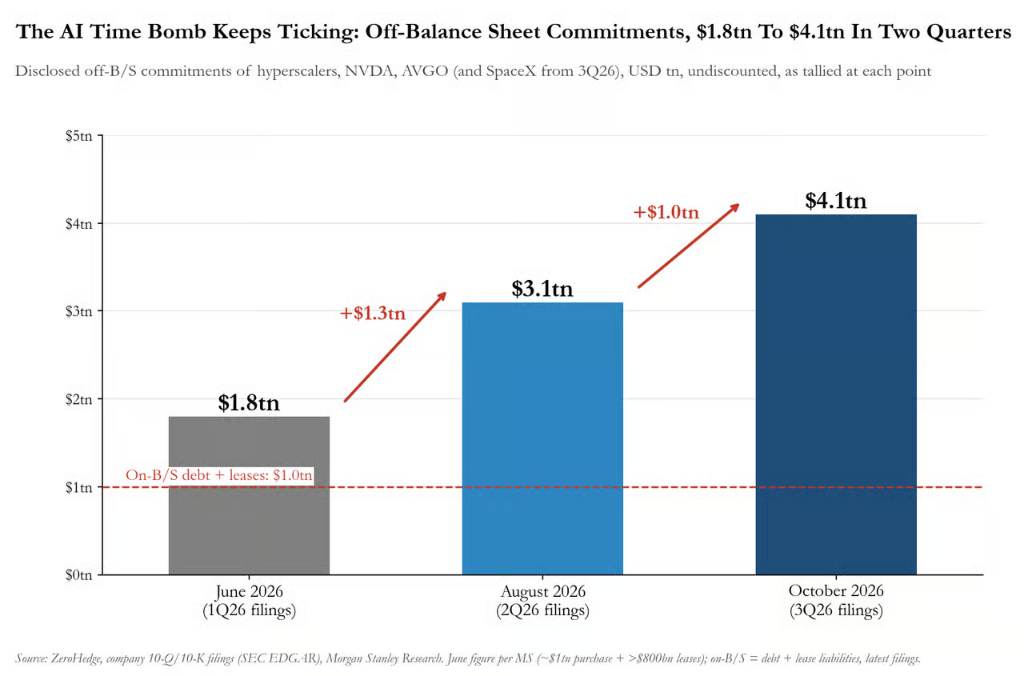
The ultra-large-scale cloud computing companies centered on Alphabet, Meta, Microsoft, and Amazon, along with Nvidia, Broadcom, and SpaceX, have disclosed off-balance-sheet commitments totaling $4.11 trillion—adding nearly $1 trillion in just about 90 days. Meanwhile, these companies' on-balance-sheet debt and lease liabilities combined amount to roughly $1 trillion, meaning that for every $1 of on-balance-sheet debt, there are more than $4 in commitments not yet reflected on the balance sheet. By contrast, the combined market capitalization of the Nasdaq 100 index constituents has evaporated by over $1.2 trillion this month.
 Off-balance-sheet commitments do not vanish with stock price fluctuations and must be honored upon maturity. The central question now is whether AI‑related commercial revenues can catch up before the next wave of such commitments emerges. Meanwhile, as the impact of high interest rates on AI subsectors becomes increasingly apparent, the market is shifting from euphoria to fragmentation, with capital allocation growing more cautious.
The typical narrative of the bubble's final stage: high interest rates "don't matter"
Ruchir Sharma, Chairman of Rockefeller International, points out that whenever bond yields rise, analysts invariably claim that the AI boom will remain immune—yet this is precisely the classic logic of a bubble: the cost of capital always matters, and there are compelling reasons to believe that this is truer now than ever before.
During the 2000 dot-com bubble, a popular myth held that "the sky‑high demand for internet products" had freed tech companies from the constraints of conventional economic forces like interest rates. On the eve of the 2008 financial crisis, analysts argued that "rising interest rates would not burst the bubble"—or at most would only slow, rather than reverse, the upward momentum in asset prices—because corporate earnings were at their "best level in 30 years."
Today, a similar argument has resurfaced in the name of AI: interest rates of just a few percentage points are negligible for companies that are generating record‑breaking value growth; and the Federal Reserve's rate hikes, measured in mere basis points, cannot curb the spending appetite of firms determined to win the AI arms race.
Sharma emphasized that the current interest-rate environment is only loosely comparable to that of the 1990s. Not only are rates at elevated levels, but they have also surged sharply in a short period following nearly 25 years of historically low rates—this abrupt shift in policy conditions alone is sufficient to generate financial stress. Early signs are already emerging: investors are demanding higher yields to finance weaker borrowers in AI‑related supply chains.
Off-balance-sheet commitments have expanded rapidly, with new additions exceeding US$570 billion in a single quarter.
The current surge in AI infrastructure investment is taking on a striking profile in the financial data.
According to the latest quarterly reports, the total scale of off-balance-sheet commitments disclosed by ultra-large cloud computing companies centered on Alphabet, Meta, Microsoft, and Amazon, as well as Nvidia, Broadcom, and SpaceX, has reached $4.11 trillion—up nearly $992 billion from Morgan Stanley's tally of $3.12 trillion at the end of August, meaning nearly $1 trillion in new commitments were added in roughly 90 days. If we also factor in the off-balance-sheet commitments that Morgan Stanley previously included based on news reports rather than formal financial disclosures, the total would climb to $4.29 trillion.
Opacity in accounting practices is triggering direct market reactions.
Analyst firm Needham noted that once off-balance-sheet liabilities are factored in, Meta's enterprise value would increase by 35%. Following the earnings release, Meta's credit default swaps surged to record highs, prompting the company to announce an equity‑raising plan totaling up to $95 billion—of which $37.5 billion has already been completed, with roughly $60 billion in at‑the‑market (ATM) offerings still pending. Amanda Lynam also observed that some companies have explicitly stated they need to lock in capital ahead of market saturation—a sentiment widely seen as a direct response to Meta's equity‑raising effort and likely not the last such move.
Morgan Stanley warned in August that these commitments hold "strategic value" during periods when computing power supply is constrained, but "if supply and demand normalize sooner than expected, companies will have to pay for excess capacity or attempt to renegotiate contract terms." Alphabet's stock suffered a record single-day plunge this month, Amazon continued to decline, and the Nasdaq 100 index constituents collectively lost more than $1.2 trillion in market capitalization this month.
Sharma's assessment is succinct and straightforward: AI‑related debt issuance is projected to exceed $600 billion by 2026, a tenfold increase from 2024; moreover, every major boom over the past three centuries has ultimately ended with a tightening of financial conditions. This technological surge—perhaps the most transformative in history—may likewise prove unable to withstand the pull of high capital costs.
Editor/Deng