
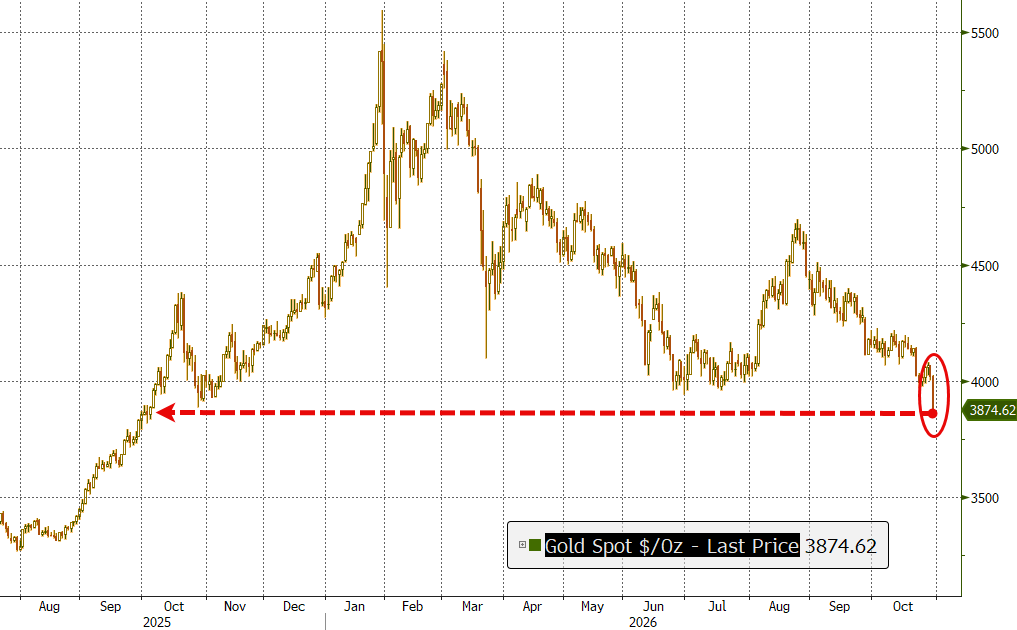
Spot gold has fallen below $3,900 per ounce, hitting a more than one-year low. According to a Kitco survey, bearish sentiment dominates on Wall Street, with 63% of analysts expecting further declines, while retail investors remain 53% bullish. Market attention is focused on the U.S. midterm elections and nonfarm payrolls data; gold prices may continue to adjust in the short term, with a shift toward looser monetary policy remaining the key to a rebound.
The gold market has recently experienced sharp volatility. Under the combined pressure of the Federal Reserve's hawkish stance, robust economic data, and a sell-off in tech stocks, gold prices plunged more than 3.7% over the week, hitting a low of $3,870—the lowest level in over a year.
According to Kitco News' latest weekly gold survey, among the 16 Wall Street analysts surveyed this week, only one—representing 6%—is bullish on the outlook, while 63% expect gold prices to continue declining and another 31% anticipate a period of sideways trading.
 Meanwhile, in an online survey of 184 retail investors, 53% remain bullish on gold prices for the coming week, with the proportion of bulls significantly higher than that among institutional investors. The domestic market echoes this divergence: at Caibai's flagship store, all gold bars under 30 grams have sold out, while gold‑centric hubs such as Shuibei in Zhengzhou and Shenzhen are packed with shoppers, many rushing in to "catch the dip."
Goldman Sachs' commodity team's latest analysis reveals the underlying logic behind this round of unusual selling: the driving force is not hedge funds, but sovereign entities forced to liquidate their gold reserves to meet liquidity needs. Since September 22, the market has cumulatively unwound $19.5 billion in gold futures positions, at a pace far outstripping central banks' monthly buying rate of 85 tonnes. As of press time, the spot gold price stood at $3,875.05 per ounce, down 3.74% for the week.
Amid multiple negative factors, gold prices fell below two key integer levels in a single week.
Gold opened the week on a relatively steady note. Spot gold settled at $3,994.95 per ounce Sunday evening, edging higher early in the week on bargain‑hunting buying. On Tuesday, aided by falling U.S. Treasury yields and a weaker dollar, it briefly reclaimed the $4,050 level and, ahead of the Federal Reserve's interest‑rate decision on Wednesday, climbed to a weekly high of $4,082.50.
However, the Federal Reserve voted 10–2 to keep the target range for the federal funds rate unchanged at 3.75%–4.00—though the two dissenters favored another 25-basis-point hike—sending a hawkish signal that briefly capped the rebound. On Thursday, better-than-expected U.S. third-quarter GDP data and elevated core PCE inflation further bolstered market expectations of a more aggressive tightening of monetary policy, putting gold under renewed pressure and pushing it back toward the $4,000 level.
On Friday, technology stocks plunged as doubts emerged over the return on investment in artificial intelligence, triggering a wave of forced liquidations across asset classes and prompting a sell-off in gold and silver. Gold prices consecutively fell below the key psychological thresholds of $4,000 and $3,900, hitting a low of $3,870.25—the lowest level in more than a year—and posting a weekly decline of 3.74%.
Sovereign entities are being forced to sell, while central banks are struggling to keep pace with the buying.
Goldman Sachs analyst Robert Quinn pointed out that the main drivers of this round of selling came from the "other" category and the unreportable category, which together accounted for about 95% of total sales—far from the hedge funds typically blamed. Market participants believe that sovereign entities, in order to meet liquidity needs, are dumping gold—the most liquid reserve asset—regardless of price.
This has created a structural dilemma: central banks, acting as "price‑insensitive" structural buyers, continue to enter the market, yet their pace of purchases falls far short of the current rate of selling. In effect, "price‑insensitive" buyers are facing off against equally "price‑insensitive" sellers. Over the past five weeks, $19.5 billion in sell orders has been dumped onto the market—far outpacing the central banks' monthly capacity to absorb 85 tonnes.
Goldman Sachs also noted that on Friday, CME trading volume surged 80% from the previous day, with GLD ETF recording about $4 billion in single-day trading, ranking seventh among all market ETFs for the day. Put sentiment in the options market has risen to an 85th percentile high in a year, and the market is actively positioning for further downside protection. Goldman Sachs warns that $3,850 could become the next line of defense, with positions not yet fully unwound and downside risks still uneliminated.
From a full-year perspective, gold prices have erased much of their earlier gains. At the start of 2026, gold was trading around $4,318 per ounce; on January 29, it briefly hit a record high of $5,598 per ounce, but has since retraced roughly 30% from that year-to-date peak.
Wall Street is collectively bearish, with technical and fundamental factors in sync.
Professional pessimism was fully voiced this week.
FxPro's senior market analyst, Alex Kuptsikevich, notes that gold prices have been on a downtrend for nearly two and a half months, steadily forming an almost perfect resistance line that has progressively pushed lower the local highs. He points out that, over the entire upward move from the four-year low to this year's peak in January–February, gold has retraced 61.8%, hitting the lower boundary of a classic pullback. At the same time, he cautions that this latest decline, accompanied by a broad sell-off in equities, reflects a margin‑call‑driven liquidation typical of risk‑aversion episodes, with markets at this stage largely ignoring price levels as they work to bring positions back to normal levels. Kuptsikevich maintains his original forecast from earlier this year, predicting that gold could fall to $3,300 per ounce.
Marc Chandler, Managing Director at Bannockburn Global Forex, said that gold prices recently approached $4,700 in late August, and the current downward trend indicates that "gold's luster has faded." He noted that gold is now trading below the lower Bollinger Band—more than two standard deviations below the 20-day moving average—but a full-fledged capitulation sell-off has yet to materialize. Should prices fall further to new year-to-date lows, he believes gold could dip into the $3,750–$3,850 range.
Daniel Pavilonis, a senior commodities broker at StoneX Group, warns that this correction could prove deeper and more prolonged than most expect. "From a purely technical standpoint, the chart patterns are not encouraging, and without any fundamental support, prices could fall further," he told Kitco News. He forecasts silver may dip into the upper $30s, while gold could even slide toward $3,000, with the timing likely around the first quarter of 2027. Pavilonis draws parallels between the current market and the burst of the precious‑metal bubble in the early 1980s, noting a recurring pattern of sharp corrections following cyclical peaks, and advises long‑position holders to begin hedging risk using collar strategies.
Neil Welsh, head of metals at Britannia Global Markets, focuses on policy signals. He believes that the Federal Reserve's mere pause in rate hikes will not be enough to boost gold prices; the market needs clear evidence of a genuine shift in policy direction—particularly a substantial deterioration in the labor market. He notes that next Friday's nonfarm payrolls report will be a crucial test: if the data come in weak, accompanied by slower wage growth, a rising unemployment rate, or downward revisions to prior figures, it could materially temper expectations for a December rate hike, creating a more favorable macroeconomic backdrop for gold.
Retail investors are buying the dip against the trend, and domestic gold shops are seeing a surge of customers.
In stark contrast to the bearish consensus on Wall Street, domestic retail investors are viewing this downturn as a rare buying opportunity.
According to reports, at noon on November 1, the investment gold bar counter at Beijing's Caibai flagship store was crowded, with electronic displays showing a base price of 840 yuan per gram. All small‑weight investment gold bars under 30 grams had sold out, yet customers continued to inquire whether restocks were planned for the day, and some even purchased 100‑gram investment gold bars on the spot. Our reporter observed that many consumers opted to enter in batches, with purchase prices ranging from 837 to 866 yuan per gram.
According to a report by Elephant News, Shenzhen's Shuibei Market saw foot traffic surge to 60,000 this weekend. Similarly, venues such as Zhengzhou's Jinduoyin Jewelry Plaza and Zhongyuan Jewelry City experienced pronounced peaks in visitor numbers. Some merchants noted that today's gold price stands at around 860 yuan per gram, roughly 250 yuan per gram lower than a month ago.
Beyond investment demand, spending on weddings and holiday gifts is heating up in tandem. Some consumers say they're taking advantage of falling prices to stock up on New Year's gifts ahead of time, while soon-to-be newlyweds admit, "We're here to cut our losses." Compared with the purchase price earlier this year—over 1,000 yuan per gram—they've now managed to recoup some of their investment.
Industry insiders caution that, because gold jewelry carries markups such as craftsmanship fees, it is typically redeemed at the prevailing spot price of gold bullion—so it should not be treated as a speculative investment. Moreover, since no institution can reliably predict turning points in gold prices, consumers with genuine demand are advised to accumulate in stages, while investors are encouraged to diversify their holdings and avoid heavy, one‑time positions.
Key events this week: Midterm elections and non-farm payrolls will set the tone.
The market is about to enter a busy event-driven window. This week's two most closely watched events are the U.S. midterm elections and the October nonfarm payrolls report.
On Tuesday, JOLTS job openings data will be released, coinciding with the midterm elections; on Wednesday, look for ADP private-sector employment and the ISM Services PMI; on Thursday, attention turns to the Bank of England's monetary policy decision and the weekly initial jobless claims; and on Friday, the spotlight falls on October nonfarm payrolls and the University of Michigan's preliminary consumer confidence reading.
Looking ahead, independent precious metals analyst Jesse Colombo is also keeping an eye on geopolitical risks this weekend. He notes market concerns about a potential escalation in U.S.-Iran tensions, suggesting that some selling may reflect a "sell first, ask questions later" risk-off dynamic. He points out that if gold closes decisively below $3,900 on strong volume, the next key support level would lie near $3,500—but he stresses that this is merely a technical reference point, not a baseline forecast.
Colin Cieszynski, Chief Market Strategist at SIA Wealth Management, outright labeled this week's trend as bearish, arguing that a break below $4,000 would carry significant technical implications. Rich Checkan, President of Asset Strategies International, adopted a more neutral stance, noting that Middle Eastern tensions and the outcome of the midterm elections are offsetting each other. At the same time, he added, "Every dip in gold prices should be viewed as an opportunity to buy on weakness."
Editor/lambor