Trump tends to give diplomatic mediation with Iran more time and delay launching a new round of military action; Iran says that if the Trump administration accepts its conditions, the "seven-day plan" could be implemented within two days. International oil prices fell sharply on Monday, with Brent crude futures plunging 6.24% to around $106 per barrel; WTI futures dropped 6.42% to $97 per barrel.
International crude oil futures tumbled sharply on Monday,$Brent Last Day Financial Futures (JAN7) (BZmain.US)$Falling to around $108 per barrel,$Crude Oil Futures (DEC6) (CLmain.US)$Oil prices fell below the $100 mark as market expectations for diplomatic progress between the U.S. and Iran rose, unwinding some of the geopolitical risk premium that had built up over the past few weeks amid ongoing tensions in the Strait of Hormuz.
According to CCTV News, on November 2 local time, Iranian President Pezeshkian stated that the government is working to resolve issues through dialogue and that, in this regard, Iran's Supreme Leader has also granted the government certain powers.
 According to Axios, Trump is inclined to give diplomatic mediation with Iran more time and postpone launching a new round of military action. According to CCTV News, on October 31, Trump had a "direct and sharp" phone call with Israeli Prime Minister Netanyahu regarding U.S.-Iran negotiations. Sources said Netanyahu urged Trump to "immediately resume war against Iran" after the U.S. midterm elections on November 3, and expressed concern over the ongoing U.S.-Iran talks mediated by Qatar. At this stage, Trump hopes to "let the negotiations fully unfold" and does not want Israel to interfere with the negotiation process. Reportedly, if the talks fail, Trump's stance could undergo a "significant change."
In response, according to CCTV International News, Iranian Foreign Ministry spokesperson Baghaei stated today (November 2) that the secretary of Iran's Supreme National Security Council will decide how and in what manner to respond to the U.S. letter, based on national interests.
Baghaei also stated that the primary basis for all indirect negotiations between Iran and the United States, conducted through mediators, is Iran's "Seven-Day Plan," which has now been streamlined to allow for full implementation within two days. This temporal flexibility demonstrates Iran's goodwill and constructive stance. The plan's execution, the commencement of negotiations, and the restoration of security in the Strait of Hormuz depend entirely on the decisions, conduct, and concrete actions of the U.S. side.
Although diplomatic signals have eased market sentiment, analysts warn that the global oil supply buffer is shrinking rapidly, leaving limited room for oil prices to fall.
Diplomatic signals prompt a pullback in oil prices.
Brent crude fell about 2.8% on Monday to around $110 per barrel, while WTI dropped about 3.3% to $100.67 per barrel, after all of Brent's gains from Friday had been erased before the U.S. market opened.
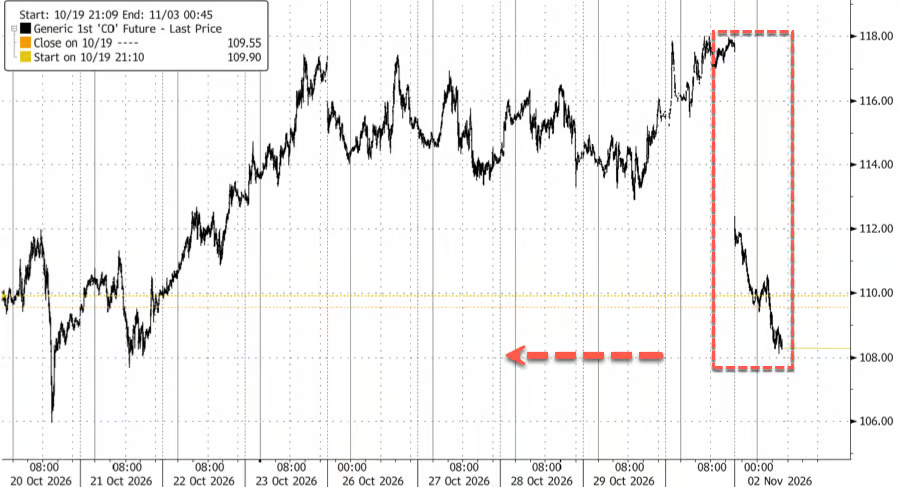
UBS Group market analyst Nana Antiedu wrote in a briefing, "As expectations for diplomatic progress heat up, the geopolitical premium embedded in the October crude oil rally has eased." He noted that Iranian and Qatari officials have held talks for three consecutive days on ending conflicts with the United States and Israel.
U.S. Secretary of State Marco Rubio said on Saturday that no decision has yet been made on whether to launch a new round of strikes against Iran, adding that Trump prefers to resolve the issue through diplomatic channels. Other reports indicate that Trump has conveyed to Israeli Prime Minister Benjamin Netanyahu his desire to engage in diplomatic outreach with Iran.
Iran sets conditions for reopening the strait.
According to China Central Television, on November 1 local time, Iranian Foreign Minister Araghchi said in a media interview that the Iranian delegation's visit to Qatar is a continuation of ongoing communications between Iran and mediators such as Qatar and Pakistan. The proposal currently on the table is broadly similar to Iran's earlier "Seven-Day Plan." That plan set out conditions for Iran to open the Strait of Hormuz, stipulating that the strait would be reopened on the sixth day if Iran's conditions were met, and that U.S.-Iran negotiations would resume on the seventh day. Mediators including Qatar and Pakistan have also held multiple consultations and discussions on this issue and have put forward proposals that are more feasible and actionable than Iran's "Seven-Day Plan."
Iranian Foreign Ministry spokesperson Baqaei stated that Tehran is continuing to exchange information with the U.S. side through intermediaries, emphasizing that "everything depends" on whether the U.S. side accepts Iran's demands. "Only under this precondition can we discuss arrangements for the next phase."
Baqaei said:
"If Iran's demands are met, it will be possible to restore security and order in the Strait of Hormuz in the short term and restart the negotiation process."
However, analysts caution that the diplomatic situation is rapidly evolving, and these signals are not sufficient to support an optimistic assessment of de-escalation.
Supply buffers are being depleted rapidly, and fundamentals remain fragile.
While diplomatic expectations have helped push oil prices lower, pressure on global oil supply has not eased. According to Reuters, Sultan Al Jaber, CEO of the Abu Dhabi National Oil Company (ADNOC), said that since shipping through the Strait of Hormuz was disrupted, global oil inventories have fallen by nearly one billion barrels. Diesel stocks in some markets have dropped to 35-year seasonal lows, while the share of shipping and logistics costs in the price of a barrel of crude has surged from around 5% to 30%.
June Goh, a senior oil market analyst at the commodity research firm Sparta Commodities, noted that diesel is the refined product with the tightest supply-demand balance as the Northern Hemisphere heads into winter. She also pointed out that most of the world's spare refining capacity is concentrated in China, and Chinese authorities' ongoing controls on refined-product exports further limit the global flexibility to adjust diesel supplies.
Goldman Sachs analysts had previously raised their December forecast for Brent crude to $105 per barrel and projected an average price of $88 for the entire next year. In its report, Goldman Sachs noted:
"The situation in the Middle East, the Russia-Ukraine conflict, and broader geopolitical fragmentation together pose a significant risk of supply disruptions."
Editor/lambor