
Bernstein has outlined three main themes for China's AI investment opportunities: domestic DRAM, MRDIMM, NPO, and AI SuperPod are driving upgrades to the hardware supply chain; an engineer dividend and advantages in the local supply chain are helping Chinese industrial firms move from domestic substitution to globalization; and AI is further penetrating intelligent driving, drug discovery, consumer goods, and asset management, with competition for control over data and workflow interfaces. The report particularly favors 12 companies, including Tencent, Alibaba, CXMT, CATL, and BYD, with the core focus on identifying firms that can translate AI into tangible profit advantages.
The investment rationale for China's AI industry is shifting from technological innovation to commercial implementation.
Bernstein's latest in-depth report on the Chinese market, "China Next Winners: From AI to Alpha," released on October 27, notes that opportunities in China's AI sector are expanding from large models and computing infrastructure to the broader real economy. Improving capabilities of domestically developed models and declining inference costs, coupled with a relatively abundant and affordable electricity supply, as well as a rapidly growing local semiconductor and server industry chain, are laying the groundwork for AI applications in China.
 Bernstein believes that the next wave of Chinese AI winners may not necessarily be the companies with the strongest model capabilities, but rather those that can leverage proprietary data, economies of scale, infrastructure, low costs, and distribution channels to translate AI into sustainable competitive advantages.
This means that the core issue in AI investment is shifting: the market should no longer focus solely on who is building computing power or training models, but also on who can leverage AI to boost productivity, enhance operational performance, and ultimately translate technological advantages into profit growth.
AI investment is spreading from computing infrastructure to industrial applications.
Bernstein believes that China has entered a phase of large-scale AI deployment and possesses several interconnected advantages.
First, domestic AI models continue to improve in capability while maintaining relatively low inference costs. Second, China's ample and cost-effective electricity supply supports the expansion of computing infrastructure. At the same time, the domestic ecosystem for semiconductors, storage, networking equipment, and servers is rapidly advancing.
Although China remains subject to restrictions on certain advanced chip technologies, a domestic industrial chain is emerging to establish a new technology supply system. The report specifically highlights developments in domestically produced DRAM, AI SuperPods, and optical interconnect technologies, noting that these areas are generating new opportunities within the industry chain.
However, Bernstein's assessment does not stop at the data center. As AI expands from model training to inference and agent-based applications, its impact is spreading into industrial manufacturing, transportation, consumer services, and the financial sector.
The report argues that the real question is whether AI can translate its technological capabilities into tangible economic value.
Domestic Storage, Memory Interface Chips, and Optical Interconnects: AI Hardware Demand Is Evolving
In the technology hardware sector, Bernstein focuses on domestic storage chips, memory interface chips, and optical interconnect technologies.
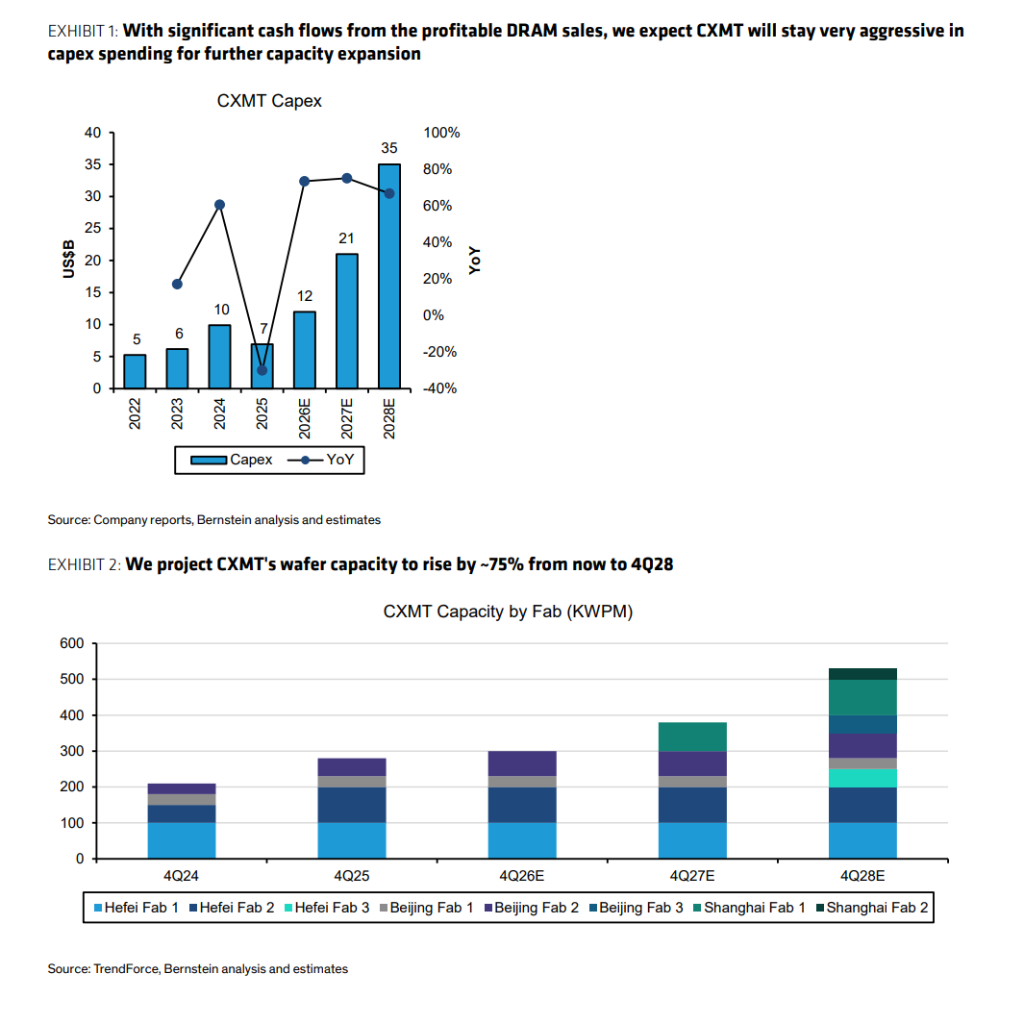
In the domestic DRAM sector, ChangXin Memory's capacity expansion and technological advancements are worth watching.
Bernstein forecasts that ChangXin Memory's monthly wafer capacity could reach 530,000 by the end of 2028, surpassing Micron. Its global DRAM market share is expected to rise from 9%–10% in 2026 to 12%–13% in 2028.
In the memory interface chip sector, Bernstein believes that AI agents could unlock new growth opportunities.
As AI applications evolve from single-turn question answering to multi-step task execution, systems must handle larger amounts of contextual information, retrieval results, and working memory, making memory bandwidth increasingly critical.
The report is particularly optimistic about the development of MRDIMM technology. Bernstein forecasts that by 2030, MRDIMM will account for approximately 25% of global server DIMM shipments, and MRCD- and MDB-related products will contribute roughly 73% of the memory interface chip market size at that time.
This shift means that competition in AI infrastructure is no longer solely about GPU computing power; memory systems could also become a new performance bottleneck and an investment opportunity.
In the realm of optical interconnects, NPO and AI SuperPod are another focus of the report.
Bernstein believes that as AI cluster sizes grow, the efficiency of data transfer between chips becomes increasingly critical, and technologies such as near-package optics (NPO) are expected to drive the development of optical components, switches, and related hardware supply chains.
The development of domestically produced computing power systems will also generate demand for ABF substrates, switches, complete servers, and ODM manufacturers.
Another bottleneck for AI: electricity and energy infrastructure
The expansion of computing power is inseparable from electricity supply. Bernstein argues that as data centers' electricity demand grows, power grids, energy storage systems, and power conversion equipment will become key components of the AI industry chain.
The report projects that from 2026 to 2030, investment in China's power grid will exceed RMB 5 trillion. At the same time, data centers' demands for reliable power supply and renewable energy integration will also drive the deployment of energy storage systems.
China's scale advantages in the battery industry chain underpin this trend. According to Bernstein data, by 2025 China will account for roughly 80% of the global lithium-ion battery market, with battery manufacturing capacity exceeding 3,000 GWh—more than four times the combined total of all other regions.
Among the relevant companies, Bernstein is particularly bullish on CATL and Sungrow Power.
CATL, with its battery technology and grid-scale energy storage system deployment, is poised to benefit from the growing demand for energy storage; Sungrow, meanwhile, is leveraging inverters, energy storage systems, renewable energy grid integration, and grid infrastructure to seize industry opportunities driven by AI-powered electricity demand.
Notably, Bernstein expects that the significant acceleration in electricity demand from China's AI data centers is likely to occur more prominently over the next decade. By 2035, data center electricity consumption is projected to account for approximately 10% of China's total electricity demand, compared with an estimated 16% in the United States.
China's Manufacturing Sector: From Domestic Substitution to Global Competition
Bernstein believes that Chinese industrial enterprises are entering a new stage of development: in some sectors, the focus has shifted from import substitution in the domestic market to competing in the global marketplace.
The core strengths underpinning this shift lie in the depth of China's engineering talent and its domestic supply chain. Particularly in emerging technology sectors, where R&D engineers constitute a significant portion of costs, Chinese companies can leverage their engineering resources and supply-chain synergies to build a competitive edge.
However, the pace of globalization varies across different industrial sectors.
In emerging sectors such as commercial robots, humanoid robots, and robotic vision systems, Chinese companies have the opportunity to establish technological and market advantages early in the industry's development. Meanwhile, traditional industrial equipment—such as machine tools, injection molding machines, and laser equipment—must first achieve domestic substitution at the mid- to high-end levels before they can further expand into overseas markets.
Industrial automation components and industrial robots may undergo a more gradual globalization process due to the complex customer validation and system integration involved.
The report also notes that, for some Chinese industrial enterprises, gross profit margins on overseas operations exceed those in the domestic market by 3 to 23 percentage points, highlighting the profitability potential of foreign markets.
In the field of humanoid robotics, Bernstein has put forward a noteworthy observation: the market may be overestimating the importance of harmonic drives.
The report argues that harmonic drives are not essential components for humanoid robots, and that robot manufacturers may, in the future, choose among different technological solutions—such as harmonic and planetary gear reducers—based on factors including cost, durability, torque density, precision, and weight.
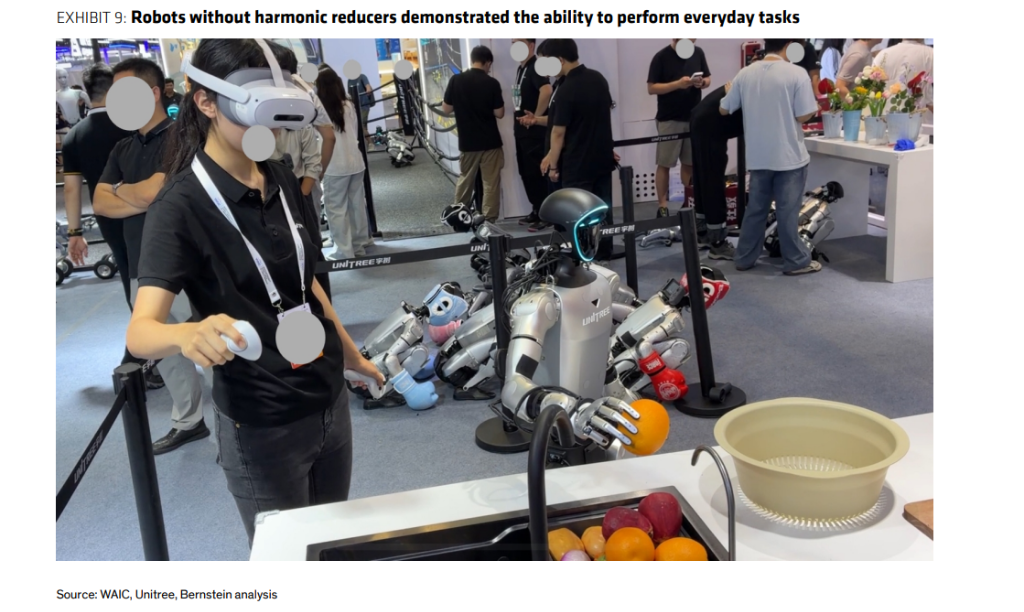
This means that the value distribution across the robotics industry chain may not necessarily follow the current market's focus on individual components.
Intelligent Driving and Healthcare: AI Applications Are Expanding into a Wider Range of Industries
In the field of autonomous driving, Bernstein believes that China has advantages in scale, cost, and data.
China's mass-produced vehicles continuously generate real-world driving data, creating a positive feedback loop for data accumulation and algorithmic iteration. Unlike companies that start directly with L4 autonomous driving, some Chinese firms are taking a gradual approach, advancing from L2-level driver assistance to higher levels of autonomy.
Bernstein believes that this bottom-up development model can leverage mass-produced vehicles to expand the data pool and bridge the gap between technology and commercialization.
However, whether Chinese companies can further translate this advantage into global market competitiveness remains to be seen.
In the healthcare sector, a different path for AI implementation is emerging.
Bernstein reports that, from 2023 through the third quarter of 2026, the number of R&D pipelines at Chinese AI-driven drug development companies grew from 47 to 219—more than quadrupling. Meanwhile, the value of AI-related licensing deals now accounts for roughly 25% of all licensing activity originating in China.
However, the report also explicitly cautions that current evidence more strongly indicates AI can accelerate the drug discovery process than that it has yet been proven to improve the success rate of clinical trials.
Therefore, the value of AI-driven drug discovery cannot be reduced to simply generating more candidate molecules; what truly matters in the future is the ability to generate deeper biological insights and improve efficiency across the entire pipeline, from drug discovery to clinical development.
The AI Agent Battle: Who Will Control User and Enterprise Data?
In addition to hardware and industrial applications, Bernstein also views AI agents as a competitive area worth watching.
The report notes that large models typically do not persistently retain user information across different tasks, whereas Agent Harness can establish a persistent working environment through persistent memory, tool invocation, task orchestration, and a skills library.
Accordingly, AI competition is expanding from model inference capabilities to context capture and workflow control.
Bernstein focused on analyzing the opportunities for Tencent and Alibaba.
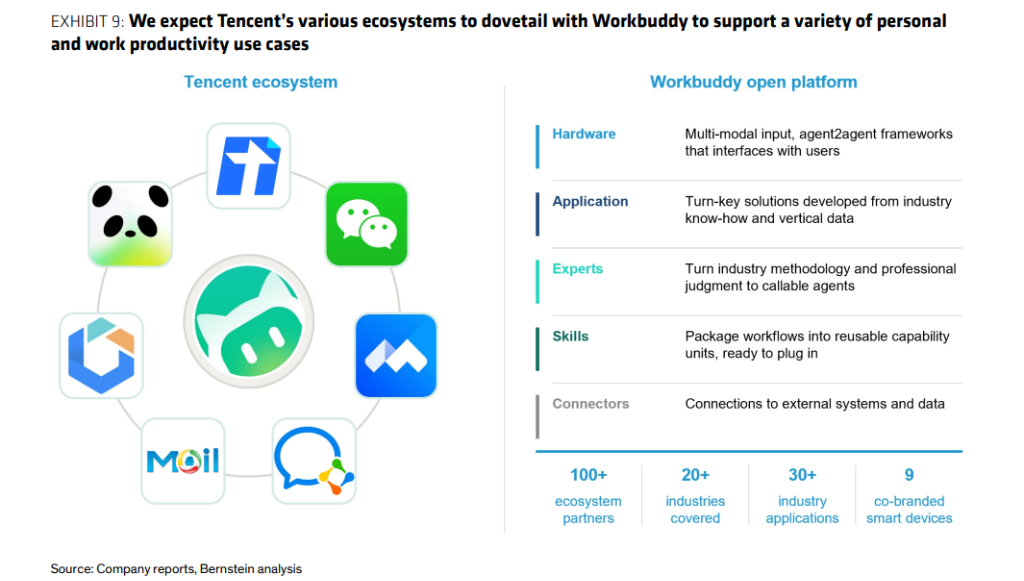
Tencent WorkBuddy integrates its own models and third-party models, leveraging its social, communication, and distribution capabilities to enter the workplace; Alibaba, relying on Qwen, Alibaba Cloud, and DingTalk, focuses on capturing enterprise data and workflows.
ByteDance enjoys scale advantages on the consumer side with DouBao, but the report notes that commercializing its consumer‑facing AI products remains challenging; the enterprise market is therefore a key focus for its next phase.
In the consumer sector, Bernstein believes that companies with strong brands and proprietary consumer data are better positioned to leverage AI agents to enhance operational efficiency. For example, Moutai could use the sales data accumulated through its iMoutai platform to develop consumer-facing AI agents, while other brands may focus more on optimizing demand forecasting and operations via retail channels.
The financial industry is also a key domain for AI applications. Bernstein notes that Chinese asset management firms are integrating open-weight models, internal data, and agents into their research, trading, and investment processes, driving AI's evolution from a productivity tool to an integral part of investment infrastructure.
From AI to Alpha, the real winners will be those who turn technology into profits.
Overall, the key Chinese AI investment targets listed by Bernstein span multiple industry segments, including Tencent, Alibaba, CXMT, SMIC, FIH Mobile, CATL, Sungrow Power Supply, BYD, Xiaomi, Hengrui Pharma, Innovent Bio, and Wuxi Apptec.
These companies correspond to areas such as AI applications, semiconductors and hardware infrastructure, power and energy storage, intelligent driving, and healthcare.
Bernstein ultimately emphasized that investors should not simply seek companies with an AI label, but rather those that can leverage proprietary data, scale, physical infrastructure, low costs, distribution channels, and execution capabilities to build sustainable economic advantages.
Transforming AI into productivity, then turning that productivity into profit growth, ultimately generating excess returns—this is precisely the core logic conveyed in the report's title, "From AI to Alpha."
Editor/Deng