On Tuesday, the United States held midterm elections. If Congress becomes divided between the two chambers, legislative progress will likely stall, making it difficult to effectively rein in the U.S. fiscal deficit of roughly $2 trillion. Analysts note that rising U.S. Treasury yields and an AI investment boom are drawing capital away, putting downward pressure on gold prices. A shift in outcomes could prompt markets to reassess the trajectory of the fiscal deficit and monetary policy, potentially reversing gold's current weakness.
Gold is on track for its worst annual decline in more than a decade, but the upcoming U.S. midterm elections may be setting the stage for a narrative shift—reviving concerns about fiscal deficits and inflation, which could rekindle the precious metal's safe-haven appeal.
The AI investment boom continues to draw capital into risk assets, while rising bond yields and expectations of interest-rate hikes keep weighing on this non-yielding asset. Tuesday's midterm elections have prompted markets to reassess fiscal deficits and the trajectory of monetary policy, potentially offering gold some breathing room.
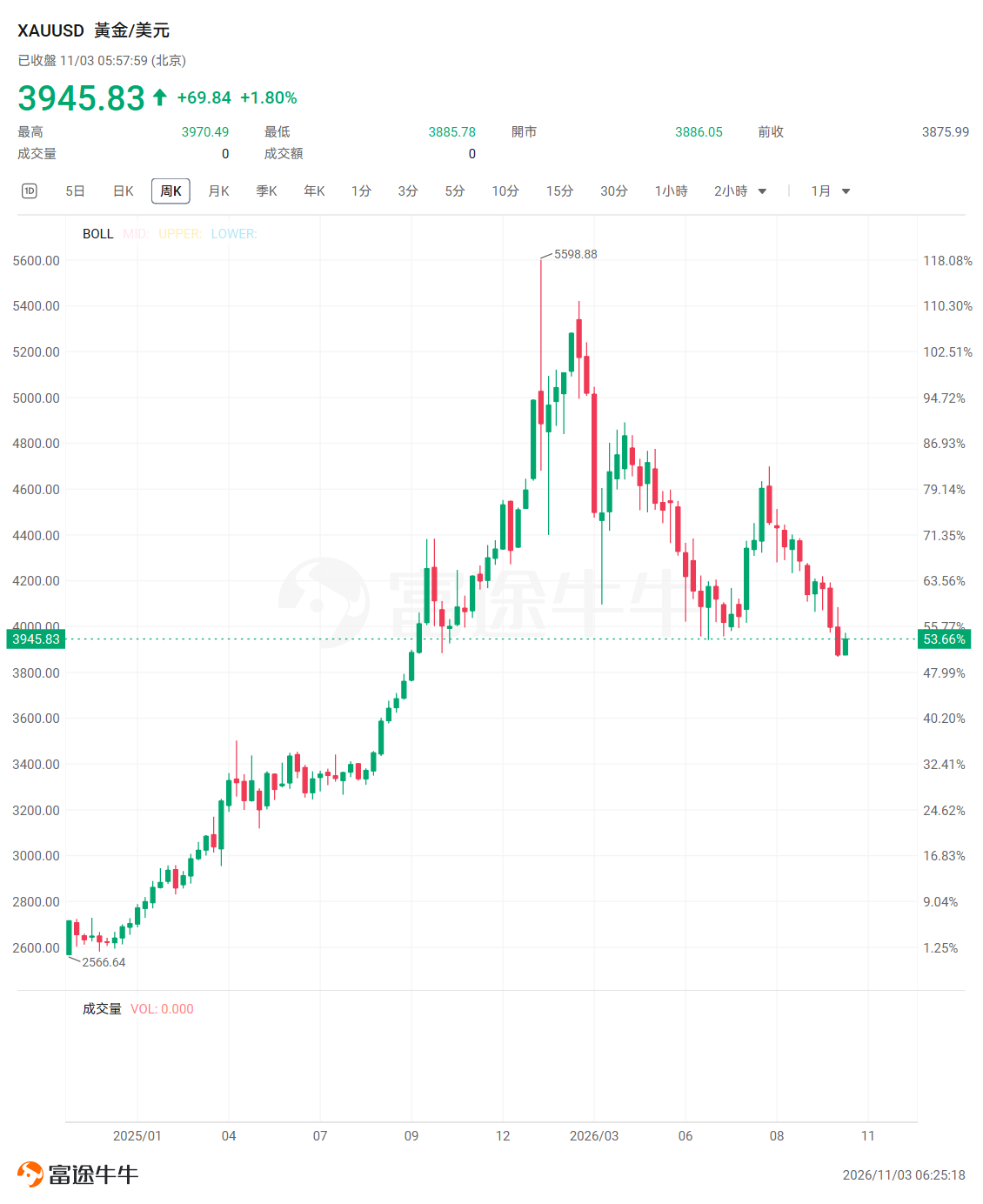
 Gold prices have fallen from a record high above $5,500 this year and are now below the $4,000 mark, with a year-to-date decline of more than 8%.
If the election results lead to a divided Congress, as was the case after the midterm elections during Trump's first term, legislative progress will likely stall, and the U.S. fiscal deficit of about $2 trillion will be difficult to contain effectively.
Matt Miskin, Co-Chief Investment Strategist at Manulife John Hancock Investments, said that if the 2027 trend mirrors that of 2019, gold's current weakness could reverse.
Congressional gridlock could become a catalyst for gold prices.
Multiple polls show the Democratic Party holding an advantage in regaining control of the House of Representatives, but the outcome for Senate majority remains uncertain. Even if Democrats take both chambers of Congress, the president's veto power and limited room for expanding fiscal spending will cap budgetary leeway, putting downward pressure on Treasury yields—one of the key factors weighing on gold prices this year.
"A political stalemate could reduce the risk of fiscal policy further pushing up real yields," Miskin said, adding that this would be a "very positive development" for gold. He expects the election to bring about a moderate shift in the political landscape with limited changes at the policy level.
Anthony Saglimbene, Ameriprise's chief market strategist, noted that regardless of its composition, the next Congress will face a challenging fiscal environment.
The stalemate not only constrains spending but also hinders politically sensitive measures to cut the budget or raise revenue, making it difficult for the U.S. fiscal situation to improve substantially. Saglimbene expects that investors concerned about the U.S. fiscal outlook will shift toward safe-haven assets other than government bonds, which should benefit gold.
Real yields and the U.S. dollar are exerting a dual headwind.
Gold prices are under pressure this year, driven by the combined impact of rising real yields and a stronger U.S. dollar. As a non-yielding asset, gold is at a natural disadvantage in a high-yield environment, while robust economic performance fueled by the artificial intelligence boom has further shifted investor attention and capital toward riskier assets.
Meanwhile, rising oil prices have heightened inflation concerns, reinforcing market expectations of tighter monetary policy and prompting investors to favor higher-yielding government bonds. This has been a defining feature of the market this year: despite escalating geopolitical risks and ongoing U.S. fiscal challenges, gold has failed to consistently serve as the safe-haven asset investors had hoped for.
This dynamic creates a unique tension for gold investors: fiscal concerns are pushing yields higher, making interest-bearing assets more attractive and weighing on gold in the short term; yet persistently rising yields also signal mounting fiscal pressures, and if investor confidence in the dollar's long-term outlook erodes, this could, in turn, bolster gold's appeal as an alternative store of value.
The sustainability of the AI boom and the Federal Reserve's credibility are key variables.
Gold's trajectory hinges to a large extent on whether AI investment can remain sustained. The massive capital requirements of AI infrastructure development are prompting companies to compete for access to bond markets, while the U.S. government also needs to raise funds to cover its hefty budget deficits. These two forces combined continue to push bond yields higher, weighing on gold prices.
Roger Aliaga-Díaz, head of global portfolio construction at Vanguard Group, stated that the AI capital spending boom is one of the strongest investment cycles in decades and is unlikely to come to an abrupt halt. Vanguard expects economic growth next year to exceed mainstream market expectations.
Under Vanguard's framework, large deficits do not automatically boost gold prices: if policymakers remain credible and are willing to raise interest rates to curb inflation, fiscal expansion will ultimately translate into higher yields rather than a collapse in dollar confidence, remaining negative for gold. "If the Fed does its job," Aliaga-Díaz said, "fiscal issues should not be the primary driver of gold prices."
However, once investors begin to question the Federal Reserve's independence or its willingness to curb inflation, gold's appeal will increase significantly.
Some investors have already positioned themselves at lower levels.
Despite ongoing disagreements about the outlook, gold's fall below $4,000 has begun to attract bargain hunters.
Doug Daly, portfolio manager at CoreCommodity Management, said his portfolio remains focused on energy and Middle East dynamics in its election-related positioning, but he has gradually shifted to a more bullish stance after gold fell below $4,000. Miskin also revealed that the strategy he manages added to its holdings around the $4,000 level, with overall positioning currently ranging from neutral to slightly overweight.
From a longer-term perspective, Kristina Hooper of Man Group identifies stagflation as a key signal to watch—historically, it has been the most favorable macro backdrop for gold, characterized by persistent inflation alongside slowing economic growth. "The bigger question is whether we have truly entered a stagflationary environment," Hooper said, adding that she is closely monitoring signs of weakening job growth amid price pressures.
If economic growth slows, real yields decline, or concerns persist that Washington cannot rein in fiscal imbalances, gold's former allure could quickly return. However, if AI-driven investment continues to underpin growth, the Federal Reserve remains hawkish, and U.S. Treasuries keep offering attractive yields, gold may remain in the shadows.