AI companies are becoming major infrastructure buyers.
$Anthropic (ANT.US)$Its expansion has moved beyond training models and courting enterprise clients to encompass building data centers, procuring chips, and coordinating power resources. To secure sufficient computing capacity, the company has begun directly taking on tasks previously handled mainly by cloud service providers and infrastructure operators.
On November 2, U.S. local time, Anthropic filed an updated prospectus with the U.S. Securities and Exchange Commission. The document supplements financial data for the third quarter of 2026 and discloses long-term procurement and leasing arrangements.
 The documents show that computing power has become the most significant cost item in Anthropic's expansion. To meet the demands of Claude model training and enterprise customer usage, the company has not only signed long-term agreements with cloud service providers such as Amazon, Google, and Microsoft, but has also begun directly procuring chips, participating in data center construction, and seeking electricity and server room resources from former cryptocurrency mining companies and new cloud service providers.
01 Revenue increased twelvefold, and operating losses reemerged
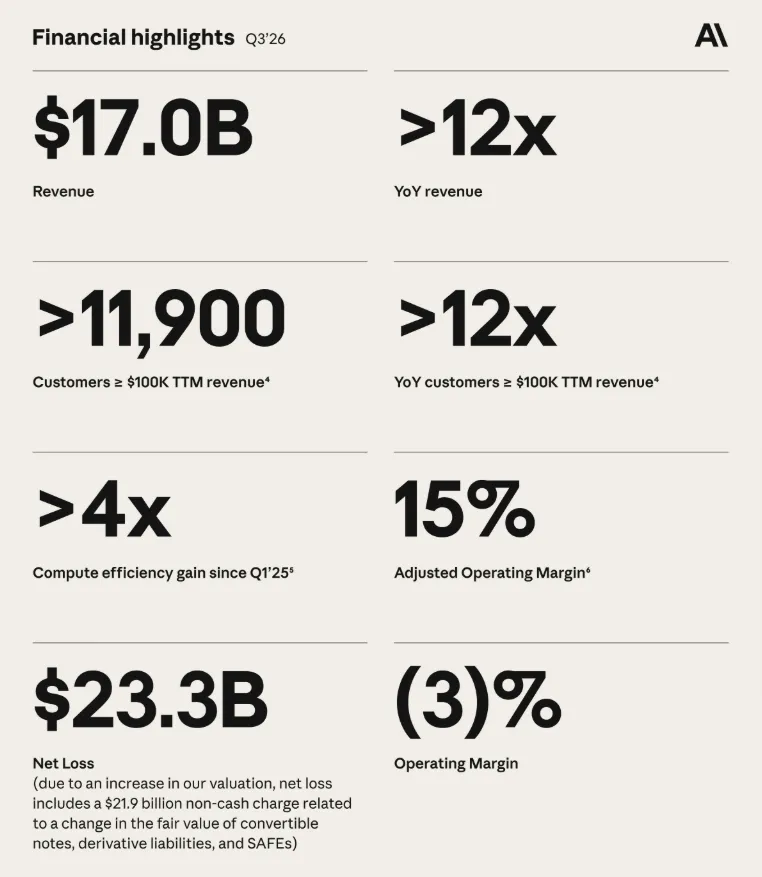
The updated prospectus shows that,$Anthropic (ANT.US)$Third-quarter revenue was $16.96 billion, up from $11.56 billion in the second quarter and well above the approximately $1.38 billion reported in the same period of 2025.
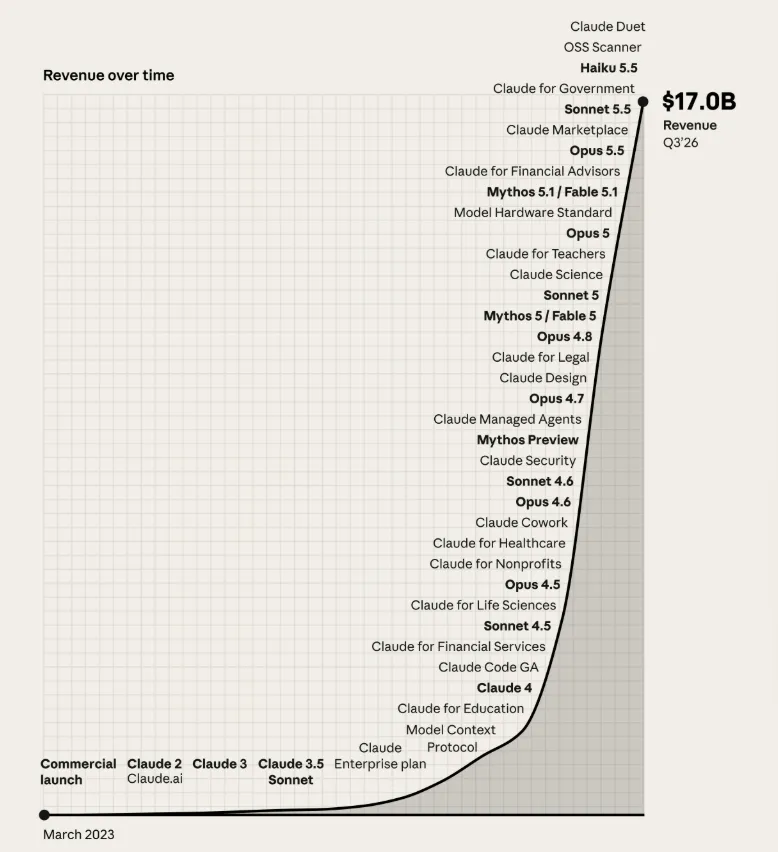
In the first three quarters of this year, Anthropic's cumulative revenue reached $33.242 billion, compared to $2.545 billion in the same period last year, representing roughly a twelvefold increase.
However, revenue growth has not been matched by a corresponding improvement in operating profit.
In the third quarter, Anthropic's operating expenses rose to $17.5 billion, compared with $10.6 billion in the second quarter. The company reported an operating loss of $567 million for the quarter, whereas it had posted an operating profit of $974 million in the second quarter. Computing and infrastructure costs reached approximately $9.9 billion, nearly doubling from about $5.6 billion in the second quarter.
Anthropic attributed its shift to an operating loss primarily to short-term compute procurement. As customer demand outpaced its previously secured compute capacity, Anthropic was forced to purchase additional computing resources on the spot market at prices significantly higher than those in its multi-year contracts.
In the third quarter, Anthropic's short-term computing power procurement amounted to approximately $5 billion. Additionally, a non-cash expense of about $2 billion related to an employee donation-matching program also impacted the quarter's operating results.
Excluding share-based compensation and the aforementioned grant‑matching expenses, Anthropic's adjusted operating margin for the third quarter was approximately 15%, down from 19% in the second quarter. The decline in adjusted margin reflects that, amid revenue expansion, spending on computing power and other operating costs continues to erode profit margins.
Price changes have also emerged. Anthropic disclosed that, from the second quarter to the third quarter, revenue growth driven by increased customer usage was partially offset by price reductions for new model versions and contractual discounts, resulting in an impact of approximately $600 million.
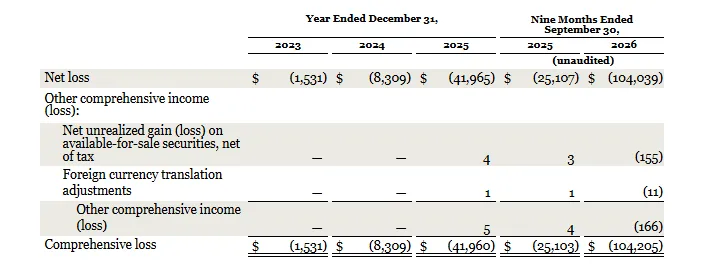
Anthropic reported a net loss of $23.29 billion in the third quarter, down from $66.3 billion in the second quarter. Cumulative net losses for the first three quarters totaled $104.039 billion, though approximately $94.3 billion of this was attributable to changes in the fair value of financial instruments such as convertible notes and derivative liabilities, primarily driven by an increase in the company's valuation.
02 $895.4 billion in commitments, nearly half of which will be fulfilled by 2030
The prospectus discloses that as of the end of September,$Anthropic (ANT.US)$Cumulative spending commitments arising from procurement commitments and lease agreements totaled $895.4 billion, the vast majority of which relate to computing resources and infrastructure.
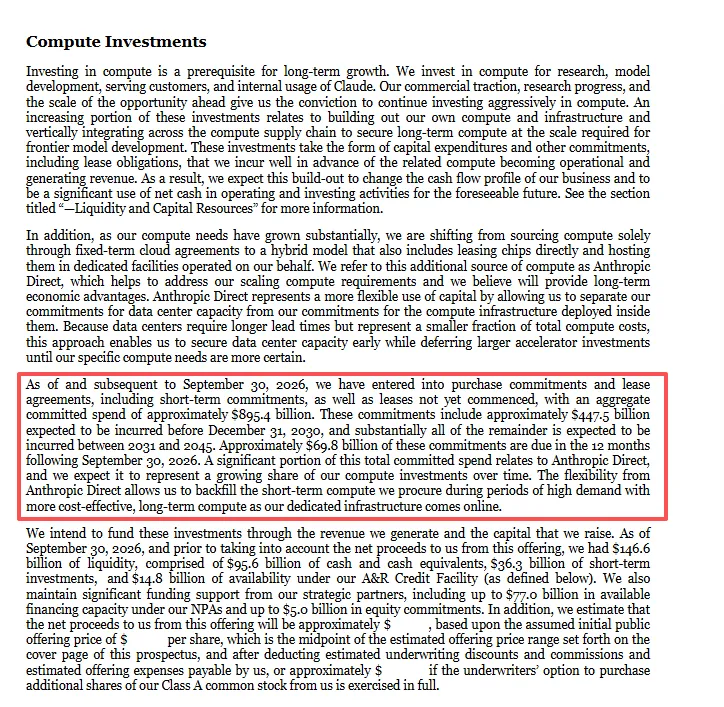
Of this amount, approximately $447.5 billion is expected to be disbursed by December 31, 2030, with the remainder spread across the period from 2031 to 2045. Commitments maturing within the next 12 months total about $69.8 billion.
This amount does not equal the interest-bearing debt that has already been incurred, nor does it mean Anthropic must pay the full sum immediately. It encompasses various types of procurement contracts, equipment leases, and data center-related agreements, with payments spread over multiple years. However, some contracts are highly binding, so even if actual usage falls short of expectations, the company may still be required to meet its corresponding payment obligations.
From a contractual perspective, uncommenced lease commitments amount to approximately $321.4 billion, while fixed minimum purchase commitments total about $265.6 billion. These long-term arrangements lock in future costs for computing power procurement and infrastructure usage, thereby subjecting the company to extended payment obligations.
As of the end of September,$Anthropic (ANT.US)$Holds a combined total of $131.845 billion in cash, cash equivalents, and short-term investments. Including available lines of credit, the company's total liquidity is approximately $146.6 billion.
The scale of long-term commitments is significantly larger than the reported cash balance. $895.4 billion is approximately 6.8 times Anthropic's cash and short-term investments; meanwhile, about $69.8 billion in commitments maturing over the next 12 months represents roughly 53% of its current cash and short-term investments.
The prospectus also explicitly highlights the associated operational risks. Anthropic's revenue is primarily derived from usage-based consumer‑facing services, with most of this revenue lacking long‑term contractual guarantees, while computing power and infrastructure expenditures typically must be committed to years in advance. The company may enter into long‑term agreements based on projected revenues, but actual future revenues may fall short of those projections.
If customer revenue growth fails to cover related payments, or if the company is unable to continue obtaining financing on acceptable terms, Anthropic may be unable to fulfill certain contracts. Breaches of some commercial agreements could also trigger cross-default provisions in credit agreements and convertible notes, resulting in accelerated debt maturity and even supplier terminations.
Cost increases have already been reflected in the financial data. In the first three quarters,$Anthropic (ANT.US)$Computing and infrastructure expenses increased 329% year over year, rising by approximately $14.4 billion. In the third quarter, these expenses totaled about $9.9 billion, accounting for roughly 58% of quarterly revenue.

03 From cloud service providers to mining companies, Anthropic is sourcing computing power worldwide.
According to foreign media reports, at the end of last year,$Anthropic (ANT.US)$Management has recognized the significant uncertainty in forecasting computing power demand and has subsequently signed dozens of agreements on computing power and infrastructure. Partners now span from major technology companies to data center startups, chipmakers, and firms that previously engaged in cryptocurrency mining.
This round of procurement is no longer limited to purchasing cloud services. Anthropic has begun hiring data center construction and supply chain experts, directly procuring server hardware and cooling systems to help partners accelerate data center builds. It has also engaged with data center developers in multiple states to explore grid connectivity, project permitting, and the potential to repurpose retired coal-fired power plants and industrial facilities as data centers.
New cloud service providers and former cryptocurrency mining companies have thus entered Anthropic's supply network. According to compiled public data from foreign media, companies such as Fluidstack and Lambda provide computing resources,$TeraWulf (WULF.US)$、$Hut 8 (HUT.US)$Other companies participate in data center construction.
These partners control land, power‑connection resources, or existing data‑center facilities. For Anthropic, leveraging existing sites and power infrastructure can cut the time required to build a large campus from scratch. For some former mining companies, pivoting to AI data centers also opens up new avenues for business growth.
However, having a ready-made site does not mean computing power can be delivered immediately. Power supply, equipment installation, and construction personnel can all slow down the project timeline.
Anthropic initially sought data center projects with a minimum capacity of around 200 MW, but later began considering projects of about 50 MW, supplementing their power supply with battery storage and natural gas generation. The company is also exploring the option of bundling multiple smaller projects to gradually expand its computing capacity.
Anthropic has also begun directly participating in the design and procurement of infrastructure projects. The company purchases equipment such as chips and cooling systems, then hands them over to partner operators for installation, thereby shortening the time from project construction to the deployment of computing power.
This model has broadened the range of resources available to Anthropic, but it has also increased the complexity of project management. Construction timelines, equipment specifications, power requirements, and delivery schedules vary across different data centers. Even after contracts are signed, actual computing capacity cannot be deployed until construction is completed, equipment is installed, the systems are connected to the grid, and they undergo commissioning.
John Tough, managing partner at the energy investment firm Energize Capital, believes that Anthropic does not control an end-to-end computing power supply chain and must instead source electricity and infrastructure resources globally on a project-by-project basis, piecing together facilities of varying scales.
In its prospectus, Anthropic refers to this dedicated infrastructure as Anthropic Direct. The company aims to reduce its reliance on more expensive short-term compute purchases by securing dedicated capacity on a long-term basis.
Foreign media, citing sources familiar with the matter, revealed that$Anthropic (ANT.US)$It is expected to have over 3.5 GW of computing capacity by 2026, with plans to double that capacity by 2027.
Anthropic's long-term compute contracts are concentrated in the hands of a few large tech companies and infrastructure providers.
According to the prospectus and related disclosures, Anthropic and$Alphabet-C (GOOG.US)$The contract amount is approximately US$121.3 billion, and with$Amazon (AMZN.US)$Approximately 110 billion USD, and with$Microsoft (MSFT.US)$Approximately US$44.9 billion; and$SpaceX (SPCX.US)$The related agreements amount to a maximum of approximately $120.5 billion and extend through 2036. In addition, the company has entered into related agreements with Fluidstack and Lambda.
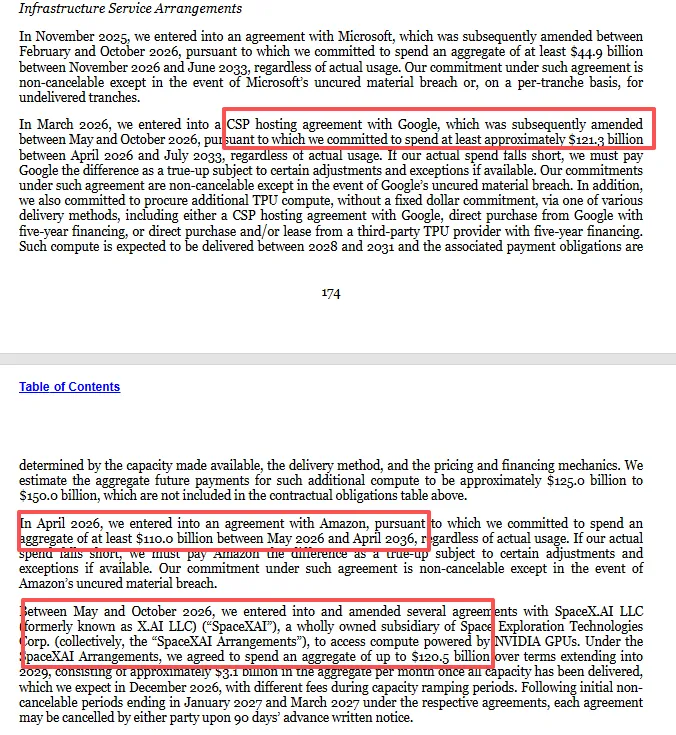
$Broadcom (AVGO.US)$Commitments for related equipment leasing amount to approximately $161.2 billion, which is also an indispensable component of the current structure of computing power expenditures.
In addition, Anthropic plans to purchase approximately $125 billion to $150 billion worth of Google chips and expects to spend over $20 billion on AMD chips. These arrangements do not have fixed contract amounts and are therefore not included in the aforementioned total commitment of $895.4 billion.
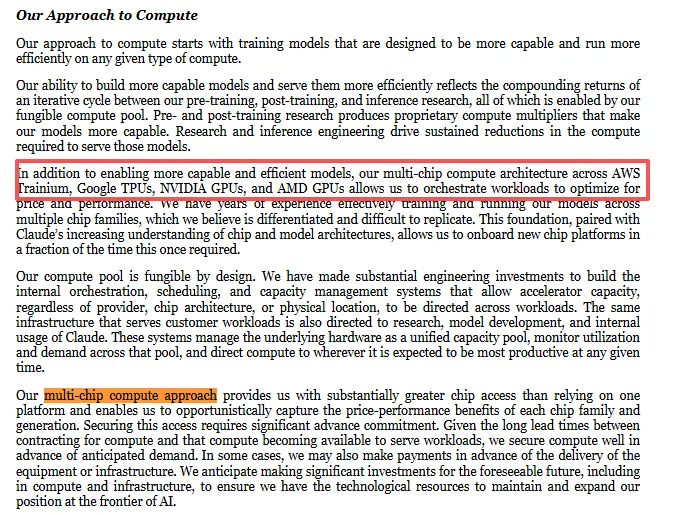
A multi-chip architecture is another measure NVIDIA has taken to reduce supply risks. The company stated in its prospectus that its computing resources come from AWS Trainium, Google TPUs, NVIDIA GPUs, and AMD GPUs, and it centrally schedules computing power from different sources, allocating resources based on the price and performance requirements of various tasks. This helps reduce reliance on a single chip supplier, but it also makes Anthropic's relationships with its supply chain partners more complex.
$Amazon (AMZN.US)$and$Alphabet-C (GOOG.US)$Both are$Anthropic (ANT.US)$an important investor, as well as a provider of cloud services and chip resources. Microsoft also offers cloud infrastructure. Broadcom is involved in the supply of chips and equipment. Anthropic pays these companies for computing power while also receiving investment or financing support from some of them.
Evercore ISI analyst Mark Mahaney previously noted that Anthropic's relationship with major cloud service providers is multifaceted: it is both a customer, a competitor, a sales channel, and an investment target.
Edited by melody