
① Over the next five years, global data centers are expected to add approximately 170 GW of capacity, corresponding to capital expenditure needs of about $8.5 trillion; ② The United States is projected to account for roughly 60% of the world's new capacity, with Neocloud accelerating its expansion and large-scale HPC projects serving as the primary growth drivers; ③ Risks related to power supply, regulatory approvals, and highly leveraged financing are becoming increasingly pronounced, yet projects with higher delivery certainty are still likely to underpin industry growth.
Cailian Press, November 3 (Editor: Xia Junxiong) — On November 2, Goldman Sachs released a research report significantly raising its forecast for global data center capacity. It now expects global data center capacity to reach 273 gigawatts (GW) by 2030, up from the previous estimate of 217 GW, an increase of about 26%.
According to the bank's latest forecast, global data center capacity will grow from approximately 103 GW in 2025 to 273 GW by 2030, representing a compound annual growth rate of about 21%. Over the next five years, cumulative new capacity is expected to reach roughly 170 GW; based on an assumed investment of $50 billion per gigawatt, this would translate into capital expenditures totaling as much as $8.5 trillion.
 Despite challenges in power supply, regulatory approvals, and financing costs facing data center construction, Goldman Sachs believes that global data center capacity expansion will not slow significantly in the medium term, with projects featuring reliable power supplies and favorable approval conditions expected to maintain strong growth.
Global capacity forecasts continue to be revised upward, with the United States accounting for 60% of the新增 capacity.
This forecast adjustment is mainly based on data center project tracking information from the market research firm 451 Research as of the second quarter of 2026, as well as Goldman Sachs' additional estimates for future projects that have not yet been announced.
According to updated data from 451 Research, compared with the forecast version adopted by Goldman Sachs in the first quarter, the forecast for new global data center capacity in 2026 has been raised by 8%, and the forecasts for 2027 and 2028 have both been raised by 14%.
Goldman Sachs believes that, due to 451 Research's high threshold for including projects in its database, some data center construction plans that have not yet been officially announced were not counted, so additional adjustments are needed for longer-term capacity forecasts.
This is also a key reason why Goldman Sachs has significantly raised its 2030 forecast. The firm expects global data center annual new capacity to grow from about 25 GW in 2026 to 32 GW in 2027 and 35 GW in 2028, further increasing to around 40 GW by 2030.
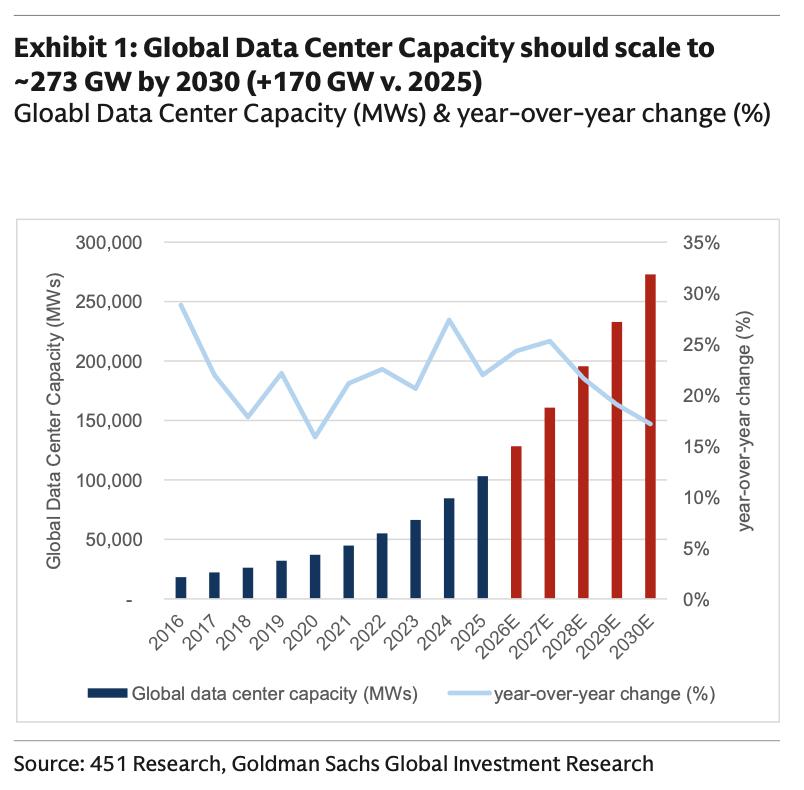
(Goldman Sachs forecasts that global data center capacity will grow from approximately 103 GW in 2025 to 273 GW in 2030, representing a cumulative addition of about 170 GW over five years.)
In fact, Goldman Sachs has revised its data center capacity forecasts upward consecutively. Compared with the previous projections for Q1 2026, Q4 2025, and Q3 2025, the latest report raises the forecast for global total data center capacity from 2026 to 2030 by an average of 11%, 17%, and 26%, respectively.
From a regional perspective, the United States will remain the primary growth market for global data center construction.
Goldman Sachs has raised its 2030 U.S. data center capacity forecast from 125 GW to 152 GW, projecting a cumulative addition of 103 GW after 2025, accounting for about 60% of the global新增 capacity during the same period.
Notably, the adjustment to Goldman Sachs' forward capacity forecast for the United States is particularly significant. Goldman Sachs has raised its annual new capacity forecasts for the U.S. in 2029 and 2030 by 56% and 180%, respectively, compared with the previous report, primarily reflecting additional estimates for projects that have not yet been announced.
Forecasts for new data center capacity in the Asia-Pacific region have also been revised upward, while the upward revisions for Europe are concentrated mainly in 2029 and 2030, indicating that long-term construction expectations in markets outside the United States have likewise increased.
Neocloud is accelerating its expansion, with large-scale HPC projects driving growth.
An important factor driving Goldman Sachs to raise its forecast for U.S. data center capacity is the rapid expansion of the new cloud computing service provider (Neocloud).
Goldman Sachs data shows that, in the forecast for cumulative new capacity of U.S. data centers from 2026 to 2030, the projection for the combined category of cloud computing, Neocloud, cryptocurrencies, and wholesale and retail data centers has been raised by 11.8 GW, while the projection for traditional hyperscale cloud providers has been increased by 9.4 GW.
Goldman Sachs believes that the significant growth in the former category reflects Neocloud providers rapidly scaling up their infrastructure to meet the sustained demand for GPUs.
In addition to changes in the developers, new data center capacity worldwide is increasingly concentrated in large-scale projects.
Goldman Sachs projects that by 2028, projects with a single capacity of no less than 75 megawatts (MW) will account for 66% of the annual新增 capacity of global data centers, significantly higher than the 25% in 2025.
In the United States, this share is projected to rise from 37% in 2025 to 75% in 2028 and remain at that level in 2029 and 2030.
Goldman Sachs noted that such large-scale projects are typically associated with high-performance computing (HPC) and artificial intelligence (AI) workloads. As demand for AI computing grows, large HPC data centers are expected to become the primary source of future capacity expansion.
However, large-scale data center projects typically impose stricter requirements on power supply, infrastructure support, and financing capabilities, making it all the more critical that these projects be delivered on schedule.
Five-year investment demand could reach US$8.5 trillion
Based on an estimate that each GW of new capacity requires approximately $50 billion in total capital expenditure, Goldman Sachs projects that the global data center sector will add 170 GW of new capacity over the next five years, corresponding to investment needs of about $8.5 trillion.
This estimate does not represent the investment amounts that companies have already committed to or implemented, but rather the potential capital expenditure scale calculated based on capacity growth forecasts and assumptions about unit investment costs. Goldman Sachs also noted that IT infrastructure costs continue to face upward pressure.
Looking at capital expenditure expectations among technology companies, the market expects AI- and cloud computing-related investments to continue growing rapidly in 2026 and 2027.
Goldman Sachs, citing Visible Alpha's market consensus data as of October 30, reports that eight AI- and cloud-computing-related companies—Apple, Amazon, Meta, Alphabet (Google's parent company), Microsoft, Oracle, and others—are expected to have combined capital expenditures of $918.2 billion in 2026, up 101% from 2025.
In 2027, capital expenditures by these eight companies are expected to increase further by 65%, reaching approximately $1.52 trillion; by 2030, they are projected to total about $1.74 trillion, with a compound annual growth rate of roughly 31% from 2025 to 2030.
Among them, Alphabet's capital expenditures for 2030 are expected to reach approximately $394.8 billion, Amazon about $345.8 billion, Microsoft around $267.9 billion, and Meta roughly $244.4 billion.
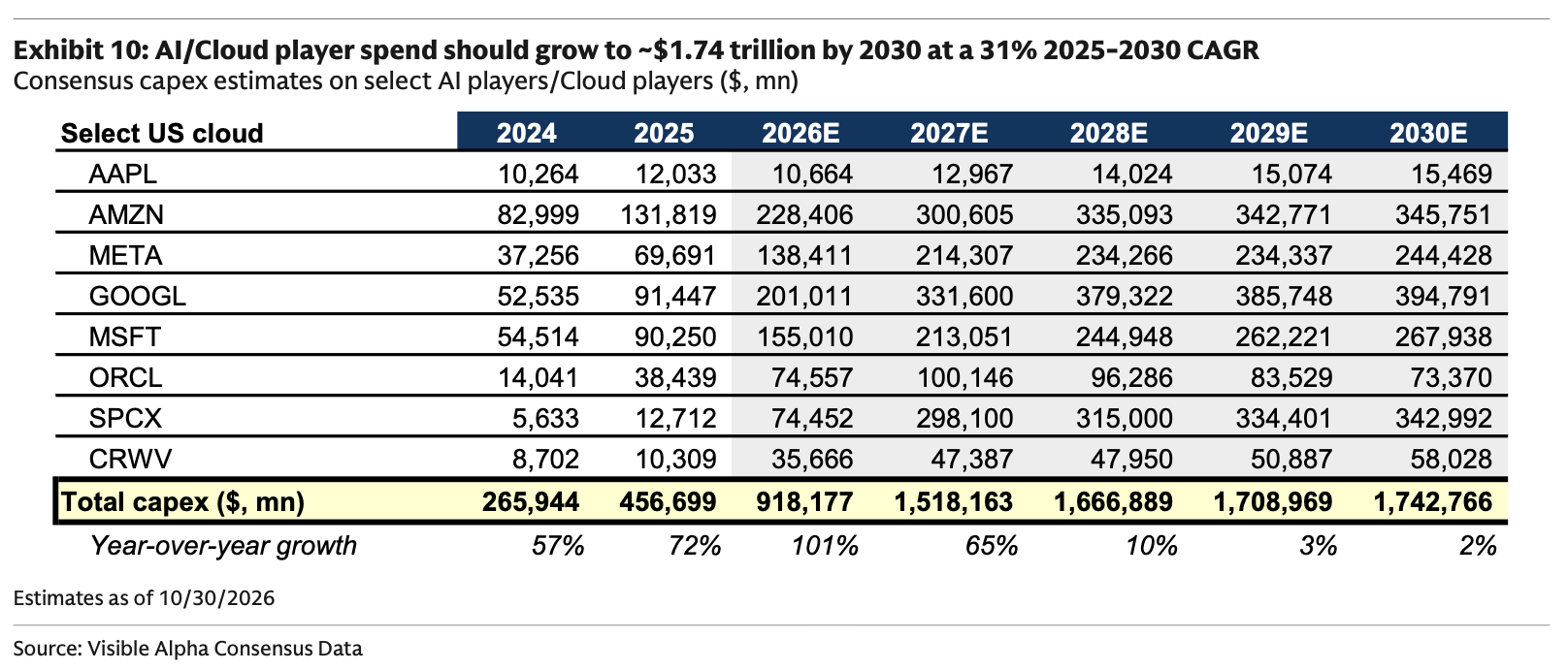
(Market consensus expects the combined capital expenditures of eight U.S. AI and cloud computing–related companies to reach approximately $1.74 trillion by 2030, a significant increase from 2025.)
However, the market expects capital expenditure growth to slow markedly starting in 2028. For the eight companies mentioned above, year-on-year capital expenditure growth is projected at 10%, 3%, and 2% respectively from 2028 to 2030.
Goldman Sachs believes that the current market expectation of approximately $1.51 trillion per year in capital expenditures for these companies from 2026 to 2030 is sufficient in scale to support investment estimates for adding new capacity to their U.S. data centers.
The bank noted that the relevant capital expenditure forecasts have been revised upward repeatedly over time and still do not cover investments by hyperscale cloud service providers outside the U.S., such as Alibaba and Tencent, as well as certain private AI labs and data center platforms.
Intensified electricity, regulatory, and financing constraints are putting project delivery to the test.
Despite continuously raising its capacity forecast, Goldman Sachs also warned that execution risks in global data center construction are rising.
First is the restriction on power supply. Goldman Sachs, citing media reports, pointed out that Microsoft recently delayed the launch of its projects and withdrew from a data center leasing commitment due to power supply issues. Oracle's project in New Mexico, USA, is also facing difficulties in obtaining approval for power supply.
Goldman Sachs believes that as data center construction scales up, securing a reliable power supply is becoming a critical factor in determining project timelines.
Secondly, there is local regulatory oversight and community resistance.
The report notes that relevant administrative measures in Texas and Pennsylvania have effectively suspended the expedited approval processes for data centers in those states, which could affect the progress of some projects.
In addition, issues such as the strain on the power grid, rising electricity prices, water consumption, and noise caused by data center construction have also drawn attention from local communities. Goldman Sachs believes that even if developers adopt water-saving cooling, noise reduction, and other technical measures, they may still not be able to completely eliminate public opposition.
Financing risks should not be overlooked either.
Goldman Sachs pointed out that HPC data center construction typically features high leverage, with loans accounting for 80% to 90% of project costs, meaning that project returns are highly sensitive to changes in debt financing spreads.
As borrowing costs and the risk of construction delays rise, financiers are expected to place greater emphasis on data center tenants' creditworthiness and lease contract durations.
For projects with high-quality tenants, asset-backed financing can secure funding through 15- to 30-year contractual cash flows provided by investment-grade tenants. Once the project matures, developers can also reinvest proceeds into new construction by selling or liquidating existing assets.
Goldman Sachs believes that the aforementioned risks could have a greater impact on speculative projects that have not yet secured definitive construction conditions. In contrast, projects that already have reliable power supply and regulatory approval still enjoy a high degree of delivery certainty.
Editor/Deng