The Democratic Party swept the U.S. midterm elections, taking control of Congress, which pushed the U.S. dollar and Treasury yields lower. Gold extended its gains after surging more than 3% on Wednesday.
Zhitong Finance APP reports that the Democratic Party swept the U.S. midterm elections, taking control of Congress, which drove the U.S. dollar and Treasury yields lower. Gold extended its gains following a more than 3% surge on Wednesday. The gold price is currently trading above $4,100 per ounce. In the previous trading session, gold recorded its largest single-day gain since August, reclaiming the key support level of $4,000 per ounce.
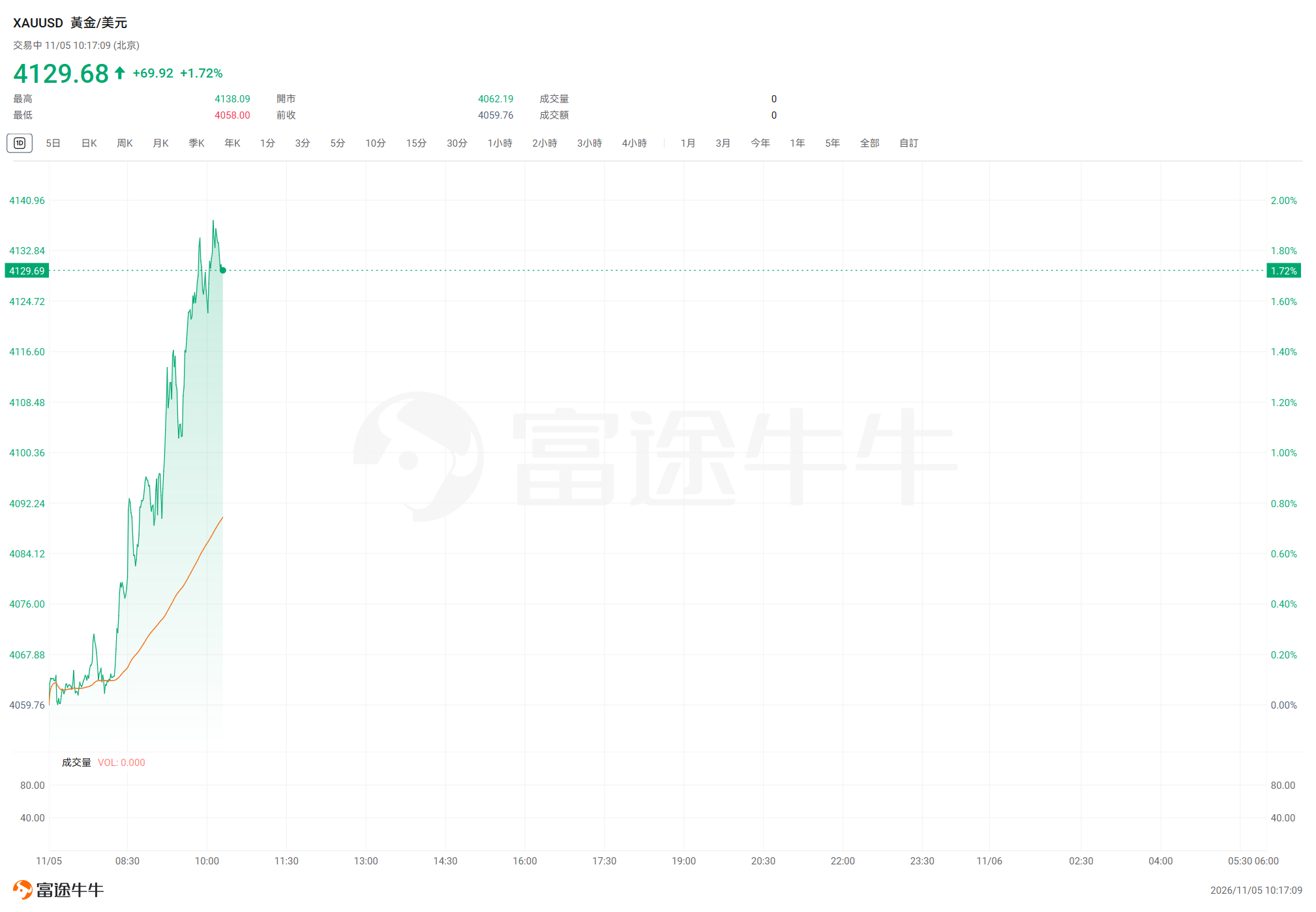
As of press time,$XAU/USD (XAUUSD.CFD)$Up 1.72%, quoted at $4,129.68 per ounce.
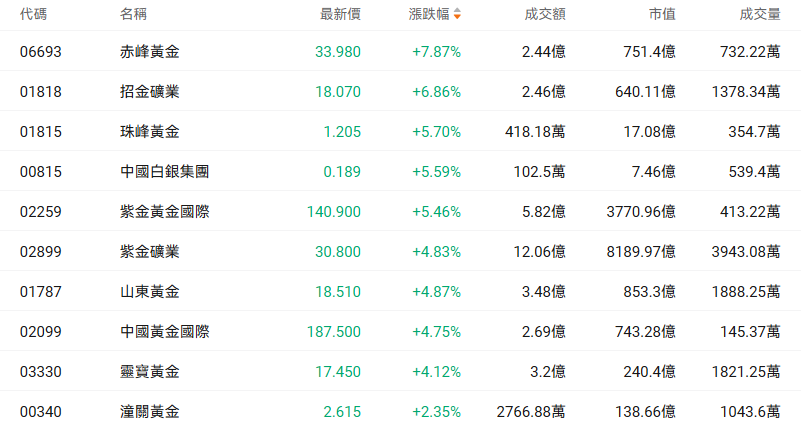
 Gold stocks in the Hong Kong market rose broadly. As of press time,$CHIFENG GOLD (06693.HK)$rose nearly 8%,$ZHAOJIN MINING (01818.HK)$rising nearly 7%,$SD GOLD (01787.HK)$、$ZIJIN MINING (02899.HK)$、$CHINAGOLDINTL (02099.HK)$gaining nearly 5%.$LINGBAO GOLD (03330.HK)$with gains exceeding 4%.
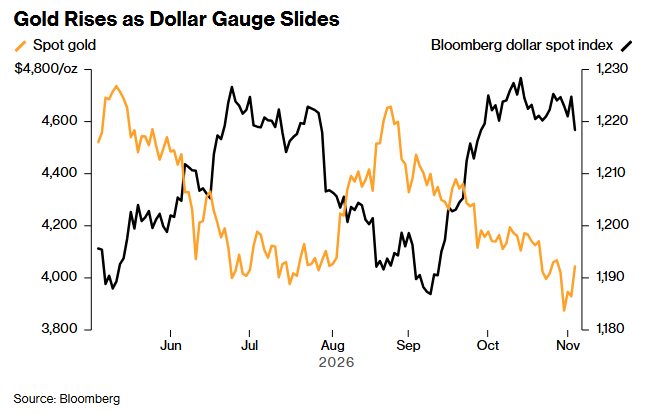
On Wednesday, influenced by news of the Democratic victory, yields across all maturities of the U.S. Treasury yield curve fell, while the U.S. dollar weakened by 0.4%. On Thursday, the U.S. dollar and Treasury yields declined further.
With the Democratic Party controlling both the House of Representatives and the Senate, while Republican Trump remains President, the United States will enter a state of "divided government." This may lead to several changes: the Trump administration will face greater resistance in pushing new fiscal stimulus and large-scale spending plans; the Democrats may block or limit parts of the Republican policy agenda; and tariff, trade, and geopolitical policies may face increased congressional checks and balances.
Meanwhile, the market interpreted the Democratic sweep as a political signal pointing toward de-escalation in the Iran conflict. U.S. Vice President Vance explicitly attributed the Republican defeat to Middle East wars on social media, further reinforcing the de-escalation narrative. These factors collectively contributed to the weakness in the U.S. dollar and Treasury yields. Since gold does not generate interest income, a weaker U.S. dollar and lower Treasury yields are generally favorable for gold prices.
Although this gold rebound marks the most significant breakout after months of sluggish performance, gold prices have still fallen by more than one-fifth since the outbreak of the US-Iran war in late February. The surge in energy prices triggered by the war has prompted a tightening of monetary policy.
In a report, OCBC Bank analysts, including Sim Moh Siong, stated: "Encouragingly, gold has once again responded positively to a favorable macroeconomic environment. We are cautiously optimistic that gold prices may be finding a bottom. However, the easing of expectations for Federal Reserve policy tightening and the renewed rise in investment demand remain key to sustaining the upward trend in gold prices."
Traders will focus on the US non-farm payrolls report scheduled for release on Friday to seek further clues regarding economic and interest rate trends. If the data indicates that inflation is under control, it would provide greater room for the Federal Reserve to implement monetary policy easing.
Looking ahead to the fourth quarter, global demand for gold ETFs, Western market gold bars and coins, derivatives, and over-the-counter transactions may face the interplay of multiple macro forces: rising policy rates, higher bond yields, and a stronger US dollar could suppress gold demand; meanwhile, fiscal concerns, inflation risks, geopolitical tensions, and financial market pressures are expected to support gold demand.
Regarding the gold market outlook through the end of the year, Louise Street, Senior Market Analyst at the World Gold Council, believes that bullish and bearish factors are roughly balanced. Although rising interest rates and diverging inflation expectations may exert pressure on gold prices, the intertwining of geopolitical risks and financial market stresses may prompt market participants to turn to gold in search of stability.
Edited by Melody