
JPMorgan expects the global oil market to have returned to a supply surplus: in October, the surplus widened to 1.4 million barrels per day, close to last year's full-year average. This shift is being driven by three factors: the continued recovery of Middle Eastern supply, steady production increases in Latin America, and a sharp decline in global demand. In addition, as expectations for a U.S.-Iran ceasefire rise, Brent crude has fallen from $118 to $103 within days. The firm estimates a fair value of $94 per barrel, leaving about $9 of upside potential yet to be realized.
Oil prices are under dual pressure. On one hand, there are reports of a potential U.S.-Iran ceasefire; on the other, JPMorgan's latest research report reveals a key shift—the global oil market has once again slipped into a supply surplus.
According to Wind Trading Desk, JPMorgan's commodity research team estimates that the global oil market surplus was about 1.1 million barrels per day in September, expanding further to 1.4 million barrels per day in October—roughly on par with last year's full-year average surplus level of 1.3 million barrels per day.
The market has stopped destocking and begun rebuilding inventories.
This conclusion can be corroborated from two perspectives: trade flows and inventory data.
Global crude oil imports averaged 43.0 million barrels per day in September, up 500,000 b/d year on year; in October, they rose further to 44.9 million b/d, an increase of 1.3 million b/d compared with the same month last year.
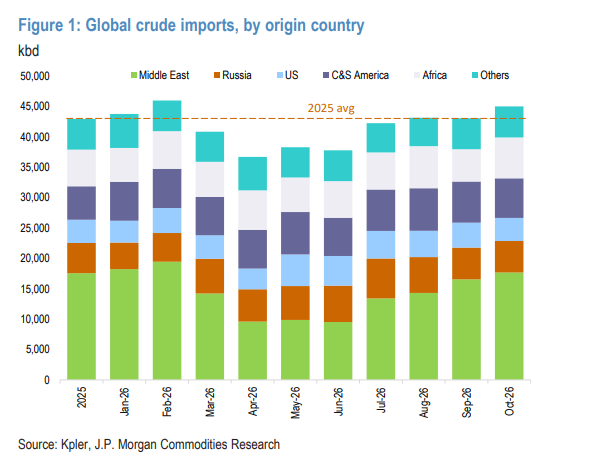
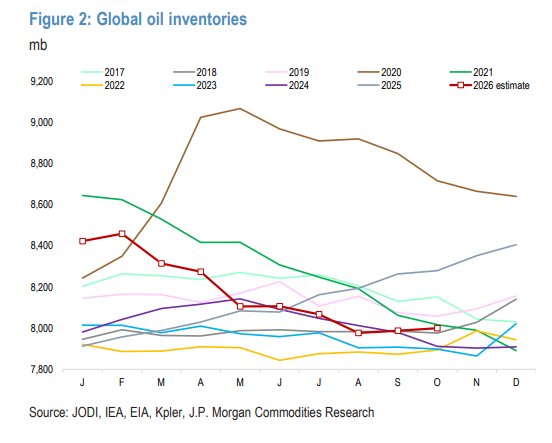
Inventory data also points in the same direction. South Korea's strategic petroleum reserves have rebounded from a June low of 50 million barrels to 67 million barrels, a five-year high; over the past three weeks, OECD member countries in Europe have collectively added roughly 11 million barrels of crude oil to their inventories. Overall, global inventories currently stand at approximately 7.999 billion barrels, up 23 million barrels from August and 12 million barrels from September.
Where does the surplus come from? Three forces are pushing in the same direction.
In its report, the bank attributed the market's return to surplus to three overlapping forces.
First, Middle East supply continues to recover.
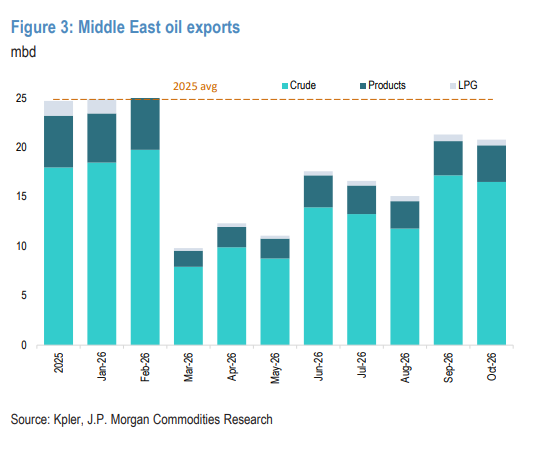
Since the outbreak of the war, oil flows in the Middle East have experienced repeated disruptions and an uneven recovery. However, the trend is clear: Middle Eastern oil exports have rebounded from a March low of 9.8 million barrels per day to around 20.7 million barrels per day today. Although still below the pre-war average of 24.7 million barrels per day, this recovery has brought back substantial volumes that had previously been absent from the market.
Second, increased production in Latin America will fill the gap.
Unlike the intermittent disruptions in Middle Eastern supplies, production increases in Latin America have been more steady and sustained. The region is currently delivering roughly 1.5 million barrels per day more crude to the global market than a year ago, with Brazil accounting for about 800,000 b/d, Venezuela around 400,000 b/d, Guyana approximately 300,000 b/d, and Argentina roughly 100,000 b/d.
Third, global demand has contracted sharply.
This is a factor that is often underestimated in the market's rebalancing process. Since the war began, global oil consumption has fallen by an estimated 3.3 million barrels per day; the decline reached 4.1 million b/d in September and 3.5 million b/d in October. Record-high oil prices and supply disruptions have forced consumers to cut usage sharply, and this contraction in demand has absorbed much of the shortfall in supplies of refined products, liquefied petroleum gas, and petrochemicals.
Consider the three forces together: Middle East oil flows remain 4 million barrels per day below pre-war levels, but production increases elsewhere have offset about 1.5 million barrels; meanwhile, demand has fallen by roughly 3.8 million barrels per day, ultimately resulting in a global oil market surplus of 1.4 million barrels per day in October.
Crude Oil and Refined Products: One Is Building Up Stocks, the Other Is Losing Demand
However, this round of excess is not balanced.
The report specifically notes that crude oil and refined petroleum products are heading in starkly different directions.
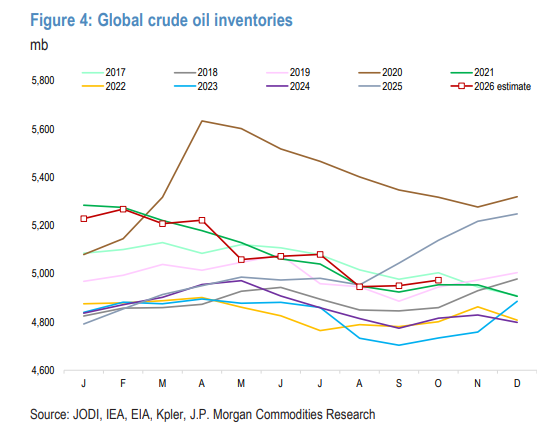
On the crude oil front, the global supply gap caused by the war has largely been closed. The resumption of crude flows from the Middle East, combined with increased production elsewhere, has not only filled the shortfall but has even begun to create a surplus, causing crude inventories to rebound starting in September after a sharp decline in August.
In the refined petroleum products sector, the situation is quite the opposite. Diesel, gasoline, liquefied petroleum gas, and other products that Middle Eastern refineries and processing facilities would normally supply cannot be easily replaced by refining capacity elsewhere in the world—because such capacity is inherently insufficient. Ultimately, the shortfall is not offset by increased supply but is absorbed through a sharp contraction in demand.
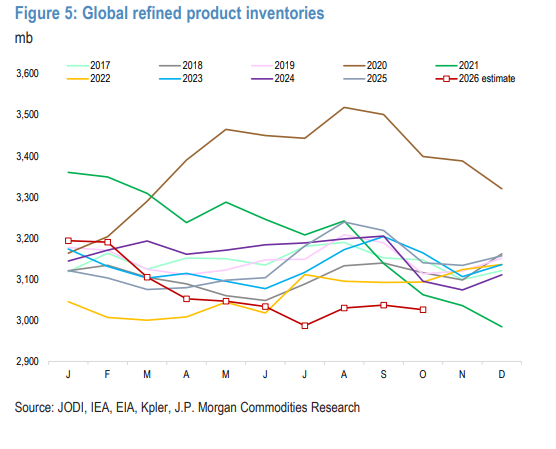
The result is that crude oil inventories are rebuilding, while refined product inventories continue to decline. Global refined product inventories currently stand at around 3 billion barrels, near the lower end of the historical seasonal range, with the United States accounting for the bulk of the drawdown. The firm estimates that refined product inventories were flat or even slightly down in October, continuing the sustained downward trend that began in February this year.
Oil price premiums are fading fast—where does fair value lie?
The reality of oversupply, coupled with expectations of a ceasefire, is jointly eroding the "geopolitical risk premium" previously embedded in oil prices.
Brent crude oil fell from $118 per barrel last Friday to $103 on Tuesday, wiping out $15 in just a few trading sessions.
The bank estimates Brent's fair value at $94 per barrel. Based on this, the premium over current prices has narrowed from a previous $24 per barrel to about $9, with more than two-thirds of the premium erased in just a few days.
In other words, if expectations of a ceasefire are further realized and the oversupply situation persists, there is still room for oil prices to converge toward their fair value.
Editor/Joe