
"I attempted to invest in DeepSeek, but U.S. law prohibits it."
Eric Schmidt, former CEO of Google, made this remark during a dialogue at the Masters of Scale summit in San Francisco on October 22.
He stated that when restrictions were initially imposed to prevent China from accessing advanced AI chips, it was believed these measures would remain effective for approximately a decade. However, the gap between China and the United States in the field of artificial intelligence may now have narrowed to just six months.
 Schmidt’s assessment warrants close attention.
In 2001, he joined Google, which had been established only three years prior, as its CEO. Over the following decade, he worked alongside founders Larry Page and Sergey Brin to transform Google into a global technology giant.
After stepping down from frontline management at Google, his influence gradually extended into the realms of U.S. technology and national security policy. In 2016, he became the inaugural chairman of the Defense Innovation Board of the U.S. Department of Defense. He subsequently served as chairman of the National Security Commission on Artificial Intelligence, participating in the formulation of U.S. strategies regarding AI, advanced semiconductors, and national security. He is currently the CEO of Relativity Space.
In 2021, the commission he led released a final report spanning 756 pages, which systematically addressed how the United States could maintain its global leadership in artificial intelligence and respond to China’s technological catch-up.
Schmidt was also among the earliest figures in the U.S. technology sector to take seriously the competitive strength of China’s AI capabilities.
As early as 2017, he warned his American counterparts that the pace of China’s AI development should not be underestimated.
Following the rise of DeepSeek in 2025, he further re-evaluated the actual effectiveness of U.S. restrictions on advanced chip exports and published articles discussing China’s transition from a technology follower to an innovator.
In this latest dialogue, he not only acknowledged China's progress in algorithmic efficiency and open-weight models but also emphasized China's capacity to translate AI technologies into practical applications.
"We are the ones inventing cutting-edge technologies, while they are the ones truly deploying them." Schmidt, who visited China just a few months ago, advised U.S. hardware entrepreneurs to visit China for firsthand observation.
He further predicted that over the next decade, Chinese AI models could achieve a larger global user base, driven by lower costs and broader applications.
"Ultimately, the majority of people worldwide will be using Chinese models."
Schmidt's assessment is particularly worth considering in light of the new developments currently facing the U.S. AI industry.
With the results of the U.S. midterm elections now clear, the Republican Party has lost control of both chambers of Congress, while the Democratic Party has won several gubernatorial races, including in Texas.
Following the election, investors in Silicon Valley have begun to worry that data center construction may face stricter local approvals as well as energy and environmental regulations.
Brad Gerstner, founder of Altimeter Capital, even estimates that 10 to 15 gigawatts of the AI computing infrastructure originally planned in the United States may fail to be built on schedule due to policy and regulatory hurdles.
These are merely projections, not canceled projects. However, they serve as a reminder to investors that the constraints on U.S. AI development extend beyond whether massive capital expenditures will yield returns; they also include electricity supply, land availability, local policies, and society's capacity to withstand this unprecedented investment boom.
Just how large is this round of investment?
In its mid-year investment outlook, Capital Group made an intriguing historical comparison.
After joining the World Trade Organization in 2001, China invested approximately $20 trillion in industrialization over the following decade. This wave of investment profoundly transformed global trade, commodity markets, labor markets, and capital flows.
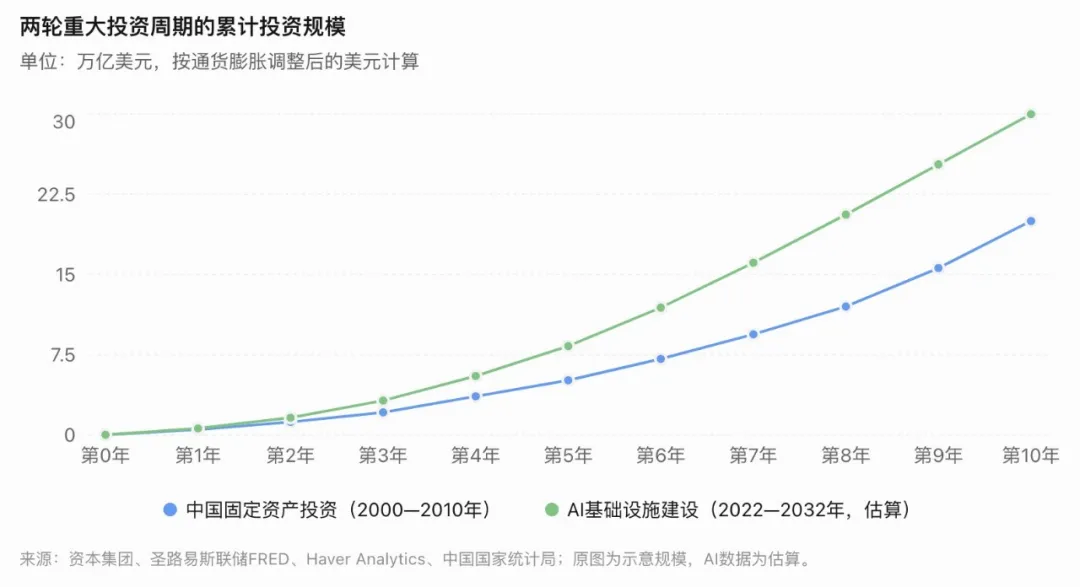
According to Capital Group’s estimates, if AI investment continues along its assumed growth trajectory, cumulative global AI-related investment could reach $30 trillion by 2032, surpassing the scale of China’s industrialization during that period.
Of course, the $30 trillion figure is a scenario-based estimate predicated on continued growth in future spending, rather than a confirmed investment plan.
Jared Franz, a U.S. economist at Capital Group, argues that we should not view AI merely through the lens of the technology sector cycle or NVIDIA’s valuation. Instead, we should recognize its potential lasting impact on economic growth, electricity demand, capital allocation, labor markets, and asset prices across various industries.
Interestingly, as the United States seeks to maintain its technological lead through such massive capital infusion, Eric Schmidt has cautioned observers to note China’s advantage on a different path: achieving broader practical application of AI at lower cost and higher efficiency.
Nevertheless, Schmidt has not altered his stance on the need for the United States to maintain its technological leadership. However, he also believes that the AI competition between China and the United States is not a zero-sum game.
This roughly 27-minute conversation also reveals how a key figure long involved in shaping U.S. technology strategy is reassessing China’s competitiveness in AI. The host was Bob Safian, former editor-in-chief of the prominent U.S. business media outlet Fast Company.
Below is the latest dialogue curated by Smart Investors for our readers.
01. The AI gap between China and the United States has narrowed to approximately six months
Safian: Regarding the development of AI in China, we often hear bellicose rhetoric that makes it difficult to discern the reality. Therefore, I am delighted to have you here today to help us clarify these issues.
The United States originally held a clear first-mover advantage in the field of artificial intelligence, but there is now growing skepticism about whether this advantage can be sustained. You have previously stated that the AI gap between China and the United States has narrowed to approximately six months. What significant changes have occurred recently?
Schmidt: The most significant change over the past year, which everyone present should note, is that the cost of software has plummeted from being very expensive to nearly zero. When the price of something drops sharply, its quantity increases substantially.
Thus, as I look ahead to the coming years, my focus is on the following: We will have an enormous volume of software. What functions will this software perform? Who will develop it? How will these systems interact with one another? How will AI agents operate? And so on.
China is grappling with the same questions.
In my view, the competition between China and the United States is the most decisive rivalry for your generation, our generation, and indeed our era. This is because both sides are striving to develop reasoning and intelligence systems that surpass human capabilities.
This does not imply that these systems will become human-like; rather, they will possess capabilities exceeding those of humans, known as superintelligence. In fact, such capabilities have already emerged in certain domains.
Consider the Waymo autonomous vehicles on the road today; their visual perception exceeds that of human drivers, particularly given that they do not drive under the influence of alcohol. I believe you understand my point.
Let us return to the AI competition between China and the United States.
A few years ago, I was among those advocating for restrictions on China's access to advanced chips. At the time, I believed these measures would remain effective for approximately a decade.
A year or two ago, China appeared to be one to two years behind the United States. Currently, that gap has narrowed to approximately six months, a judgment supported by numerous studies.
How have they achieved this?
After all, haven't we restricted China's access to advanced chips? Indeed, we have. However, the Chinese are highly resourceful; they have found ways to leverage algorithms developed and knowledge accumulated by us to achieve comparable technological capabilities with roughly one-tenth of the energy consumption, although gaps remain in certain performance metrics.
The entire industry is now debating whether this gap will continue to narrow or widen again in the future.
But at least for now, it is fair to say that this has become a race between two superpowers: China and the United States. In my view, this is the most decisive competition of our time.
The race for leadership in the field of artificial intelligence is, without exaggeration, a competition of millennial significance. Once such intelligence truly emerges, our children, grandchildren, great-grandchildren, and subsequent generations will be fundamentally affected by the changes taking place today.
Safian: Some argue that emphasizing China's progress in AI is merely an excuse to delay regulation. Do you find this argument valid? Does this concern you?
Schmidt: People will always concoct various narratives.
I have been deeply involved in related discussions between China and the United States. Before Dr. Kissinger passed away, I worked with him to promote communication between the two countries. I accompanied him on his last trip to China, where he met with national leaders.
The Chinese are fully aware of the nature of this competition and the potential dangers posed by AI, but they will not stop.
Therefore, one way to answer your question is to reframe it: If we wanted to slow down the pace of AI development, what exactly should we do?
How many frontier AI labs are there in the United States today? Five, six, or seven? Roughly that number. And in China? Also five, six, or seven. This means you are dealing with a problem involving approximately twelve stakeholders.
In China, the government can theoretically mandate these labs to act in accordance with its directives. In the United States, however, you must rely on voluntary agreements among the relevant companies.
Thus, this issue involving twelve stakeholders is simplified into a bilateral matter between China and the United States.
The subsequent challenge is that, given China already perceives itself as lagging behind, how could we possibly persuade them to slow down? It is simply not feasible.
We must seek alternative approaches to ensure the safety of this technology while continuing to advance technological development and maintain our competitive lead over China.
02. I attempted to invest in DeepSeek, but U.S. laws prohibited it.
Saffian: In certain respects, China holds structural advantages. The government can designate AI as a national strategy, aligning all parties toward a common objective. You have previously argued that the United States’ strength lies precisely in its diversity and decentralization. These represent two distinctly different development models.
Are there any practices within China’s AI industry that U.S. leaders would benefit from studying?
Schmidt: Let me provide you with a simple analytical framework.
China possesses robust energy supply capabilities and abundant renewable energy resources. A decade ago, the United States also pledged to achieve similar goals, but we fell short.
China does not require companies to wait seven years in queue for grid connection, nor does it face the same types of debates seen here. They are building data centers on a massive scale.
Furthermore, despite greater restrictions in its financial markets, China remains capable of providing financing to startups.
It is illegal for Americans to invest in DeepSeek; I know this because I attempted to do so myself. Believe me, under U.S. law, this is indeed prohibited.
(The U.S. Department of the Treasury's outbound investment security rules took effect on January 2, 2025, imposing prohibition or reporting requirements on U.S. persons investing in certain Chinese artificial intelligence, semiconductor, and quantum information technology enterprises.)
DeepSeek is currently seeking financing. To my knowledge, they recently completed a substantial funding round, and the capital appears to be secured. My Chinese contacts informed me that the funds originated from the private sector and that they consider the business economically viable.
There is also a highly complex open-source issue involved, which we can discuss later.
Fundamentally, however, China has advanced along its own path. Their most critical shortage at present is chips.
In the United States, we possess all the necessary resources: talented individuals, diverse debates, and a financing market of remarkable depth.
Where else in the world can you raise $50 billion with a single text message? Apart from the United States, few other places can achieve this.
Thankfully, the U.S. financial sector is providing funding for the pursuits of individuals like us. As for the outcome, we shall wait and see.
However, the United States faces shortages in both energy and data centers. The correct solution is to build our own power supply systems.
There is a quote attributed to Alexis de Tocqueville: “America is great because of the optimism of its people, its vast land, and the absence of a king.”
At the very least, we can still measure ourselves against these three criteria.
The United States indeed possesses abundant land, with many areas remaining undeveloped. Data centers should be built in these locations. This would benefit local economies and allow for the concurrent construction of supporting power generation facilities.
This is precisely what we need to do.
Current estimates suggest that by 2030 or 2031, we will require approximately 60 to 80 gigawatts (GW) of power supply capacity. Whether sufficient financing can be secured for these projects remains to be seen.
Based on my estimates, the investment required for related infrastructure is approximately $50 billion per gigawatt of power demand. For context, one gigawatt is roughly equivalent to the installed capacity of a large nuclear power unit. To my knowledge, the United States cannot deploy nuclear units at such a rapid pace.
03. China chooses open source, while the United States chooses closed source. Which path will prevail?
Saffian: You just mentioned open source. China’s leading position in open-source models, or open-weight models, has facilitated the global spread of Chinese AI. For the business leaders present today, is it a wise choice to develop based on China’s open-source models?
Schmidt: Let us first clarify the concepts.
First, there is open source. When I was at Berkeley, I participated in the early development of the open-source movement, a contribution of which I remain very proud. That was a long time ago, but the code I wrote back then is still open source today. If you wish to examine those very old codebases, they are still accessible.
In addition, there is open weights. Open weights refer to the practice of investing substantial capital to train a model and then publicly releasing the resulting parameters. The volume of these parameters is enormous, potentially reaching into the trillions. (Note that open weights do not necessarily equate to fully open source.)
China’s strategy relies heavily on open source and open weights, whereas the United States’ strategy primarily emphasizes closed source and closed weights.
From the perspective of U.S. companies, this approach is entirely logical. Training a model costs between $100 million and $500 million, correct?
Saffian: Exactly. Given such significant expenditure, why would one give it away for free?
Schmidt: That is precisely the argument lawyers would make.
I have debated with lawyers for fifty years. I have always maintained that certain assets should be provided free of charge, as this facilitates the establishment of a platform.
The fundamental principle of the open-source movement is to first establish a platform upon which others can develop their own solutions.
The closed-source model operates differently. A classic example from the early days is Microsoft, under the leadership of Bill Gates and Steve Ballmer. Their primary focus was on end users, with product quality ultimately validated by market acceptance.
In the United States, open source has largely prevailed, becoming the foundation for much of today’s technological work. However, most large AI models remain closed-source. There are sound reasons for this, and I am not criticizing them.
Of course, there are also some divergent examples.
For instance, Reflection AI recently released a model with 500 billion parameters. NVIDIA’s Nemotron features a similarly sized model, and both are highly powerful. Google also has a model called Gemma 4, which is a very powerful smaller-scale model. These models are available for download and use.
Therefore, this is not simply a matter of binary opposition between China and the United States.
China has chosen open source and open-weight strategies because they represent the most rational approach for its context. Initially lagging behind, China needed to rapidly acquire users and was willing to accept the risk of its technology being appropriated by others.
Currently, this approach appears to be working, at least in terms of securing financing.
Consequently, the competition between open-source/open-weight and closed-source/closed-weight models will be a critical factor determining the future landscape of the AI industry.
If you ask those from open-source enterprises or closed-source model companies in San Francisco, they will all claim that their respective strategies are superior, as they believe they can maintain their lead.
If you ask Chinese stakeholders, they will likewise assert that their strategy is better, believing it enables them to stay ahead.
Thus, we are facing a genuine competition.
However, open-source models and open-weight models also face a difficult challenge. We have invested significant effort into this issue, but so far, I believe no effective solution has been found.
Consider that closed-source models are controlled by corporations, which are bound by the laws of their respective countries, and CEOs must comply with legal requirements. In China, the government exercises strong regulatory control over AI laboratories.
Open-weight models, however, are different.
Once model weights are made public, it becomes difficult to control how others use these models, even if developers have implemented safety restrictions.
A technique known as "safety mechanism stripping" can essentially remove a model's original safety constraints, resulting in an unconstrained model. Such models could be used for cyberattacks, and developers find it increasingly difficult to control where they end up or who uses them.
Even more concerning is the rapid decline in software costs.
Recall my earlier point: software costs are approaching zero. In the coming months, the expansion of software capabilities will be astonishing. This is why technologists in San Francisco and elsewhere are deeply concerned, with some beginning to ask whether the pace of AI development should be slowed down.
But as we discussed earlier, it is nearly impossible to simultaneously slow down AI laboratories in both China and the United States.
This is a highly thorny issue. Many believe that a cybersecurity incident may occur within the next 12 months, forcing everyone to truly recognize the severity of this problem.
Safian: So, if I am a business leader deciding to use Chinese models because they are lower in cost for me, would that be considered unpatriotic? Does it reflect a lack of long-term vision?
Schmidt: To some extent, CEOs of U.S. companies are patriotic, but they are also highly focused on financial returns.
There are already many examples of people using small-scale servers to run open-weight models for solving specific problems, as this approach offers lower token costs.
If you deploy the model yourself, token costs can be reduced to approximately one-third to one-fifth of the original level. Of course, these models are not as powerful in terms of capabilities.
Therefore, I am concerned that a future landscape may emerge in which state-of-the-art models dominate areas of critical importance, driving incredible breakthroughs in fields such as mathematics and chemistry.
For mathematicians, this is nothing short of an apocalyptic disaster. The fundamental landscape of their world has remained virtually unchanged for the past 50 years, dating back even to when Gödel proposed his relevant theories. Yet suddenly, this world was upended within a single month. They now face an existential crisis regarding their professional relevance.
This is the change that frontier models will bring about.
However, for most of us, resolving financial accounting issues does not require such advanced mathematical capabilities. Believe me, financial accounting is not that complex.
Thus, in the future, a large number of users may adopt these more affordable open-weight models to handle various daily tasks.
Is this approach permissible? In the United States, it is likely legal.
But whether it is a sound strategy depends on how you assess risks such as those related to geopolitics.
In China, of course, people will use open-weight models.
04. Item-by-item scoring of the US-China AI competition: China may lead in deployment speed and global influence
Saffian: We have prepared a scoreboard. I will propose several indicators, and you will determine who holds the advantage: China or the United States. Let’s start with model performance.
Schmidt: The United States. According to current benchmarks, the US is in the leading position.
One way to understand this is that every AI laboratory has models already released, as well as next-generation models under development.
Based on information disclosed by these laboratories, the performance of next-generation models will be exceptional. This indicates that scaling laws remain valid and that astonishing breakthroughs are yet to come.
Therefore, regarding model performance, I choose the United States.
Saffian: Good, the next item is model cost.
Schmidt: China.
As I mentioned earlier, the token cost for Chinese models is at least three times cheaper.
In many ways, this is actually because they were forced to cut costs. Since we did not provide them with high-performance chips, they turned to algorithmic improvements, supervised fine-tuning, and other highly impressive technical approaches.
Interestingly, whenever the Chinese develop something in the open-source domain, Americans immediately adopt it. Thank you, China!
Saffian: Alright, next is energy. I assume this category goes to China, as you have mentioned earlier.
Schmidt: Well, you guessed correctly.
I recall that China’s relevant energy construction capacity last year was approximately 560 gigawatts. This is a staggering figure.
This is the benefit of national industrial policy. If they need energy, they build on a massive scale, and the vast majority of it is renewable energy.
Saffian: Good, let’s look at another indicator regarding leadership and talent.
Schmidt: I would award this category to the United States.
However, the U.S. is engaging in some very foolish actions. I imagine no one here today would be surprised by this.
Arresting the brightest minds and expelling them from the country, or denying them the essential visas needed to enter the U.S., is absolutely a poor strategy.
We provide them with education, enabling them to earn doctoral degrees, and then we deport them. A brilliant strategy, isn’t it?
It is truly foolish.
Safian: The next item is security controls.
Schmidt: The United States has a superior security control framework.
A series of meetings have been held in the past, some of which I attended. During these sessions, various laboratories agreed to exchange best practices on safety, among other topics.
I believe that, broadly speaking, we should anticipate eventual government regulation of AI.
This is not to say that I welcome regulation; rather, because AI will permeate every aspect of society, adverse consequences are inevitable, and these consequences will inevitably drive the introduction of regulatory measures.
Safety is the most evident area of concern, including issues such as aligning AI with human objectives.
Safian: The next item is deployment speed.
Schmidt: China. We are the ones inventing cutting-edge technologies, while they are the ones actually deploying them.
I visited China just a few months ago, and I will be returning next month.
The pace at which AI is being applied across various domains in China, from digital systems to mechanical equipment, is nothing short of astonishing. Moreover, they are very eager to showcase a wide range of demo products.
There are simply no comparable products in the United States.
Therefore, if anyone here is currently developing hardware, I encourage you to visit China and see for yourself, as China is outpacing us in this sector.
This category clearly belongs to China.
Safian: The final item is global influence.
Schmidt: If measured by its impact over the next decade, this category will belong to China.
What is the biggest difference between free and paid products? Free products tend to have a larger user base, correct?
The vast majority of countries worldwide lack the economic strength and wealth necessary to bear the costs we require, including token costs and other associated fees.
I understand why U.S. companies adopt such pricing strategies, and I do not intend to criticize this approach.
But for me, one thing has become very clear: ultimately, the majority of people around the world will use Chinese models.
This carries significant geopolitical implications. Most of the geopolitical experts I have engaged with have not yet fully realized this.
Yet, with just a moment’s reflection, the answer becomes obvious.
On one side, there are free, affordable, and sufficiently capable models; on the other, expensive and powerful models that primarily serve elites, the wealthy, major corporations, and top-tier research institutions.
5. AI is not a zero-sum competition; China and the United States can cooperate and advance together
Saffian: Are we overlooking something? Is it possible for both the United States and China to emerge as winners? Or is this destined to be a zero-sum game?
Schmidt: I do not believe AI is a zero-sum game, and China is not our enemy.
I have experienced such markets in the past, where two companies, despite competing with each other, ultimately co-created an entirely new market.
Therefore, the ideal scenario would involve some form of rational dialogue between American and Chinese elites. Of course, under the current U.S. administration, this is clearly unattainable.
But if it were possible, we should sit down and discuss: “How exactly should we manage all of this? Can we reach consensus on certain issues?”
For instance, establishing a "no-surprise rule."
During my tenure at the Pentagon, I learned that when a country launches a missile, it notifies other nations. In response, those countries direct their satellites to monitor the launch.
There are two reasons for this practice. First, to verify that the launching party conducts the launch in accordance with prior notifications; second, it allows them to train and calibrate their missile launch monitoring systems.
This represents a coordinated arrangement among parties aimed at ensuring collective security. No one wants a scenario where a missile is launched unexpectedly without any knowledge of its trajectory.
This approach is entirely logical, and such institutional arrangements were established as early as 50 years ago.
Therefore, I believe that China and the United States can identify a series of wholly reasonable areas for cooperation, with the ultimate goal of fostering human prosperity and development.
Finally, I would like to state that AI is the most significant development we will witness in our lifetimes.
AI serves as the foundation for scientific progress, which is the focus of my current work. Scientific progress generates wealth, which in turn creates opportunities, well-being, and various benefits enjoyed by society as a whole.
Due to our current advancements in the field of artificial intelligence, the future lives of our children and grandchildren will be exceedingly bright.
Indeed, we face numerous challenges. However, I believe it is crucial that we continue to devote our full efforts to this endeavor.
The pace of technological innovation has become so rapid that even I, despite my long tenure in this industry, struggle to keep up.
06. AI has transformed the way I work, invest, and manage businesses.
Saffian: To the business leaders present today, do you have any specific message to convey? If the United States is to emerge as the ultimate winner, what different actions should they take now?
Schmidt: First, start using AI.
I particularly enjoy scenarios where someone approaches me and talks at length about artificial intelligence. I simply ask them, “Have you actually used it yourself?”
He replies, “No, no.”
Well, perhaps he is smarter than I am.
But I believe you must use these tools personally.
One experience that truly astonished me was when I began leveraging AI for long-chain thinking and deep reasoning.
My reaction at the time was, “My goodness, it has truly arrived!”
At that time, I was not entirely sure if I fully understood what exactly lay before me, but I knew it had arrived.
It changed the way I think about life, as well as how I work, invest, and manage businesses.
Take a clear example: for AI systems, financial functions are relatively straightforward to handle. Why not let AI generate financial reports? Then, you and the CFO can discuss directly based on those reports. That would be very interesting.
What about inventory management in manufacturing? Safety management? Cash flow forecasting? You might sit there thinking, “Oh, these things are so boring.” No, these matters are transformative.
Because once your mindset shifts in this way, new ideas will continuously emerge. One idea leads to another, and then to yet another.
This is why living in an era like today is such a precious privilege.
Edited by Rice