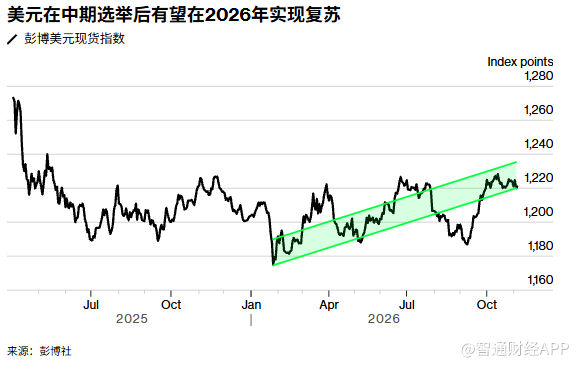
Foreign-exchange strategists say that although the outcome of the U.S. midterm elections briefly weighed on the dollar, the factors driving its strength over recent months remain largely unchanged. The Bloomberg Dollar Spot Index fell on Wednesday as traders assessed the implications of a policy stalemate in Washington following the Democrats' gain of control of Congress. However, the index steadied on Thursday despite a decline in U.S. equities; it now stands less than 1% below the nearly 18-month intraday high hit in October. Moreover, options markets indicate that traders expect the dollar to appreciate by year-end.
Growth and expectations of interest rate hikes constitute the core support.
Institutions including Bank of America, Standard Chartered Group, and hedge consultancy Chatham Financial believe that the key lies in the fact that this major global reserve currency will continue to be supported by at least two critical factors—the resilience of the U.S. economy and market expectations for Fed rate hikes over the next year.
Despite the sharp sell-off in large technology stocks following the U.S. midterm elections and growing uncertainty about foreign demand for such shares, some traders still view the dollar as a standout among major currencies.
 "I still believe the U.S. dollar is king," said Thomas Kikis, head of U.S. and Americas markets at Standard Chartered Bank.
Kikis said that supporting this view is the possibility that the U.S. economy could outperform Europe's, while Europe would need to rely on U.S. energy supplies. However, he is concerned that Washington's political landscape could evolve into a negative factor, thereby altering the economic outlook.
The U.S. dollar saw little movement this week. On Thursday, it edged higher as technology stocks tumbled, amid concerns that a Democrat-controlled Congress might propose stricter regulations for U.S. data centers.
The U.S. market is currently awaiting the monthly nonfarm payrolls report due on Friday, as well as next week's new inflation data. The jobs report is expected to show accelerating employment growth, while economists anticipate that next week's figures will indicate easing consumer price pressures.
These data are crucial for shaping expectations about the Federal Reserve, after traders scaled back bets on a rate hike as early as next month. Markets currently price in at least one rate hike by mid-2027, possibly two; earlier this week, they had expected two hikes by then.
Tech Stocks and Oil Prices Stirred, Institutional Views Diverge
Dom Bunning, Nomura's G-10 FX strategy head, pointed to a potential feedback loop that could weigh on the U.S. dollar: reduced capital inflows into U.S. equities and lower Treasury yields would translate into a weaker dollar.
"As the Nasdaq index continues to fall, we are increasingly seeing that the U.S. dollar is not entirely the 'safe-haven asset' it has historically been," Bunning said. Their positioning is a bet on the yen strengthening against the dollar, which he calls "the best FX trade in an environment of falling equities and yields."
The dollar was little changed in early Asian trade on Friday.
Sarah Ying, head of FX strategy at the Canadian Imperial Bank of Commerce, expects the U.S. dollar to weaken, partly because AI trading is facing increasing pressure. She is also closely watching whether factors such as falling oil prices will erase the so-called "Trump premium" after the election.
Brent crude oil plunged this week as market speculation that Middle East tensions might ease pared its year-to-date gains. Rising energy prices during the Iran war have stoked inflation concerns and boosted bets on Federal Reserve rate hikes.
There are more call signals than put signals, but upside potential is limited.
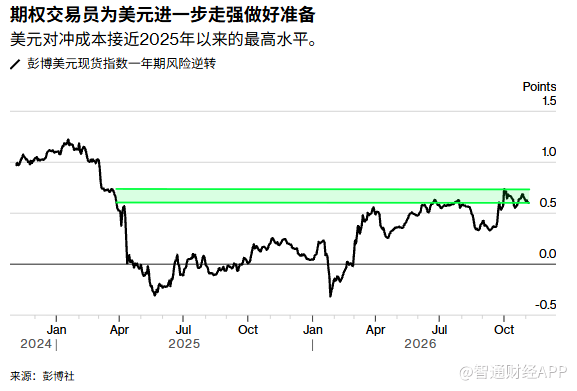
In the options market, traders are sending strong signals of confidence in the dollar's outlook through year-end. The one-year risk-reversal indicator, a barometer of market positioning and sentiment, shows investors near their most bullish level since early 2025.
Bank of America strategist Alex Cohen said this week that he expects a strong showing by Democrats in the midterm elections to be slightly negative for the U.S. dollar. Given the U.S. growth and inflation outlook, he anticipates that the dollar's weakness will be short-lived.
Data show that forecasting institutions expect the U.S. to post an annualized GDP growth rate of 2.3% this year, adjusted for inflation, while the eurozone is projected at 1% and Japan at 0.8%. Amol Dhargalkar, Chairman of Chatham Financial, said: "Taking a step back, the outlook for the U.S. economy is quite strong—this is not hard to paint." He added that when discussing the U.S. dollar, one must of course view it relative to other assets; compared with other major economies, the U.S. is the most attractive in this context.
However, with investors waiting to see how the political stalemate will affect policy and the economy, the dollar's upside appears limited for now. He said, "So the dollar will largely remain stagnant."
Editor/Joe