Goldman Sachs believes that the Fed's anticipated rate hike in December 2026 will continue to suppress Western investors' demand for "currency depreciation hedging." The market is reenacting the 2022 scenario: while central banks' monthly average of 60 tonnes of buying can provide support, high interest rates severely curb Western ETF investors, causing gold prices to abandon their one-sided upward trend and enter a stalemate characterized by "limited gains and heightened volatility." A turning point may arrive after rate cuts take effect in the second half of 2027; when ETF inflows and central bank gold purchases resonate, gold prices could regain momentum.
Goldman Sachs has sharply lowered its gold price forecast, and the Federal Reserve's hawkish pivot is suppressing investor demand. Despite the continued strong central bank gold-buying spree, gold's short-term upside remains significantly constrained.
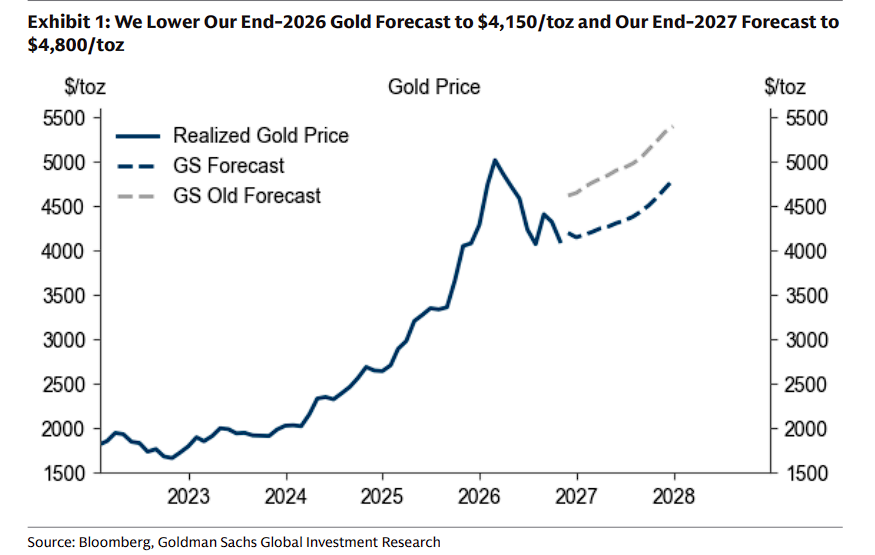
According to the Zhaifeng Trading Desk, Goldman Sachs' commodity research team released its latest precious metals research report on November 5, significantly lowering$XAU/USD (XAUUSD.CFD)$Price forecast: The year-end 2026 target price has been lowered from $4,650 per ounce to $4,150 per ounce, and the year-end 2027 target price has been reduced from $5,400 per ounce to $4,800 per ounce.
 Goldman Sachs notes that although the recent rebound in the bond market has brought pricing closer to its economists' forecasts for the Fed's terminal rate, the baseline scenario assumes that a hawkish pivot by the Fed and rate hikes through December 2026 will dampen investors' "currency depreciation" concerns, causing gold's macro policy hedging demand—reflected primarily in call option demand—to revert to its historical average rather than returning to year-to-date highs.
Goldman Sachs clearly stated that the current gold market landscape is increasingly similar to that of 2022: central bank gold purchases provide strong structural demand, but higher interest rates suppress investor holdings, resulting in a moderate increase in gold prices.
Meanwhile, Goldman Sachs maintains its long-term constructive outlook on central bank gold purchases, forecasting that monthly central bank gold buying will remain at 60 tonnes from 2026 to 2027—well above the pre-2022 average of 17 tonnes per month—but this structural support is unlikely to offset the downward pressure on investor sentiment from rising interest rates.
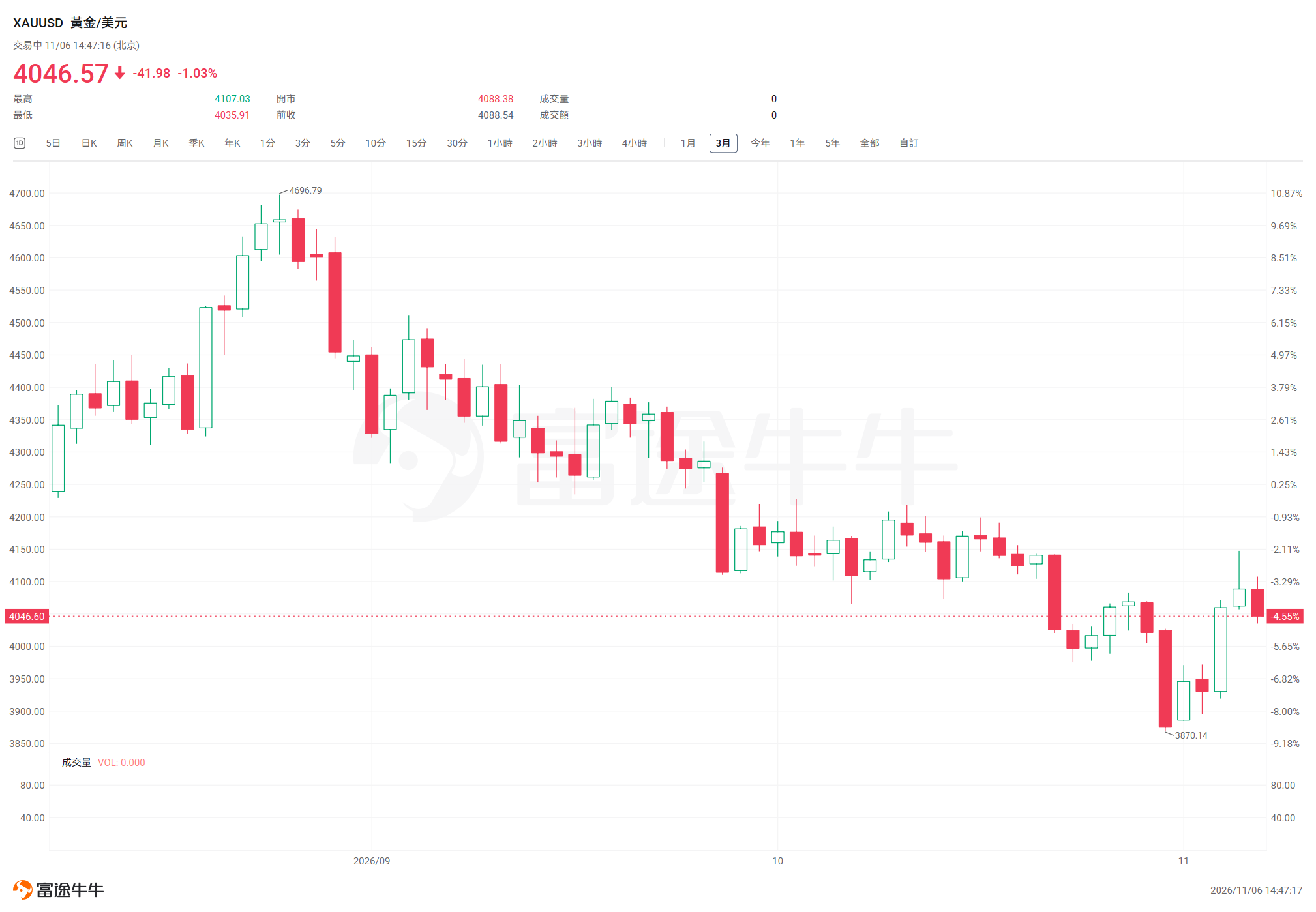
On Thursday, international spot gold fell by more than 1%, hitting a low of $4,035.91 per ounce. However, over the past two trading sessions, as oil prices and U.S. stocks declined, spot gold has staged a consecutive rebound, at one point climbing above the $4,100 per ounce mark.
Target price sharply lowered; the Fed's hawkish pivot is the key driver.
The immediate reason for Goldman Sachs's recent downgrade of its gold forecast is the profound impact of the Federal Reserve's recent shift to a hawkish stance on market positioning.
Specifically, Goldman Sachs will by the end of 2026$XAU/USD (XAUUSD.CFD)$The price target has been lowered from $4,650 per ounce to $4,150 per ounce, and the year-end 2027 target has been revised down from $5,400 per ounce to $4,800 per ounce.
Goldman Sachs' baseline scenario assumes that the Federal Reserve will raise interest rates again in December 2026, which will keep investors' "currency devaluation concerns" under pressure. Consequently, the macro policy hedging demand that previously drove gold sharply higher—specifically reflected in call option demand—is expected to revert to its historical average level, rather than returning to the highs seen in early 2026.
On the downside risk side, if the Federal Reserve were to implement an additional rate hike in March 2027, accompanied by a higher terminal rate and a delay in rate cuts, Goldman Sachs estimates that the gold price at the end of 2027 would be only $4,660 per ounce (a further decline from the baseline scenario of $4,800 per ounce).
Central bank gold purchases remain robust, but they cannot sustain the market on their own.
Despite the downgrade in the target price, Goldman Sachs maintains its stance on$XAU/USD (XAUUSD.CFD)$The long-term constructive outlook is underpinned by structurally strong central bank demand for gold.
Goldman Sachs forecasts that central bank gold purchases will remain at 60 tonnes per month in 2026–2027, far above the historical average of 17 tonnes per month prior to 2022. Goldman Sachs' real-time tracking data (GS Nowcast) shows that current central bank gold purchases have reached 85 tonnes per month on a seasonally adjusted three-month moving average basis.
From a structural perspective:
Central banks in emerging markets, particularly the People's Bank of China, still hold significantly less gold than would be warranted by their long-term allocation objectives.
The incentives for diversifying holdings of G7 reserve currencies—including geopolitical and financial risks—are likely to persist.
Notably, concerns about gold demand and reserve security are spreading beyond the confines of emerging-market central banks. Although developed-market central banks have long held substantial gold reserves and had largely remained on the sidelines of the gold-buying wave since 2022, current discussions have shifted from "whether to hold gold" to "where to store it," reflecting broader anxieties about reserve safety and cross-border trust.
However, Goldman Sachs points out that central bank gold purchases can only provide structural support and are unlikely to drive a significant rise in gold prices on their own in a high-interest-rate environment, which is precisely what makes the current situation highly similar to that of 2022.
The current situation closely resembles that of 2022: the central bank is providing support, while high interest rates weigh heavily.
Goldman Sachs explicitly draws a parallel between the current gold market and the situation in 2022: central banks are providing strong structural buying, but high interest rates are suppressing investor positions, thereby keeping net price gains moderate.
Historical experience in 2022 shows that, under such conditions, gold prices did not trend steadily lower; instead, gains were capped and volatility intensified. Ongoing central bank purchases provided support at the bottom, but persistently high interest rates significantly dampened Western investors' appetite to participate via channels such as gold ETFs.
The recent rebound in the bond market has brought pricing closer to Goldman Sachs economists' forecast for the Fed's terminal rate, but Goldman Sachs believes the Fed's hawkish stance will continue to suppress the recovery in macro hedging demand, thereby significantly constraining gold's upside.
Expectations of interest rate cuts in the second half of 2027 could serve as a catalyst for the next rally in gold prices.
Goldman Sachs economists expect the Federal Reserve to implement three rate cuts from the second half of 2027 to early 2028. Once the easing cycle begins, the constraint of interest rates on gold prices will be lifted, at which point:
Fund inflows into interest-rate-sensitive Western gold ETFs are expected to pick up again.
Private investor demand will once again resonate with structural central bank gold-buying demand.
The combined effect of these two forces will more fully translate into upward momentum for gold prices.
In addition, Goldman Sachs points to a potential upside scenario: if concerns about the fiscal sustainability of Western economies intensify—possibly exacerbated by higher military spending and the growing debt burden of energy-importing countries—and investors begin to question central banks in developed markets' willingness or ability to tackle inflation, demand for macro policy hedging could make a comeback, pushing gold prices above the baseline forecast of $4,800 per ounce.
Call Option Demand: A Key Mechanism Amplifying Gold Price Volatility
Goldman Sachs specifically analyzed in its report the amplifying effect of call option demand on gold prices, a mechanism that has become increasingly important since mid-2025.
Goldman Sachs's simple gold model indicates that for every additional 100 tonnes of net speculative demand (including Western ETF holdings, net managed fund positions, and central bank gold purchases), the price of gold rises by approximately 2%. However, since mid-2025, the actual volatility in gold prices has exceeded what can be explained by these underlying fund flows, while demand for call options has surged.
Goldman Sachs interprets this demand for call options as a reflection of hedging against macroeconomic policies or "currency depreciation": investors are paying a premium for the tail risk of a nonlinear surge in gold prices.
At the structural level, long call options can amplify gold price volatility in both directions:
As gold prices approach a key strike price, market makers who have sold call options must buy gold to hedge their exposure, thereby reinforcing the upward trend.
When gold prices fall, market makers may close out their hedging positions, further amplifying the decline.
Goldman Sachs estimates that for every increase of 1 million in GLD's net long call options open interest, the price of gold rises by about 5%.
Goldman Sachs stated that it is not currently incorporating this options-driven leverage effect into its baseline price forecast, as historical data on demand for high-strike call options are limited, leading to uncertainty in estimating the related effect.
However, Goldman Sachs emphasizes that once the Federal Reserve's rate-hiking cycle ends and interest-rate constraints ease, this mechanism could once again play a crucial role. At that point, the return of macro policy hedging demand will push call option demand back to its early 2026 highs, and market makers' hedging activities will once again amplify underlying demand into a more pronounced nonlinear surge.
Edited by melody