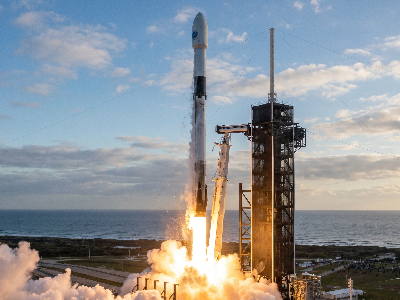
Musk said SpaceX's annualized revenue is expected to exceed $500 billion by the end of next year, and Terafab plans to achieve an annual production capacity of one exawatt of chips, equivalent to 30 times the global AI chip output next year; the Starlink computer co-designed with NVIDIA will begin orbiting in the third quarter of 2027. Meanwhile, he predicts that AI agent traffic will reach 1,000 times human internet traffic over the next five years.
Musk has once again outlined a remarkable growth roadmap for the AI industry.
On Friday local time, the 33rd Baron Investment Conference held a virtual fireside chat lasting about seventy minutes. The host was Ron Baron, founder of Baron Capital, and Elon Musk attended via remote connection.
 During the interview, Musk made a series of bold predictions:$SpaceX(SPCX.US)$Annualized revenue is expected to exceed $100 billion this December, and annualized recurring revenue could surpass $500 billion by December next year; Terafab aims to produce one exawatt of chips annually, equivalent to 30 times the global AI chip output next year; the Starlink computer co-designed with NVIDIA is expected to begin orbit in the third quarter of 2027; traffic on the agent internet has already surpassed human-generated traffic and may reach 1,000 times that of humans within five years.
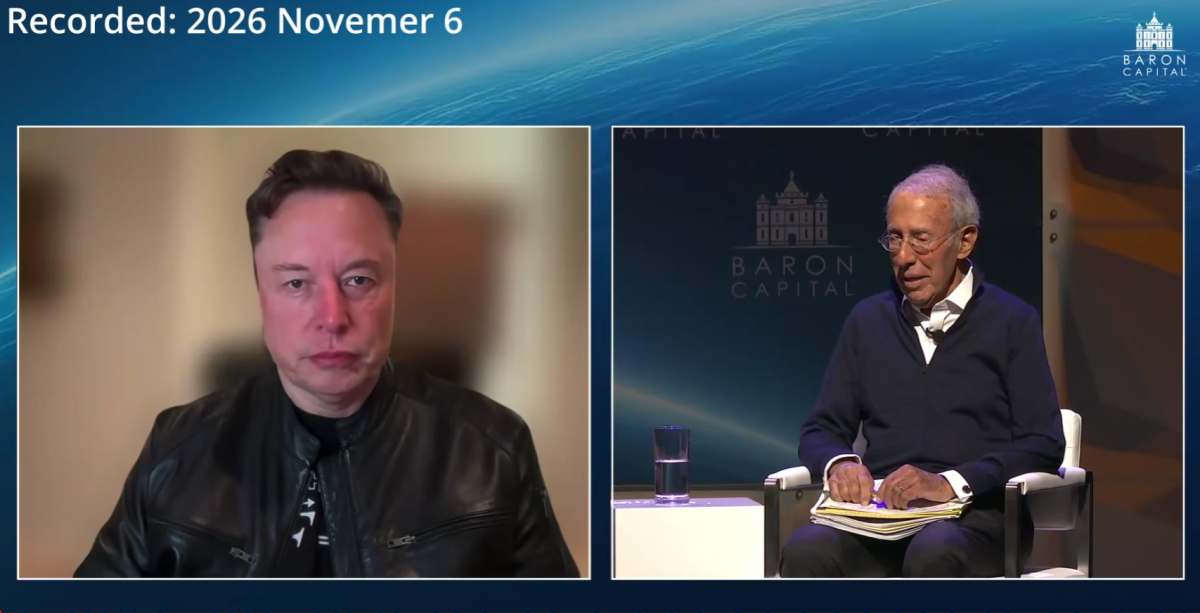
SpaceX Revenue: From 100 Billion to 500 Billion in Just One Year
SpaceX was the central focus of the interview, drawing the most market attention. During the interview, Musk clearly provided two revenue guidance ranges:
"We are on track to achieve annualized revenue exceeding $100 billion by December. Clearly, December is just around the corner, so I am quite confident about this. Unless some kind of natural disaster or similar event occurs, we will reach that target."
Going a step further, he remains equally optimistic about next year: "Based on our plans for next year, annualized recurring revenue should exceed $500 billion by December, and that looks quite achievable. This isn't a promise; it's simply what I believe will happen."
As for annualized revenue of one trillion dollars, Musk said: "A trillion dollars isn't impossible. It was impossible before, but it's no longer entirely out of the question—there may be about a 2% chance. But what's interesting is that it's not zero. That's the key. And that probability is increasing over time."
SpaceX generated roughly $15 billion to $16 billion in revenue last year. If the aforementioned trajectory holds, this would mean its annualized revenue would grow by more than 30-fold in less than two years.
Terafab: Next year, annual production of AI chips will be 30 times the global total.
During the interview, Musk elaborated on the Terafab initiative, which is being spearheaded by xAI.
He explained the naming logic: "When I say 'terawatt factory,' people sometimes think it could have three possible meanings: one is 'terror'—as in frightening; then there's 'terra,' which refers to Earth; but actually, it's 'tera,' meaning terawatt. In a way, all three interpretations apply."
In terms of scale, Terafab aims to produce chips with a total capacity equivalent to one terawatt per year. According to Musk's forecast, global AI chip production will reach approximately 35 to 45 gigawatts next year—meaning that a single Terafab facility would have a production capacity about 30 times the projected annual global output at that time.
Musk pointed out that there is significant room for improvement in current chip manufacturing efficiency. He illustrated this with a specific detail: "Right now, on a typical wafer in a chip fab, more than half the time is spent simply transporting it and waiting… sometimes, the actual time during which atoms undergo useful changes is only about 20%."
His solution is to build a research fab in Austin, aiming to consolidate design, manufacturing, and testing under one roof. "I believe we might be able to cut what normally takes a year down to just one month." The underlying logic is this: "For any given technology venture, the pace of progress depends on how many iterations you can perform… As long as you can iterate at a rate that's an order of magnitude faster, your technological advancement will, by and large, also accelerate by an order of magnitude."
Space Computing Power: The First Batch of Starlink Computers to Launch Next Year
During the interview, Musk repeatedly characterized space-based computing power as a strategic asset, presenting a clear line of reasoning.
In his view, the expansion of on‑premises computing power is constrained by electricity: the average U.S. power consumption has just exceeded 500 gigawatts. "If you were to build 200 gigawatts of AI capacity every year, that would amount to adding 40% to the entire U.S. grid annually. That's simply not feasible."
The advantages of space lie in continuous sunlight and the absence of atmospheric attenuation—allowing solar energy utilization to increase by roughly 30%—and virtually eliminating the need for large-scale energy storage. "Once you achieve a very low per‑ton cost of reaching orbit, the cost of intelligence in space will be far lower than on Earth."
Musk revealed that satellites currently being launched have been equipped with NVIDIA GPUs and Google TPUs for testing, adding, "As far as we know, they are performing well in space." The first batch of Starlink computers co-designed with NVIDIA is expected to begin launching in the third quarter of 2027, scaling up to a substantial size by 2028 and reaching a "very large scale" by 2029.
He further presented an income projection: "If we deploy 100 gigawatts of AI computing power into space each year, even if the value of each gigawatt drops to $10, that still amounts to one trillion dollars annually. Moreover, this is cumulative—adding another trillion dollars every year—because satellites don't simply vanish." If the unit price were $50, the annual figure would rise to five trillion dollars.
Musk predicts that delivering one terawatt of computing power to space each year would amount to sending into space a digital superintelligence whose annual energy consumption is twice the current average electricity usage in the United States.
Starlink: Bandwidth Increases by a Factor of 100; Agent Traffic Will Be 1,000 Times That of Humans
Musk revealed that approximately 11,000 Starlink satellites are currently in orbit, mostly of the V2 version, while launches of the V3 satellites have just begun.
Compared to V2, V3 offers more than tenfold improvement in capability, and the number of launches will also increase tenfold. "In the next two to three years, Starlink's bandwidth will be 100 times what it currently provides."
The key variable driving demand is AI agents.
Musk said, "My understanding is that, in fact, agent internet traffic has already surpassed human traffic, if I read the Cloudflare data correctly. Moreover, I believe Cloudflare's prediction that, within five years, agent AI traffic will be a thousand times greater than human traffic. And I think this even underestimates the scale of agent AI traffic."
Data Center: 35 billion investment, 50 billion recovered in one year
Musk outlined the business rationale behind xAI's data center: building it in-house takes about eight to nine months, significantly faster than the two-and-a-half years required by external contractors; the investment amounts to roughly $35 billion, below market levels.
"We'll rent out our computing power before we even use it ourselves, raking in roughly 50 billion a year. With an investment of 35 billion, we'll recoup that in one year."
He also revealed that during the construction of its Memphis data center, xAI built an in-house power plant with a capacity exceeding one gigawatt, "taking roughly one-fifth the time normally required to build such facilities—about one year instead of the usual five or so years"—and added that he personally took part in laying cables, connecting fiber optics, and performing electrical installations.
Revenue grew by more than 80% from the second to the third quarter this year, and is expected to increase by approximately 70% from the third to the fourth quarter.
The Economic Impact of Humanoid Robots and AI
Musk estimates that digital superintelligence will boost the global economy by roughly 20% to 30%, or about $25 trillion, "and it will happen very quickly," potentially doubling the productivity of white-collar jobs.
In the realm of physical AI, he presented preliminary estimates for robots replacing human labor: an efficient humanoid robot could work approximately 168 hours per week, with minimum productivity expected to be about five times that of a human; "a rough estimate suggests that roughly 20 to 30 million robots could match the output of U.S. goods and services." Regarding business models, he favors leasing over selling.
About OpenAI
Musk once again commented on OpenAI, stating bluntly: "I did found OpenAI as an open-source, non-profit organization. Now it has become a closed, profit-maximizing entity—exactly the opposite of what I originally intended."
He said he had not anticipated that OpenAI would one day become a for-profit company and expressed confusion about the structure of holding commercial interests within a nonprofit organization: "I was very puzzled at the time—how could you have commercial interests in a nonprofit? That didn't make sense to me."
Regarding Anthropic, he noted that it was founded by seven former employees who left OpenAI, adding, "In fact, Anthropic is a spin-off of OpenAI."
Starship and Rapid Reuse
Musk revealed that about a week after the interview, they will attempt to use the tower's mechanical arm "chopsticks" to catch the returning Starship, achieving truly rapid reuse.
He explained the business logic behind this system: "In principle, it would allow us to relaunch a rocket—specifically that giant booster, the Super Heavy booster—every hour." Starship is a fully reusable orbital-class launch system, which represents a fundamental difference from the Falcon 9—the Falcon 9's upper stage cannot be recovered, "essentially meaning that a medium-sized jet aircraft is discarded with every flight."
He estimates that, under extreme conditions, the cost per ton to orbit "could be lower than the freight cost of shipping by air from California to Australia," a reduction of more than 100-fold compared with historical peaks.
The following is a verbatim transcript of this interview (translated with AI assistance):
Ron Baron:
As I prepared for this conversation, an image came to mind: ET. ET flying through the moon, with a boy on a bicycle carrying a communication device, trying to call home. That was clearly a precursor to Starlink. So I suppose it didn't quite work out.
Elon follows first principles: everything should be done the right way—not the fastest, quickest, or cheapest, but in the best possible manner—and everything must be reexamined. If someone invests on his behalf in a particular venture, the guiding question is always: Is this the best we can do? The fastest? The most efficient? So I would say he is a builder. He is probably the only true builder in America that I know of, and he builds not just ordinary structures—like 10 million, 5 million, or 20 million square feet of buildings. Now, for Terap, he is considering or will soon build a 100-million-square-foot facility. No one has ever done anything like this, nor anything remotely similar.
The issue is that undertaking such an endeavor yields economies of scale. You can procure and manufacture at a far higher efficiency than smaller entities can. So the question becomes: how do you achieve this? Why hasn't anyone attempted something similar before? We're striving to bring silicon manufacturing back to the United States. We need it—both the material and the energy.
No one else is doing this but you. Why?
Elon Musk:
This isn't entirely accurate, because both Taiwan Semiconductor and Samsung are building fabs in the United States. Taiwan Semiconductor is constructing a large number of fabs in Arizona, some of which I believe are already operational. Samsung has several fabs in Texas that are already up and running, and it has also built a fab for Tesla, dedicated to the AI5 and AI6 chips designed by Tesla. However, compared to Asia, chip production in the United States is very small. Even under the most optimistic assumptions, if we include all the fabs that have been announced for construction in the U.S., they still represent only a tiny fraction—perhaps 10% of what's produced in Asia, optimistically speaking. As most people know, Taiwan shoulders an extremely heavy workload in chip manufacturing. Taiwan Semiconductor is an extraordinary company—truly incredible—in terms of the sheer volume, scale, and output of the various chips it produces. Samsung is similar, and I think Micron also does a great job in the memory sector. But the vast majority of their production takes place in Asia.
My real concern is that a certain level of geopolitical risk will persist in that region. I believe this risk could materialize at some point. In such a scenario, if we lack the full supply chain needed to manufacture chips on a large scale in the United States, we might end up with no chips at all, or only a very small fraction—perhaps around 10 percent. Looking further ahead, even setting aside geopolitical crises and disregarding any medium-term geopolitical hurdles, our pace of chip production remains far too slow.
If you want to achieve, say, one terawatt of chip production per year—this is our goal, and this is also why it's called Terap. Sometimes when people hear "Terap," they think there are three possible meanings. One is terror, T-E-R-R-O-R; some people ask why we'd want a Terap. Then there's T-E-R-R-A, meaning Earth. But actually, it's T-E-R-A, as in terawatt. You could say all three meanings apply. So it's terrifyingly large.
The rest of the world will produce roughly 20 gigawatts' worth of AI chips this year, perhaps 25 gigawatts. Next year, depending on whose forecast you believe, it will likely be between 35 and 45 gigawatts. But if you want to reach one terawatt, you'd need about 30 times next year's current global output.
Ron Baron:
It was built just for us.
Elon Musk:
Yes, we are building… We could also sell it to others, but essentially, we're constructing in a single factory a capacity 30 times the current annual output. You might think this plant's production would rival the world's GDP—roughly equivalent to the GDP of the 20th-largest economy. All in one factory.
Yes, it might even break into the top 10. Clearly, a plan like this would be reckless if it failed, but incredibly bold if it succeeded. So it all depends on the outcome. I think it will succeed, at least to some extent.
Ron Baron:
I hope so. It will cost one trillion dollars.
Elon Musk:
Over time, it could be even more. But we won't need that money right away. We'll build in phases. We're exploring ways to modify chip-manufacturing processes to boost production efficiency, just as we've done in many other areas. For example, today, wafers spend more than half their time in chip fabs simply being transported or waiting. In other words, chips spend over half their time in the fab doing nothing—either moving around or waiting for equipment. I believe there's significant room for improvement in chip manufacturing.
Ron Baron:
Why don't these companies do it themselves? If half the time their factory's chips are just sitting idle, what's stopping them from improving their own systems?
Elon Musk:
No. If you visit a wafer fab, you'll see wafers moving around constantly—shuttling rapidly from one station to another and then sitting idle. Yet less than half of the time is actually spent on processes that meaningfully alter the atoms on the wafer. I'd say that, at best, only about 20% of the time do the atoms on the wafer undergo useful changes. Chipmakers avoid experimenting with risky new approaches in their fabs because these facilities require massive capital investment. If they already have a proven recipe, they have no incentive to take chances on something entirely new. As a result, the semiconductor industry as a whole tends to stick to what worked last time, making only minor tweaks and steering clear of risk.
We are building a research laboratory at Gigafactory Texas in Austin, Texas. This lab will experiment with many different chip manufacturing methods. Many of these approaches will not succeed, but I am confident that some will. We will then translate these improvements into Terap itself—the production‑grade Terap located in Grimes County, Texas, near Texas A&M. There, we will scale up AI chip production. What I find particularly exciting about the Austin research lab is that I want to see whether we can integrate logic, memory, packaging, and lithography under one roof, enabling us to design new chips, manufacture the entire chip on the same site, and test it—all within an extremely rapid iteration cycle. Tasks that typically take a year could, I believe, be shortened to just one month.
For any technological endeavor, the pace of progress depends on how many iterations you can perform and how much ground you make between each one. If you can increase your iteration speed—doing more iterations in a given time—and improve the gains made between iterations, you'll accelerate your progress far faster than anyone else. If you can iterate an order of magnitude faster, then, as a first-order approximation, your technological advancement will also be an order of magnitude quicker.Ron Baron:
Most companies have significant inertia. If someone invests effort and money but fails, it becomes a stain on their reputation; if they succeed and aspire to the top position, it merely means they must work even harder. Thus, success demands extra effort, while failure ends everything, eliminating any chance of reaching the highest rank. Elon has cultivated a culture within his companies: always come to me with ideas—when you believe an idea will succeed, and I share that conviction, we abandon what we've already done and start over, always striving to do our best.
Regarding your culture, I find it interesting that you introduced me to Key Luck, who heads Intel and is now interested in Terap. I spent some time with him; he came to visit me, and I asked, "What's it like working with Elon?" He replied, "Other people come to tour my facility in Oregon, walk around for an hour and a half, and then leave."Elon arrived and sat there for four and a half hours, interviewing engineer after engineer and questioning everything related to speed. Later, I visited the car factory they were building in Texas at the time, and they introduced me to the facilities director, a manager who was a towering man. Of course, everyone looked like a giant to me, but he really was very tall. He had previously been Ford's head of production. I asked, "What's the difference between Ford and Tesla?" He replied, "At Ford, if I want to make a change, it has to be approved through six layers of management."
Here, whenever I need to make a change, I just walk upstairs and Elon is right there. So while the factory was being built, Elon wasn't some distant figure—he was on site, even living in an Airstream trailer. Do you know any other top executives at major companies—perhaps even the world's largest firms—who would live in an Airstream to ensure every issue during construction was addressed quickly? That's an incredible culture, incredible people, and the remarkable team he has assembled. The people who work there are exceptionally talented; landing a job there is harder than getting into Harvard. Of course, I'm not sure why anyone still bothers going to Harvard these days.
Elon Musk:
By the way, Airstreams are actually pretty good. Not as bad as you might think. Honestly, I've even grown to like my little Airstream. But it's parked right next to the power plant we built. That plant generates over one gigawatt and could reach an internal output of one and a half to two gigawatts in roughly one-fifth the time it normally takes to construct such facilities. It was completed in about a year, whereas projects like this typically take around five years. And there's no need for someone to come upstairs looking for me—there is no upstairs. Our Colossus facility in Memphis doesn't have an upper level. Sometimes I walk the entire site twice in a single day, sometimes three times, or even four or five. The whole site—the power plant and all its buildings.
I also make it a point to do some work myself. I've pulled power cables as thick as pythons—extremely heavy and long. I've done fiber-optic cabling, installed electrical switches, and worked on power-plant management software. I try to get my hands on everything, so I don't become numb to the struggles of those actually doing the job, and so I can understand the challenges and how to improve things. That way, I'm not just sitting in the office waiting for someone to come to me; I'm out in the field, actively asking questions.
Ron Baron:
That's truly remarkable. Let's talk about data centers—right now, they're a hot topic in the news. There's considerable resistance to building them. But if you want AI, you need data centers. First, let's consider data centers on this planet. Elon believes the main obstacle to expanding data center infrastructure will be whether there are enough chips and sufficient computing power. So what he's doing is… many people—well, we have Grok; he's at the forefront alongside OpenAI and Anthropic, and those folks are his team. Of course, he no longer favors OpenAI, but…
Elon Musk:
I did indeed found OpenAI as an open-source, non-profit organization, but now it has become a closed, for-profit entity. It is, in fact, the complete opposite of what I originally intended.
Ron Baron:
Right.
Elon Musk:
Anthropic was founded by seven people who left OpenAI because they didn't trust Sam Altman, and for good reason. They've said so publicly; it's no secret. So in reality, Anthropic is a spin-off of OpenAI. Yes, I suppose I should have started OpenAI as a for-profit company rather than a nonprofit. I thought it would be some kind of charitable endeavor for the world. I never imagined it would one day become a closed-source, for-profit entity.
Ron Baron:
When you left, disappointed with its direction, they offered you an ownership stake; you said no, I don't want it, and walked away.
Elon Musk:
Yes, I'm very puzzled about how you can have a financial stake in a nonprofit organization. It doesn't make sense to me. In the beginning, I provided almost all of the company's capital. I came up with the idea, named it, recruited the key personnel, and taught them everything I knew—beyond that, there wasn't much else.
Ron Baron:
Back to data centers. You'd think that running all this AI requires data centers, and people want to build them; typically, constructing one takes about two and a half years and costs roughly $60 billion—$50 or $60 billion per gigawatt. Those who build for hyperscale companies and lease the facilities need to borrow money or secure funding somehow to cover capital expenses, so they must lock in long-term leases of at least five years. Consequently, over a five-year term, the rent paid amounts to about $12 billion annually on a $60 billion investment. We decided instead to build our own. We do so because we have clear use cases—we're vertically integrated, powering cars, robots, rockets, everything. Since we need these facilities ourselves, we can absorb the construction risk without having to worry about third-party contracts. But as it turned out, even after building them, they weren't immediately needed… So now, what used to take four months now takes eight or nine months. They require two and a half years; we manage it in eight or nine months. Their cost is $60 billion; ours is $35 billion. Demand for compute power is so immense that many data centers end up sitting idle because there's no electricity to run them. We'll lease out that capacity until we need it for Grok, charging roughly $50 billion per year. Thus, with a $35 billion investment, we generate $50 billion annually. SpaceX's revenue is poised to explode.
Elon Musk:
Yes, they are ramping up. I believe our revenue growth from the second to the third quarter exceeded 80% this year. I'm not sure of the exact figure from the third to the fourth quarter, but it was probably around 70%. The fourth quarter to the first quarter will likely be similar. Bringing in large-scale computing power is extremely challenging.
I believe there are many speculators out there who think you can simply order some GPUs, hand a purchase order to a company to build a data center, and then sit back and collect cash. The reality is that this is extremely difficult. There's a meme I find quite amusing, called the "Jose meme," which you may have seen: a guy is digging a hole in the road while eight people watch him. In that meme, one person is actually doing the work, and eight others are just watching. Unless you increase the number of Josés in this country, the amount of work accomplished won't grow. Adding more people who merely issue purchase orders to Josés won't get anything done; only by increasing the number of Josés will we get more work done. That's why I aspire to be a José, and SpaceX wants to be a José. We do the real work. And that's a big deal.
As the U.S. has expanded and built on a massive scale, to be frank, it hasn't been an influx of people doing hands-on, physical labor; rather, there's been a huge surge in the number of people placing purchase orders. This means that those actually doing the work are extremely spread out. As a result, across the country there are countless data center projects that are only partially completed—like peanut butter spread too thinly, barely noticeable. The difference is that at SpaceX, we're accustomed to tackling incredibly difficult physical tasks, such as building giant rockets and enormous launch facilities. Tesla is also highly skilled at large-scale construction. Perhaps the only two companies on Earth besides China that excel at physical hardware are SpaceX and Tesla. I can't even think of who might rank third.
I believe that even Tesla might be the best in the world, and that includes China—China is incredibly strong. Notably, the Tesla Model Y is the best-selling electric vehicle in China. Let me tell you, Chinese automakers are truly outstanding.
Ron Baron:
The Ford guy went there. He said he was blown away by the quality of Chinese cars.
Elon Musk:
Yes, partly… China is amazing. By the way, I love China. Visiting there is very inspiring.
Ron Baron:
We've discussed SpaceX's substantial revenue growth. I recall it was $15 or $16 billion last year, and by the end of this year, annualized revenue will reach roughly $100 billion. Next year, we expect it to be between $500 billion and $1 trillion. So we're going from $15 billion to about $100 billion annually, and then to $500 billion to $1 trillion. And this is really just the beginning. What's truly remarkable about selling our data centers to competitors is that they're essentially paying us $50 billion for assets we acquired for $35 billion, while we'll enjoy a steady stream of cash flow from leasing out the data centers we still own. So we got them essentially for free, right?
Elon Musk:
Well, I suppose so. I'd like to comment on a few points. We're on track to exceed RMB 100 billion in annualized revenue by December. With December just around the corner, I have good visibility into this. Barring some kind of natural disaster or similar event, we should meet that target. Based on our plans for next year, it looks quite likely that our annual recurring revenue in December will surpass RMB 500 billion.
This isn't a promise; it's just what I think will happen, my best guess. I'm simply trying to distinguish between a commitment to do something and what I believe will occur. What I expect is $500 billion in annual recurring revenue by December next year. I'm saying that $1 trillion isn't out of the question—meaning it wasn't possible before, but it is now. Perhaps there's about a 2% chance. But interestingly, it's not zero. That's the intriguing part. And the probability is increasing over time.
As my biological neural network predicts, digital superintelligence could boost the global economy by roughly 20% to 30%, and that doesn't even factor in robotics. I estimate this 20% to 30% growth would translate, roughly speaking, into an additional $25 trillion in global economic output—and it would happen very quickly.
Ron Baron:
That is a $130 trillion global economy. Do you think digital AI will increase it by 25% or 30%?
Elon Musk:
20% to 30%. Yes, that's my guess.
Ron Baron:
What is your guess as to how much it will boost the economy?
Elon Musk:
I think it's probably around 20% to 30%. I think it could be even higher. But it could potentially double the productivity of white-collar jobs.
Ron Baron:
That's just numbers, not physics. Numbers AI.
Elon Musk:
Physics is what we are going to lead.
Ron Baron:
I think... yes.
Elon Musk:
The way to think about physical AI—that is, robotics—is this: any economy is the number of people in it multiplied by average per-capita productivity. If you have an extremely efficient humanoid robot that can work 24/7, putting in 168 hours a week without breaks, bathroom stops, or food, and operates faster than a human, you can expect its weekly productivity to be roughly five times that of a person—roughly speaking, because a human might work 40 hours a week, needs rest, and doesn't move as quickly as a robot. So I'd say the minimum productivity expectation for a humanoid robot is five times that of a human. Then, taking the U.S. population as an example: how many people are in school or retired? That's about half the population—roughly half are either studying or retired. Among those of working age, not everyone is employed or engaged in high-productivity work. That leaves, perhaps—I don't know exactly—about 120 million people in the U.S. who generate net positive output of goods and services. Now you ask: how many robots would it take to match that level of productivity? I'd estimate you'd need around 20 to 30 million robots to match the U.S.'s output of goods and services.
Ron Baron:
And we will build those. Building a robot is cheaper than building a car.
Elon Musk:
Yes. It's about the same at first, but it becomes much cheaper over time.
Ron Baron:
So the robot costs 30,000; we're aiming to bring that down to 20,000.
Elon Musk:
Yes.
Ron Baron:
Will we rent them out or sell them? Do we already have any ideas?
Elon Musk:
I think they might be rented out.
Ron Baron:
Back to the data center. If people are truly unhappy about data centers in their communities, and since these are so profitable for us, why don't we simply say: "Okay, your community's utility bills will stay the same; we'll subsidize them, use that subsidy, and even give you $50 million for schools and hospitals"? Do we have any programs where we go into communities and say, "Yes, we'll help your community and create more jobs for you"? We really are a job-creating company. No one creates jobs like we do. Is there a way to do this? I don't think we've done it, and I don't think our industry has done a good job of explaining that this benefits people rather than harms them.
Elon Musk:
Actually, right here in the Memphis area, I think we're quite popular. Strangely enough, it's popular where they have a data center; the places without one are the ones that don't like it, believing data centers bring negative impacts. But in Memphis, SpaceX has brought prosperity—restaurants are packed, and hotels are full. We sometimes pay people twice what they used to earn. Why isn't this being written about? Why aren't there stories on this topic?
Ron Baron:
Why doesn't this...
Elon Musk:
There are some stories… We've also helped local schools, and the tax revenue generated for the county and city has been substantial. So I think this concern about popularity may be temporary, because in reality, data centers have brought tremendous prosperity. If you talk to the townspeople, they can all feel it, as their businesses are thriving.
Ron Baron:
Now, let's talk about data centers in space. The obvious solution is to place them there, so people no longer have to worry about having them in their own neighborhoods—if they don't want them. For us, building data centers in space is more cost-effective. With each new generation we launch, the systems are more powerful than before. Isn't that right? Everyone says that's still ten years away. But Elon says, "No, we're starting now." Google has already conducted tests using a satellite we operate for them. It has been working reliably, so we'll begin deploying these systems in 2027 or 2028. How long will it take for this to make an impact?
Elon Musk:
Yes. Currently, people have already tested NVIDIA GPUs. We have a satellite equipped with an NVIDIA GPU that we launched, and we recently launched another satellite featuring a Google TPU. These are all operational, and as far as I know, they're performing well in space. We expect to begin launching the first batch of StarMind computers—co-designed with NVIDIA—possibly, and this is just my guess, in the third quarter of next year. We'll start slowly, then likely ramp up to significant production in 2028, eventually reaching very, very large-scale output in 2029. To achieve a scale of one terawatt per year—or even, as I suggest, 200 gigawatts per year—you really need to go to space, because there isn't enough terrestrial power capacity to realistically reach those levels. For reference, the United States' average electricity consumption is slightly above 500 gigawatts. Its peak power capacity is around 1.2 terawatts, but average consumption remains just over 500 gigawatts. So you can see that if you were doing, say, 200 gigawatts of AI annually, it would be like adding 40% to the entire U.S. grid every year—completely unfeasible. When you place solar panels in space, since space is essentially always sunny, the panels can face the sun directly without any angle, and there's no atmospheric attenuation of sunlight. As a result, you gain about 30% more solar energy in space. It's constantly sunny, with no seasons. You can also use a much smaller battery pack because there's no need to store energy for nighttime. The cost of intelligence in space is significantly lower than on Earth once you achieve low per-ton launch costs. Starship, being the first fully reusable rocket, will reduce the cost of accessing space by a factor of 100 or more. In fact, I believe that under ideal conditions, within roughly two to three years, the cost of putting a ton into orbit could fall below the cost of shipping goods by air from California to Australia.
Ron Baron:
NASA says the cost of getting something to orbit in 2010 was $18,500 per kilogram. That was because rockets were single-use. Later we developed the Falcon 9, which is reusable; I think the cost dropped to $2,500, and then further down to $1,500...
Elon Musk:
Now it will drop to 100, or 15, or 50. I believe we will achieve less than $100 per kilogram to orbit.
It's important to understand just how profound full reusability is. With Falcon 9, we achieve roughly 80% reusability: the booster returns and lands. You've probably seen videos of Falcon 9 boosters landing, and then there are the fairings—the nose cones that enclose the satellite—which split in two and parachute into the ocean; we recover those and reuse them, though we don't reuse the upper stage. We can't recover the Falcon 9 upper stage, and its cost is comparable to that of a mid-sized jet aircraft. This means the minimum cost per Falcon 9 flight is essentially the price of a mid-sized jet. That's still far better than anything else available. But you could argue that if every trip required discarding a mid-sized jet, air travel wouldn't be very widespread—you'd probably decide it's easier to drive instead. With Starship, however, the entire system is designed for reusability—not just reusability, but extremely rapid reusability.
The reason we use a tower arm to catch boosters and spacecraft is what we call "chopsticks." It's a bit like Mr. Miyagi in The Karate Kid catching a fly, only scaled up. The idea is that the rocket lifts off from the launch pad, where it's positioned by the tower arm; then, when it returns from space, the same tower arm captures it and places it back on the pad. So you don't just achieve fully reusable rockets—you achieve extremely rapid reusability. You really can't get faster reusability than landing right back at the launch site. In principle, this would allow us to relaunch a rocket, along with its massive booster and Super Heavy booster, every hour.
Ron Baron:
10,000 launches per year.
Elon Musk:
Yes, eventually there could be even more—more than one launch per hour. When I was young, people would line up to watch each extremely rare rocket launch. Now we can do one every hour, and it no longer even makes the news.
Ron Baron:
This is going to be quite… you really want to see it this time. This time it's cool.
Elon Musk:
It is the largest flying object ever built and the most powerful thrust‑generating machine of any kind humanity has ever created. When it lifts off, it weighs over 5,000 tons and shoots straight up, fast. Then that massive vehicle returns—coming back from space—and about five minutes after liftoff, the boosters come down, one way or another. Hopefully in a good way, but either way, they're coming back down. So excitement is guaranteed. Success isn't always guaranteed, but excitement certainly is.
Ron Baron:
It's really cool when you watch it come back and land at the takeoff spot. Chopsticks.
Elon Musk:
It sounds crazy. When I first proposed this to the team, they looked at me as if I were mad, but I said, "Look, I think this is achievable. Physically, there's nothing preventing it from happening." The only thing I can think of that would be marginally better than capturing with a boom is landing directly on the launch pad. But if something goes wrong, you'd damage the pad, and that would take a huge amount of work to repair. So capturing with a boom is slightly better, because if things go awry, it doesn't necessarily destroy the launch pad. Yet that's just a matter of a few minutes between boom capture and landing directly on the launch pad. These days, far more challenging than recovering the booster is capturing the spacecraft. The spacecraft still has to do many things it's never done before. No one has ever built a truly reusable orbital thermal protection system. The Space Shuttle's thermal protection system required nine months of maintenance between flights. Even though the orbiter returned, they jettisoned the main fuel tank on every flight—the tank being essentially the primary structural component to which everything else was attached—but they recovered the orbiter itself, and the thermal protection system needed nine months of refurbishment before it could fly again. So no one has ever built a fully reusable orbital thermal protection system. It's an extremely difficult task.
This is something we've been working on for ten years. It's incredibly difficult—arguably one of the hardest technical problems humanity has ever tried to solve. But we have an exceptionally talented team that has worked tirelessly for a long time, allowing us to iterate. Back to iteration: we've been able to run many iterations, whereas the Space Shuttle couldn't really iterate. They always had people aboard the shuttle, so they couldn't take any risks, because lives could be lost. With Starship, however, we're willing to take significant risks to explore and develop the physical characteristics needed to achieve a fully reusable thermal protection system and entire vehicle. We've already successfully executed multiple precision soft landings at sea, and if there's a tower present, the spacecraft can be captured. So here's an interesting point: if the vehicle thinks it's landing against a simulated tower, and a real tower happens to be there, it will be captured. Now we need to make absolutely sure that when we bring it back to an actual tower, everything works as expected—so we don't damage the tower or send debris raining down on people, which would certainly hurt our reputation. That's why we want to be extremely confident in the spacecraft's reliability. I believe we've finally reached the stage where we think it's worth trying with Ship 42—hopefully this proves prescient. Forty-two is a special number; we can attempt capture using the tower. That's what we plan to do in about a week.
Ron Baron:
We're all rooting for it. Starship is the big breakthrough here. By the way, I was watching the young guy in charge of Starship operations; he was speaking in front of an audience dressed in sport jackets, suits, and white shirts. When he walked up, he was wearing engineer boots, blue jeans, and a plaid shirt, unshaven with long hair. He started talking, mentioning F this, F that, F the other thing. I looked at him and thought, oh my God, that's me when I was 40. A genuinely great guy who rides a motorcycle. So this is the real game-changer. Everything Elon does might not make sense when you first hear about it, but then you say, oh wow, I get it now—he's probably been thinking about that all along.
When you think about reusable rockets and how expensive it is to get into space, the only people who could go were governments protecting their nations—perhaps at a cost of $18,000—or maybe a television company spending $2 billion on a satellite just so it could broadcast to one location without competition. But once you bring costs down that dramatically, suddenly you make Starlink possible. Starlink now has 10,000 satellites in orbit, heading toward 20,000—that was what I used to think; now he says no, it won't stop at 20,000; it will reach 100,000. Why 100,000? Because previously we believed Starlink's revenue would come from consumers, governments, and businesses. Now, however, he says agentic demand will be several times greater than we had anticipated, and each time you…
Elon Musk:
Oh yes. My understanding is that, in fact, agentic internet traffic has already surpassed human traffic, if I read the Cloudflare data correctly. I believe Cloudflare predicts that within five years, traffic will be a thousand times greater than human traffic. If anything, I think that underestimates the volume of agentic AI traffic.
Ron Baron:
How many years for a thousandfold increase? Five years.
Elon Musk:
Yes.
Ron Baron:
We've long believed Starlink could generate $1 trillion in revenue, $700–800 billion in EBITDA, and be valued at $14–15 trillion within a decade. SpaceX as a whole is currently worth less than $2 trillion. So that represented a significant opportunity. But now I think we may have seriously underestimated how much SpaceX and Starlink could be worth, given the sheer number of satellites you've added—and the fact that we now have space hubs and data centers.
Elon Musk:
Starlink's revenue is growing extremely rapidly by any standard of normal business. On a large scale, its revenue roughly doubles every year. I remember that used to be considered quite remarkable. Not long ago, doubling revenue annually with high gross margins and positive cash flow would typically be seen as impressive. Though I have to say, with AI, it really surpasses that. With AI, you have the potential for growth on the order of tenfold per year. I mean, if you think about what I just said—because I've been saying a lot of things that sound incredibly wild—I believe we will get there. Sometimes I'm a bit optimistic about the timeline, but in the end, I always deliver.
And I'm not always late, either. I mention this because the media always reports when I'm late, but they never report when I arrive early. In fact, I often get there ahead of time. However, the media doesn't write positive stories; they simply ignore my punctuality and only publish reports about my tardiness. As a result, it appears as though I'm always late, but that's not actually the case. My forecast—my goal—is to have my predictions land in the 50th percentile, which means roughly half of them will be accurate in terms of timing, and things generally unfold as expected. Currently, we have 11,000 satellites up there, mostly second-generation models.
We have just begun launching Version 3 satellites. The capabilities of Version 3 satellites exceed those of Version 2 by a factor of ten, and we will deploy ten times as many of them. Therefore, the total bandwidth Starlink will deliver—within two to three years, I expect—will be a hundred times greater than what it currently provides. Consequently, revenue per gigabit per second would be quite substantial. And when you consider the sheer volume of data transmitted, that figure becomes enormous. With AI and robotics driving demand far beyond human needs—literally by a factor of a thousand—the initial communications revenues alone would be staggering. But if we look at AI-related applications, suppose 100 gigawatts of AI computing power are deployed in space each year; for example, what would be the value of each gigawatt of computing power?
Even if it dropped to $10, that would still represent an additional trillion dollars per year. Over time, this accumulates to another trillion dollars annually, because satellites don't simply disappear. It's like stacking a trillion dollars in annual revenue year after year. Every five years… at $10, or say $50, you'd end up with five trillion. So how can telecom companies meet the demand for services using their existing infrastructure? And if they do have access to spectrum—after all, spectrum is a public good—why does the government allow this situation to persist when the required capacity far exceeds what they could possibly provide?
Ron Baron:
Yes. Um... Should we skip this question?
Elon Musk:
I believe SpaceX can go a long way using the spectrum it has already acquired. But at some point, if we can utilize the spectrum more effectively than, say, a traditional telecom company, we could simply acquire that traditional telecom company and use that spectrum far more efficiently—ten times as efficiently.
Ron Baron:
We've been thinking about data centers, so we're considering Starlink eventually reaching 10,000 to 100,000 satellites. Moreover, every five years, as we replace our existing satellites, we'll deploy new ones with ten times the capacity to replace those we're deorbiting. That's the massive capacity we'll be delivering.
Elon Musk:
Yes, we still see opportunities for order-of-magnitude improvements in satellite capabilities. I believe Starlink Version 4 will be ten times as capable as Version 3, especially with long-range laser links. Our current laser links operate at around 100 gigabits per second. Our next-generation laser links will deliver 10 terabits per second—about a hundredfold increase. And then we'll put ten of those on board. So you can imagine…
Ron Baron:
We're a bit short on time, but there are still a few points to cover. While people worry about data centers and AI, Chinese officials aren't concerned about having too many data centers or excessive electricity consumption. In China, they have roughly three times the electricity we do. Moreover, their annual increase in power capacity—300 gigawatts—is comparable to our total of 550 gigawatts. They add 300 gigawatts every year.
Elon Musk:
I'm not sure if that's the steady-state electricity figure, but there is definitely growth; I don't think it's that high. I believe it's slightly lower than that. But it's still a huge number. China now, I think, is about three times American Electric Power's output, and the trend is toward four times—at least reaching four times the total U.S. electricity output. Industrial capacity, as a first-order approximation, is proportional to electricity output. And then chips—they're lagging behind...
Elon Musk:
And they're making rapid progress. Yes.
Ron Baron:
A few years ago, an executive at SpaceX told me she believed the only thing preventing my grandchildren from speaking Mandarin was SpaceX. Can you believe that?
Elon Musk:I think there's definitely merit to learning Mandarin, regardless. It's a very interesting language. With it, we could generate several hundred gigawatts per year, and potentially even one terawatt annually. But of course, that's an enormous figure—meaning the amount of energy our digital superintelligence would produce each year is twice the current average electricity consumption of the United States. The U.S. average electricity consumption is 500 gigawatts, while one terawatt equals 1,000 gigawatts. If we were to achieve one terawatt per year, it would mean using digital superintelligence to send into space, every year, an amount of energy equal to twice the current average U.S. electricity usage. These are, by and large, staggering numbers.
Ron Baron:
There are two more questions. Why do we need so much electricity? Why do we need so many chips? Where will the demand for that kind of intelligence, that kind of electricity, and those chips come from?Elon Musk:
The demand will be—this may sound a bit circular—but the demand for intelligence, for digital superintelligence, will come from digital superintelligence itself.
Ron Baron:
That is for medical purposes, that is for… what does that mean?
Elon Musk:
This means that superintelligence will far exceed all human needs. There will be universal high incomes—indeed, universally extremely high incomes—and universal healthcare, surpassing even the best medical care available on Earth today. You could aspire to own a castle or anything else you desire; digital superintelligence could manufacture it for you as a side project. If you zoom out further, as civilization advances, you can view its progress in terms of how much energy it harnesses. Right now, to illustrate the potential for growth within our solar system: even if we increased civilization's energy consumption by a factor of one million, we would still be using less than one-millionth of the Sun's energy. That leaves vast room for expansion.
You would clearly have everything anyone on Earth could possibly desire. At that point, it would truly be digital superintelligence serving digital superintelligence. Our economy would seem quaint, and our monetary system would look like trading shells for currency. That's what our monetary system would appear to be to a superintelligence. Technologically speaking, this has happened before. Money used to be shiny metal pieces people gave to one another. I'd give you this shiny silver piece, and then you'd have shiny gold pieces; you had to carry these shiny metal chunks from place to place to make transactions, which, frankly, was very cumbersome and easy to rob if you were carrying gold or silver coins. But that was once how people paid for things. Buying goods over long distances must have been extremely difficult, because you had to transport all that silver and gold across the seas—ships sank, and you didn't even know what had happened. It's nothing like being able to just call someone on your phone.
Ron Baron:
Obviously, it would be fascinating to keep talking with you forever, but I'm running out of time, so I have just one final question. When you're 83, like me, how do you hope people will see you? You work these crazy hours; you're making money—no one works like you just to accumulate wealth, in my view. You believe that anything you own will eventually be heavily taxed, yet a great deal of your money will ultimately go to your foundation, your foundation. How do you want people to remember you? When you're 83, how do you hope people will see you?
Elon Musk:
I want… to have both cognition and reality. I want reality, regardless of what cognition is, but I want that reality to be one in which I've made a significant contribution to the advancement of civilization. So, you know, I… yes.
Ron Baron:
Thank you very much for being here today. Thank you.
Editor/lambor