
The dynamics of the U.S. midterm elections are introducing new variables into the global AI valuation framework. Based on stock market performance in the U.S. on Thursday and Friday, capital flows have exhibited a notable pattern of simultaneously seeking safe havens while pursuing aggressive opportunities.
On Thursday,$NVIDIA (NVDA.US)$、$Advanced Micro Devices (AMD.US)$、$Arm Holdings (ARM.US)$、$Coherent (COHR.US)$、$Marvell Technology (MRVL.US)$、$SanDisk (SNDK.US)$、$Western Digital (WDC.US)$、$Micron Technology (MU.US)$Related stocks in the AI computing power chain all plunged sharply. On Friday, the market reversed course, with SanDisk, NVIDIA, Micron Technology, Supermicro Semiconductor, and others staging a notable rebound at one point.
The deeper the decline, the sharper the rebound—so is this merely a technical correction after over‑selling, or a buying wave triggered by investors reassessing the stock? To answer that question, we must first understand the underlying drivers of this round of selling.
 The underlying driver of this market rally may be a dual‑expectation tug‑of‑war following the conclusion of the U.S. midterm elections:

On the one hand, with Democrats regaining control of both the Senate and the House, expectations for foreign policy and fiscal policy are being reshaped. Markets are betting on an easing of Middle East tensions and a reduction in war risks, which should push down international oil prices and ease inflationary pressures. At the same time, room for large-scale fiscal expansion—through tax cuts and increased spending—is constrained, marginally reducing supply pressure on U.S. long-term Treasury bonds and causing long-term yields to decline, thereby benefiting the bond market and valuations of long-duration assets.
On the other hand, Democrats won gubernatorial elections in key battleground states such as Texas, Ohio, and Georgia. With stricter regulations on data center approvals, energy consumption, and land use now taking effect, the market has begun revising downward its medium- to long-term capital expenditure forecasts for North American cloud providers and AI giants.
With the AI hardware sector having already fully priced in both elevated valuations and optimistic expectations for sustained high‑growth order intake, any relaxation of growth assumptions will likely trigger concentrated selling pressure on overvalued names first. As panic spreads from compute hardware to broader markets, semiconductors, memory stocks, and discretionary consumption sectors are weakening in tandem, while capital flows are showing marked divergence: some investors are shifting into U.S. Treasuries as a safe haven to benefit from falling rates, while others may be beginning to reassess assets that can capitalize on lower interest rates without being heavily tied to North American compute‑related capex.
Notably, SanDisk, NVIDIA, Micron Technology, and others staged a sharp rebound last Friday—does this rally signal a trend reversal or just a bullish trap? Moreover, with the AI sector in U.S. stocks experiencing a major shake-up, how can we seize the opportunities arising from the divergence within Hong Kong and A-share AI supply chains? The answer to this question may lie in the logic behind capital's reallocation.
Sharp decline; high probability of a rebound the next day.
A review of cases since 2000 in which the decline reached this magnitude on a given trading day is shown in the table below:
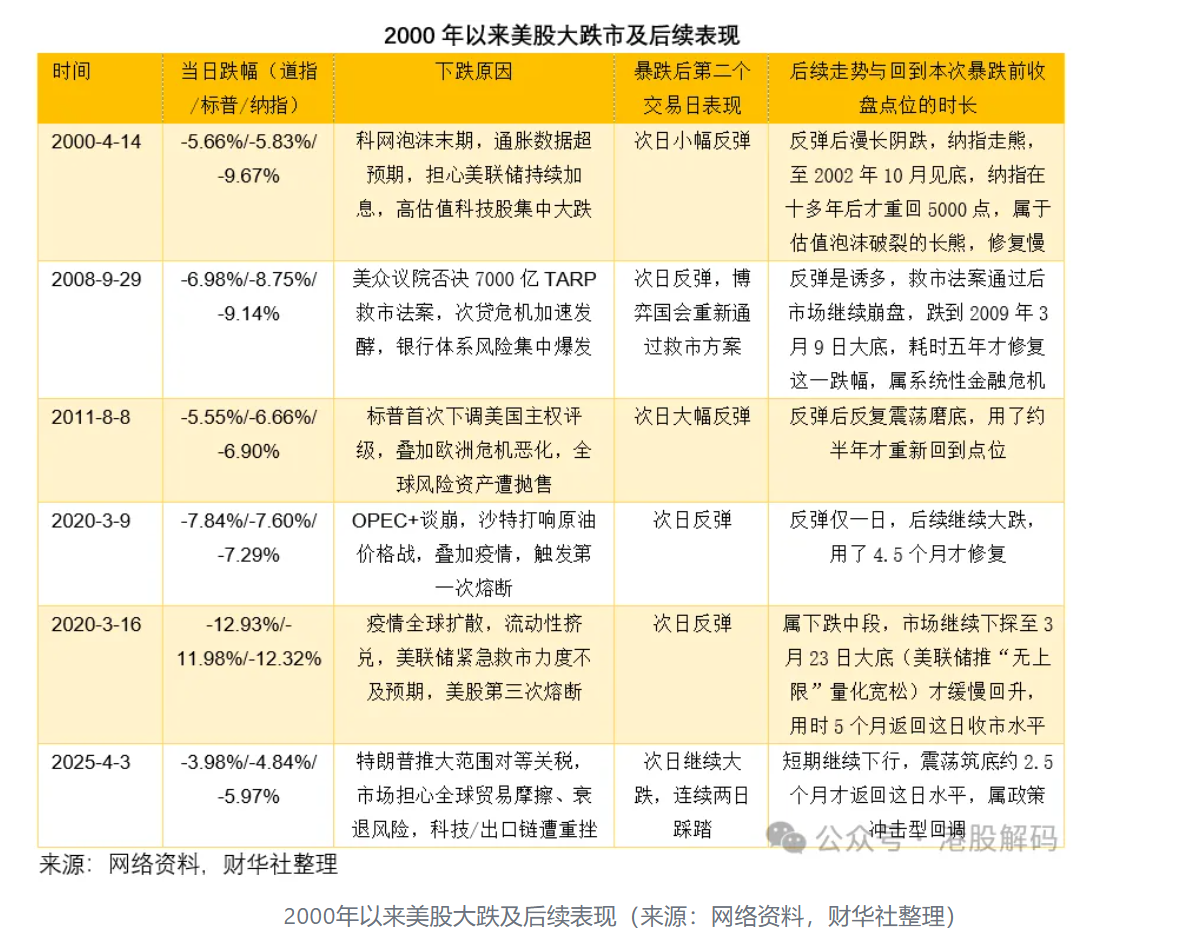
Comparing the current synchronized plunge in the three major U.S. stock indices since 2000 with historical episodes, Caihua Securities notes a divergence in market dynamics: the 2000 dot-com bubble burst and the 2008 subprime mortgage crisis were systemic risks rooted in balance-sheet disruptions, with recovery periods spanning several years; by contrast, events such as the 2011 downgrade of the U.S. sovereign credit rating, the initial wave of panic during the 2020 pandemic, and the tariff shock in April 2025 were driven by policy shifts and external shocks that triggered adjustments in market expectations, resulting in recovery times typically confined to a few months.
The nature of this market move appears closer to the latter—structural repricing driven by downward revisions to capital expenditure expectations—rather than a collapse of the entire system. However, the key difference is that these midterm elections have simultaneously triggered multi‑pronged repricing across interest rates, inflation, fiscal deficits, AI regulation, and more, with asymmetric implications for global capital flows.
So, what implications does this have for the performance of A-shares and Hong Kong stocks?
Reconstructing the Macro Narrative: Ceasefire Expectations, Oil Prices, and Long-Term Bond Yields—Who Will Benefit?
Following the Democrats' victory in the midterm elections, the first major narrative centers on the opportunities presented by easing geopolitical risks. Markets may anticipate a shift toward a more conciliatory foreign policy; a de-escalation of conflicts would push down crude oil prices, alleviating imported inflationary pressures at the source, prolonging the Federal Reserve's period of high interest rates, and even opening the door earlier to expectations of rate cuts. Indeed, after the midterm election results were announced, crude oil futures prices declined, falling below $100 per barrel.
On the fiscal front, resistance to Trump's large-scale tax cuts and increased defense spending is mounting, which may slow the pace of U.S. deficit expansion. This could temporarily ease pressure on long-term bond supply, benefiting U.S. Treasury performance and relieving valuation discount pressures on long-duration assets—also a reason for the decline in yields on U.S. Treasuries with maturities of ten years or more.
The sectors likely to benefit from this set of macro conditions may include:
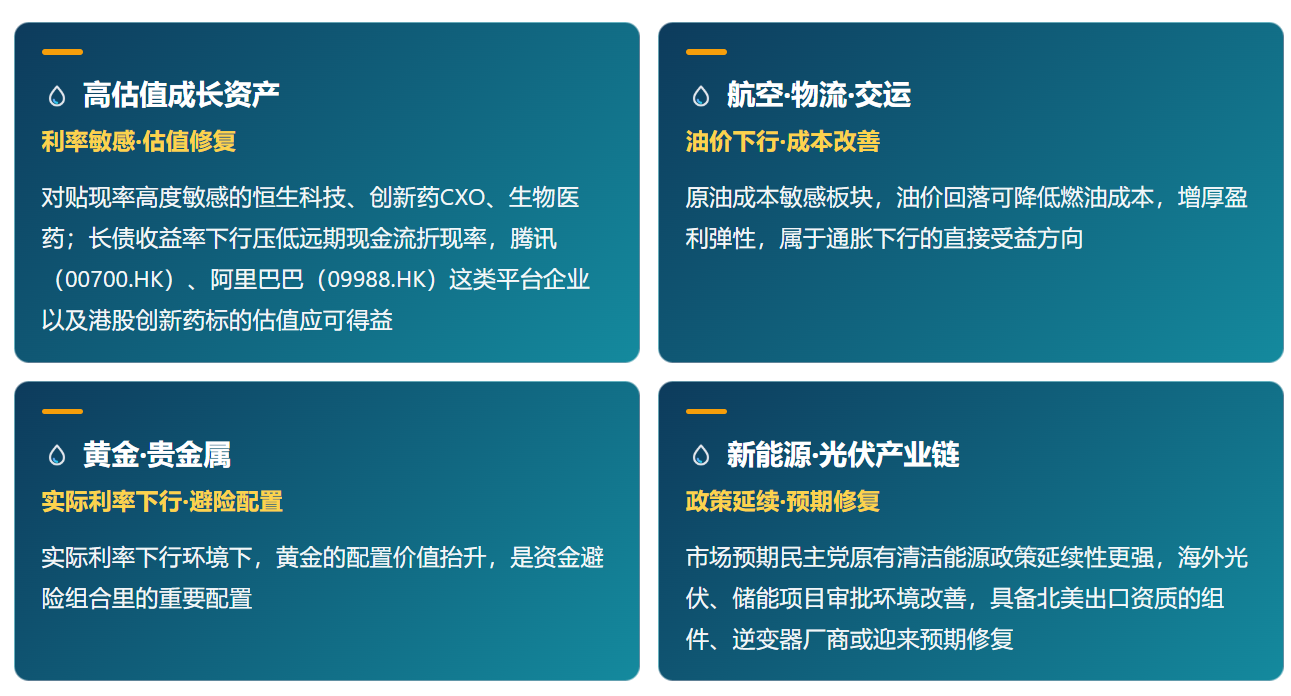
High-valuation growth assets—such as Hang Seng Tech, innovative drug CXOs, and biopharmaceuticals, which are highly sensitive to discount rates—are favored. Declining long-term bond yields help lower the discount rates applied to future cash flows.$TENCENT (00700.HK)$、$BABA-W (09988.HK)$Valuations of such platform companies, as well as Hong Kong‑listed innovative drug stocks, should benefit from falling interest rates.
Crude-oil-cost-sensitive sectors such as aviation, logistics, and transportation. A decline in oil prices can reduce fuel costs and enhance earnings flexibility, making these sectors direct beneficiaries of easing inflation.
Gold and precious metals assets. In an environment of declining real interest rates, the allocation value of gold increases, making it an important component of safe-haven portfolios.
In the new energy and photovoltaic industries, market expectations are that the Democratic Party will maintain continuity in its existing clean energy policies. With an improving regulatory environment for approving overseas PV and energy storage projects, module and inverter manufacturers with North American export qualifications may see a recovery in investor sentiment.
However, caution is still warranted here: election expectations are merely priced into the market, and ceasefire negotiations and fiscal budget battles remain subject to reversals. The downward trends in oil prices and U.S. Treasury yields are not smooth, one-way moves; geopolitical flare-ups and debt-ceiling talks could at any time reverse the current prevailing narrative. We should not mistake temporary expectations for definitive trends.
Cross-Market Risk Transmission: The Computing Power Chain Under Broad Pressure
Last Thursday's sell-off in the U.S. equities computing power sector essentially reflected a market reassessment of the risks associated with slowing or declining capital expenditures by North American cloud providers. This expectation cascaded down the global computing‑power supply chain; during Asia‑Pacific trading hours, Japanese and South Korean markets adjusted in tandem, while Hong Kong‑listed and A‑share stocks linked to upstream computing‑power segments came under pressure as well.
Understanding the logic of this transmission chain is not difficult: North American cloud providers face constraints on data center site selection and energy consumption approvals, which may prolong the pace of new project starts and grid connections → capital expenditure plans slow down → cloud providers lower guidance for computing rack purchases → core computing chip makers like NVIDIA cut shipment forecasts and slow expansion plans → downstream demand for high-speed optical modules, server PCBs, high-speed connectors, storage chips, and other supporting components declines in tandem. Many computing hardware companies listed on the Hong Kong and A-share markets are deeply embedded in this global supply chain, with orders closely tied to leading North American cloud providers and computing solution vendors, thus directly bearing valuation pressure from the downward revision in demand expectations.

$ZJ INNOLIGHT (03308.HK)$It is the most representative stock in this sector; the company derives over 90% of its revenue from overseas, with more than 60% coming from the U.S. market.$NVIDIA (NVDA.US)$、$Alphabet-C (GOOG.US)$、$Microsoft (MSFT.US)$、$Meta Platforms (META.US)$Orders for high-speed optical modules, serving leading North American cloud providers as core customers, have been highly volatile amid this round of downward revisions, tracking the pace of construction of North American computing clusters. Closely following,$YOFC (06869.HK)$、$CIG (06166.HK)$、$TIME INTERCON (01729.HK)$Waiting for the synchronous callbacks of optical communication targets; within the PCB and server structural components sectors, related targets deeply tied to NVIDIA's GB-series servers are also under pressure; storage chip targets such as$GIGADEVICE (03986.HK)$、$MONTAGE TECH (06809.HK)$It adjusted in tandem amid three overlapping factors: a systemic sell-off in computing‑power hardware stocks, broad pressure on the semiconductor sector, and a marginal slowdown in the pace of memory price increases.
The common trait of these stocks is that their business models sit upstream in the computing‑power infrastructure value chain, essentially as "shovel sellers," with orders arising as a derivative of downstream capital expenditures rather than being endogenous. Should North American cloud providers extend construction timelines or revise their procurement guidance, there is room for downward revisions to forward‑looking order intake, shipment volumes, and gross margin expectations, potentially squeezing the valuation premium built on earlier strong market conditions.
Evolution of Storage Supply and Demand Dynamics
According to reports, memory manufacturers began reallocating production capacity around June 2026, gradually shifting advanced-node capacity from HBM toward general-purpose DRAM. With$SK hynix (SKHY.US)$For manufacturers represented by NVIDIA, a shift in the profit structure has already emerged in the first quarter of 2026. Industry estimates show that although the per-Gb selling price of standard DRAM is lower than HBM, its operating profit margin is at least 15 percentage points higher. Revenue generated from a single wafer allocated to standard DRAM is roughly twice that of HBM, with gross profit approaching three times as much. Coupled with downward revisions to production forecasts for NVIDIA's Rubin chip equipped with HBM4, manufacturers are proactively slowing HBM4 capacity expansion, prioritizing resource allocation to DDR5 and standard DRAM.
Line switching itself is subject to rigid constraints related to process validation, yield ramp-up, and customer certification, making capacity release a gradual process. However, the medium- to long-term direction of capacity reallocation has already been set. With the U.S. election now concluded, market pricing reflects expectations that data center approval scrutiny will tighten and demand for AI server storage will weaken marginally. These factors will further reinforce manufacturers' current production scheduling choices and accelerate the implementation of this capacity reallocation.
Based on this trend, as the structure of storage supply continues to adjust, upward pressure on storage chip prices may gradually ease, creating room for marginal improvements in material costs for end products such as smartphones, PCs, and AI PCs, and providing manufacturers in the consumer electronics sector with opportunities to restore gross margins or adjust end‑product pricing. Coupled with a marginal boost to consumer confidence from falling oil prices, earnings constraints in the consumer electronics sector are likely to loosen gradually. However, given the inherent ramp‑up cycle of production capacity, the benefits of slower cost growth will not translate into a sudden surge in listed companies' earnings in the short term.
Fund Style Rebalancing: Shifting from a North American "shovel seller" in the computing power sector to a player focused on closed-loop domestic use cases?
Amid external expectation shocks, capital within the Hong Kong A-share market has also undergone a style rebalancing: upstream computing‑power hardware that relies solely on North American export orders and lacks an endogenous ecosystem faces valuation pressure as lofty multiples come under discount; by contrast, platform companies with strong domestic ecosystems, substantial end‑user traffic, the ability to independently deploy AI applications, and the capacity to leverage AI to improve operational efficiency may see their value thesis bolstered by the valuation tailwind of declining U.S. Treasury yields.

From the perspective of order characteristics, upstream hardware such as optical modules and server components falls under cloud providers' elastic capital expenditure categories rather than rigid, perpetual demand. North American cloud providers can dynamically delay orders based on approval constraints, energy consumption targets, and project IRRs. Consequently, upstream order guidance is highly contingent on customers' forward-looking capacity expansion plans; a downward revision in expectations will simultaneously weigh on both revenue and gross margins. Coupled with the inflexible constraints of dedicated production lines, high‑margin capacity is difficult to swiftly reallocate to other booming sectors, further amplifying earnings volatility. Meanwhile, ongoing geopolitical trends continue to drive diversification of the North American computing power supply chain. Export‑oriented hardware companies with relatively high customer concentration must continually absorb discounts to account for geopolitical risks.
By contrast, platform companies such as Alibaba and Tencent embed their AI investments within established ecosystems—advertising, e-commerce, enterprise services, and local commerce. The cost reductions, efficiency gains, and incremental commercialization driven by AI translate into improved operating cash flow. Moreover, their customer bases are diversified across a vast network of domestic merchants and consumers, shielding them from direct constraints imposed by U.S. data‑center approval policies.
The two also differ fundamentally in their valuation anchors: For computing‑hardware companies—especially those primarily focused on exports—the pricing anchor is the growth rate of overseas capital spending, making them cyclical growth stocks that are highly sensitive to assumptions about growth rates. By contrast, platform firms' valuations rest on existing cash flows; however, AI‑related capital expenditures are now materially weighing down these platforms' profits and free cash flow, keeping their valuations under sustained pressure. That said, if such capital spending can generate new cash flows, that would be positive news for platform companies. More importantly, AI monetization is beginning with the end users of these platforms; if the flywheel effect takes hold, platform valuations could recover.
It is worth noting that the commercial deployment of AI on domestic ecosystem platforms remains in an exploratory phase. The monetization rates of agents, industry-specific large models, and enterprise intelligence tools, as well as customers' willingness to pay, have not yet been validated over a full business cycle. Ongoing expenditures on computing power and R&D will continue to erode short-term profits, and the return on AI investments remains uncertain. Meanwhile, Chinese internet platforms still face long-term constraints such as intensifying industry competition, peaking traffic dividends, and increasingly stringent regulatory compliance. In other words, capital reallocation is a slow, iterative process rather than a one-time shift in strategy; platform stocks offer relatively better returns but are not risk-free assets.
View market trends rationally: distinguish between changes in volatility and the underlying fundamentals of the industry.
Amid sharp intraday swings, the market tends to fall into black-and-white thinking: either keep betting on sustained strong demand for AI computing power, outright short the entire AI sector, or simply assume that falling interest rates will spark a broad-based rally.
However, both the industrial chain and macroeconomic variables evolve in a hierarchical manner and are subject to multiple real-world constraints:
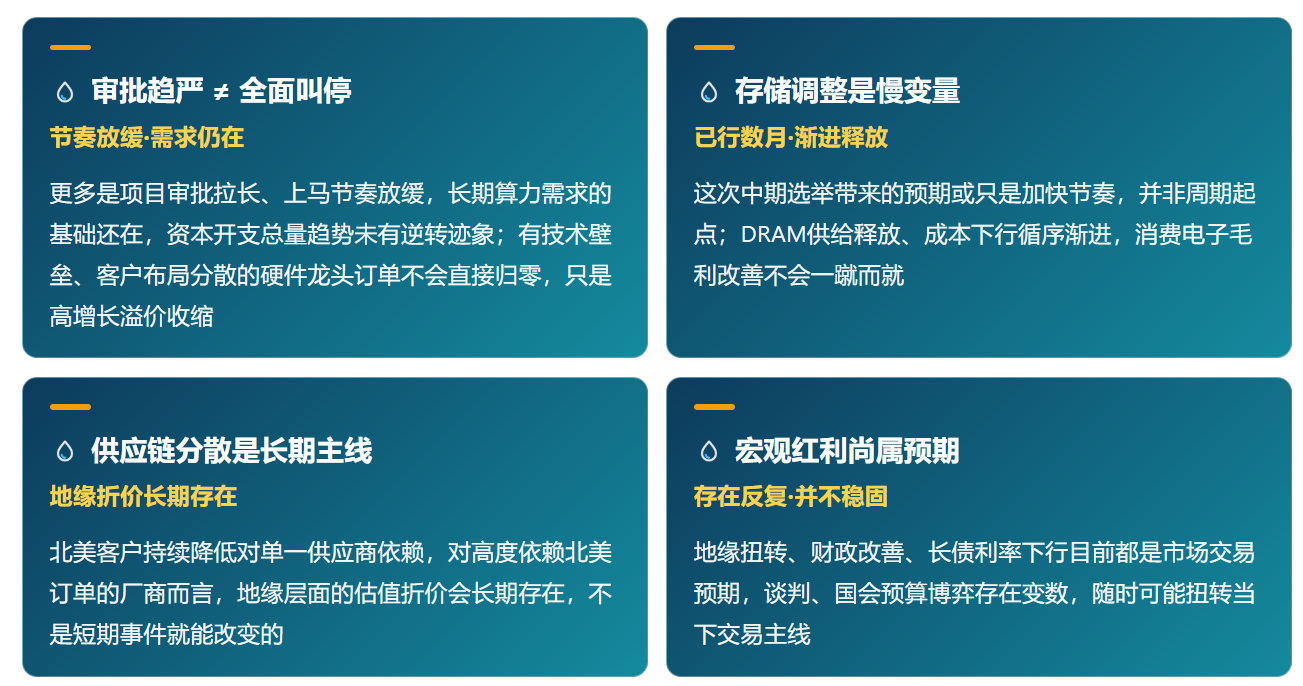
Stricter approval processes for data centers in North America do not mean a complete halt to computing capacity expansion. Rather, project approvals are taking longer and the pace of new projects is slowing; the underlying long-term demand for computing power remains intact, and there are no signs yet that the overall trend in capital expenditures has reversed. For hardware leaders with strong technological barriers and diversified customer bases, orders will not simply vanish—expectations have shifted, and the high-growth premium previously priced into the market will accordingly narrow.
Capacity adjustments on the supply side have been a gradual trend unfolding over several months; the expectations triggered by this midterm election may merely accelerate this pace, but they do not mark the beginning of a new cycle. The release of DRAM capacity and the decline in costs will be gradual processes, and improvements in consumer electronics gross margins will not materialize overnight.
Supply chain fragmentation is a long-term trend that will continue to advance. North American customers are steadily reducing their reliance on single suppliers; for manufacturers heavily dependent on North American orders, geopolitical valuation discounts will persist over the long term and cannot be reversed by short-term developments.
Geopolitical risk reversals, fiscal improvements, and falling long-term bond yields are all currently market‑driven expectations. Negotiations and congressional budget battles remain uncertain, and geopolitical news is volatile, meaning the prevailing market narrative could shift at any time; thus, the interest‑rate tailwind is far from secure.
Against this backdrop, capital may shift from the computing‑hardware sector to the domestic AI ecosystem sector. Computing‑hardware orders naturally exhibit greater volatility as they track the capacity‑expansion plans of North American cloud providers; however, it is important to note that the valuation of AI‑ecosystem companies hinges more on real‑world deployment within domestic use cases and their ability to generate tangible cash flow.
Edited by melody