
Claude Fable 5.2 and Mythos 5.2 have made significant advances in areas such as programming, reasoning, and vision, with output speeds up to 30% faster than their respective predecessors and API pricing reduced by 20% after a 20% discount. According to Anthropic, 1,000 Fable 5.2 agents completed a formal proof of Fermat's Last Theorem in just 30 hours, whereas Opus 5.5 agents with the same configuration took 18 hours to complete 26% of the work, showing virtually no further progress after extending the run to 30 hours. Mythos focuses on high‑tech domains with steep barriers to entry, such as cybersecurity and biomedicine; it has achieved breakthroughs in protein structure prediction, though its cybersecurity capabilities remain limited in open settings.
As Anthropic prepares for its upcoming IPO roadshow, it has unveiled its next-generation flagship AI models, Claude Fable 5.2 and Claude Mythos 5.2, with major enhancements to their programming, reasoning, vision, and scientific research capabilities. Both new models deliver output speeds up to 30% faster than their respective predecessors, and API pricing has been reduced by 20%, further strengthening Anthropic's competitiveness in the high-end AI model market.
On Monday, November 9, Anthropic announced that Fable 5.2 and Mythos 5.2 have made significant advances in areas such as programming, reasoning, and vision, addressing complex technical challenges. Benchmark tests released by the company show that Fable 5.2 outperformed both its previous flagship, Opus 5.5, and OpenAI's GPT-6 Astra across multiple metrics, while also surpassing Google's Gemini 4 Carbon in certain tasks.
 The release also showcased the new models' ability to tackle complex tasks: 1,000 Fable 5.2 agents formalized a proof of Fermat's Last Theorem in just 30 hours; meanwhile, Mythos 5.2 discovered a novel method for predicting the structures of entire viral capsids used in gene therapy, successfully forecasting 28 out of 34 capsid types in testing.
This announcement comes as Anthropic prepares for a major IPO. Amid sharp volatility in AI‑related stocks, Anthropic is showcasing its technological prowess with a next‑generation model, seeking to demonstrate to potential investors its commercial potential across enterprise software, scientific research, and high‑value professional workflows.
According to reports, Anthropic officially launched its Nasdaq IPO roadshow on Tuesday morning, November 10. The Wall Street Journal reported that the company has scheduled investor meetings this week, aiming to list on November 19 or 20, and is expected to file its prospectus early this week, disclosing the valuation range, number of shares to be issued, and offering price.
Programming and reasoning capabilities have surged, outperforming GPT-6 Astra on multiple benchmarks.
Anthropic states that Fable 5.2 and Mythos 5.2 have improved over the previous generation across nearly all capabilities evaluated by the company. Testers also found that the new models produce clearer output, with inference speeds up to 30% faster than the preceding Fable 5.1 and Mythos 5.1.
In benchmark tests published by Anthropic, Fable 5.2 outperformed the previous flagship Opus 5.5 across multiple metrics and also led OpenAI's GPT-6 Astra and Google's Gemini 4 Carbon in some tests.
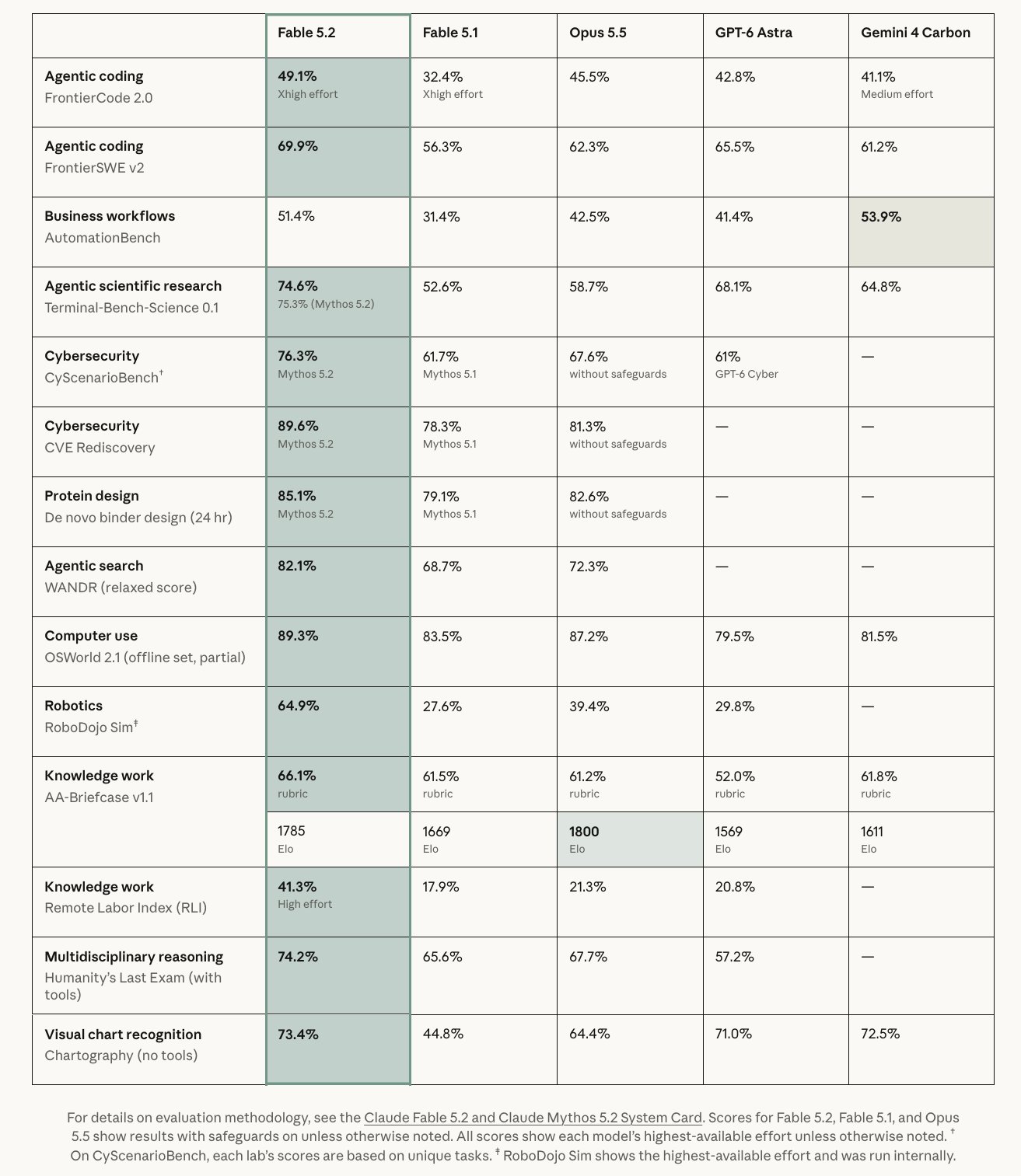
Among them, in the FrontierCode 2.0 test measuring agent programming capabilities, Fable 5.2 scored 49.1% at the highest Xhigh effort level, surpassing Fable 5.1's 32.4%, Opus 5.5's 45.5%, and GPT-6 Astra's 42.8%. In another agent software engineering test, FrontierSWE v2, Fable 5.2 scored 69.9%, also exceeding Opus 5.5's 62.3% and GPT-6 Astra's 65.5%.
In the multidisciplinary reasoning test Humanity's Last Exam, Fable 5.2 scored 74.2%, surpassing Opus 5.5's 67.7% and GPT-6 Astra's 57.2%; in the tool-free chart recognition test Chartography, Fable 5.2 scored 73.4%, also exceeding Opus 5.5's 64.4%, GPT-6 Astra's 71%, and Gemini 4 Carbon's 72.5%.
Furthermore, in the Remote Labor Index test for knowledge work, Fable 5.2 scored 41.3%, significantly outpacing Opus 5.5 at 21.3%, GPT-6 Astra at 20.8%, and the previous-generation Fable 5.1 at 17.9%, demonstrating a particularly pronounced advantage.
However, the new model does not outperform its competitors across all benchmarks. For example, in AutomationBench, a test of enterprise workflow automation, Gemini 4 Carbon scored 53.9%, surpassing Fable 5.2's 51.4%; and in another knowledge‑work benchmark, Elo, Opus 5.5 narrowly led Fable 5.2 with 1,800 points to 1,785. Thus, what Anthropic calls an all‑round upgrade more accurately reflects progress in most evaluation areas, rather than ranking first on every single benchmark.
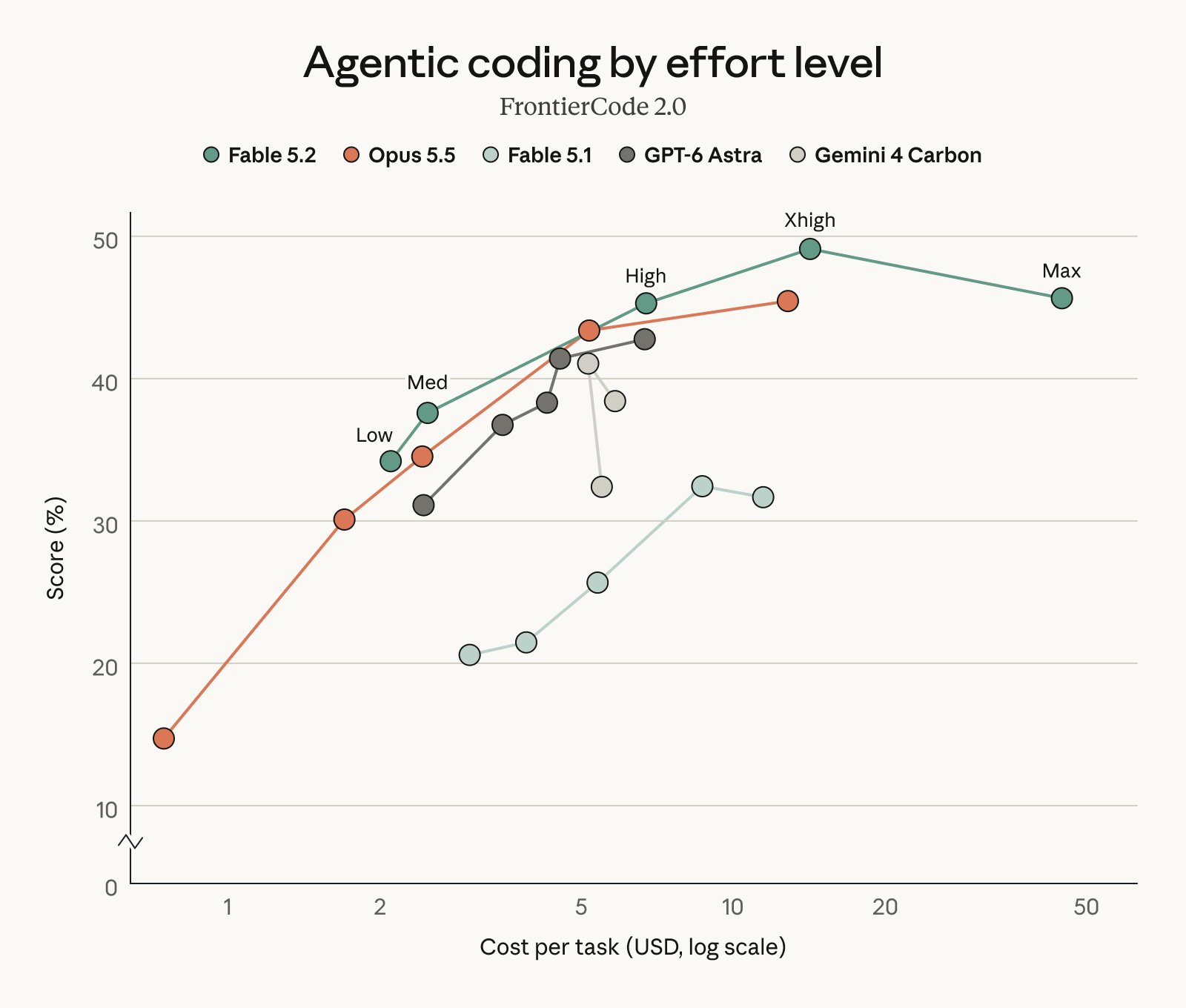
In terms of coding efficiency, Anthropic particularly highlights the model's Effort setting. In FrontierCode 2.0 testing, Fable 5.2 scored 45.3% at the High effort level, roughly comparable to Opus 5.5's 45.5% at Max effort, yet with about half the cost per individual task; when the effort level was raised to Xhigh, Fable 5.2's score further increased to 49.1%, reaching the highest level among released models tested by Anthropic.
Anthropic stated that Medium is the default effort level for both the Claude app and Claude Code. Under this setting, Fable 5.2 also requires fewer tokens to complete complex tasks.
A thousand agents formalized Fermat's Last Theorem in 30 hours, and robot and hardware design capabilities have improved.
One of the most notable demonstrations at this event was Fable 5.2 using large-scale agent collaboration to complete a mathematical proof.
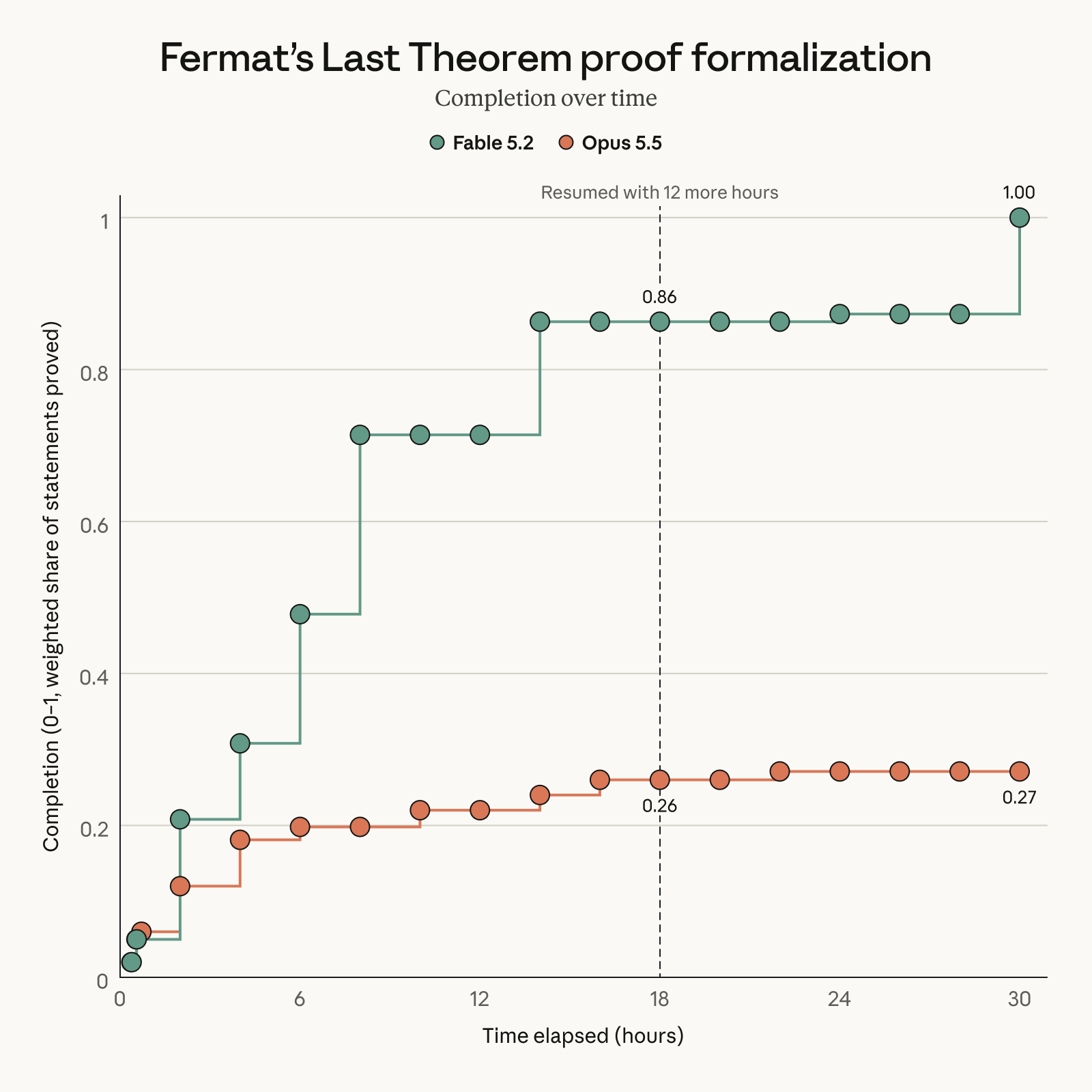
Anthropic stated that a team of 1,000 Fable 5.2 agents completed a full formal proof of Fermat's Last Theorem in just 30 hours, translating the mathematical proof into Lean language code that a computer can verify step by step with only minimal human intervention.
By comparison, Anthropic previously used an unreleased research version of Claude to complete the same task in 11 days, relying on a specially designed tool framework and guidance from human researchers. In this Fable 5.2 iteration, the number of action tokens used is only one-third of that in the earlier approach, and the length of the generated proofs has been reduced to about one-seventh of their original size.
Under the same configuration of 1,000 agents, Opus 5.5 completed only 26% of the formalization task after 18 hours, and even after extending the runtime to 30 hours, there was virtually no further progress. This comparison demonstrates that improvements in model capabilities are reflected not only in the quality of individual responses but also in the decomposition of complex tasks, agent collaboration, and long-term autonomous execution.
Another striking example of an agent's capabilities is equally remarkable: in another test, an engineer had Fable 5.2 run over 1,000 sub-agents continuously for eight days, ultimately building an operating system that booted successfully on a laptop.
Anthropic also showcased Fable 5.2's advances in physical robot control. In the RoboDojo benchmark for dual-arm robots, Fable 5.2 scored 64.9%, surpassing Opus 5.5's 39.4%, GPT-6 Astra's 29.8%, and the previous-generation Fable 5.1's 27.6%. Anthropic stated that the model has achieved "significant improvements" in robot control, including the ability to perform manipulation tasks it had not been explicitly trained on beforehand, and its performance on the RoboDojo tests outperformed most AI systems designed specifically for robot control.
In terms of hardware engineering, Anthropic reports that Fable 5.2 designed three electronic devices— a home voice assistant, a USB speakerphone, and a handheld virtual pet—based solely on a brief prompt. The model defined specifications, selected electronic components, designed four-layer circuit boards, created 3D enclosure models, and wrote software, then guided partner company Diode through manufacturing and assembly; all three devices ultimately functioned properly.
In terms of research, Anthropic also stated that Fable 5.2 has resolved two open problems in theoretical physics related to black holes, concerning the connection between general relativity and quantum mechanics. The company believes these cases demonstrate that Fable's role is expanding from a mere programming assistant to an intelligent agent system capable of undertaking long-term, open-ended technical projects.
Notably, Anthropic also disclosed that over 90% of the merged changes in its core codebase are now being handled by Claude under human supervision.
Mythos conquers protein structure prediction, while cybersecurity capabilities remain constrained and open
Unlike Fable 5.2, which targets a broader user base, Mythos 5.2 focuses on high-tech fields with significant technical barriers, such as cybersecurity and biomedicine.
Anthropic states that Mythos 5.2 has discovered a new method for predicting the structure of the entire adeno-associated virus (AAV) capsid. The protein shell of AAV can be used to deliver gene therapies, and its structure influences therapeutic efficacy—for example, determining whether the therapy is readily blocked by the patient's immune system.
Traditional protein-folding models can typically predict the structure of a single protein, but AAV capsids consist of dozens of proteins, making overall structure prediction considerably more complex. Mythos 5.2 combines two open-source protein-folding models to predict overlapping protein chain groups separately, then integrates the results by leveraging the known symmetry of the capsid.
In Anthropic's tests, Mythos 5.2 attempted to predict the structures of 34 natural and artificially designed capsids, accurately forecasting 28 of them. The company believes this approach could help biologists design viral capsids for gene therapy more quickly and at lower cost.
In terms of cybersecurity, Anthropic states that Mythos 5.2 is currently the company's most advanced model for cybersecurity engineering, capable of identifying more software vulnerabilities and improving both vulnerability reproduction and remediation. In an internal test targeting 1,829 publicly disclosed vulnerabilities, Mythos 5.2 detected 10.2% more vulnerabilities than Opus 5.5 and 14.4% more than the previous-generation Mythos 5.1.
However, for security reasons, Anthropic has not made Mythos 5.2 available to general users; instead, it grants access to vetted organizations through its Cybersecurity Verification Program and Life Sciences Verification Program.
Anthropic explained that Fable and Mythos use the same underlying model, but Fable maintains stricter cybersecurity and biological safety safeguards, blocking high-risk cybersecurity tasks such as penetration testing and exploit code generation, as well as most research-related biological tasks. Mythos, on the other hand, makes these capabilities available to vetted professional organizations.
In terms of safety testing, Anthropic stated that the new model underwent evaluation by external organizations—including the UK's AI Safety Institute (AISI), Frontier Design, and METR—prior to its release. The company reported that the new model performs on par with or better than recent models across most alignment assessment metrics, and that Fable 5.2's cybersecurity and biological safety capabilities are no weaker than those of the previous generation, while false positives have been significantly reduced.
APIs are 20% off, but Anthropic still recommends using Opus for everyday tasks.
In addition to performance upgrades, Anthropic has also lowered the API prices for Fable 5.2 and Mythos 5.2 this time.
The new model is priced at $8 per million input tokens and $40 per million output tokens, a 20% reduction from the previous generation's Fable 5.1 and Mythos 5.1 rates of $10 and $50, respectively. In fact, pricing has long been one of the primary criticisms leveled against the Fable series, and this price cut partially addresses that concern.
Additionally, the new model offers an optional Fast Mode that boosts token-generation speed up to 2.5 times that of standard mode, but at a corresponding price doubling to $16 per million input tokens and $80 per million output tokens.
Based on Anthropic's currently published API pricing, the price tiers for its major models are as follows:
model | Enter price (USD/million tokens) | Output Price (USD/Million Tokens) |
|---|---|---|
Fable 5.2 / Mythos 5.2 | 8 | 40 |
Opus 5.5 | 4 | 20 |
Sonnet 5.5 | 2 | 10 |
Haiku 5.5 (input does not exceed 100,000 tokens) | 0.10 | 0.50 |
Haiku 5.5 (over 100,000 tokens input) | 0.50 | 2.50 |
This means that although the Fable 5.2 is 20% cheaper than the previous generation, its input and output prices are still twice those of the Opus 5.5 and four times those of the Sonnet 5.5, respectively. For typical enterprise workflows that require extensive invocation, cost remains a key factor in model selection.
Notably, Anthropic does not position Fable 5.2 as the default choice for all tasks. The company explicitly recommends that, for most everyday programming and knowledge work, users should continue to prioritize Opus 5.5, then scale up to Fable or Mythos depending on the task's scope and complexity, or scale down to Sonnet 5.5 and Haiku 5.5.
Fable 5.2 can also serve as an advisor or coordinator, with smaller models such as Haiku, Sonnet, and Opus seeking its guidance on complex problems, or with Fable delegating simpler tasks to lower-cost smaller models.
In terms of availability, Fable 5.2 is now live across all paid plans of Claude, the Claude Platform API, and major cloud platforms such as AWS, Google Cloud, and Microsoft Azure, with the API model identifier claude-fable-5-2. Mythos 5.2, meanwhile, remains available on a restricted-access basis, offered only to eligible professional organizations.
Anthropic also offered eligible paying users additional Fable credits during the week of the new model's release, with some Pro and Team users receiving extra usage allowances.
IPO valuation has dropped from 2 trillion to 1.3 trillion—can the roadshow restore confidence?
The release of this model and the IPO roadshow are proceeding almost in tandem, a timing that is intriguing.
Just last Thursday, the Nasdaq 100 index plunged 6.4% in a single day, setting a record for the largest one-day wipeout of market capitalization at $2.3 trillion. In response, some potential investors have sharply lowered their estimates of Anthropic's valuation from the $2 trillion circulating in early October to around $1.2 trillion to $1.3 trillion—a drop of as much as 40%. Polymarket's prediction of the probability that Anthropic will complete its IPO by November 25 has also plummeted from 86% before the plunge to 54%.
Just a week ago, investors were still expecting Anthropic's target valuation to be around $1.5 trillion; however, according to the Wall Street Journal, some major investors now hope to push this figure down further. Company executives are in close talks with bankers from Goldman Sachs and Morgan Stanley to discuss how to set the price range for the offering. The report indicates that the company could still choose to delay the IPO, but doing so would carry the risk of triggering market panic.
One of the triggers for this round of sell-offs was the midterm election results, which brought a group of AI skeptics into Congress and led to the passage of moratoriums that could slow the construction of data centers in the United States. Meanwhile, OpenAI raised less than half of its initial target in its latest funding round, with a final valuation of $125 billion—also below expectations. According to Anthropic's S-1 filing updated on November 2, the company has committed to spending that has surged to $900 billion, second only to Google among all AI firms.
As AI-related stocks have experienced sharp volatility and the market reassesses the return on investment in AI infrastructure, Anthropic has showcased its technological advances across domains such as programming, scientific research, financial analysis, and enterprise workflows through Fable 5.2 and Mythos 5.2.
Notably, among Anthropic's early testing partners announced this time are not only tech companies such as Vercel, Shopify, Datadog, and Snowflake, but also quantitative trading and investment firms including Jump Trading, IMC, XTX Markets, and Balyasny Asset Management. These use cases demonstrate that the company is striving to extend model capabilities to high-value scenarios such as financial research, data analysis, and complex corporate decision-making.
However, leading technical metrics do not yet guarantee proven commercial returns. Higher-performance models still require substantial computational resources, and the token prices for premium models are significantly higher than those of products like Sonnet and Haiku. Anthropic must demonstrate that improvements in model capabilities translate into greater willingness to pay among enterprise customers, increased usage volumes, and improved unit economics.
Judging from this pricing strategy, the company has, on the one hand, lowered the barrier to using its high-end models by reducing prices by 20%, while on the other hand retaining distinct price tiers for Opus, Sonnet, and Haiku, enabling enterprises to flexibly select models based on task complexity and cost requirements.
For Anthropic, which is about to face scrutiny in the public markets, Fable 5.2 and Mythos 5.2 represent more than just model updates; they are critical steps to demonstrate technological leadership, expand use cases, and bolster investor confidence ahead of its IPO.