
①SpaceX has ordered a solar-cell production line from Starmind for its Starlink AI satellites, with the first line scheduled for delivery in the first half of 2027; ②Starship's 15th test flight will aim to achieve the first-ever simultaneous return-and-recovery of both stages, with the upper-stage spacecraft expected to orbit Earth 14 times and return after more than 22 hours of flight.
As SpaceX begins ordering solar-cell production lines for AI satellites, the upcoming 15th test flight of Starship takes on clearer industrial significance: future space-based data centers will require both a continuous power supply and rockets capable of transporting equipment at scale and low cost.
German equipment manufacturer SINGULUS announced on November 10 that it will supply SpaceX with turnkey production lines for heterojunction solar cells (HJT), with the first line scheduled for delivery in the first half of 2027. Mike Nicolls, SpaceX's senior vice president of Starlink, stated explicitly that these cells will be used in Starmind artificial intelligence satellites manufactured at its Texas facility.
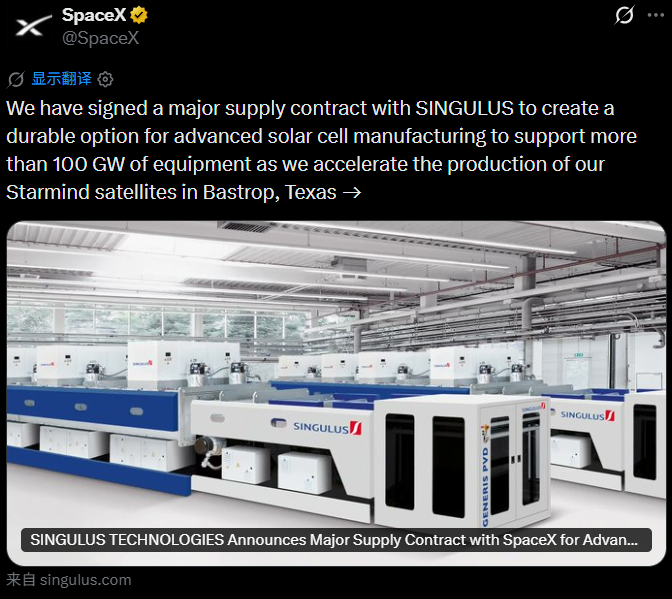
 (Source: X)
The announcement also stated that the two parties plan to add multiple production lines, with subsequent expansion of production equipment supporting solar cell manufacturing capacity exceeding 100 GW. However, the announcement did not disclose the specific capacity of the first production line or the timeline for completing all expansions.
According to publicly available information from SpaceX, Starmind aims to harness space-based solar power to provide low-cost, high-performance AI computing services to Earth. In addition to computing, storage, and networking hardware, the project requires large-scale solar power generation systems and active cooling systems; the solar cell production line represents preparatory manufacturing for the power supply component of these systems.
Meanwhile, Starship is about to face a critical test. SpaceX plans to conduct its 15th test flight as early as November 13, U.S. local time, marking the first attempt to recover both the Super Heavy booster and the Starship upper stage (Starship spacecraft) at the launch site during a single mission, using the tower's capture arms.
After orbiting Earth 14 times, the Starship spacecraft made its first attempt to return home.
During the 14th test flight on September 28, Starship reached orbit for the first time and successfully deployed 26 Starlink V3 satellites, but an engine failure caused the mission to end prematurely. The 15th test flight will pose a further challenge: after completing satellite deployment, returning the spacecraft from orbit to the launch site.
According to the mission plan, the booster will be captured approximately 6 minutes and 35 seconds after liftoff, while the Starship upper stage will orbit Earth 14 times at an altitude of about 275 kilometers before returning after more than 22 hours.
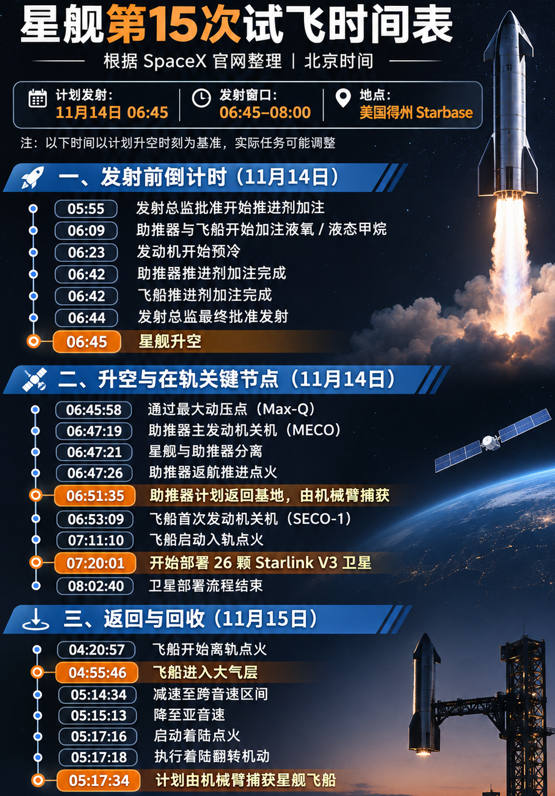
This will be the first attempt to capture a Starship upper stage on re-entry, as well as the first capture attempt for a V3‑version booster. Previously, SpaceX has successfully captured three V1‑version boosters, two of which have since been reused.
The launch window will open at 6:45 a.m. Beijing time on November 14 and last for 75 minutes, subject to regulatory approvals and other conditions. If the launch occurs on schedule and all goes smoothly, the upper-stage capture is expected to take place at around 5:17 a.m. Beijing time on November 15.
Three satellites conduct a "health check" on the spacecraft.
To determine whether Starship can return safely, SpaceX has also scheduled a space "health check": of the 26 Starlink V3 satellites carried on this mission, three are equipped with cameras that will scan Starship's thermal protection system and transmit images back to Earth, helping the team assess reentry conditions.
This time, Starship will continue to incorporate the thermal‑tile improvements from its 14th test flight, including reinforcing the attachment of areas prone to shedding during ascent, sealing potential pathways for plasma to enter behind the tiles, and extensively using curved tiles to reduce heating at the gaps between tiles.
SpaceX has made it clear that it will only attempt a return to the launch site once it has confirmed that the critical systems required for reentry maneuvers, landing ignition, and approach to the tower are healthy; otherwise, it will continue to aim for a splashdown at sea when conditions are favorable.
If the mission succeeds, Starship will achieve, for the first time, the full return and capture of both stages of a two-stage rocket on the same orbital mission, providing crucial validation for fully recovering this launch system. However, "being able to recover" is still a long way from "being able to reuse rapidly and at low cost."
The key next step is determining how much inspection and maintenance the upper stage requires after high-speed reentry—specifically its thermal tiles, engine, and structure—and whether the two-stage rocket can sustain rapid turnarounds. According to SpaceX, of the three V1‑version Super Heavy boosters it has successfully recovered, two have already been reflown.
For the future deployment of Starmind's AI satellites, a successful dual recovery on a single flight will be a major milestone, while only a steady rate of reuse and controllable maintenance costs will determine how much Starship can reduce the cost of space transportation.