
Anthropic's roadshow video revealed that the company believes it can achieve an adjusted operating margin of 35% or higher over the long term, far surpassing the 15% recorded in Q3 this year; the target for computing cost as a percentage of revenue will be reduced to 45%-50%, with sales and personnel expenses being cut in tandem. As of the end of Q3, Anthropic had more than 11,900 enterprise customers with revenues exceeding $100,000 over the past 12 months, an increase of more than 12-fold year over year; the net revenue retention rate among enterprise customers stood at 900%. Anthropic showcased use cases from major corporate clients including Eli Lilly and Co., Rakuten, Salesforce, and Walmart, demonstrating that Claude is rapidly gaining traction across industries such as law, pharmaceuticals, software, and retail.
In an IPO roadshow video released on Tuesday, the 10th, Eastern Time, Anthropic disclosed its long-term profitability target: the company believes that, as computing power efficiency improves, the proportion of directly purchased and leased compute increases, and the share of inference workloads expands, its long-term adjusted operating margin could exceed 35%, up more than 20 percentage points from 15% in the third quarter of this year.
In addition to this long-term profitability target, Anthropic's roadshow also unveiled several operational metrics previously undisclosed in a consolidated manner: as of the third quarter, the company's revenue reached $17 billion, more than a 12-fold year-over-year increase; over 11,900 enterprise customers generated more than $100,000 in revenue over the past 12 months, also up more than twelvefold year over year; and compute efficiency improved by more than fourfold compared with the first quarter of 2025. Anthropic further disclosed that, as of the end of October this year, its annualized revenue stood at approximately $81 billion.
 The roadshow materials also showcased application cases from major corporate clients such as Eli Lilly and Co., Rakuten, Salesforce, and Walmart, aiming to demonstrate that Claude is expanding from a programming tool to fields including scientific research, legal services, business operations, and retail.
This suggests that Anthropic is seeking to demonstrate to investors a path from rapid growth to high profitability. However, the company has not provided a clear timeline for achieving its long-term target of over 35% margin; meanwhile, the roughly $900 billion in computing power commitments implies that the realization of its profitability goals will ultimately depend on enterprise customer growth, control of computing costs, and the pace of AI commercialization.
Enterprise customer revenue expanded rapidly, with net revenue retention reaching 900%.
In the IPO website and roadshow materials released on November 10, Anthropic for the first time presented a comprehensive overview of several operational metrics as of the third quarter.
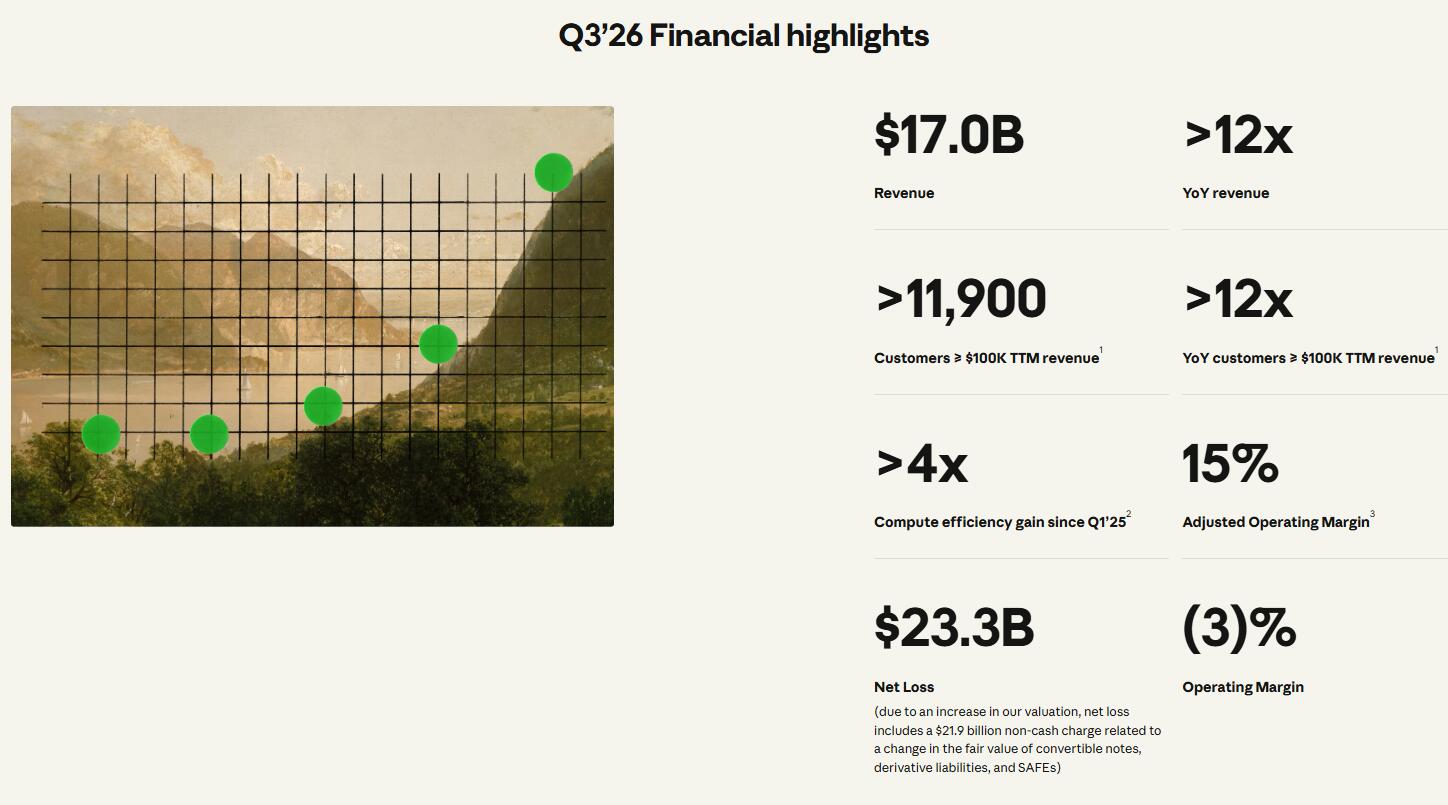
According to official disclosures, as of September 30, 2026, Anthropic had more than 11,900 enterprise customers with revenues exceeding $100,000 over the past 12 months, an increase of more than twelvefold compared with the same period last year. Among them, over 1,900 customers generated more than $1 million in revenue during the past 12 months, and approximately 250 customers reported revenues exceeding $10 million.
Customer retention and expansion metrics are equally impressive. Anthropic disclosed that its enterprise customers' net revenue retention rate is approximately 900%, meaning that as existing enterprise clients expand their use cases and scale with Claude, the revenue they generate increases significantly. Furthermore, more than half of its enterprise customers use both the Claude Platform and at least one of Anthropic's proprietary applications, up from roughly 30% in the fourth quarter of 2025.
In terms of compute efficiency, Anthropic stated that, as of the third quarter, its compute efficiency had improved by more than fourfold compared to the first quarter of 2025. This metric is calculated as the ratio of revenue to computing and infrastructure expenses, comparing the revenue-to-compute spending ratio between the third quarter of 2026 and the first quarter of 2025.
Official documents show that this metric rose from 0.40x in the first quarter of 2025 to 2.08x in the second quarter of 2026, before falling back to 1.72x in the third quarter. The company explained that the efficiency gains in the third quarter were partially offset by a temporary increase in computing power supply, including $5 billion worth of short-term compute purchases, whose costs were significantly higher than those under multi-year procurement agreements.
Anthropic also disclosed that, as of the third quarter of 2026, revenue per employee over the past 12 months exceeded $6.6 million. The company cited high talent density, a streamlined sales organization, and widespread use of Claude by its employees to boost internal productivity as key factors in improving operational efficiency.
Furthermore, as of October 2026, Anthropic's revenue run rate has reached approximately $81 billion. It should be noted that the run rate is an annualized estimate based on recent revenue levels and does not represent actual full-year revenue.
Five enterprise customers showcased their commercialization achievements, and Claude is accelerating its penetration into fields such as research and retail.
In addition to its operating metrics, Anthropic has also compiled case studies showcasing five enterprise clients on its IPO website, covering the legal services, pharmaceutical, internet, software, and retail sectors.
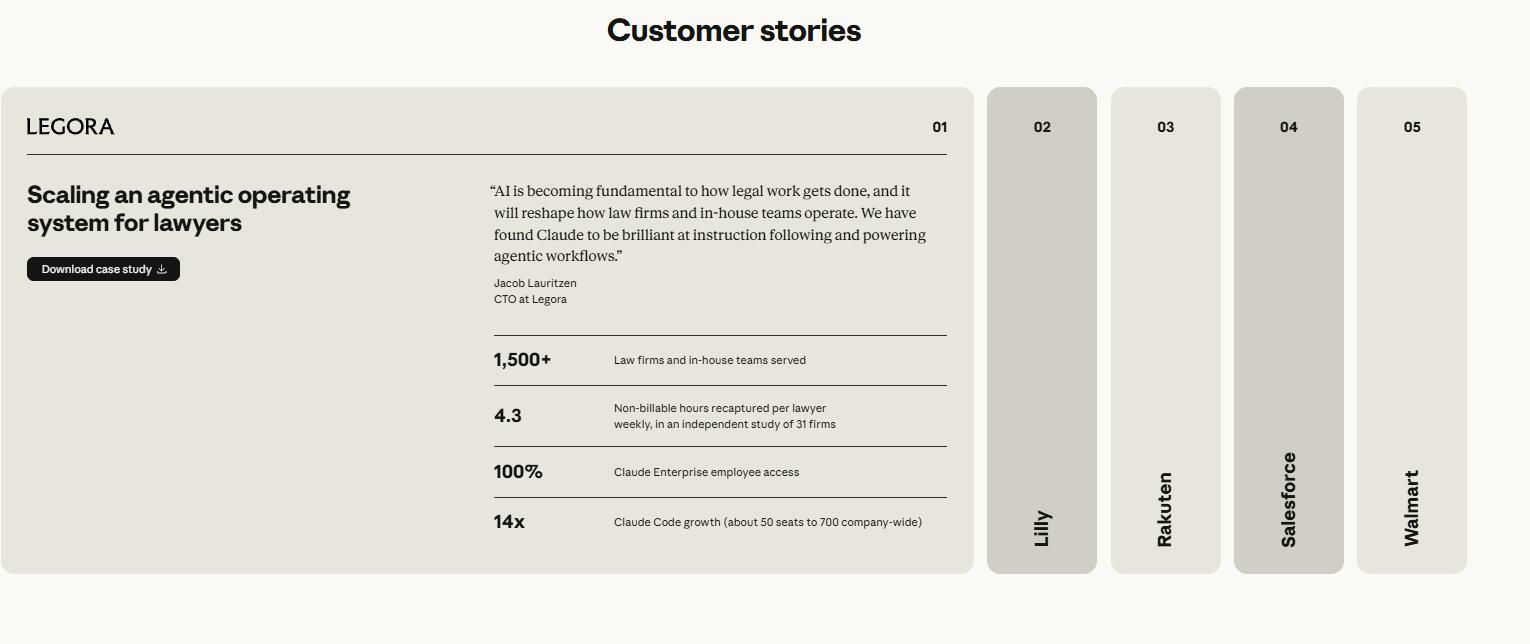
Among them, the legal tech company Legora serves more than 1,500 law firms and corporate legal teams, with all employees having access to Claude Enterprise. An independent study involving 31 law firms showed that Claude helps each lawyer save and reallocate approximately 4.3 hours per week from non-billable tasks.
Pharmaceutical company Eli Lilly and Co. has made Claude Enterprise available to more than 50,000 employees, with over 85% of staff in key functional departments actively using the tool. Anthropic used this to emphasize that the applications of Claude are expanding from software development into the life sciences and research sectors.
Japan's Rakuten Group demonstrated the efficiency of Claude Code in software development. The company disclosed that more than 70 of its business units are using AI, with an accuracy rate of 99.9% for complex code modifications; with AI, the number of working days required to bring a new feature from development to market has been reduced from 24 days to 5 days.
Salesforce stated that over the past year, the effective output per developer increased by 151%, and an API migration task originally expected to take 231 working days was completed in just 13 days using Claude-related tools. Walmart disclosed that its AI shopping assistant, Sparky, saw a month-over-month increase of over 110% in weekly active users, and the average order value for orders placed through the assistant was approximately 35% higher than for non-Sparky orders.
These cases demonstrate that Anthropic is seeking to convince investors that Claude's commercial value extends beyond software development, expanding into areas such as scientific research, legal services, corporate operations, and consumer retail. At the same time, the company disclosed that among Global 2000 firms, more than 30% spent over $100,000 on Anthropic in the past 12 months, while among Fortune 500 companies, this share exceeds 50%. However, on average, Fortune 500 customers still account for less than 0.1% of Claude's total revenue, a figure the company views as indicating significant room for further expansion in the enterprise market.
The target for the share of spending on computing power has been lowered to 45%–50%, and sales and personnel expenses are being reduced in tandem.
According to the roadshow video, Anthropic Chief Financial Officer Krishna Rao stated that the company believes it can achieve an adjusted operating margin of 35% or higher over the long term, compared with 15% in the third quarter of 2026.
To achieve this goal, Anthropic expects that, as it continues to improve compute efficiency, increases the share of Anthropic Direct compute capacity, and shifts more compute resources to inference workloads, its compute and infrastructure spending as a percentage of revenue will gradually decline to approximately 45%–50%. This ratio stood at 58% in the third quarter.
Anthropic Direct is the company's model of directly leasing AI chips and data centers, rather than relying entirely on cloud service providers for computing power. By acquiring and managing computing resources directly, the company aims to strengthen supply-chain control and reduce long-term computing costs.
Other expenses have also been factored into the long-term optimization targets. The roadshow video indicates that sales, marketing, and partner expenses as a percentage of revenue are expected to decline to 7%–10%, compared with 14% in the third quarter; adjusted headcount and other operating expenses are projected to fall to 7%–10%, versus approximately 13% in the third quarter.
Based on this long-term cost structure, Anthropic aims to keep computing and infrastructure expenses at roughly half of revenue, while further reducing the relative share of sales, marketing, personnel, and other operating expenses, thereby driving overall adjusted operating margin above 35%.
Notably, Anthropic also disclosed in its official materials that by September 2026, more than 90% of code contributions to the company's codebase will have been generated by Claude. The company cites this figure to illustrate that AI is not only a product it sells externally but has also become deeply integrated into its own R&D and operational processes.
Adjusted earnings remained volatile, with the company posting another GAAP loss in the third quarter.
Anthropic's prospectus disclosed that revenue reached $16.956 billion in the third quarter of 2026, a substantial increase from $1.382 billion in the same period last year; adjusted operating profit was $2.463 billion, corresponding to an adjusted operating margin of 15%, down from 19% in the second quarter.
However, under GAAP accounting standards, Anthropic still reported an operating loss of $567 million in the third quarter, contrasting sharply with the $974 million operating profit recorded in the second quarter. The company explained that its third-quarter results were impacted by approximately $5 billion in short-term compute procurement costs and about $2 billion in non-cash expenses related to its donation-matching program.
Additionally, GAAP net loss for the third quarter totaled $23.3 billion, including approximately $21.9 billion in non-cash expenses arising from changes in the fair value of convertible notes, derivative liabilities, and SAFE agreements. This item is not equivalent to the company's operating loss.
Adjusted operating margin and GAAP operating margin are not the same metric. Anthropic defines adjusted operating profit as operating profit excluding share-based compensation expense, non-cash charitable contributions, and the Bartz litigation settlement expense; adjusted operating margin is then calculated as adjusted operating profit divided by revenue. Investors should note that this non-GAAP measure excludes certain expenses actually recorded in the financial statements and should not be equated directly with the company's profitability under GAAP.
Over the longer term, in the first nine months of 2026, Anthropic reported revenue of $33.242 billion and a GAAP operating loss of $1.26 billion; however, adjusted operating income reached $4.081 billion, corresponding to an adjusted operating margin of approximately 12%. For the same period in the prior year, the company's adjusted operating loss was $3.133 billion.
This indicates that Anthropic's adjusted operating performance has improved markedly, though volatility persists from quarter to quarter. The company also cautioned in its prospectus that investments in additional computing capacity typically precede the realization of corresponding revenue; going forward, as large-scale compute resources are progressively brought online, operating margin and adjusted operating margin may still face temporary pressure.
A computing power commitment of approximately $900 billion, with large-scale investment still required over the next several years.
While showcasing prospects for improved computational efficiency and profit margins, Anthropic also disclosed a substantial long-term plan for computing power investment.
According to the official IPO factsheet, as of the third quarter of 2026, Anthropic's total committed compute spending amounts to approximately $900 billion. Of this, about $451.6 billion is expected to be incurred by the end of 2030, with the majority of the remainder projected between 2031 and 2045. Commitments maturing within the next 12 months total approximately $70.7 billion.
As a financial reserve, as of the end of the third quarter, the company held approximately $96 billion in cash and cash equivalents, along with about $36 billion in short-term investments. The company also disclosed that it has raised cumulative financing of roughly $141 billion.
This means that, despite Anthropic's goal of boosting its long-term adjusted operating margin to over 35% through improved computational efficiency and cost optimization, the company will still need to continue investing heavily in building out its computing infrastructure. Striking a balance between cutting-edge model research and development, hardware procurement, and profitability will remain a key concern for investors following its public listing.
Goldman Sachs analysts forecast that Anthropic's annual revenue could reach approximately $685 billion by 2030, with enterprise customers accounting for about $586 billion. However, this is an analyst projection and not a performance commitment from the company.
The founding team will retain a substantial shareholding, with the shares to be sold representing approximately 2.9% of the IPO offering size.
Beyond the profit targets, the Anthropic founding team's stock sale arrangements have also become a major focus of this IPO prospectus.
According to the prospectus updated on November 10, all seven co-founders of Anthropic plan to sell 3.3784 million shares. Based on the midpoint of the $74 per share offering price range, each will realize approximately $250 million, for a combined total of about $1.75 billion.
The seven founders include CEO Dario Amodei, President and Director Daniela Amodei, as well as Tom Brown, Jack Clark, Jared Kaplan, Sam McCandlish, and Christopher Olah.
Despite the sale reaching a scale of one billion dollars, based on the midpoint of the offering price, each founder would still retain holdings worth approximately $18 billion. According to Bloomberg's Billionaires Index, the IPO pricing suggests that each of the seven founders could see their personal wealth reach around $18 billion.
This is not the first time the founders have sold shares. According to the prospectus, Dario Amodei and Daniela Amodei previously participated in tender offers for shares in June 2025 and April 2026. In this IPO, the seven individuals are collectively selling shares representing approximately 2.9% of the total shares offered in this public offering, and the company itself will not receive any proceeds from this secondary-market sale.
The IPO could raise up to $64.4 billion, with an additional $26 billion raised through private placement.
Anthropic's IPO plans to issue 825 million Class A common shares, with the company issuing approximately 801.4 million shares and existing shareholders selling about 23.65 million shares. The proposed price range is $70 to $78 per share. Based on the top end of the range, the offering could raise up to approximately $64.4 billion.
In addition, the company has arranged a concurrent private placement totaling $26 billion, with subscribers including technology firms such as AMD, Broadcom, Google, Microsoft, NVIDIA, Micron, and Taiwan Semiconductor. When the IPO and private placement are combined, the total financing could reach as high as $90.4 billion.
Valuations reported by the media vary depending on the number of shares publicly issued and related equity calculations: Reuters, using the share count disclosed in the prospectus, estimates a maximum valuation of approximately $1.02 trillion; Bloomberg's reported valuation of about $1.4 trillion, however, incorporates broader potential equity dilution. The two figures are not based on exactly the same valuation methodology.
Anthropic's official website also disclosed that the IPO roadshow kicked off on November 10, with the final offering price expected to be set on November 18. The stock is scheduled to begin trading on Nasdaq on November 19 under the ticker symbol ANT.
For investors, Anthropic's roadshow is not only about showcasing its rapidly growing revenue and model competitiveness but also about explaining how the company is transitioning from heavy investment in computing power to sustained profitability. A long-term adjusted operating margin target of over 35%, more than a fourfold increase in compute efficiency, over 11,900 enterprise customers, and roughly $900 billion in long-term compute commitments together form the key focus of this massive IPO.
However, beyond the high growth expectations, whether investments in computing power can translate into sufficient revenue and profits, and whether enterprise customers will continue to increase their spending on AI services, remain central questions that the market cannot avoid when assessing Anthropic's long-term value.
Editor/stephen