of November 12th$Baidu (BIDU.US)$At the World Conference, Robin Li discussed a common business practice in the large model market—the key pain points of intermediary platforms.
"These hubs aggregate various model providers and make their models available for developers to use, but they do not take responsibility for the model's performance, service stability, or response speed. In some cases, even the authenticity of the model cannot be verified; if a flash version is used instead, or if a Pro version is generated, it will likely face little resistance on these platforms."
With an increasing number of model providers and third-party inference service vendors, the same model often has multiple supply channels, each offering different pricing and performance levels, thereby raising developers' selection costs. Consequently, a wave of intermediary platforms has emerged, aggregating model resources and providing unified APIs to offer invocation services to developers.
 To address this pain point, Baidu has launched its own large-model trading platform, YuanSuo. According to You Li, YuanSuo's product manager, "YuanSuo is a neutral, trustworthy large-model trading platform that connects suppliers and consumers, bridging the information gap between them. It makes YuanSuo transactions as convenient, open, and transparent as trading shares of listed companies."
At this Baidu World Conference, Baidu disclosed that since Yuanqi went live a month ago, more than 100 supply resources have joined the platform, with daily API calls exceeding 50 million and daily token calls surpassing 700 billion.
What YuanSu aims to do is consolidate model‑invocation resources scattered across different channels into a single platform that allows users to compare prices, view runtime metrics, and access credit ratings.
For model providers, it serves as a sales channel to reach developers; for developers and enterprise customers, it is a centralized portal for discovering, comparing, and procuring model services.
For Baidu, aggregating model resources is just the beginning; the key to this business is attracting both supply and demand sides to continue transacting on the platform.
From the transit hub to the trading platform
At the token marketplace, the invocation service for the same model can be provided by multiple vendors.
What users purchase is the model invocation service offered by a specific vendor under certain price, performance, and availability conditions; the model itself is not included in the transaction.
This means that even if the model names are the same, the services users actually receive may differ.
As of November 12, the platform's official website model marketplace showcases more than 40 models, covering mainstream models such as DeepSeek, Kimi, Zhipu GLM, and MiniMax, as well as video models; Baidu's own Wenxin series is also included.
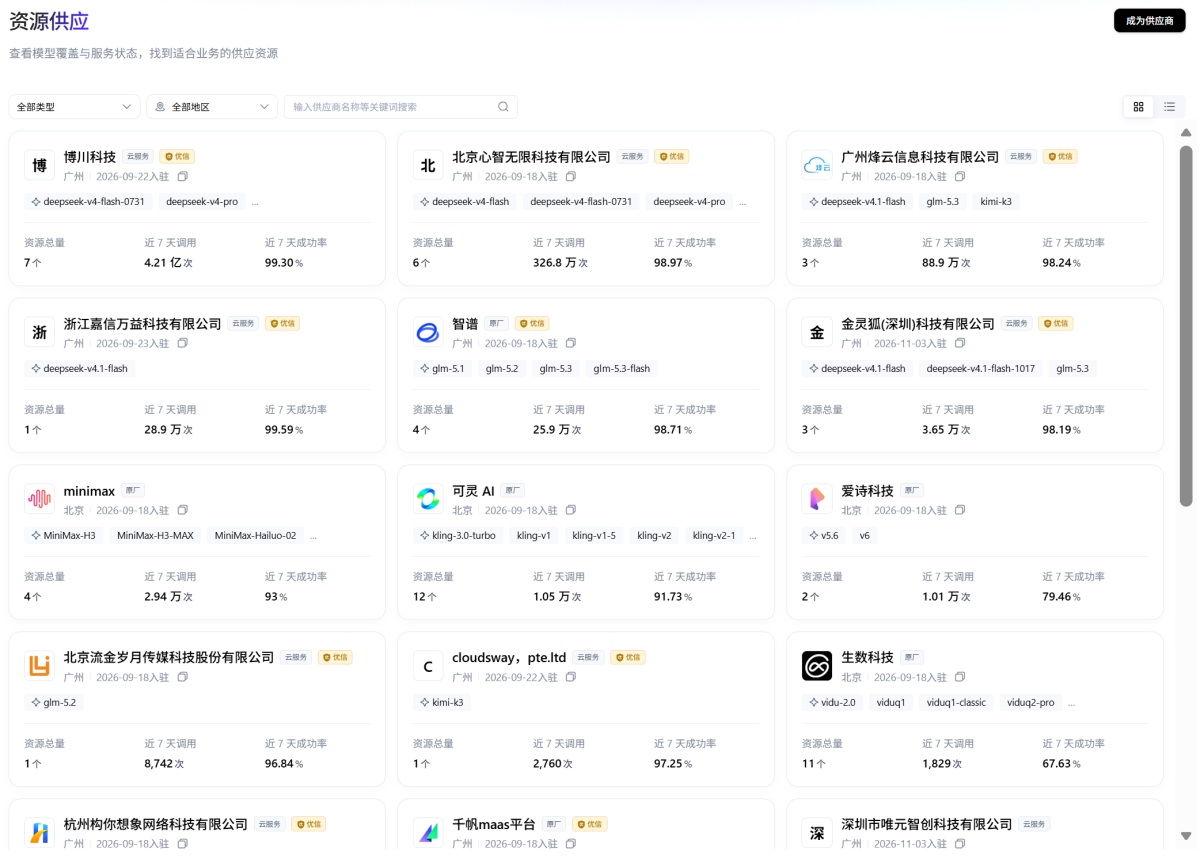
According to the official website's supplier list for Ciyuan, many suppliers registered between September 18 and 23, with new registrations also appearing in early November.
For the same model, different vendors offer different prices.
Taking DeepSeek-V4.1-Flash as an example, the quoted prices for output tokens from five providers range from RMB 2.96 to RMB 6.00 per million tokens, while the first-token latency varies from 951 milliseconds to 2,114 milliseconds.
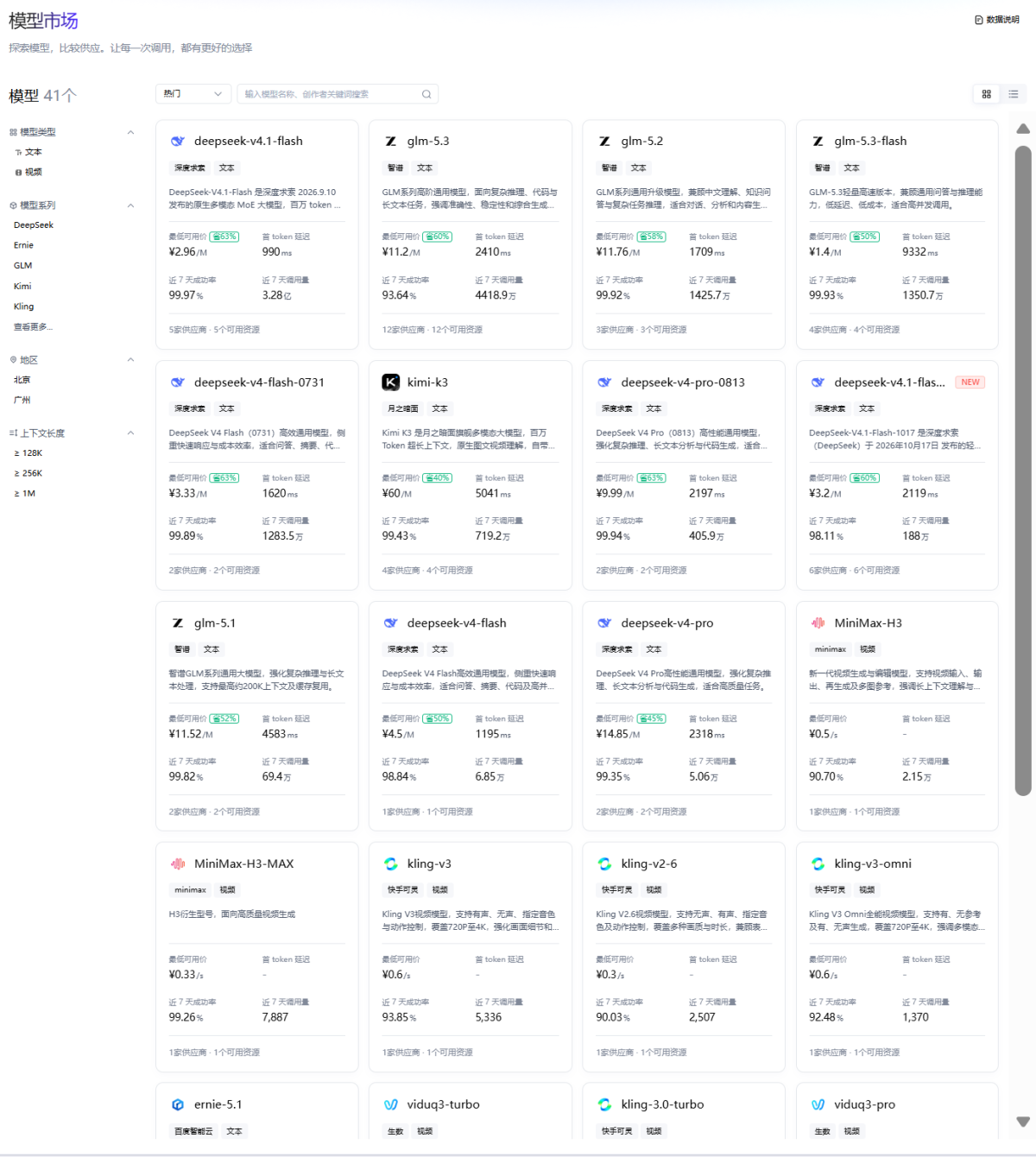
In the past, if developers wanted to compare quotes and service performance across different channels, they often had to search for vendors individually, review their pricing, or test their APIs. Token consolidates this information, making it easier for developers to find and initially screen vendors.
For new users who have not yet established model supply channels, this convenience may be more attractive than the unified API itself.
According to the official vendor rankings on the Ciyuan Su website, there is a wide disparity in the number of API calls received by different vendors. As of November 12, Bochuan Technology recorded approximately 421 million calls over the past seven days, while Beijing Xin Zhi Wu Xian logged about 3.268 million calls, a difference of roughly 129-fold. Some vendors reported fewer than 10,000 calls during the same period.
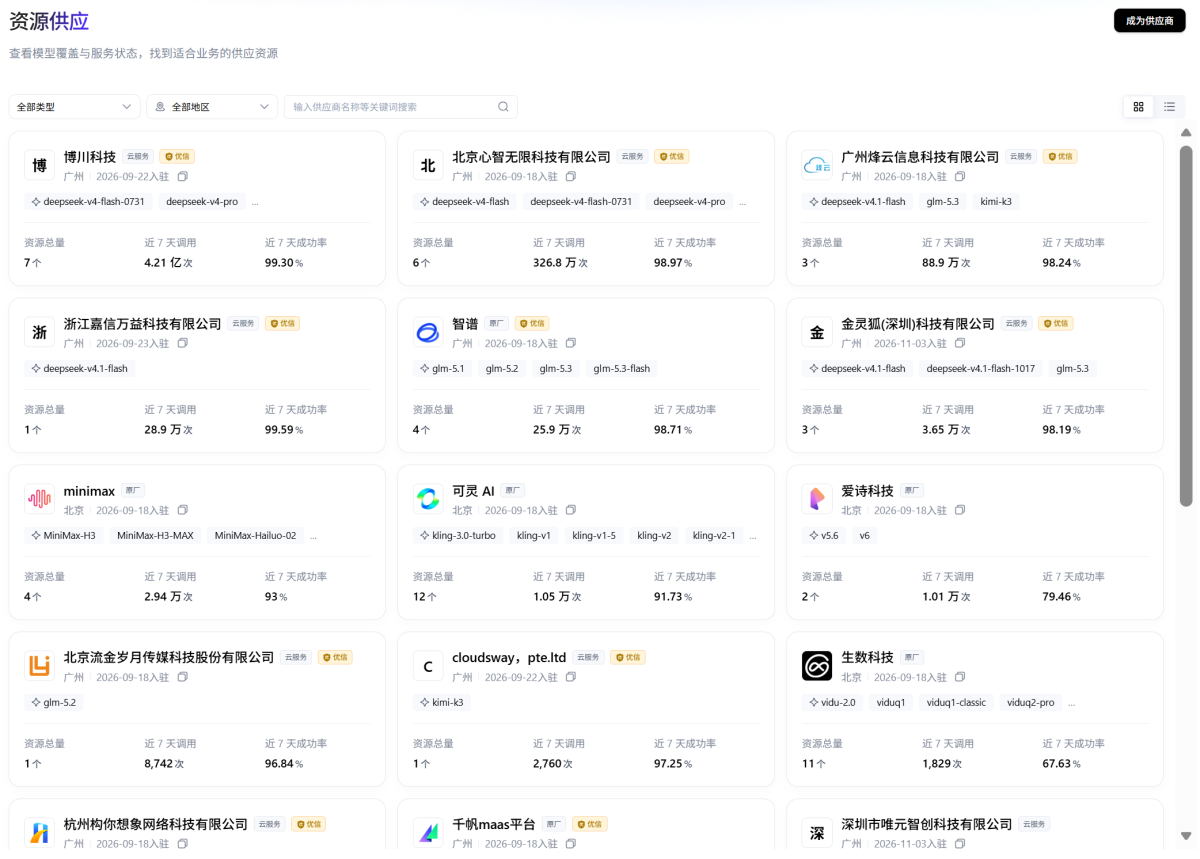
The token aggregates quotes, performance metrics, and invocation data from different vendors, enabling developers to compare services on a single platform while exposing vendors to direct competition with other service providers.
However, supplier onboarding and growth in transaction volume are two separate matters. Although Bochuan Technology's call volume listed on the ranking is far higher than that of other suppliers, it is difficult to disaggregate, based on existing data, the contribution from its existing customers versus new transactions generated on the platform.
Aggregating supply resources is only the first step; Baidu needs to attract customers to keep sourcing on the platform in order to turn the model showcase into an actual trading marketplace.
Entry position filling
In addition to its existing Qianfan MaaS business, Baidu has added a trading platform for multiple model providers through Yuan.
Shen Dou, Executive Vice President of Baidu Group and President of Baidu Intelligent Cloud Business Group, introduced at the conference: "We offer two types of model services. First, as a model service provider, we provide MaaS services with exceptional cost-effectiveness. Second, there is Token House. Its hallmark is neutrality and trustworthiness, offering an interoperability platform for all token providers and consumers."
Enterprises can obtain model services through Baidu's existing MaaS channels, or they can use Yuan to compare and purchase model invocation resources from different vendors.
This arrangement is related to Baidu's existing cloud business. In his speech, Shen Dou positioned Intelligent Cloud as follows: "Traditional cloud services cater to enterprise IT systems, supporting the migration of various enterprise software and applications to the cloud. Now, Intelligent Cloud will further support intelligent agents in accomplishing one task after another."
A model trading platform needs to attract both suppliers and buyers. The more suppliers there are, the greater the variety of model resources, pricing options, and service plans that developers can compare; the more buyers there are, the stronger the incentive for suppliers to join the platform, offer competitive quotes, and provide reliable services.
This mutually reinforcing relationship between supply and demand is a crucial condition for the trading platform to scale up. Baidu can leverage its existing cloud customers to generate initial demand, then attract new developers with more third-party model resources. If transactions increase, the platform will also have the opportunity to bring in more suppliers.
However, in the model call marketplace, buyers and sellers are usually not bound in a one-to-one relationship. Suppliers can connect to other cloud platforms and intermediary services at the same time, and developers can also invoke the same model through multiple channels. Even if Tokenwise aggregates a large number of resources, it does not mean that these suppliers and customers will remain exclusively on Baidu.
Baidu's Q2 2026 earnings report shows that AI cloud infrastructure revenue was RMB 7.3 billion, up 50% year over year; AI application revenue was RMB 2.5 billion, up 3% year over year.
For enterprises already using Baidu Cloud, as AI applications increase, the models they invoke may not be limited to Baidu's Wenxin; they could also include third-party models such as DeepSeek, GLM, and Kimi. Token supports Baidu account login, top-ups, and API calls, giving enterprises already on Baidu Cloud an additional option to procure third-party model invocation services within the Baidu ecosystem.
If the enterprise's existing procurement, access control, and settlement systems can be reused as a whole, the switching costs will be lower; however, at present, it is difficult to determine the extent of such reusability.
The token has added a channel for Baidu to meet multi-model demands; on one hand, it handles the multi-model procurement needs of Baidu's existing cloud customers, and on the other hand, it attracts more developers through a unified model marketplace, pricing, and credit evaluation.
Baidu's advantage first stems from its existing cloud business. If a company's original account, procurement, and settlement systems can be integrated with Yuan, adding third-party model calls may reduce the effort required to reconnect with other platforms.
However, this advantage is not unique to Baidu. Other major cloud service providers also have enterprise customers, model service platforms, and mature billing systems, and can likewise meet customer needs by aggregating third-party models. The unified API, model display, and billing functions themselves can also be adopted by other multi-model service platforms.
Transaction revenue is another business return that needs to be validated.
At this Baidu World Conference, Robin Li stated: "Earlier this year, even companies that had once emphasized token maxing have now turned around and begun to rein in their budgets in this area."
The Token Store has not yet disclosed specific commission, markup, or service fee structures, and existing call volumes cannot be directly converted into platform revenue. Beyond the transactions themselves, Baidu may also reach new developers and enterprise customers through the Token Store, directing model procurement needs toward Qianfan, Agents, and other cloud services, but there are currently no publicly available data on new customers, payments, or business conversions.
Beyond Credit Ratings
To address the challenge of tool selection, CiYuan presents two categories of tools.
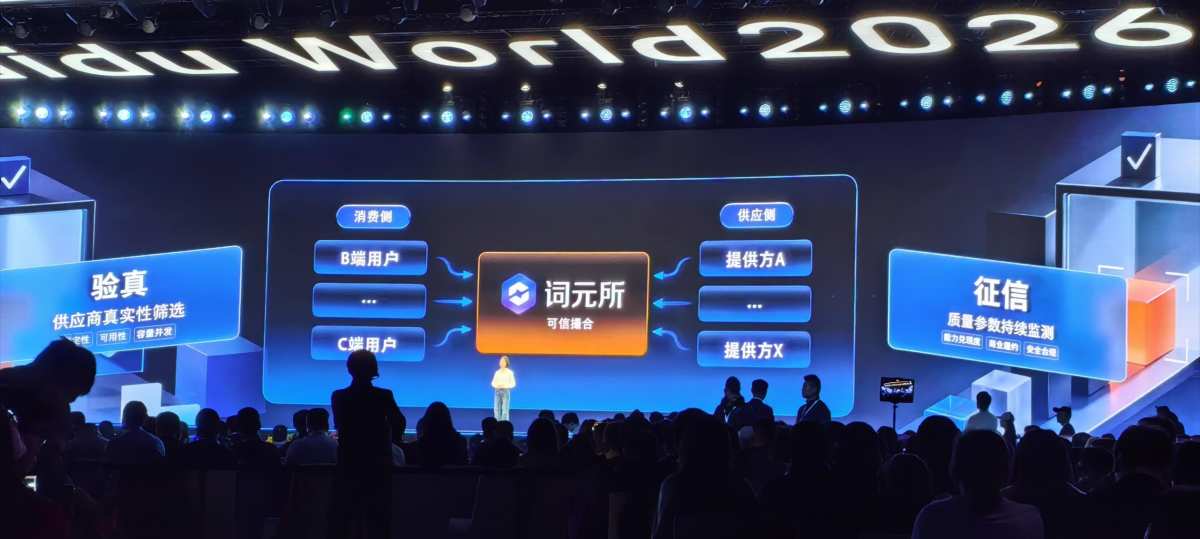
The first category is verification, which corresponds to the supplier onboarding process. The platform conducts qualification and source verification for model providers and performs comprehensive admission testing on model resources, covering model fingerprint comparison, capability testing, performance testing, usability testing, and capacity stress testing. Baidu aims to use this approach to identify issues such as model impersonation and false parameter claims.
The second category is credit reporting, which primarily focuses on the service performance of models after they are deployed. At the launch event, You Li, a product manager at Ci Yuan, cited an example: a customer initially experienced good service when accessing model resources, but anomalies emerged after a period of use, and the issue was only discovered when end users filed complaints.
According to Baidu's description, after model resources are listed, the platform will continuously monitor service quality, conduct regular spot checks, and display operational metrics from actual invocations. It will score suppliers across dimensions such as service quality, fulfillment rate, security and compliance, and commercial performance, generating credit rating tags, with data accumulating into publicly accessible credit profiles.
However, when enterprises purchase third-party model services via tokens, they must also consider stability.
The service agreement updated by Baidu on November 11 states that, with respect to the platform's own gateway and authentication services, Baidu undertakes to use reasonable commercial efforts to ensure stability; however, for failures of third-party vendors, network fluctuations, degradation of model capabilities, or deprecation, the agreement stipulates that the platform shall not bear corresponding liability for breach of contract or compensation.
The agreement also clarifies that Baidu's formal verification of information disclosed by suppliers does not constitute a guarantee of the suppliers' actual conduct.
With respect to the platform's indemnification obligations under the agreement, the service agreement establishes a cumulative cap on damages, not exceeding the service fees actually paid by the user over the past 12 months. Additionally, the agreement recommends that users implement multi‑model resource disaster recovery and degradation strategies at the business level.
In other words, Baidu is willing to undertake the detection, display, and credit management of model resources, but it has not thereby committed to guaranteeing the full service quality of third-party models. Undertaking quality management and providing customers with a quality guarantee are two different matters under the contract.
Baidu stated that when a supplier's credit score declines, the platform will proactively notify users; however, publicly available information has not yet clarified the rules regarding ranking adjustments, order acceptance restrictions, resource delisting, and dispute resolution following a credit downgrade.
For Baidu, credit rating has the potential to become a differentiating capability for its model trading platform, but whether it can establish a sustainable competitive advantage depends on the extent to which it influences customer choices and supplier behavior.
The token already has supply resources and call volume; what remains to be demonstrated is how many new customers, revenue, and profit these transactions can bring to Baidu.
Editor/Deng