Google has unveiled Gemini 4 Hydrogen, positioning it as a high-performance execution engine that emphasizes speed and accuracy. Compared to its predecessor, Flash, task speeds are 2.5 times faster, while hallucination rates have dropped by more than fivefold. The model is now available globally across multiple platforms, including Search, the Gemini apps, and APIs. Google also introduced the Orchestrator feature, which dynamically coordinates Carbon and Hydrogen for collaborative operation, reducing quota consumption by 24%.
Google has comprehensively expanded the reach of its Gemini 4 series with a high-performance model designed for both everyday users and developers.
Following the launch of its flagship model, Carbon, this week, Google unveiled Gemini 4 Hydrogen on Thursday, positioning it as "bringing cutting-edge intelligence to everyone."

 This model prioritizes speed and execution efficiency, abandoning the established "Flash" brand name in favor of Hydrogen.
Google stated that Hydrogen has launched globally simultaneously for developers, businesses, and consumers, spanning multiple platforms including the Gemini API, AI Studio, Gemini applications, Google Search, and Google Antigravity.
In benchmark tests, Hydrogen outperformed the Argon model in its series on the Artificial Analysis Intelligence Index using the default High Thinking mode (51 points vs. 50 points), and could reach 54 points when the maximum xhigh thinking mode was enabled.
Compared to the previous-generation Gemini 3.8 Flash, Hydrogen completes tasks 2.5 times faster at the same settings, its Terminal-Bench 4.1 score jumps from 18.2% to 57%, and its fabricated claims rate drops by more than fivefold.
For developers, the model is priced at $1.50 per million input tokens and $7.50 per million output tokens, with pricing calculated uniformly across the entire 1-million-token context window.
Positioning: Efficiency Execution Layer, Completing the Multi-Model Collaboration Puzzle
Google's division of labor for the Gemini 4 series has become clear: Carbon and Argon handle deep reasoning and complex tasks, while Hydrogen serves as a fast execution engine, suitable for everyday coding, agent workflows, and multi-step data processing.
To systematize this multi-model collaboration approach, Google has simultaneously introduced the "Orchestrator" feature in Google Antigravity. This feature dynamically schedules Carbon and Hydrogen within the same session, automatically switching between them based on task complexity without requiring manual user intervention.
According to internal test data disclosed by Google, Orchestrator achieves a task success rate on Terminal-Bench 4.0 that is comparable to Carbon's, while reducing quota consumption by an average of 24% and increasing speed by 19%.
In a parallel agent workflow, Carbon acts as the coordinator, while Hydrogen drives the work and validation agents, synchronously building and testing code changes within isolated workspaces—aiming to help teams accelerate the delivery of complex projects while controlling token costs.
Consumer端: Search and the Gemini app have been comprehensively upgraded
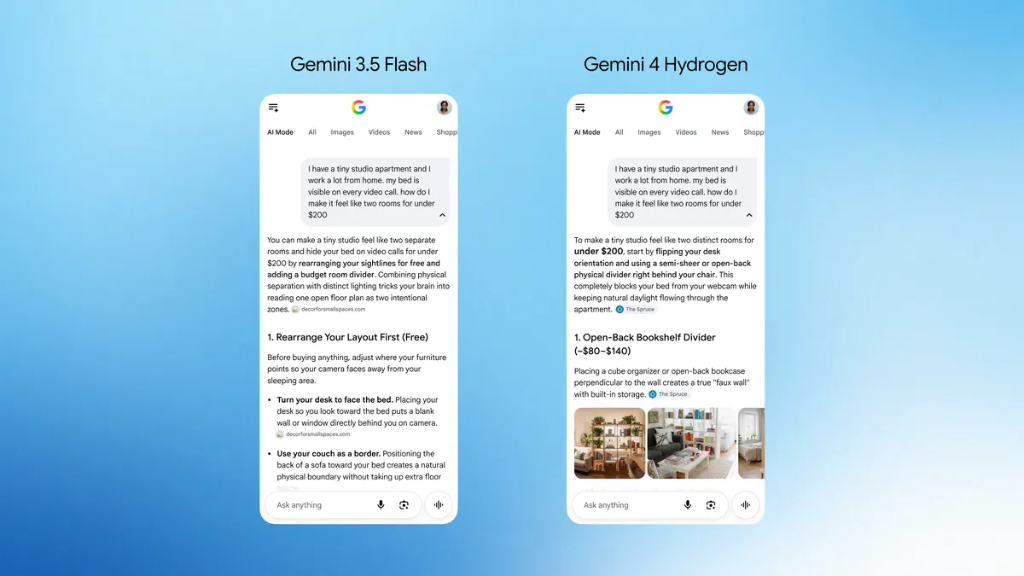
At the product level for general users, Hydrogen has become the default model for Google Search's AI Mode and is also used to handle "most difficult questions" in AI Overviews.
Google says Hydrogen can better understand users' true intent, intelligently parsing queries even when they contain multiple sub-questions, misspelled terms, or highly specific requirements. Additionally, search results will feature more visual presentation and cover a broader range of relevant links.
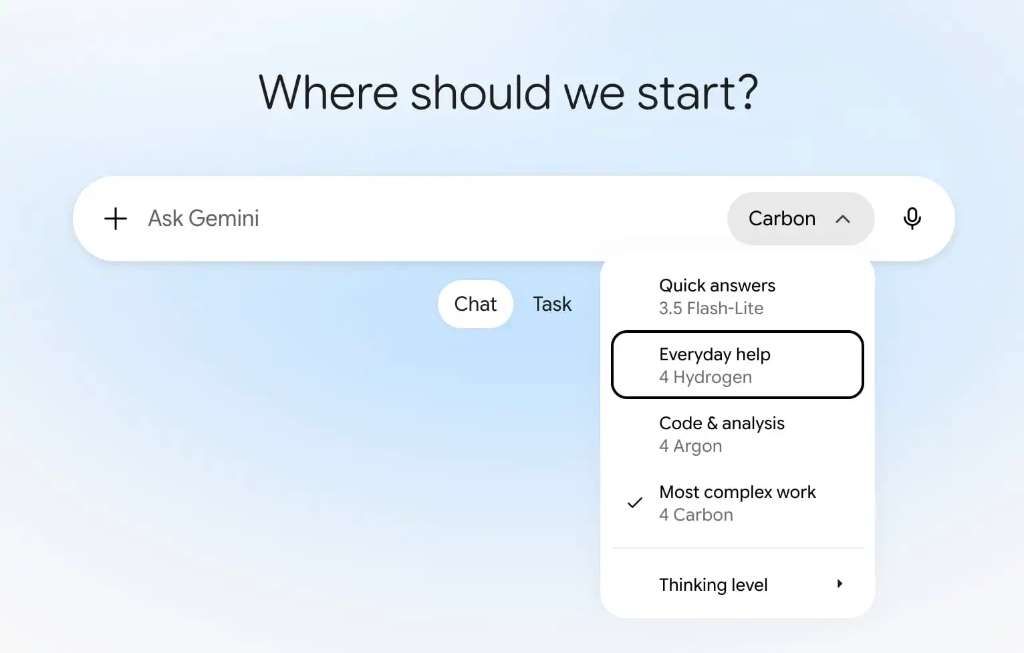
In the Gemini app, Hydrogen is positioned in the model selector as a "Everyday Assistant," falling between "Quick Reply" (3.5 Flash-Lite) and "Deep Research" (3.1 Pro). Free users can access Hydrogen via the "[Auto] Automatic Model Selection" feature when prompted to adapt.
Google says the model can more strictly adhere to user-defined tone, format, and rules, enabling email drafts, study guides, and documents to be ready for use right out of the box.
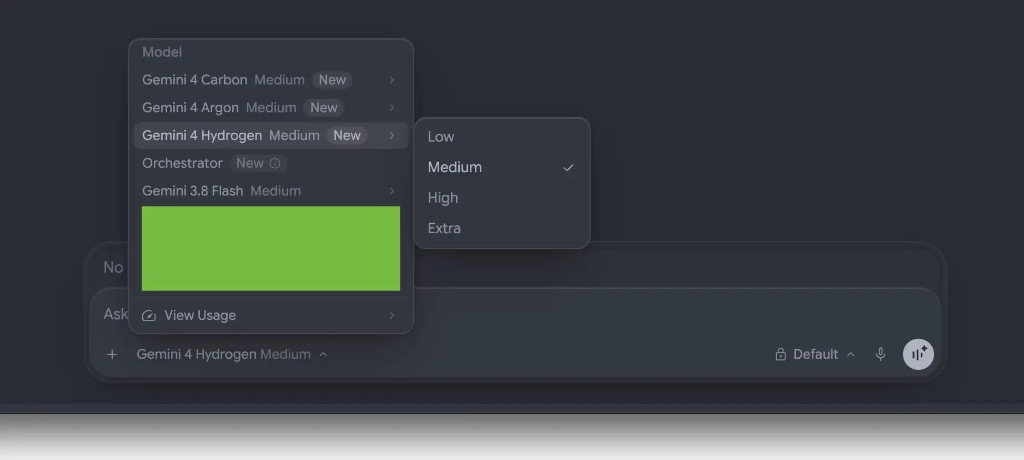
In Google Antigravity, Hydrogen adds an "Extra" thinking layer; this feature is available to paid AI Pro and Ultra subscribers and can be integrated with the aforementioned Orchestrator multi-model collaboration capabilities.
Performance: A Dual Leap in Speed and Accuracy
Google positions Hydrogen as a "major standalone upgrade" to Flash 3.8, with core improvements focused on three areas: speed, accuracy, and contextual processing capabilities.
In terms of speed, early testing by partners shows that Hydrogen delivers a 2- to 2.8-fold performance boost in complex graph computations, SQL queries, and data-intensive enterprise workflows, while reducing token consumption by 12% to 23%.
Yashodha Bhavnani, VP at enterprise software company Box, stated that Hydrogen significantly improves accuracy while running approximately twice as fast as Flash 3.8 and reducing token usage by 12%. Yashodha Bhavnani said:
The improvement is most noticeable in data-intensive workflows that require accurate table reading and complex calculations.
In terms of accuracy, Hydrogen supports native 1 million-token inputs and up to 1 million tokens in output, enabling it to handle dense PDF files, spreadsheets, charts, audio, and video content.
On the Multimodal Knowledge Agent (MKA) benchmark, Hydrogen outperformed other models with a score of 53.4%; in the Agents' Last Exam v1.1 test, which targets end-to-end professional workflows, it achieved a score of 71.6%.
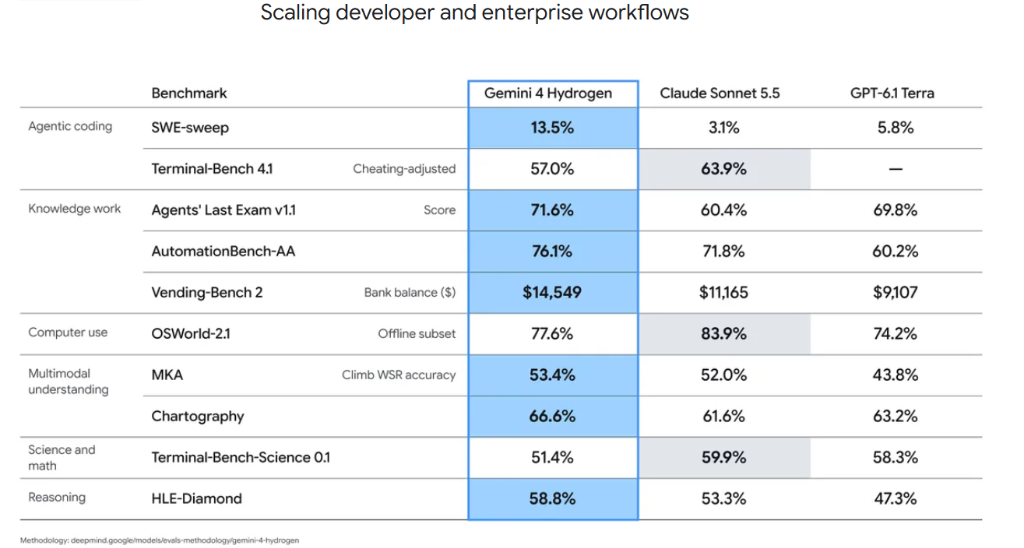
In vertical domains, Hydrogen leads its peers with 58.8% on the HLE-Diamond deep-domain reasoning benchmark, ranks first with 52.3% on the Vals Tax Agent Bench, and ties for first with 55.8% on the Vals Legal Research Bench.
The team at biotechnology company LatchBio stated that Hydrogen achieved a 67% pass rate in the toxicology and safety sections of its antibody development benchmark, whereas the Gemini model managed only 37%.
Safety: Agent alignment capabilities have been significantly enhanced.
Google emphasizes Hydrogen's improvements in agent safety alignment, which are particularly critical for the model's primary use case of autonomous workflow execution.
Compared to Flash 3.8, Hydrogen reduces "overreach" in agent tasks by up to 81% and "under-service" by up to 79%, while misaligned behavior during tool use and code evaluation, as well as task shortcutting, are reduced by a factor of 12.
When faced with tasks that cannot be completed or are blocked, Hydrogen's probability of bypassing permission boundaries is reduced by up to a factor of two, achieving a 96.7% honesty rate in Google's internal agent honesty evaluations.
In terms of reasoning transparency, Hydrogen maintains 99.9% readability of its chain-of-thought in over 200,000 audited conversations, with no recorded instances of deceptive reasoning edits.
In the Gray Swan IPI benchmark targeting indirect branch injection attacks, Hydrogen's resistance to such attacks improved by more than 2.3 times.
Additionally, Google stated that the updated security barrier has significantly improved accuracy in identifying genuine biosafety risks and legitimate medical or scientific issues, with a false rejection rate of less than 0.4% on HealthBench Pro.
Editor/stephen