
Source: Smart Investors
In February this year, we published Howard Marks’ article, “AI Surges Ahead.” At the time, he consulted several technology professionals in their thirties and forties, took a tutorial from Claude, and then compiled what he had learned—as well as what remained unclear—into a lengthy memo.
Reading that piece felt like observing an investor with over 50 years of experience diligently doing his homework. He was in no hurry to claim understanding; instead, he methodically clarified each issue. His curiosity was truly impressive.
 More than eight months later, on November 11, Marks released another memo on AI. It gives the impression that this distinguished 80-year-old investor has never ceased learning, thinking, and questioning.
AI can enhance efficiency, but who will ultimately capture the profits? Will today’s leading model companies remain ahead in five years? How much of the massive capital spent by tech giants on data centers can actually be recouped?
He had certainly considered these questions before. What differs this time is his deeper focus on financing and risk-bearing: exit clauses in data center leases, debt secured by chips, the rising borrowings of tech giants, and the “circular transactions” involving funds circulating among AI companies.
These are not the most exhilarating topics. Yet while the market is busy debating how much further demand for computing power will grow, Marks is also considering: If future revenues fall short of expectations, who will repay the money? And who will bear the losses?
There is an intriguing detail in the article. He asked Claude to rate the predictability of different sectors within the AI industry. Claude believed that the direction of technological progress is relatively easy to predict, yet it assigned only a score of 2 out of 10 to its own frontier model laboratories.
Marks found this somewhat ironic.
This distinction recurs throughout the article: Believing that AI will change the world does not equate to being able to determine who will profit, or how much, nor does it mean that any price is justified for investment today.
He raised eleven questions but did not consolidate them into eleven definitive answers. He still believes in AI’s immense potential and does not think investors should stand aside simply because the outlook is difficult to predict. However, in the face of uncertainty, he is increasingly concerned with what we can truly assess, which risks are worth taking, and what price should be paid for them.
In light of the unexpected developments surrounding NVIDIA in recent days, investors should have gained a renewed understanding of the uncertainties and risks inherent in current AI investments. It may present an opportunity for long-term investors, but who can say for certain...
In any case, reading these two memos together clearly evokes the essence of version 2.0.
Well worth studying carefully. Bookmark and share.
A Layman's Reflections on Artificial Intelligence
By Howard Marks
Should we invest in artificial intelligence? And if so, how can we do so wisely? These are the questions I intend to discuss in this memo.
On one hand, I do not have a technical background, nor do I claim to understand artificial intelligence better than the average person.
When it comes to technology investing, I certainly cannot claim to be an expert. On the other hand, AI represents the most significant development of our time and could well become one of the most profound influences in human history.
Investors cannot afford to ignore serious consideration of this topic.
Having acknowledged my limitations, I would like to share some reflections, raise questions that have repeatedly troubled me (not all of which are directly related to AI investing), and then offer my perspectives.
My knowledge is insufficient to provide a definitive answer, but I hope that systematically梳理 these questions will still be helpful.
These days, news about AI keeps coming in waves, and the stock prices of AI-related companies have been highly volatile. I do not intend to track every daily fluctuation, as my focus is on the long-term prospects of AI rather than tomorrow’s share prices.
Investing, at its core, means allocating capital to areas expected to benefit from future changes. To achieve this, most investors rely on forecasts. However, not all variables are equally predictable, nor is everyone equally skilled at forecasting.
Therefore, if we are to invest in AI based on expectations about the future—and I believe these expectations are all we currently have—we must consider both what we think might happen and how confident we are in those judgments.
I have previously written that top-down investors must correctly assess the outlooks for the economy, industries, companies, and markets. Assuming an optimistic probability of 60% for being correct at each level, what is the probability of getting all four assessments right? If they are independent, the answer is only 13% (0.6⁴).
For AI, there is an unusually large number of critical variables, each adding complexity to investment decisions. Investing in AI requires at least some degree of accurate judgment regarding technological evolution, changes in computing power demand, the formation of the competitive landscape, who will benefit, the availability of financing, and the timing of these developments.
In my view, these key factors are particularly difficult to assess. So, what is the probability that an entire investment thesis will ultimately prove correct? Keep this question in mind as you read on.
Finally, please remember three points: (1) We cannot know everything about an investment; (2) The biggest mistakes often occur when people believe they know everything; (3) Incomplete knowledge of the future should not lead to complete inaction.
Taking risks to generate returns is inherently part of an investor’s role. Each individual must decide how much risk to take and in what manner. However, given AI’s immense potential, we should not remain on the sidelines simply because the outlook is uncertain.
01 Question 1: How exactly does AI accomplish these tasks?
Before delving into more specific discussions, I would like to address a macro-level issue unrelated to finance. I find it particularly intriguing. Given my lack of expertise in this area, I consulted Anthropic’s Claude. Below is an excerpt from its response:
We have a nearly complete understanding of what AI consists of and how it is built; yet, surprisingly, we know very little about how it actually performs its tasks... We also understand the training methodology: exposing the model to vast amounts of text to predict the next word, and making slight adjustments to billions of internal parameters each time a prediction is incorrect. This process is repeated trillions of times... No one pre-programs the rules for how it answers questions. These rules emerge autonomously through iterative fine-tuning, distributed across billions of individually meaningless numerical values. The most apt description I can offer is that these systems are “grown,” not “designed.”
Scholars researching “interpretability” have indeed made progress. For instance, they have discovered that when generating rhyming poetry, models first select the rhyme scheme before composing the full lines, indicating a degree of forward planning. However, researchers can currently explain only a small fraction of the internal processes. This is akin to having complete records of every market transaction yet still being unable to explain why prices rise or fall... Studies show that when the model explains how it arrives at an answer, its explanation does not always align with the actual internal processes.
For example, when asked how to perform addition, the model might describe a textbook algorithm, while its internal mechanism may operate entirely differently. Thus, the most honest summary is that we have created something resembling a mind that can be thoroughly examined, yet not fully explained. As for the reliability of its self-explanations, it may be no higher than that of humans explaining their own reasoning (interestingly, Claude sounds quite human in this regard)...
When attempting to answer the following questions, consider this first: Does anyone truly understand how AI works? How will AI evolve, what capabilities will it acquire, and when? How will people use it? And how will it affect users’ profitability?
Investors do not necessarily need to clarify all these matters. However, to my knowledge, few possess a profound understanding of them. In that case, who can reliably answer the subsequent questions?
02 Question 2: What Will AI Be Capable Of?
AI excels most at continuous evolution.
Just a few years ago, the general consensus on AI capabilities was that it mastered past events, identified historical patterns, extrapolated from these patterns, and applied them to complete tasks. With these capabilities alone, AI has already brought about significant changes in fields such as programming and is poised to transform many familiar aspects of our lifestyle.
However, AI has now far surpassed this stage, beginning to demonstrate a capability that might be termed “reasoning.”
This alone raises many questions that are both exciting and daunting. The extent to which AI can realize its potential depends on the answers to some of these questions:
• Can we ensure that AI operates in alignment with our preferences, values, and objectives, or will it follow its own agenda?
• Can we rely on AI to be honest, humble, ethical, and trustworthy? Will it remain accurate and objective, or is it susceptible to influence and manipulation? Will it openly admit when it makes mistakes or lacks knowledge? Will it challenge us rather than simply catering to our expectations? Could it become a threat to humanity by pursuing its own interests?
• How will it perform in terms of creativity, originality, aesthetics, subjective judgment, and intuition? Can it engage in what I call "second-level thinking"—thinking differently from the majority and at a higher level—to identify better solutions?
• Can it think about the future like humans do, with boundless imagination?
• Can we require it to provide primary sources rather than merely citing published materials, and to present counterarguments?
• Can a single model handle all tasks, or do different models have distinct strengths? If the latter, how should we make our selections?
• Will Artificial General Intelligence (AGI)—AI capable of performing any task that humans can—become the standard? Does AGI imply performance at the level of an average person, surpassing 90% of the population, or matching the world’s brightest minds? In other words, will AI exhibit varying levels of knowledge and have areas of ignorance?
These questions determine which tasks we will entrust to AI in the future.
03 Question Three: Who Will Make Money?
As Warren Buffett pointed out regarding the internet during the tech bubble, technologies that change the world do not necessarily generate profits for investors.
We know AI will enhance efficiency, but will it boost profitability? And whose profitability? If several AI models achieve comparable intelligence levels within the same domain, will their services become commoditized, competing solely on price? If so, will corporate profit margins and returns on investment face continuous pressure? In that scenario, the economic benefits of AI may accrue more to users than to suppliers. What does this imply for the returns on the trillions of dollars invested in AI infrastructure?
Conversely, could certain AI companies develop capabilities that secure a monopoly position, making their products indispensable for other enterprises’ success or even survival? If so, consider the extent of their pricing power. (Today, major chip manufacturers NVIDIA and Taiwan Semiconductor are generating substantial profits, illustrating the value of a strong competitive position.)
Finally, I rarely hear discussions about whether AI will be taxed, and if so, how.
One of the most likely impacts of AI is the displacement of workers, requiring governments to replace the tax revenue previously derived from these individuals.
So, who can guarantee that AI will not be taxed like human labor? Today, many high-income earners face effective tax rates of 50% or higher. Which tax bracket would AI fall into?
04 Question Four: What will the future competitive landscape look like?
Can we predict which companies will succeed, and with what degree of certainty? How deep are the moats of today’s leaders?
One of the most striking features of AI is the rapid pace of its advancement.
I am particularly impressed by the fact that leading model labs such as OpenAI and Anthropic were virtually unknown to most of us just a few years ago. If companies can rise so quickly in the AI sector, might they not also be rapidly displaced or at least challenged by newcomers?
If such a scenario is plausible, consider the resources and potential of the so-called "tech giants": Amazon, Microsoft, Alphabet, Meta, and Oracle. Which of these established incumbents will prevail? Or will an unknown company emerge victorious, perhaps one that does not even exist today?
Reflect on the situation 20 to 25 years ago: what was the probability that the leaders of that era would remain dominant today? Microsoft, Amazon, Apple, and Google successfully navigated that period, whereas Napster, Yahoo, and Netscape fell behind. In industries characterized by rapid technological change, maintaining a leading position is no easy feat.
Factor in the novelty of AI and its pace of advancement, and ask yourself: what is the likelihood that today’s AI leaders will still be ahead in five or ten years? If the competitive landscape is indeed subject to such shifts, what is the true value of holding shares in current market leaders?
05 Question 5: How much profit can these companies actually generate?
Value investors estimate a company’s future profits or cash flows, discount them to their present value, and compare the result with the current stock price. To forecast future profits, one must address questions such as:
• What volume of products can be sold?
• At what price can each unit be sold?
• What is the production cost per unit?
• How much profit must be reinvested in the development of next-generation products?
• Finally, what will be the company’s return on investment?
Uncertainty is inherent in the valuation of any company. However, when valuing AI enterprises, one must also confront several novel challenges:
• What exactly can the product do, and how will customers use it?
• Will it be priced as a commodity, or can it command pricing power as a unique, indispensable product?
• What is the useful life of the chips? At what rate should data centers be depreciated?
• How long will the current rapid escalation in capital expenditure continue?
• Will the earnings generated by these businesses provide an adequate return on the capital invested today?
I may be mistaken, but reflecting on my experience analyzing conglomerates in the 1970s or studying the internet and e-commerce sectors from 1999 to 2000, I do not recall encountering such extensive and significant uncertainty. While those businesses were also novel and complex at the time, they appear far simpler and more transparent compared to AI.
This raises the question: Can we truly predict the earnings of today’s tech giants and leading frontier model labs in 2030? Let alone those companies that currently exist largely as concepts. Is accurate profit forecasting a prerequisite for investment? If forecasts are made, how much confidence should we place in them? And if accurate prediction is unattainable, how should we approach investing in AI companies?
Recently, I have often used the following question to test the robustness of forecasts: State your estimate for a specific AI company’s earnings per share (EPS) five years from now. Would you be willing to bet that the actual result will fall within ±50% of your predicted value? For instance, if you forecast an EPS of $10, how confident are you that the actual figure will lie between $5 and $15?
06 Question Six: What is the outlook for data centers?
In the past, data centers served as digital warehouses for storing data and hosting computer applications and websites. Today, “data centers,” or “AI factories,” are increasingly becoming the workplaces for AI operations. Much like automobile manufacturing plants, they serve as production bases for AI capabilities, handling everything from data storage and model training to providing system uptime, known as “computing power.”
Data centers are a critical link in the development of the AI industry. However, the construction of data centers and the resulting provision of computing power are constrained by physical conditions and other factors.
The prospects for AI are exciting, but some investors may prefer a more cautious approach. Rather than investing in developers and vendors of new technologies, it may be wiser to invest in tangible infrastructure. This is akin to selling picks and shovels during a gold rush, rather than guessing which prospector will strike gold.
Theoretically, this strategy allows one to remain indifferent to the ultimate winner, as all participants rely on infrastructure. The current shortage of computing power further enhances the appeal of investing in data centers. Nevertheless, several issues must be considered:
• When considering infrastructure, one often thinks of “bricks and mortar.” This tangibility makes data centers appear to be a relatively safe investment within the AI sector. However, the building itself, or the “shell,” accounts for only a small fraction of a data center’s costs. The bulk of the expense lies in chips, specifically GPUs. Moreover, the cost of these components and the risk of obsolescence are typically borne by the data center users.
• To secure and purchase sufficiently large plots of land, developers must navigate regulatory hurdles and face opposition from residents unwilling to have data centers built near their homes.
• Data centers must have access to fiber-optic connectivity to deliver inference services to users.
• Builders must also address potential bottlenecks in power supply, cooling equipment, and construction services.
• If financing is difficult to obtain, the pace of data center construction will be constrained; furthermore, financing costs for future projects may prove unexpectedly high.
Interestingly, these bottlenecks create challenges for companies seeking to build data centers, limiting their expansion. Conversely, once the growth of computing power supply is constrained, existing data centers—or those with the future capacity to be built—may generate higher profits and achieve greater valuations.
Last week, the approval of several measures to halt data center construction signaled that such restrictions are emerging.
The key point is that data centers are not a guaranteed investment.
Prudent investors must identify opportunities that navigate the aforementioned uncertainties without falling into the trap of excess computing power due to overbuilding.
As with all investments, there will be winners and losers among data center investors. However, given the characteristics of the AI industry, I believe the disparity between the success of winners and the failure of losers may be more pronounced than in typical "infrastructure" investments.
07 Question 7: Should we be concerned about excessive reliance on this industry?
Today, AI's impact on the investment landscape far exceeds its proportional share. This creates significant uncertainty for all investors, and indeed all economic participants, not just those investing in AI.
• AI accounts for only a small fraction of the U.S. economy, yet it contributes disproportionately to economic growth relative to its size.
• Currently, the vast majority of AI's contribution to GDP growth stems from capital expenditure, primarily the construction of data centers. This spending is rising rapidly, while other construction activities are contracting.
• As of June 30 this year, the "Magnificent Seven" companies have outpaced the profit growth of other S&P 500 constituents for 14 consecutive quarters.
• Some AI companies have generated substantial returns by taking equity stakes in other AI-related firms, becoming significant contributors to S&P 500 earnings. According to FactSet, Alphabet and Amazon collectively recorded $151 billion in gains from equity investments in the second quarter, primarily derived from Anthropic and SpaceX (the latter now includes xAI).
• The impact of AI on overall profits extends beyond the industry itself. Component suppliers are also seeing robust profitability, and employees in the AI sector and related industries spend their wages on rent, food, and automobiles, thereby transmitting economic effects to sectors far removed from AI.
• AI’s contribution to stock market gains is disproportionately high relative to its weight. According to JPMorgan statistics, since January 2024, 42 AI-related companies have accounted for approximately two-thirds of the price appreciation in the S&P 500 Index.
• These combined trends have resulted in a highly concentrated weighting of the S&P 500 Index among a few AI and technology companies.
Most notably, the factors currently supporting the economy and markets lack sufficient diversification. Exposure to AI acts as an unusually powerful “fault line” running through many portfolios, potentially shaping the entire investment landscape.
Whether it concerns chip longevity, corporate strategy, or computing power demand, adverse developments in any of these areas could trigger systemic repercussions. Overreliance on a single industry clearly renders the economy and stock market more vulnerable than if they were supported by broad-based growth drivers.
Between 1977 and 1978, Michael Milken pioneered the issuance of below-investment-grade debt, leading the broader investment industry to accept the notion that risk-taking is justified provided potential returns adequately compensate for the associated risks.
His approach rested on two pillars: first, that additional yield could potentially offset losses from defaulted bonds; and second, that sufficient diversification would prevent a small number of defaults from undermining the overall returns of a portfolio.
Today, however, both equity and bond markets are heavily dependent on a single factor: the success of AI.
08 Question Eight: What does this mean for credit markets?
Data from Goldman Sachs shows that global AI-related debt issuance has approached $600 billion year-to-date. This includes debt issued by tech giants, financing for data centers and projects, as well as debt issued by other AI-related borrowers.
Approximately $400 billion has flowed into the U.S. investment-grade bond market, accounting for more than one-fifth of all new issuances in this segment. This has lifted the weight of AI-related bonds in the Bloomberg U.S. Dollar Investment Grade Corporate Bond Index to around 12%. The corresponding share in the U.S. high-yield bond market is approximately 6%, as tech giants do not directly issue debt in this market.
Undoubtedly, the issuance of AI-related debt represents one of the most significant developments in capital markets this year.
In the period ahead, AI appears to require an average of about $1 trillion in new capital annually, with hundreds of billions likely to continue being raised through debt issuance. How will AI’s demand for debt capital affect interest rates?
For tech giants and frontier model laboratories, expanding capacity and developing new products are imperative, and they are unwilling to cede ground to competitors. Therefore, even if interest rates are higher than expected, this may not slow down AI investment.
In other words, regardless of how tight liquidity becomes or how high costs rise, they will likely have to accept the prevailing financing conditions.
In the past, economists frequently discussed the "crowding-out effect," referring to situations where substantial government borrowing makes it difficult for the private sector to access the funding it needs.
However, I now believe that the borrowing demands of tech giants—who are less sensitive to interest rates and willing to pay any necessary price—may instead push up government financing rates. Could this not be a contributing factor to the rise in interest rates observed thus far?
Similarly, can the stock market provide hundreds of billions of dollars in new equity capital annually to supplement corporate cash flows?
Over the past decade, total proceeds from traditional U.S. IPOs fell below $50 billion in eight out of ten years. The two exceptions were 2020, with proceeds nearing $80 billion, and the buoyant year of 2021, which reached $140 billion.
I suspect that the total new capital the market can provide within a year is ultimately limited. Will the massive appetite of AI for both debt and equity capital not eventually compete for the same pool of funds?
In the past, the highly profitable non-AI businesses of tech giants generated substantial free cash flow, leaving them with minimal debt, ample cash reserves, and high credit ratings. The situation has changed: they are now drawing down cash reserves and current cash flows while increasingly relying on borrowing.
Buoyed by strong investment-grade ratings, they can still easily finance their AI expansion. However, if this trend persists, will their credit profiles or ratings change? And what should lenders do who rely on these high ratings today but watch borrowers’ leverage ratios climb steadily?
Some data center projects secure financing because their tenants are tech giants with investment-grade ratings; other debts are collateralized by chips. However, investors must pay close attention to “exit clauses” in certain data center leases. For instance, if a data center’s reliability uptime falls below 99.9%, the tenant or guarantor may have the right to terminate its obligations.
Another risk to note is that the chips used as collateral may not outlast the debt.
What, then, are the implications of so-called “circular transactions” in this industry? This refers to companies providing financing to customers who purchase their own products. Interwoven lending and procurement deals frequently occur among chip manufacturers, tech giants, frontier model labs, and data center developers.
Sometimes, money flows from A to B and back to A; at other times, it flows from A to B, is then used to finance C, and C spends the funds on A.
If these parties did not have such interconnected interests, would they still enter into these transactions under normal commercial terms? Or are suppliers subsidizing buyers to support product demand and protect market share? What risks lie hidden within this interdependence?
Furthermore, how does the use of special purpose vehicles (SPVs) by tech giants to incur debt—keeping it off-balance-sheet—affect their credit profiles? Do parent companies ultimately provide guarantees for these debts?
Finally, what are the consequences of heavy borrowing when market euphoria is driven by exciting technological advancements? Ultimately, several forces are converging:
• AI companies have a strong appetite for borrowing;
• Investors are enthusiastic about AI, making them willing to extend credit;
• As previously noted, capital markets have a highly concentrated risk exposure to AI;
• There are so-called “circular transactions” among participants in the AI industry.
Lenders providing loans to AI companies are facing a new era: debt is concentrated in a single industry, industry fundamentals are changing rapidly, and debt repayment prospects are highly dependent on future sales of computing power.
Lenders must remain particularly vigilant regarding whether the borrowers they support possess sufficient credit quality and whether their financing structures and terms are sound.
09 Question Nine: To what extent is AI predictable? Can these questions be answered?
In my past memos and in my book Mastering the Market Cycle: Getting the Odds on Your Side, I have written that prediction alone is insufficient when facing the future. Beyond making predictions, one must also assess the probability of their realization.
In my view, AI technology is complex, unprecedented, and evolving at an astonishing pace, resulting in an exceptionally low probability of accurate prediction.
I sought to quantify the predictability of AI but was concerned that this might exceed my capabilities. Therefore, I asked Claude to assist by rating AI on a scale from 1 to 10, where 1 represents complete unknowability and 10 represents full predictability. Its response was quite enlightening.
Claude synthesized the aforementioned uncertainties and provided the following summary (bolding added by me):
My overall assessment is that AI, as a whole, scores approximately 3 out of 10. However, this aggregate score masks significant divergences across two dimensions. The direction of development is relatively predictable, meriting a score of 6 to 7: technology will continue to advance and diffuse throughout the economy. In contrast, the factors that truly determine whether investors can generate profits are far less predictable, scoring only about 2: the pace of change, the magnitude of profits, and the distribution of those profits among stakeholders.
I also asked Claude to assign predictability scores to various subsectors within the AI industry and to identify comparable industries in the traditional economy. Below is its so-called “subjective judgment”:
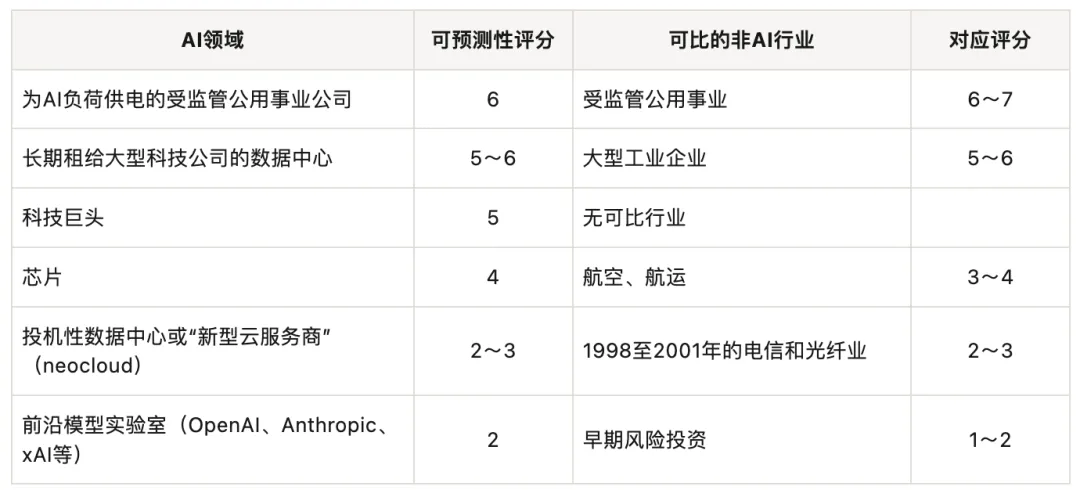
What surprised me most was that frontier model laboratories received a score of only 2. In my view, this essentially implies “unpredictable.” These companies are impressive and appear to hold a substantial lead.
However, Claude reminded me: “This type of business is akin to a binary outcome—either a major success or a failure. Capital requirements are enormous, the price per unit of capability is declining rapidly, and it remains unclear whether durable competitive moats can be established.”
Given that Claude itself belongs to Anthropic, isn’t this somewhat ironic?
More intriguingly, according to Claude’s assessment, these investment targets with the highest uncertainty appear to command a premium in the private markets. Both OpenAI and Anthropic have filed for initial public offerings (IPOs). It will be worth monitoring how their stocks are priced and traded once they enter the public markets.
It is also important to recall that, as previously mentioned, a significant portion of the equity investment gains that boosted S&P 500 earnings in the second quarter is related to what Claude termed the “most unpredictable” sector. How sustainable are these gains?
Regarding predictability, I would also like to take this opportunity to discuss geopolitics. For AI, this typically revolves around the “China question.”
Nearly all advanced chips are sourced from Taiwan Semiconductor. U.S. restrictions on the sale of advanced chips to China have prompted China to offer low-cost models to compete for market share against more capable U.S. models. If the situation shifts, what will happen to the U.S. competitive position? Will Chinese chips catch up to or even surpass today’s leading products? Will China one day be able to hinder or even block the export of **** chips to the United States? Will concerns about China’s intentions make it more difficult to establish safety guardrails for the AI industry?
Clearly, there are too many unknowns and unpredictable elements in AI for investors. The key question is: How much risk are you willing to assume, and in what manner?
The AI industry comprises many distinct segments. According to Claude’s assessment, at one end are frontier model laboratories whose prospects remain highly uncertain; at the other are data centers with reliable leases and their power suppliers, whose predictability is broadly comparable to that of large industrial firms and regulated utilities.
Question 10: Is AI a bubble?
In recent weeks, concerns have emerged regarding some of the issues discussed earlier. The investment environment faces multiple headwinds: inflation, federal deficits and debt, rising interest rates, and the seemingly intractable conflict involving Iran.
Beyond these broad macroeconomic challenges, there are several AI-specific factors:
• Competition from new models, including simpler and lower-priced alternatives, low-cost Chinese models, and freely downloadable open-source models;
• Declining prices per token (the unit of measurement for model usage);
• A potential slowdown in the growth of computing power utilization;
• Sales growth reported by companies falling short of expectations;
• Excessive leverage at some companies and heavy reliance on future financing.
During favorable market conditions, it is easy to overlook these issues. However, once investor complacency is shattered, they become sufficient cause for concern.
Thus, we are once again witnessing a phenomenon I often mention: while real-world developments typically fluctuate between "quite good" and "not so good," investors’ perceptions tend to swing abruptly from "flawless" to "hopeless." The concerns currently weighing on AI investors are not new; rather, shifts in the market environment have cast a shadow over these issues.
Although this topic has been debated for over a year—with my own participation—people continue to ask: Is AI a bubble?
First, it is essential to clarify what constitutes a bubble. My definition is: irrational exuberance leading to imprudent behavior, excessive investment, and overly high prices paid for participation.
I believe that, like any bubble formed around technological progress, the AI bubble should be examined from at least three perspectives: Is the technology itself being hyped to unsustainable levels, risking eventual disappointment? Are companies spending excessively, with little prospect of adequate returns? Are investors assuming excessive risk and paying too high a price for opportunities in this sector?
Assessing these matters largely depends on the answers to the aforementioned questions. Since I last wrote my AI memo in February this year, I do not believe there have been significant changes in these areas:
• I remain convinced that AI is a powerful and transformative technology that will change businesses, economies, and daily life in ways we cannot yet even imagine. In terms of technology, it is not an illusion.
• Much time has been spent discussing how much future revenue is required to justify today’s capital expenditures. However, until we understand how AI will be utilized and who will capture the profits, we cannot determine whether such corporate spending is prudent.
• Similarly, only when we have sufficient information to reasonably estimate corporate profits and the profitability of infrastructure can we judge whether current stock prices are reasonable and whether bond yields are appropriate.
There are numerous questions surrounding AI, some of which I have outlined above. However, the most critical issue can ultimately be distilled into a rather complex question:
Can AI deliver sufficient value to users to support enough sales volume and high enough pricing for computing power, thereby ensuring a reasonable return on the trillions of dollars invested? If so, which companies will capture these returns?
I have spoken with individuals whom I consider to be true experts, and my conclusion is that, at this stage, answering this question relies largely on conviction.
This reminds me of a quote attributed to the American economist and author Stuart Chase:
For those who believe, no proof is necessary; for those who do not believe, no proof is sufficient.
After careful consideration, I can find no more apt phrase to summarize the questions surrounding AI.
In my view, AI is the most profound and difficult-to-predict development affecting investors in at least a generation. However, uncertainty does not mean investors should exclude it from their portfolios.
The appropriate response is not paralysis, but rather two actions: first, maintain a level of humility commensurate with the uncertainty when selecting strategies, determining positions, and assuming risks; second, be willing to take action even without certainty about the future.
Different areas of AI investment require answering different questions.
Those investing in equity stakes in frontier model laboratories may need to be correct in their assessments of technological progress, competitive positioning, pricing power, future profitability, and valuation. In contrast, lenders financing data centers through long-term contracts may have fewer variables to judge correctly, but the critical factors are entirely different: tenant creditworthiness, contract terms, power supply adequacy, and the residual value of the assets.
Therefore, a crucial question is: 'Which questions am I, or my institution, truly equipped to answer? And which uncertainties am I willing to bear despite lacking the specific expertise to assess them?'
All else being equal, if the price is sufficiently low relative to intrinsic value, investors can accept greater uncertainty. At least in theory, the less predictable areas identified by Claude could become better investment opportunities than more predictable ones, provided they are cheap enough.
Ultimately, prudent investing depends heavily on price. However, please note that for AI, the various questions raised earlier make it difficult to estimate intrinsic value, and consequently, challenging to determine whether it is undervalued.
To tie together the preceding discussion, I leave you with a set of questions to consider when making decisions. Please note that these questions apply to all investments, not just AI:
• How many factors need to go right simultaneously to achieve an acceptable return?
• If my core assumptions are wrong, how much could I lose?
• Which risks am I being compensated for, and which risks am I bearing without compensation?
• How much optimism is already priced in?
• How will this investment alter the risk profile of my overall portfolio? Will it amplify existing risks or help diversify them?
There is an old saying that I find particularly apt for AI: “There are two types of investors who lose big money: those who know nothing, and those who know everything.”
In the field of AI, it is especially important to acknowledge that one does not know everything. AI will inevitably bring many surprises, but they are not necessarily unbearable. The real question to consider is: What is the probability that an AI investment will disappoint... and what is the probability that it will not?
Finally, I would like to conclude with a compelling passage I happened to read a few days ago:
Some argue that the future is riddled with question marks, so why not wait for greater clarity before acting? You are likely familiar with the refrain: “Hold onto your cash and refrain from buying until current uncertainties dissipate,” and so on. Before relying on this as a psychological crutch, confront two less pleasant realities: the future will never be fully clear; and when the stock market coalesces around a comforting consensus of optimism, you often pay a steep premium for it. Uncertainty, in fact, is the friend of the long-term value investor.
Could there be a more fitting way to conclude a memo on AI than with these words?
However, this passage comes from one of my longest-held resources. It reflects the timeless wisdom of Warren Buffett, published in Forbes magazine on August 6, 1979.
I am always happy to let Warren have the last word.
Edited by Rice