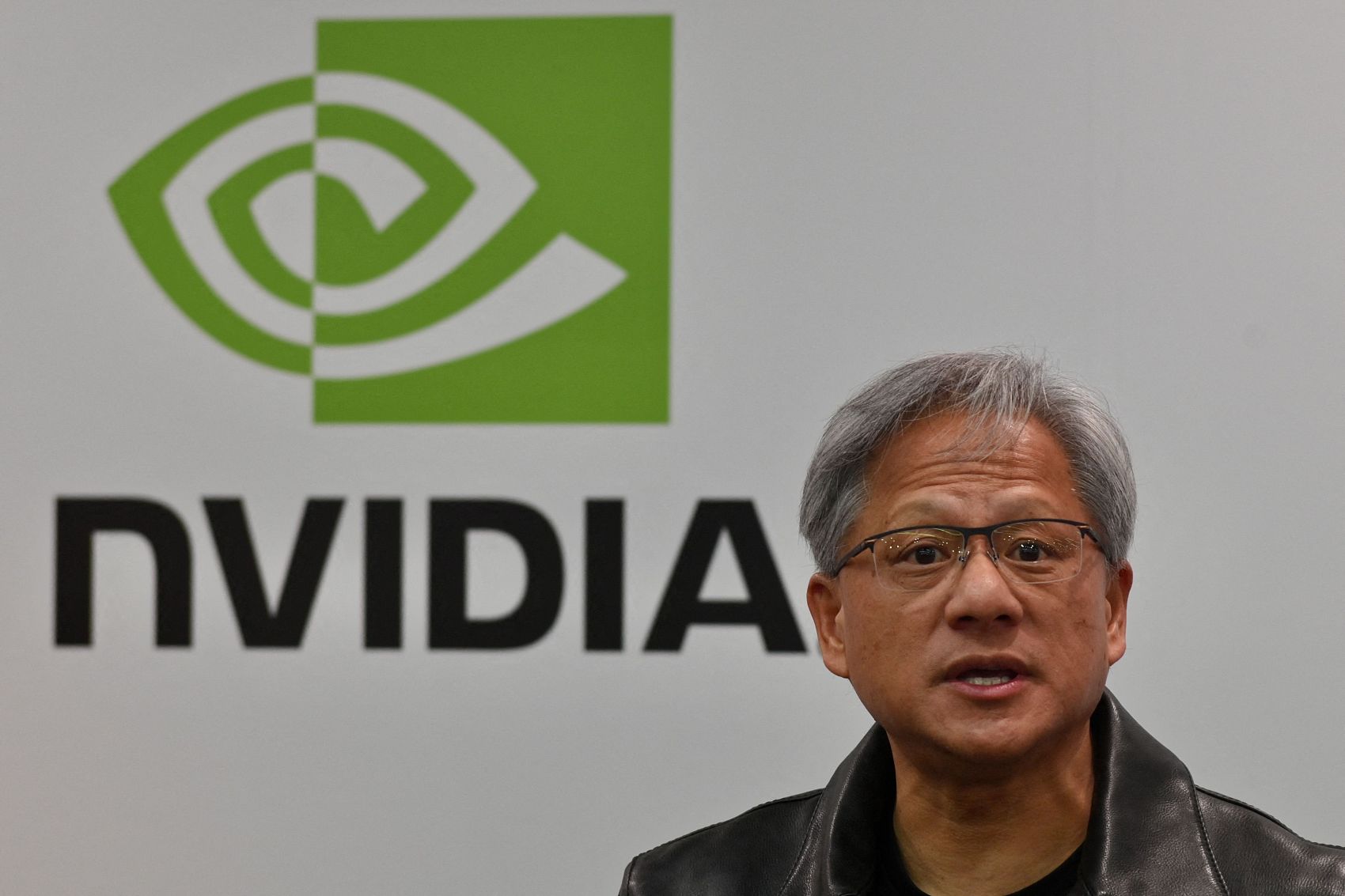
After the market opened on Thursday, retail investors defied the trend to snap up NVIDIA, with net purchases reaching $111 million in half an hour, a record for the same period. Investors such as Tom Lee publicly voiced strong support, while institutions are optimistic about opportunities arising from order backlogs extending to 2028, robust revenue growth, and falling valuations. Meanwhile, firms like Bernstein and Goldman Sachs have grown more cautious about NVIDIA's outlook, with Jensen Huang's departure raising concerns over management succession and technological leadership.
$NVIDIA (NVDA.US)$The stock price has suffered a severe setback, with the forward price-to-earnings ratio falling to around 12 times, the lowest level since 2012. However, despite valuations dropping to historic lows, this has not translated into unanimous bullishness on Wall Street. With founder and CEO Jensen Huang stepping down, market confidence in this AI chip giant is showing clear signs of divergence.
On Thursday, NVIDIA's stock price plunged more than 14% in early trading before gradually recovering thanks to emergency PR efforts and bargain buying, ultimately closing down 4.34% at $166.19. Compared with its intraday high of $243.37 reached on October 6, the stock has now accumulated a decline of over 30%.
 As the stock price plummeted, retail investors rushed to buy the dip. According to Vanda Research, in the first half-hour after Thursday's open, retail investors' net purchases of NVIDIA totaled $111 million, setting a record for the same period. Prominent bulls such as Tom Lee of Fundstrat Global Advisors and Paul Meeks of Freedom Capital Markets also publicly urged buying, arguing that current valuations are already attractive.
But on the other hand, some institutions on Wall Street are pulling back. Bernstein downgraded NVIDIA from Buy to Market Perform, cutting the price target from $400 to $200; Goldman Sachs, while maintaining a Buy rating, lowered its price target from $300 to $220. Renowned short-seller Michael Burry even warned that NVIDIA bulls might want to exit as soon as possible during the next earnings window.
The focus of this battle between bulls and bears is no longer just whether demand for AI chips can persist, but rather whether NVIDIA can maintain its former technological leadership, organizational efficiency, and the AI industry financing ecosystem it has spearheaded after Jensen Huang's departure.
Retail investors are snapping up bargains at record levels, with well-known bulls like Tom Lee publicly urging buyers to pile in.
On Thursday, NVIDIA's stock price fell as low as $148.80 in early trading, down more than 14% from the previous day's close and breaking below its 52-week low of $164.27. The stock subsequently rebounded gradually, ultimately closing down 4.34% at $166.19. Although the decline narrowed, the stock is still about 32% below its all-time high of $243.37, reached on October 6.
The sharp drop in stock price has instead sparked retail investors' enthusiasm for bargain-hunting. According to Vanda Research data, during the first half hour of trading on Thursday, net retail buying of NVIDIA reached $111 million, the highest record ever for that time window.
According to data from the Fidelity Investments platform, as of noon Eastern Time on Thursday, clients had placed a cumulative total of 394,818 buy orders for NVIDIA, while there were only 80,088 sell orders. The number of buy orders was more than twice the combined total of buy orders for the stocks ranked second through tenth in trading volume on that day on the platform.
Prominent investors have also adopted a bullish stance at this time. Tom Lee of Fundstrat Global Advisors and Paul Meeks, head of technology research at Freedom Capital Markets, have both publicly expressed optimism about NVIDIA. Meeks believes that current valuations are unreasonably low and stated that he will be making substantial purchases.
Mark Hackett, Chief Market Strategist at Nationwide Financial, believes that investors' repeated attempts to buy the dip have become habitual, with each successful move reinforcing this behavior. He also noted that the long-term outlook for AI remains positive.
Valuations have fallen to 2014 lows, and order backlogs extending through 2028 provide support.
The core rationale underpinning the current bottom-fishing view is that NVIDIA's order visibility, product roadmap, and profitability have not changed significantly despite the decline in its stock price.
Piper Sandler analyst David O'Connor maintained an Overweight rating with a $300 price target. He noted that NVIDIA's orders for 2027 are already sold out, and 2028 is essentially the same; discussions with customers now focus on business from 2029 onward. Wolfe analyst Chris Caso similarly believes that NVIDIA's fundamentals and profitability will not be significantly affected at least through 2028.
RBC estimates that current chip demand exceeds supply by about 50%; JPMorgan notes that the volume production ramp-up paths for subsequent products such as Vera Rubin, Rubin Ultra, and Feynman have been clarified.
The latest quarterly results also support this assessment: NVIDIA's revenue reached $96.2 billion, up 106% year over year; data center revenue grew 117% to $89 billion, and the company expects next-quarter revenue of about $108 billion.
What has drawn even more attention from investors is the valuation. As the stock price continues to pull back, NVIDIA's forward price-to-earnings ratio has fallen to around 12 times, hitting its lowest level since 2012. Depending on the earnings forecast methodologies used by different institutions, its projected P/E ratio for fiscal year 2027 is about 10 times, and the consensus estimate for fiscal year 2028 implies a P/E ratio of only about 7 times.
Raymond James maintained a Strong Buy rating and a $515 price target, believing that NVIDIA's fundamentals have hardly changed and the stock has entered oversold territory.
However, market sentiment toward NVIDIA is not uniform. According to TipRanks data, among 27 analysts, 10 still maintain a hold rating, with an overall rating of "moderate buy," and an average price target of about $257. The 14 investment banks that have issued price targets give an average target of around $260.
Wall Street is beginning to reprice: downgrades and target price cuts are emerging one after another.
In contrast to some investors who are actively buying the dip, a growing number of institutions on Wall Street have begun factoring the uncertainty surrounding Jensen Huang's departure into NVIDIA's valuation.
Bernstein analyst Stacy Rasgon slashed the price target from $400 to $200. He believes that NVIDIA may be facing more issues than those already exposed, using the analogy of "finding two ants in the kitchen" to suggest that additional problems could surface later.
Goldman Sachs analyst James Schneider, while maintaining a buy rating, lowered the price target from $300 to $220. Notably, Goldman Sachs did not cut its earnings-per-share forecast; instead, it reduced the valuation multiple from 30x to 22x to reflect the uncertainty associated with management's transition period.
Well-known short-seller Michael Burry is even more pessimistic. He acknowledged that mechanical buying from index funds and retirement accounts has helped NVIDIA absorb some of the selling pressure, but he believes the true impact of Jensen Huang's departure on the business may take longer to materialize. He warned that NVIDIA bulls may yet face an even better chance to exit, stating bluntly: "NVIDIA bulls will have another excellent opportunity to flee. Flee."
Burry also questioned the company's succession plan: about 60 executives report directly to Jensen Huang, yet there are hardly any clear internal successors.
Institutional views on the stock's bottom also diverge. Cantor, Piper, KeyBanc, and Citi all see around $150 as a reasonable support range, corresponding to roughly 9 to 11 times the 2027 expected earnings per share. RBC's downside scenario puts the floor as low as $100, corresponding to about 6 times the 2027 expected EPS—below NVIDIA's valuation lows over the past five years.
Jensen Huang left behind two major challenges: the management structure and the financing ecosystem.
Compared with short-term orders and profits, the impact of Jensen Huang's departure on NVIDIA's long-term competitiveness is harder to quantify, mainly manifesting in two areas: organizational management and industrial financing.
First is the organizational structure. Seaport analyst Jay Goldberg stated bluntly, "Simply put, no one can wear Jensen Huang's leather jacket." Wells Fargo & Co. also pointed out that about 60 executives report directly to Jensen Huang; this flat structure is unsustainable and difficult to replicate, which could affect internal coordination efficiency and the pace of product launches.
JPMorgan believes that the interim management team may be able to maintain the existing product roadmap in the short term, but in two to three years, the real test will be whether the new management can identify the next technological inflection point in the field of accelerated computing and continue building platforms and ecosystems that go beyond chips themselves.
Next is the financing ecosystem. Over the past few years, Jensen Huang has leveraged NVIDIA's quarterly free cash flow of roughly $50 billion to $60 billion to provide funding support to companies such as OpenAI, Anthropic, xAI, and CoreWeave through equity investments, asset endorsements, and supplier prepayments.
UBS analyst Tim Arcuri believes this is one of the biggest potential impacts of Jensen Huang's departure. Even if the new leadership decides to continue similar strategies, there could still be a period of pause. If as much as $50 billion per quarter no longer flows into the AI industry chain, the financing environment for related companies could deteriorate rapidly.
This risk comes as interest rates rise and liquidity in the credit markets tightens. On the day the news was announced, CoreWeave's stock fell more than 11% in pre-market trading, even as the company was pitching a investment-grade loan exceeding $4 billion to the market.
Seaport also pointed out that the financing platform plan involving six private equity funds and totaling $500 billion, which Jensen Huang had previously announced, has yet to have its relevant contracts finally signed. Without Jensen Huang's impetus, it is also uncertain whether this plan can continue to move forward.
Regulatory pressure combined with intensifying competition is putting NVIDIA's competitive moat to the test.
Jensen Huang's departure has not alleviated the regulatory pressure facing NVIDIA. The independent board investigation chaired by Joon Kim of Wachtell is still ongoing, and the U.S. Department of Justice's Megaspeed probe has yet to conclude. The House of Representatives has requested a closed-door briefing on November 18, while Senators Warren and Coons have asked NVIDIA to submit relevant records.
Export controls are also a focal point of market attention. Goldman Sachs estimates that NVIDIA's sales exposure in markets outside the United States is about 11%; UBS, meanwhile, believes that stricter export rules could affect the company's shipments to Singapore, Malaysia, and other regions, putting roughly 10% of its revenue at risk. However, Wolfe argues that market concerns over export controls may be somewhat exaggerated.
Meanwhile, competitors may benefit from the uncertainty facing NVIDIA. BNP Paribas, Seaport, and William Blair have all identified AMD and Broadcom as potential beneficiaries, believing that hyperscale cloud providers and AI labs may become more proactive in diversifying their chip supply sources. BNP Paribas forecasts that by 2030, custom chips could account for nearly three-quarters of AI accelerator shipments.
William Blair also noted that a major competitive barrier in the CUDA ecosystem stems from the cost of code migration, but AI programming assistants are lowering this threshold. In its IPO roadshow materials, Anthropic disclosed that adapting its Claude Mythos Preview model to handle prompts on AMD MI355X chips reportedly took only about three days, whereas similar work previously typically required six to twelve months.
Counterpoint Research, on the other hand, believes that Jensen Huang previously integrated the entire AI supply chain into the annual product iteration cycle. As this unified pace may change, the AI hardware industry could enter an era of "multi-speed parallelism," and supply chain partners will also need to readjust their product planning and investment rhythms.
With the successor still undecided, the financial report has become the next challenge.
Currently, there is still no clear answer regarding the succession of NVIDIA's CEO. According to an analysis released on November 12 by the forecasting market firm The Action Network, internal executive Ian Buck leads with an implied probability of 35.5%, interim CEO Colette Kress ranks second at 25.5%, Arm CEO René Haas is third at 9.1%, and AMD CEO Lisa Su has a probability of 2.4%. (The above estimates combine pricing from Kalshi and Polymarket prediction markets and are weighted based on each platform's historical prediction accuracy.)
Ian Buck worked at NVIDIA for 22 years, overseeing hyperscale and high-performance computing businesses, and is regarded as the core architect of the CUDA architecture. Among external candidates, Arm CEO René Haas, AMD CEO Lisa Su, and Micron Technology CEO Sanjay Mehrotra were also mentioned by the media.
NVIDIA is scheduled to release its third-quarter earnings report on November 17. The market will not only focus on revenue, orders, and guidance for the next quarter, but will also closely watch how the interim management explains the strategic plans following Jensen Huang's departure.
Mark Hackett noted that with the new management team only recently in place, it will be difficult to earn the market's full confidence based on a single earnings call. Additionally, Anthropic is expected to launch its IPO later next week, which will serve as an important gauge of investment sentiment in the AI sector.
For NVIDIA, order backlogs extending to 2028 and sustained profit growth may be enough to support some investors' current bottom-fishing rationale. However, what the market truly needs to reprice is whether this AI chip giant can continue to maintain the technological, organizational, and industrial ecosystem advantages it has built over the past, now that Jensen Huang is gone.
Editor/rice