①Goldman Sachs forecasts that the average price of Brent crude will be $88 per barrel in 2027, and the average price of European TTF natural gas will be €45 per MWh; ②It expects copper prices to rise to $15,600 per ton by the end of 2027, while aluminum prices may fall back to $2,600 per ton; ③Goldman Sachs has lowered its year-end 2027 gold target price from $4,800 to $4,650 per ounce, leaving about a 16% upside.
Cailian Press, November 13 (Editor: Xia Junxiong) — In its 2027 commodities outlook report released on November 12, Goldman Sachs noted that as Middle Eastern energy supplies gradually adapt to the wartime environment, crude oil and natural gas prices may fall further.
The bank forecasts that the average price of Brent crude will be $88 per barrel in 2027, with European TTF natural gas averaging €45 per megawatt-hour. The Bloomberg Commodity Index (BCOM) is expected to deliver a total return of approximately -2% for the year, after having risen 26% since 2026.
 However, Goldman Sachs still advises investors to actively allocate to commodities. The firm believes that the recent sharp decline in risk premiums in the commodity market has, on the contrary, enhanced the hedging and asset diversification value of commodities.
Meanwhile, Goldman Sachs believes that the competition between China and the United States over artificial intelligence (AI) and energy, geopolitical fragmentation, and the high concentration of critical resource supplies will continue to drive up prices for certain commodities facing supply-demand imbalances.
Among them, Goldman Sachs expects copper prices to rise to $15,600 per ton by the end of 2027, up about 13% from the time the report was released; gold prices could reach $4,650 per ounce, an increase of about 16%.
As Middle East supplies gradually recover, energy prices still face upside risks.
Goldman Sachs pointed out that although energy prices in 2026 are significantly higher than pre-war expectations, given the prolonged duration of the Iran conflict, the actual increase remains below the bank's and the market's forecasts at the outset of the war. This is mainly attributable to the strong adaptability demonstrated by the global energy supply and demand system.
On the demand side, the drawdown of energy inventories and fuel switching—particularly the adjustments undertaken by China—helped the global economy navigate the period of peak supply tightness from March to May relatively smoothly.
On the supply side, Goldman Sachs estimates that, after accounting for exports such as "dark shipping," crude oil exports from the Persian Gulf in September have already returned to levels close to the 2025 average, and the global oil market may once again experience a supply surplus in October. Goldman Sachs projects that, as ship-to-ship transfers and new pipeline capacity continue to take effect, average Middle East oil production in 2027 will be 1.1 million barrels per day higher than in 2025.
However, the extent to which supply has recovered varies significantly across different goods.
As of November 8, crude oil exports from the Persian Gulf have largely resumed, but exports of refined petroleum products, liquefied natural gas (LNG), aluminum industry feedstocks, and fertilizers remain significantly below their 2025 average levels.
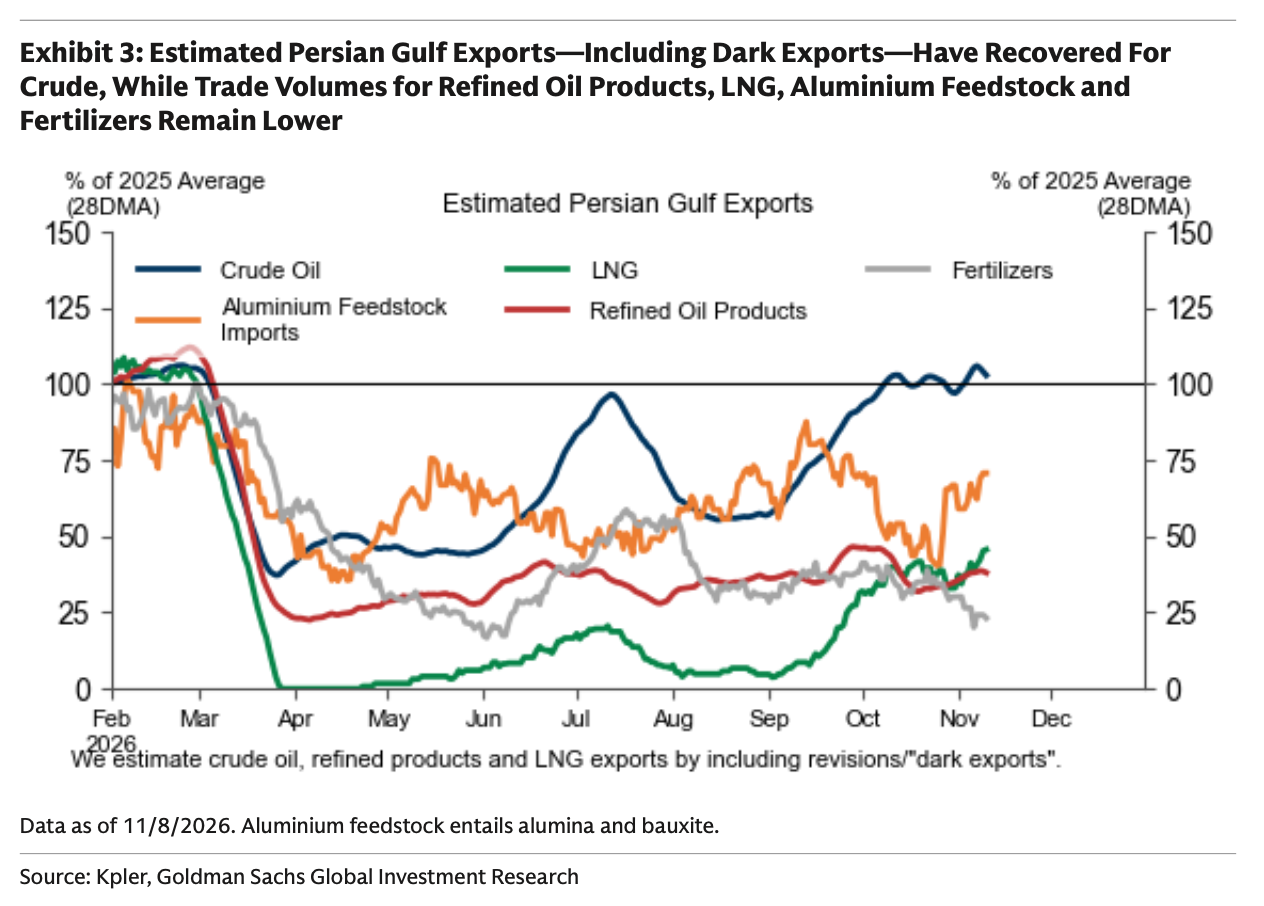
(Goldman Sachs data shows that crude oil exports from the Persian Gulf have largely returned to 2025 levels, but trade in refined oil, LNG, aluminum industry feedstocks, and fertilizers remains significantly constrained.)
Goldman Sachs explained that, compared with crude oil, refined oil products and LNG are more flammable, making ship-to-ship transfers more difficult. In addition, some refining, natural gas liquefaction, and aluminum smelting facilities have not yet fully recovered from war damage.
Supply chain adjustments have also incurred substantial costs. Goldman Sachs estimates that the global average freight rate for crude oil tankers has risen by about $20 per barrel year-on-year, with roughly three-quarters of this increase attributable to adjustments in the Middle East shipping system to adapt to the conflict.
Ship-to-ship transfers are consuming more tanker capacity, and the U.S. blockade of Iranian tankers is further curtailing available transport capacity. Rising crude oil shipping costs are also prompting some product tankers to carry crude, driving up product freight rates and ultimately passing through to consumer fuel prices.
Under the baseline scenario of a sustained supply recovery, Goldman Sachs expects Brent crude oil prices to gradually decline from $103 per barrel in the fourth quarter of 2026 to $80 per barrel in the fourth quarter of 2027, with the full-year average further dropping to $73 per barrel in 2028.
However, energy prices still face significant upside risks.
Goldman Sachs warns that if the conflict escalates again, causing 2027 oil production in the Persian Gulf to average 2.5 million barrels per day lower than in 2025, Brent crude prices could surpass $130 per barrel in early 2027, with the full-year average reaching around $120 per barrel.
If refining output were to fall by an additional 3 million barrels per day, U.S. diesel wholesale prices could rise to around $230 per barrel by late 2026, hitting a new record high.
The European natural gas market likewise faces dual risks from supply and weather.
Goldman Sachs forecasts that if, during the winters of 2026–2027, LNG exports from the Persian Gulf remain at only 25% to 30% of pre-war normal levels, and European temperatures are about 0.7 degrees Celsius below average, TTF natural gas prices in the first quarter of 2027 could approach €150/MWh.
However, over the longer term, as LNG projects that received final investment decisions between 2025 and 2026 gradually come on stream, global supply growth could accelerate after 2027. Goldman Sachs expects the average price of TTF natural gas to fall further to €20/MWh in 2028.
Equities and bonds are more sensitive to energy shocks, increasing the hedging value of commodities.
Despite the outlook for energy benchmarks leaning toward lower prices, Goldman Sachs believes that the current market environment still favors commodities as a hedge against risk.
The report notes that since November, energy and copper prices have declined, driven primarily by shifts in market sentiment and expectations regarding short-term geopolitical risks, rather than a significant deterioration in underlying supply-and-demand fundamentals.
Goldman Sachs estimates that the risk premium embedded in the spot price of Brent crude has fallen from $27 per barrel on the Friday before the U.S. midterm elections to just a few dollars per barrel in the days leading up to the report's release.
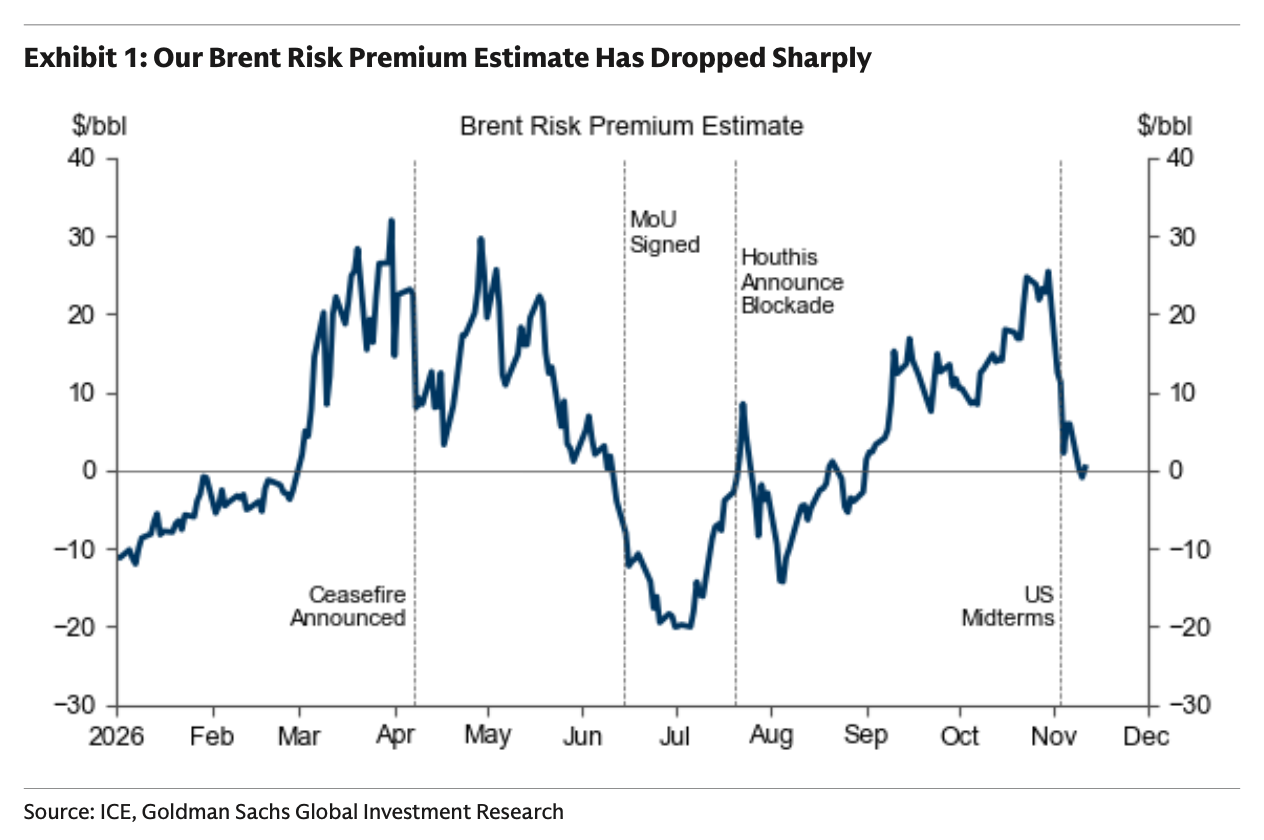
(Goldman Sachs estimates that the Brent crude oil risk premium has dropped sharply from around $27 per barrel before the U.S. midterm elections to just a few dollars per barrel recently.)
The bank believes that the rapid decline in risk premiums presents investors with a more attractive entry point, as shipping security and energy infrastructure in the Middle East continue to face risks of supply disruptions.
More importantly, the impact of energy prices on equity and bond markets is growing.
Goldman Sachs noted that since the outbreak of the war in Iran, changes in Brent crude oil prices have shown a strong correlation with the S&P 500 index and U.S. 10-year Treasury yields. Rising energy prices have intensified inflationary pressures, prompting central banks to adopt more hawkish policy responses, thereby affecting bond and equity valuations.
Although recent AI investment and concerns about economic growth have weakened this correlation, Goldman Sachs believes that if a new energy supply shock occurs in 2027, the sensitivity of equity and bond markets to energy prices could strengthen again.
In this scenario, bonds could come under pressure as they did in 2026, and equities may retrace their 2022 losses, particularly in an environment where economic growth and employment face downside risks.
Meanwhile, over the past five to six years, the correlation between equity and bond returns has risen markedly, potentially weakening the risk‑diversification benefits of traditional stock–bond portfolios.
Goldman Sachs reviewed market performance over the past sixty years and found that during 12-month periods when both stocks and bonds posted negative real returns, gold or a broad commodity index delivered positive real returns in at least one of those categories.
Therefore, Goldman Sachs believes that the investment value of commodities depends not only on expected price increases but also on their ability to withstand adverse supply shocks.
Copper and aluminum price trends may diverge significantly.
As energy prices tend to fall, Goldman Sachs remains optimistic about the structural upside potential of copper.
The bank forecasts that the average LME copper price for 2027 will be $15,400 per tonne, rising further to $15,600 per tonne by year-end.
On the demand side, electrification, energy security, strategic inventory accumulation, data center construction, and AI investments continue to boost copper consumption, while copper mine supply remains constrained over the long term.
Goldman Sachs believes that the competition between China and the United States over critical resource supply chains has further exacerbated the supply-demand imbalance in the refined copper market.
In the United States, uncertainty over potential import tariffs has prompted companies to bring in and stockpile copper ahead of time, resulting in a large influx of refined copper into the U.S. and reducing available supplies in other markets.
In China, stricter regulations on scrap copper invoices have constrained the domestic supply of scrap copper, prompting manufacturers of copper rods, wires, and tubes to increase their use of refined copper.
Goldman Sachs expects these two trends to persist until 2027, keeping the refined copper market outside the United States in a supply deficit and further supporting copper prices.
However, the bank also noted that copper prices still face short-term downside risks if uncertainty surrounding U.S. copper tariffs eases or if the recovery of AI-related investor long positions falls short of expectations.
By contrast, Goldman Sachs is cautious about aluminum prices.
Although supply disruptions in the Middle East keep the aluminum market currently tight, bauxite resources are relatively abundant, and higher smelting margins are spurring new investment, so supply growth may accelerate in the future.
Notably, the expansion of Indonesian aluminum smelting capacity backed by Chinese capital stands out. Goldman Sachs forecasts that Indonesia's share of global primary aluminum production will rise from about 1% at the end of 2025 to around 4% by the end of 2027.
As new capacity comes online, Goldman Sachs expects the global aluminum market to shift to a supply surplus, with LME aluminum prices potentially falling to $2,600 per tonne by the end of 2027, below the roughly $3,085 per tonne level at the time the report was released.
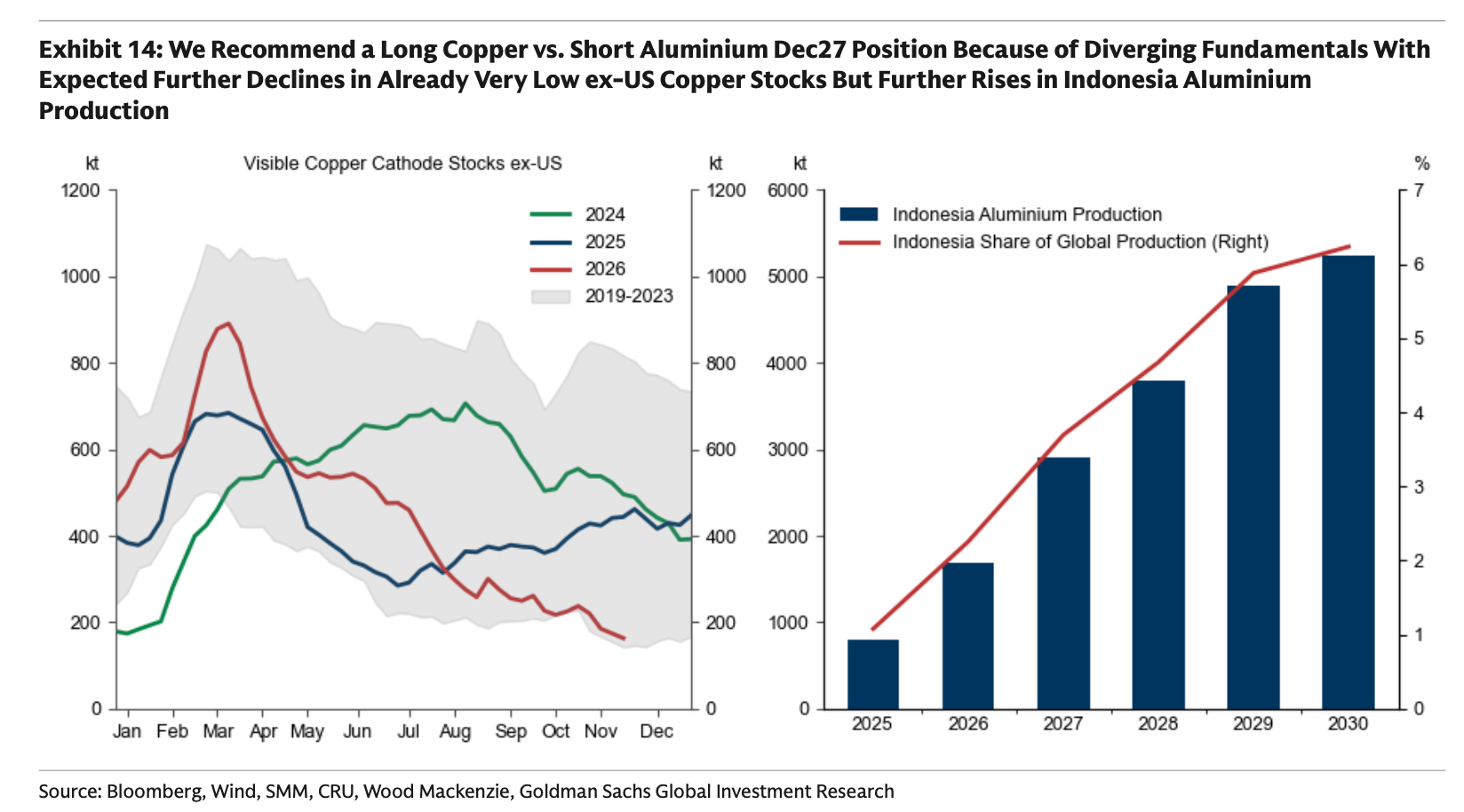
(Goldman Sachs data shows that visible refined copper inventories outside the United States continue to decline, while Indonesia's aluminum production is expected to grow rapidly, reflecting a divergence in the supply and demand fundamentals of the copper and aluminum markets.)
Rising interest rate expectations are weighing on gold prices in the short term, while central bank gold purchases provide longer-term support.
Regarding gold, although Goldman Sachs maintains its long-term bullish view, it has lowered its year-end 2027 target price from the previous $4,800 per ounce to $4,650 per ounce, as the Federal Reserve's policy outlook has turned more hawkish.
The adjustment was mainly due to Goldman Sachs economists revising up their expectations for Fed rate hikes.
Building on its earlier expectation of a 25-basis-point rate hike in December 2026, Goldman Sachs' latest forecast further factors in a 25-basis-point hike in March 2027.
Goldman Sachs believes that rising federal funds rates will continue to curb private investors' demand for gold allocations in early 2027.
However, the continued gold purchases by central banks worldwide continue to provide significant structural support for the metal.
The report notes that since the freezing of Russian central bank assets in 2022, global central banks' demand for gold has risen markedly, with official entities—including the People's Bank of China—continuing to purchase gold, thereby serving as a key pillar supporting gold prices.
Goldman Sachs expects the Federal Reserve to begin cutting interest rates in December 2027. As interest rate constraints ease, private investors' demand for gold may rebound, pushing gold prices toward their year-end target levels.
Geopolitical tensions, compounded by extreme weather, are keeping commodity supply risks elevated.
In addition to energy and metals, Goldman Sachs also warns that global agricultural commodity prices face potential upside risks.
The report notes that the BCOM Agriculture sub-index has risen 10% since 2026, but Iran and the Russia-Ukraine conflict, potential restrictions on grain exports, and a super El Niño that could reach record intensity could still further drive up agricultural commodity prices.
Goldman Sachs pointed out that transport routes related to the Strait of Hormuz typically account for about one-third of global fertilizer exports, while grain exports from Russia and Ukraine via the Black Sea represent roughly 15% to 20% of global grain trade. Any disruption to these shipments could drive up agricultural production costs and tighten food supplies.
Meanwhile, El Niño-induced droughts and floods could affect the production of key agricultural commodities such as soybeans, corn, and sugar in Brazil, cocoa in West Africa, and coffee in Vietnam.
These risks highlight the fragility of global commodity supply chains.
Goldman Sachs believes that events such as the 2022 shock to Russian natural gas supplies and the 2026 crisis in the Strait of Hormuz reflect the same long-term trend: geopolitical fragmentation is interacting with highly concentrated commodity supply chains, structurally increasing the risk of supply disruptions.
Editor/Deng