
① Following the sudden resignation last week of NVIDIA CEO Jensen Huang, U.S. stock market AI investment themes suffered a severe blow, yet their overall performance still demonstrated remarkable resilience; ② As Anthropic's mega-IPO is set to hit the market soon, investors' concerns about potential turmoil in the stock market continue to spread.
Following the sudden resignation last week of NVIDIA CEO Jensen Huang, U.S. stock market AI investment themes suffered a severe blow, yet their overall performance still demonstrated remarkable resilience. However, as Anthropic's mega-IPO is set to hit the market, investor concerns about potential market turmoil continue to spread.
There is widespread concern in the market that investors will choose to sell their existing stock holdings to free up capital to snap up shares in this massive new offering…
 Anthropic said last Tuesday that it plans to raise $62.5 billion from investors this week through an unprecedented initial public offering, while also raising another $26 billion through private placements targeted at tech giants including NVIDIA and Micron Technology.
Industry insiders' concerns are clearly well-founded—recent high-profile IPOs have already been accompanied by sharp volatility: just about a week before SpaceX's record-breaking, ultra-large offering on June 12, the market suffered a severe sell-off on June 4, driven by a stronger-than-expected non-farm payrolls report and worries about the IPO's potential to drain liquidity.
The incident also almost perfectly timed the peak of this round of semiconductor gains. According to FactSet data, since then, NVIDIA's stock price has cumulatively fallen by more than 20%, and the benchmark index tracking the sector has also dropped sharply, well below its June high.
Mark Hackett, Chief Market Strategist at Nationwide, noted: "Especially in the current complex and intertwined environment, market concerns are entirely justified."
Success or failure hinges on this battle.
Historical data does indeed provide reason for caution. According to the Securities Industry and Financial Markets Association (SIFMA), U.S. stocks have often entered bear markets in the years following peaks in IPO activity—though this pattern is based on a small sample of just two instances.
An estimate from Goldman Sachs indicates that the firm expects IPO fundraising to reach approximately $250 billion in 2026, with even higher levels in 2027. According to SIFMA data, the previous peaks in IPO issuance occurred in 2000 and 2021.
It is undeniable that the U.S. stock market has recently shown signs of fatigue—particularly the star technology stocks that led the broader market earlier this year, which have been underperforming.
As of Friday's close last week, the Nasdaq Composite was nearly 10% below its October record high. Stock market performance has deviated from the usual historical pattern—that major indices typically rise after midterm elections.
Interactive Brokers economist Jose Torres believes that recent reports of Anthropic's hot oversubscription have, to some extent, boosted investor confidence. However, if the stock underperforms expectations in its early trading days, the spillover impact on the broader market will be widespread.
"This (Anthropic's IPO) is of great significance," Torres said.
However, the good news is that the market has actually already priced in a significant portion of the negative expectations recently. Major indices have all retreated from their peaks, and some popular concept stocks that had previously benefited from the AI infrastructure bottleneck theme—such as Caterpillar—have seen their share prices cut in half since June. Meanwhile, the Chicago Board Options Exchange Volatility Index (VIX), often referred to as the "panic index" for U.S. stocks, closed at 18.92 points on Friday, only slightly below its long-term historical average.
Deutsche Bank's equity strategy team examined this period of history from different perspectives. The bank's strategists, Parag Thatte and Binky Chadha, outlined the multi-year "uptrend" in equity issuance over the past three decades.
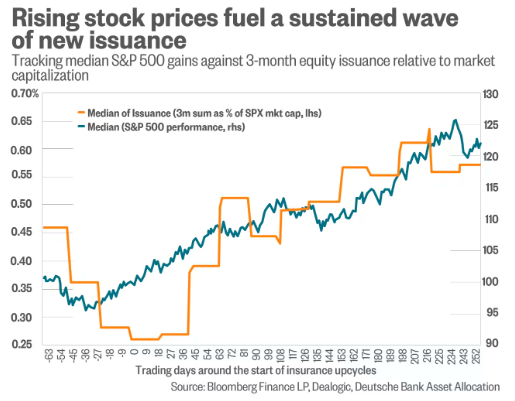
They found that periods of strong U.S. equity issuance often coincide with prolonged bull markets—rather than the reverse. They noted that this supports findings in the academic literature. In a June research report, the team wrote: "Investors commonly worry that surging IPO activity will drain liquidity from the broader market and trigger sell-offs. However, earlier academic research suggests that the causal chain actually runs in the opposite direction: market conditions drive issuance volumes, rather than issuance weighing down the market."
Facing Turbulent Challenges
Currently, wealth management advisors surveyed by the media generally report that their clients are indeed interested in purchasing shares in Anthropic's IPO.
However, historical experience suggests that the first year of trading for many of the largest U.S. listed companies has often been rocky.
For investors eager to snap up shares in mega-IPOs on their first day of trading, historical data serves as a sobering reminder: among the top 20 traditional U.S. stock IPOs by funds raised since 1990, 15 saw their share prices fall below the offering price within the first year, with a median maximum drawdown from the first-day closing price as high as 40.9%.
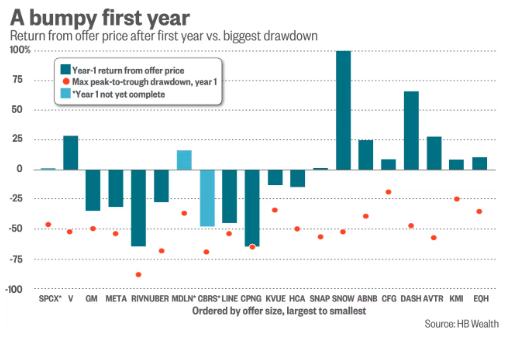
Only five companies—Medline, Snowflake, Airbnb, Citizens Financial, and DoorDash—kept their stock prices above the IPO price for the first 12 months after going public.
"Volatility is typically very high in the first year after a new stock lists," said Michael Casper, senior market strategist and director of equities at HB Wealth. "The vast majority of companies experience fairly deep valuation pullbacks during this period."
Despite the significant potential risks, many in the industry believe that Anthropic's successful IPO could serve as a catalyst to restore market confidence and reignite sluggish AI investment.
Jawad Mian, founder of the investment research newsletter Stray Reflections, noted that Anthropic's IPO offers public-market investors a rare opportunity to gain direct exposure to a pure-play generative AI company.
"Until now, market speculation and investment enthusiasm have been overwhelmingly focused on upstream segments such as computing chips, cloud infrastructure, and the hardware supply chain. Anthropic, however, gives investors a chance to directly share in the value growth of the intelligent models themselves," Mian said. "Anthropic's IPO is more likely to reshape and reallocate the valuation premium within the AI sector than to derail the broader stock market."
Editor/lambor