
SemiAnalysis has cut its 2028 global AI accelerator capital expenditure forecast by 28% and its 2030 forecast by 40%; the cumulative forecast for accelerator silicon wafer shipment area from 2026 to 2030 has been reduced by 17%, while its 2028 HBM demand forecast has been slashed by 30% and its 2030 power consumption demand forecast lowered by 34%. NVIDIA is the hardest hit, accounting for 66% of the global reduction in silicon wafer shipments, with its shipment forecast—based on projected compute revenue for 2030—slashed by as much as 66%.
A new sign of cooling has emerged in the AI infrastructure investment boom.
In its latest model update released on November 13, semiconductor research firm SemiAnalysis significantly lowered its forecasts for AI accelerator shipments, capital expenditures, HBM demand, and power consumption over the next several years. The adjustments were particularly pronounced for the period from 2028 to 2030: the global AI accelerator capital expenditure forecast for 2028 was cut by 28%, while the 2029 and 2030 projections were reduced by 41% and 40%, respectively.
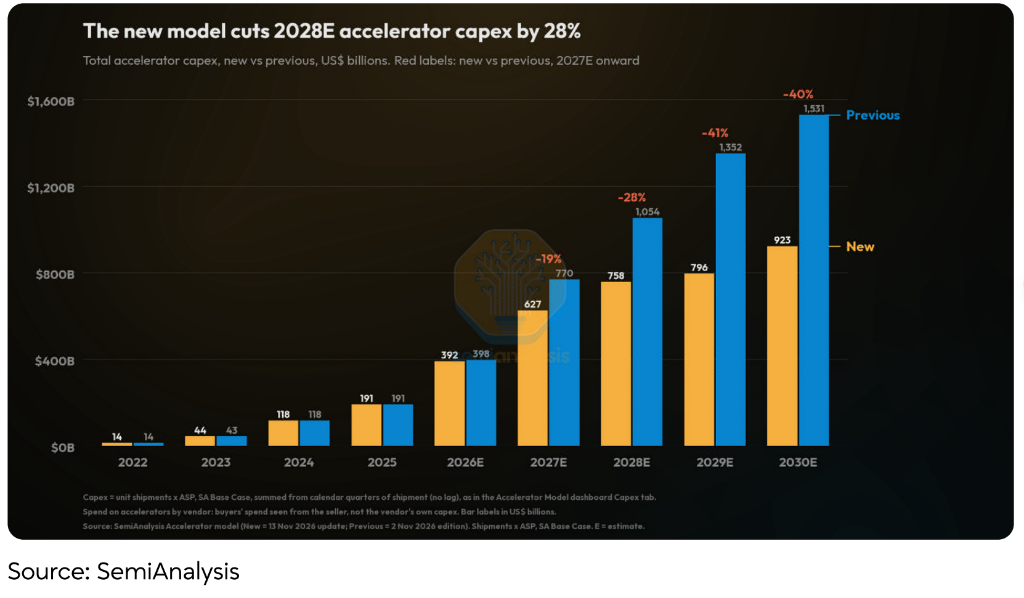
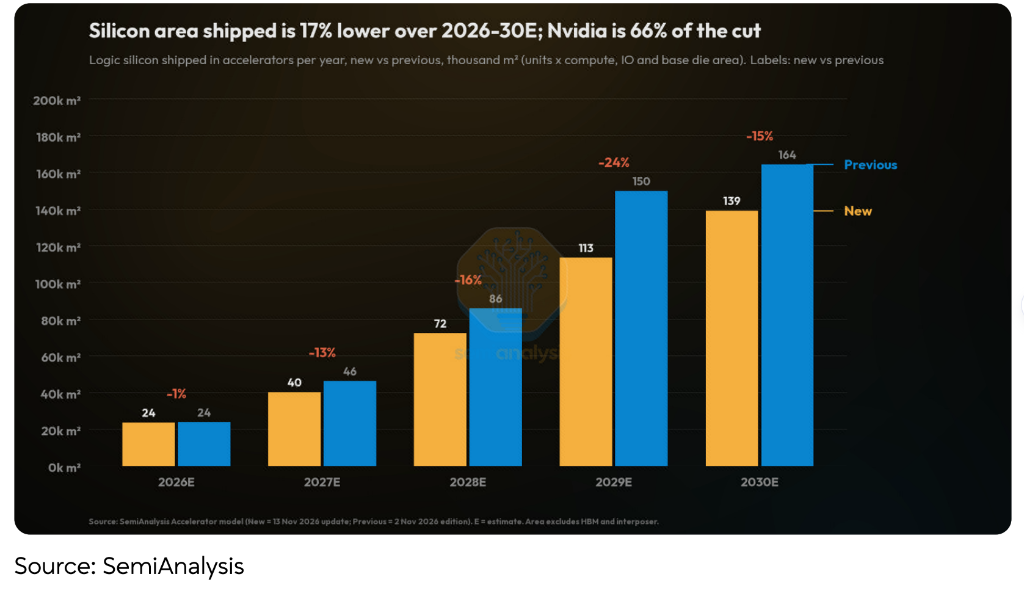
 According to the latest model, global capital expenditure on AI accelerators in 2030 will decline from the previously forecast $153.1 billion to $92.3 billion, a reduction of $60.8 billion. Meanwhile, the cumulative forecast for accelerator logic die shipment area from 2026 to 2030 has been revised down by 17%, with NVIDIA accounting for 66% of this cut.
In this round of forecast adjustments,$NVIDIA (NVDA.US)$It has been hit the hardest. SemiAnalysis has not only sharply lowered its shipment forecasts for NVIDIA over the next several years but has also further reduced its assumptions for the average selling price of next-generation products, arguing that as competition in the AI hardware market intensifies, NVIDIA will need to accept lower profit margins to remain competitive.
AI capital expenditure expectations have plummeted, with the 2030 forecast revised down by $608–80 billion.
The most immediate signal of SemiAnalysis's latest adjustment is a reassessment of the global scale of capital expenditures for AI accelerators.
According to its latest model, the forecast for global capital expenditure on AI accelerators in 2026 remains largely unchanged, hovering around $392 billion. However, starting in 2027, the previously projected high growth has been significantly revised downward.
The 2027 capital expenditure forecast has been cut from the previous $770 billion to $627 billion, a 19% reduction; for 2028, it has been lowered from $1.054 trillion to $758 billion, a 28% decrease; in 2029, it is reduced from $1.352 trillion to $796 billion, a 41% drop; and in 2030, it falls from $1.531 trillion to $923 billion, a 40% decline.
This means that SemiAnalysis's earlier forecast of a continued rapid expansion in capital spending on AI accelerators is being significantly revised. In particular, for 2029 and 2030, the annual investment level, previously projected to exceed $1 trillion, has now been lowered to a range of $800 billion to $900 billion.
This does not mean that investment in AI infrastructure will cease to grow. According to the new forecast, global capital expenditure on AI accelerators is still expected to rise from $392 billion in 2026 to $923 billion in 2030, though the pace of growth is significantly lower than previously anticipated.
Behind the downward revision in capital expenditures are dual shifts: AI industry revenue growth and the financing environment.
SemiAnalysis noted that Frontier AI Labs' year-over-year recurring revenue (ARR) growth slowed in the third quarter, prompting it to reassess the potential token revenue generated across its ecosystem. To ensure that AI‑related revenue can more sustainably cover computing costs, the firm accordingly lowered its projections for future expansion of computing power supply.
Meanwhile, debt and equity investors are becoming less willing to fund AI infrastructure capital expenditures, especially for projects lacking procurement commitments from major cloud service providers (Hyperscalers). This will directly affect the development of data center land, power, and building structures (Shell), leading to a reduction in future power supply available for deploying AI computing systems.
The results of the U.S. midterm elections have further intensified this pressure. SemiAnalysis projects that 5.8 GW of planned U.S. data center capacity, originally slated to enter service in the second half of 2027 through the first half of 2028, will be delayed, and regulatory factors will further constrain data center capacity in 2028.
However, the firm emphasized that delays in data center construction stemming from the midterm elections are merely an additional factor behind the downward revision of its forecast; slower AI revenue growth and a tighter financing environment are the more significant drivers.
Cumulative shipments of silicon wafers have been revised down by 17%, and HBM demand has also been significantly adjusted.
In addition to revising down its capital expenditure forecast, SemiAnalysis has also adopted a more cautious stance on actual hardware demand.
According to the latest model, the cumulative forecast for global AI accelerator logic die shipment area from 2026 to 2030 has been revised down by 17%. Specifically, the forecasts for 2027, 2028, 2029, and 2030 have been lowered by 13%, 16%, 24%, and 15%, respectively.
Notably, NVIDIA accounts for 66% of the decline in silicon wafer shipment area, indicating that this round of adjustments to AI hardware demand expectations is not being evenly borne by all suppliers; NVIDIA is the primary party affected.
HBM demand forecasts have also been significantly revised downward. The 2028 global HBM shipment forecast has been cut from the previous estimate of 9.0 EB to 6.4 EB, a 30% reduction; for 2029, it has been lowered from 10.3 EB to 7.9 EB, a 23% cut; and for 2030, from 10.9 EB to 9.6 EB, a 12% decrease.
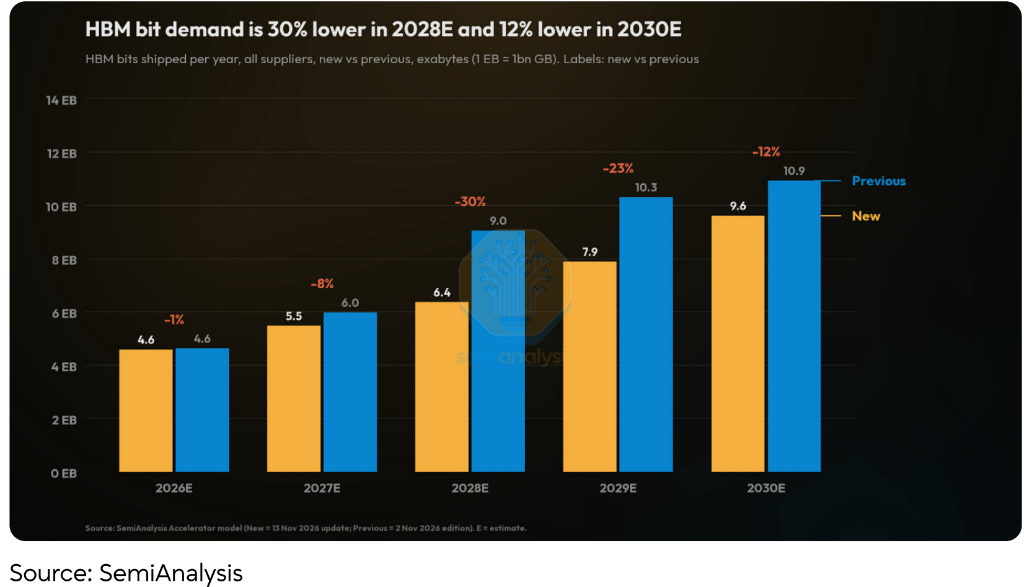
SemiAnalysis believes that the HBM supply-demand balance is improving, so it has lowered its assumptions for future HBM prices and translated the price changes into bill-of-materials (BOM) costs for various AI chips.
Previously, a significant portion of the growth in AI infrastructure spending through 2027 was driven by price increases, particularly for memory. In this firm's view, the downward revision of price forecasts also signals that the supply chain is returning to a more normal state.
In addition, the power consumption demand for AI accelerators has been significantly revised downward. According to the latest forecast, by 2030, AI accelerator power consumption will drop from the previous estimate of 122.8 GW to 80.7 GW, a reduction of 34%; for 2029, the forecast has been lowered from 108.7 GW to 72.5 GW, a decrease of 33%.
This shift stems both from a decline in chip shipments and from revised assumptions about the power consumption of individual chips going forward. SemiAnalysis notes that power continues to be a limiting factor, and the peak chip power budgets in future accelerator roadmaps may also become more moderate.
NVIDIA is under the greatest pressure, with its future chip shipment forecast sharply revised down.
Among the major AI chip suppliers, NVIDIA has been the company most affected by this forecast adjustment.
SemiAnalysis, using the Compute Revenue metric, has lowered NVIDIA's shipment forecasts for 2027 to 2030 by 22%, 39%, 56%, and 66%, respectively; when calculated based on total power consumption including the entire system, the reductions are 14%, 35%, 50%, and 59%, respectively.
In terms of pricing, SemiAnalysis not only takes into account the impact of declining HBM costs but also believes that NVIDIA needs to reduce its markup on the Feynman and subsequent products to cope with increasingly fierce competition.
Specifically, Feynman's average selling price forecast has been lowered from approximately $110,000 to about $78,000, Feynman Ultra from roughly $175,000 to around $98,000, and Feynman Next from approximately $191,000 to about $118,000.
Both shipment volumes and selling prices have been cut, which will put greater pressure on NVIDIA's future revenue forecasts. This adjustment affects not only GPUs but also Groq LPUs and discrete CPU products.
SemiAnalysis explained that NVIDIA has been hit harder, mainly because its chips have become less attractive than other platforms in the compute procurement portfolios of some large AI labs.
Take Anthropic as an example; its four major computing platforms include TPUs, Trainium, AMD GPUs, and NVIDIA GPUs. SemiAnalysis believes that, in terms of performance-to-cost ratio, NVIDIA GPUs occupy a marginal position among these four types of platforms, and Anthropic tends to favor the other platforms.
At OpenAI, while GPUs still play a significant role in its infrastructure, AMD GPUs have become a highly attractive option. Additionally, OpenAI will prioritize deploying in-house ASIC projects such as Jalapeno and the next-generation Serrano.
The new cloud computing service provider (Neocloud) poses another risk to NVIDIA. SemiAnalysis points out that NVIDIA has the largest exposure to Neocloud's customers, especially smaller long-tail clients. These companies currently face greater risks in project execution and financing.
Notably, SemiAnalysis emphasized that this model adjustment did not factor in the potential impact of Jensen Huang stepping down as NVIDIA's CEO; even if Jensen Huang remained CEO, the firm would still revise its forecast downward. However, the firm believes that leadership changes could further increase the downside risk of NVIDIA losing market share.
$Broadcom (AVGO.US)$Relatively stable, with AMD and MediaTek facing adjustments to varying degrees.
In stark contrast to NVIDIA, Broadcom demonstrated greater resilience in this forecast adjustment.
SemiAnalysis has lowered its forecast for Broadcom's cumulative ASIC revenue from 2026 to 2030 by 11%, primarily due to adjustments in average selling prices resulting from declining HBM costs, rather than a large-scale reduction in shipment volumes.
The firm believes that Broadcom's major ASIC projects, including Google's TPU and those related to OpenAI and Anthropic, offer advantages in performance-to-cost ratio and energy efficiency. Additionally, Broadcom can collaborate with creditors to provide financing for data center land, power, building infrastructure, and system deployment.
AMD has also shown some resilience, but still faces significant downward revisions. According to SemiAnalysis, using the total power consumption metric, AMD's forecasts for 2028–2030 have been cut by 23%, 55%, and 57%, respectively; using the shipment volume metric, the cuts are 29%, 35%, and 32%. The 2027 forecast remains relatively stable, with power consumption essentially unchanged and shipment volume reduced by 11%.
AMD has been less affected than NVIDIA, largely thanks to its presence among major customers such as Meta, OpenAI, and Anthropic. SemiAnalysis believes that the warrant arrangements between Meta and OpenAI and AMD make purchasing AMD systems highly attractive; Anthropic also views AMD as the second-best choice after TPUs in terms of performance-to-cost ratio for inference computing.
Furthermore, AMD has recently accelerated its product rollout schedule. SemiAnalysis has moved the shipment dates for approximately 25,000 MI400 chips and about 30,000 Meta-customized MI450-MC chips forward from the fourth quarter of 2027 to the fourth quarter of 2026, reflecting a stronger production ramp-up.
MediaTek, meanwhile, is facing more pronounced adjustments to its shipment volumes. SemiAnalysis has lowered its cumulative lifetime shipment forecast for the Humufish by 470,000 units between 2028 and 2029, and reduced the lifetime shipment volume for the Triggerfish project targeting Anthropic by 42%.
$Amazon (AMZN.US)$Trainium is one of the few platforms whose near-term forecasts were not revised downward in this adjustment. SemiAnalysis did not cut its 2027 and 2028 shipment forecasts for Trainium because Amazon has a relatively robust pipeline of data center projects, and Trainium's manufacturing costs are lower; Amazon is also willing to support its key customers through strategic subsidies.
Overall, SemiAnalysis's recent adjustment does not imply that demand for AI computing power will vanish entirely; rather, it signals that growth expectations—previously anchored in ongoing fundraising, rapid data-center expansion, and high-priced hardware—are being recalibrated.
As the AI lab's revenue growth slows and capital market financing tightens, competition among chip suppliers will shift from a simple race for raw performance to a more comprehensive contest of performance‑to‑cost ratios, energy efficiency, and financing capabilities.
NVIDIA still holds a strong position in the AI chip market, but according to SemiAnalysis, its future growth will face greater pressure than that of some ASIC vendors.
 Want to pick stocks or analyze them? Curious about your portfolio's opportunities and risks? For all your investment questions,Just ask Futubull AI!

Editor/rice