
AI Trading EncountersTechnical aspectsUnder the dual pressure of funding conditions, NVIDIA and the semiconductor sector have seen valuations fall sharply, but extreme short positions and mechanical selling have alsoShort squeezeCreate favorable conditions. Meanwhile, capital is flowing back into AI to support the U.S. dollar, while European stock markets with low AI exposure are becoming a new destination for global investors seeking diversified allocations.
AI trading is facing its toughest stress test since the boom began.
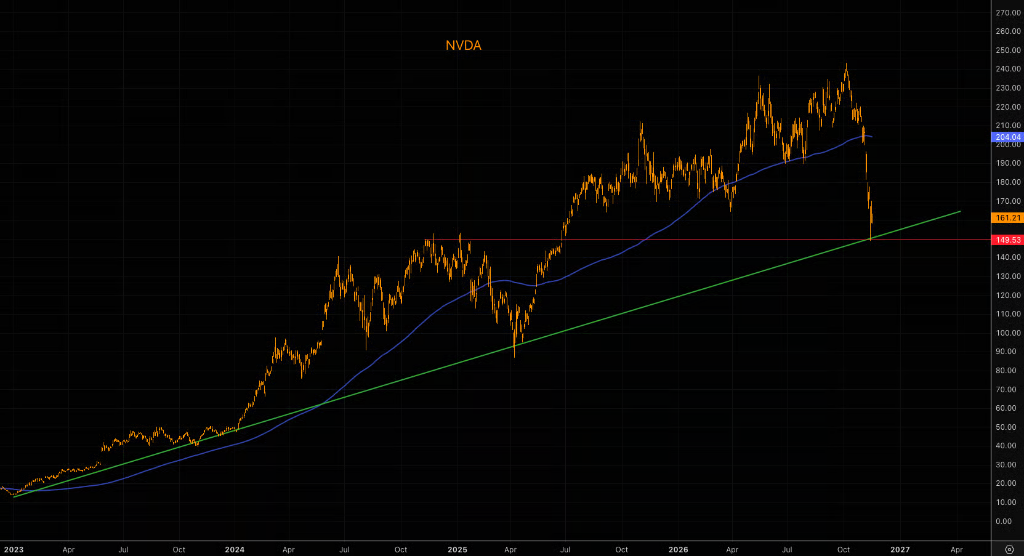
$NVIDIA (NVDA.US)$The stock price has touched a key long-term trend line,$NASDAQ 100 Index (.NDX.US)$Having encountered resistance at the 200-day moving average, systematic funds sold off over $30 billion worth of shares in a single week. However, valuations in the semiconductor sector have fallen to levels that imply a collapse in earnings, and short positions are nearing extreme levels—conditions that could quietly be setting the stage for a sharp short squeeze.
 As tech stocks face headwinds, the AI boom is profoundly reshaping global capital flows. Massive dollar surpluses from Asian chip trade are pouring into U.S. equities rather than Treasuries, bolstering the dollar and creating a positive feedback loop between AI and the greenback. Meanwhile, European stock markets—long overlooked by global investors due to their limited exposure to the AI sector—are increasingly emerging as an attractive destination for diversified allocation.
The central question at hand is this: Is the sell-off in AI the beginning of a long-term structural reset, or merely the prelude to a dramatic short squeeze? The strategies required for these two scenarios are diametrically opposed, and the market now stands at a critical crossroads.
NVIDIA: Flying Too High—At What Cost?
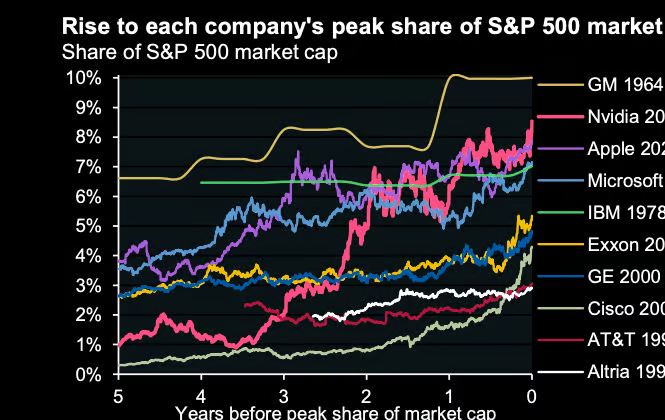
NVIDIA's previous rise can be described as unprecedented. According to JPMorgan data, in December 2022,$NVIDIA (NVDA.US)$Its weight in the S&P 500 was only 1%, but by May this year it had surged to 8.5%. Cembalest of JPMorgan compares this trajectory to that of past market dominators such as General Motors, IBM, General Electric, and Cisco—companies that mostly ended up relinquishing their dominant positions, often resulting in substantial losses for shareholders. So far, only Microsoft and Apple have broken this historical pattern.
Whether NVIDIA can become one of the few exceptions remains a matter of significant market disagreement. From a price-action perspective, the stock bottomed out at a key long-term trend line last week; although it has since rebounded, the move has been notably weak, and it still trades roughly 22% below its 200-day moving average. By comparison, at its low last April, the stock was about 30% below the same moving average.
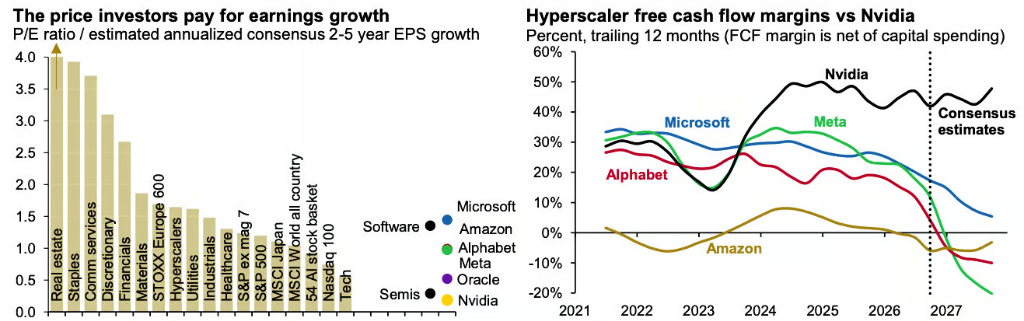
On the valuation front, NVIDIA has already undergone a significant repricing. Although, according to JPMorgan's estimates, the company captured 83% of AI chip revenue between 2023 and 2025, with gross margins as high as 75% and operating profit margins reaching 66%, indicating that its fundamentals remain strong, its PEG ratio has been compressed to just 0.2x—the lowest among major AI stocks. The market has shifted from "willing to pay any premium for growth" to "questioning how long that growth can last"—the pendulum may have swung too far.
Semiconductors: Do Valuations Already Price in an Earnings Collapse?
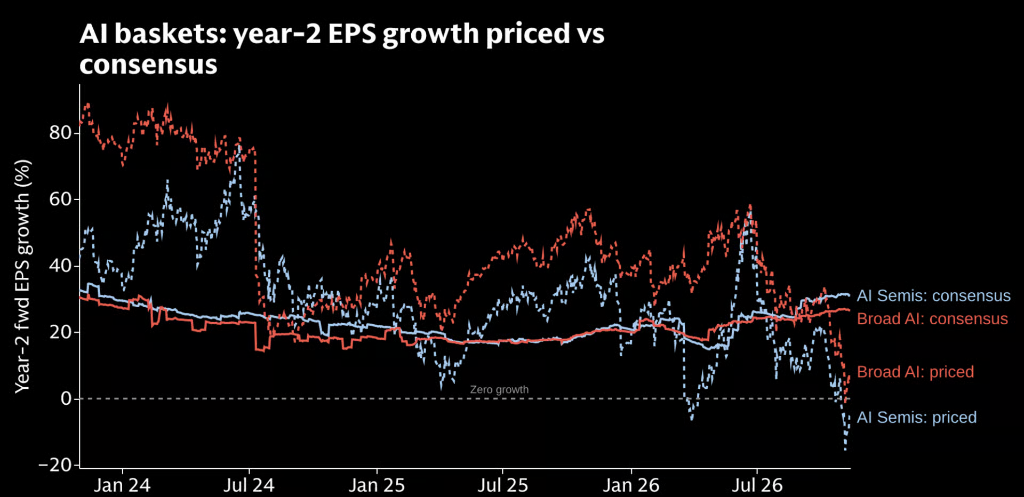
Semiconductor sector relative to$S&P 500 Index (.SPX.US)$The underperformance has exceeded 30 percentage points, marking the largest relative drawdown since 2002. According to Goldman Sachs data, the current price-to-earnings ratio of the Goldman Sachs AI Semiconductor Basket is only 11 times its projected 2028 earnings, while the S&P 500's multiple is close to 16 times—despite market consensus forecasting earnings growth of as much as 31% for this basket in 2028.
What does this valuation gap mean? Goldman Sachs points out that, extrapolating from the market's current valuation multiples, the current share price implies a pessimistic expectation of about a 6% decline in earnings, which represents a significant divergence from the consensus forecast. Only one of these two interpretations can be correct: either earnings forecasts are about to be sharply revised downward, or the market's pessimism about the AI outlook has become excessively widespread.
$NASDAQ 100 Index (.NDX.US)$It also retraced after encountering resistance at the 200-day moving average, with weakening momentum. The NDX futures level at 27,000 points represents the most critical technical support right now; this mark was a key pivot last autumn and closely aligns with the long-term trend line. Whether the market can hold this threshold will largely determine its future trajectory.
Systematic Sell-Off: Today's Sellers, Tomorrow's Buyers?
The rapid rise in market volatility is triggering mechanical deleveraging. According to Goldman Sachs estimates, volatility-control strategies and risk-parity strategies collectively sold over $30 billion in assets in the past week. In the equity options market, the spread between the VXN, which measures tech-stock volatility, and the VIX, which measures broad-market volatility, remains at a historic high, indicating that market pressure is still concentrated in the technology sector.
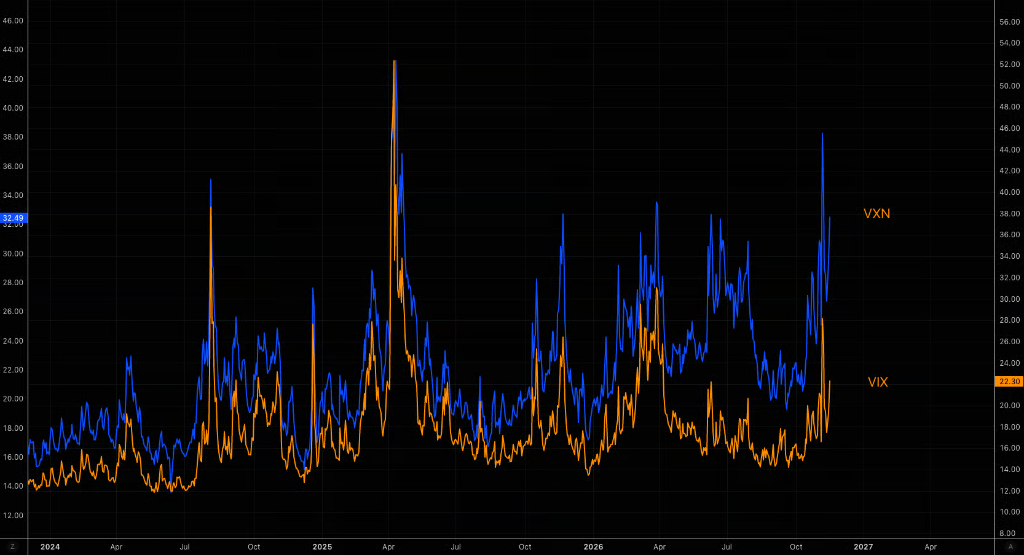
Meanwhile, the NDX short positions of momentum strategy funds have approached historic extremes. Goldman Sachs points out that such extreme short positioning itself constitutes a potential source of price instability. Even more noteworthy is the structural characteristic of volatility-control funds—these funds' operations are highly dependent on realized volatility levels: if market volatility tends to decline from December to January, the capital currently forced to sell could turn into substantial mechanical buying, providing strong support for the market.
"Chip Dollar": AI Is Reshaping Global Capital Flows
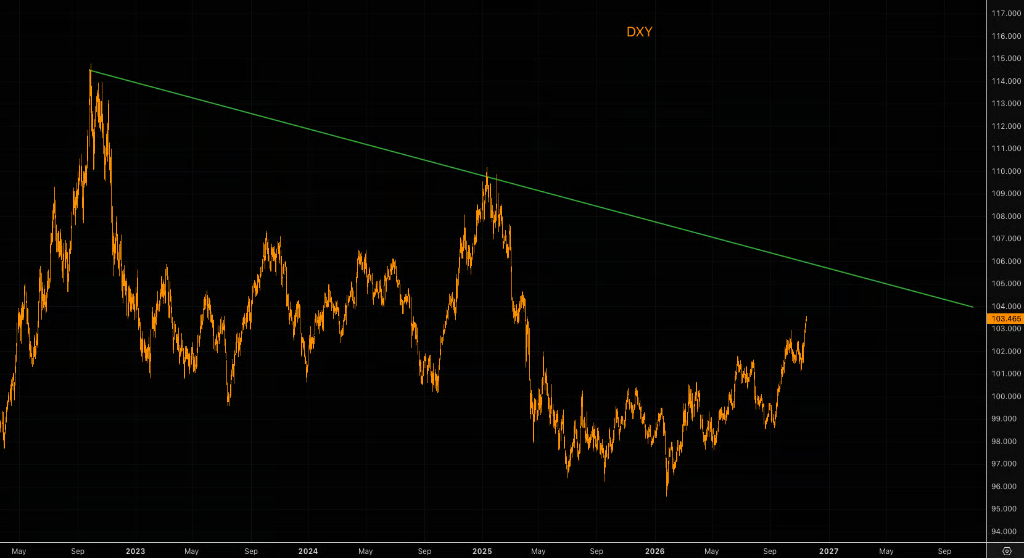
The U.S. dollar continues to strengthen amid widespread bearishness, with short sellers repeatedly forced to cover their positions; the next meaningful resistance lies near 105. Support for the dollar stems not only from price momentum itself but also from U.S. Treasury yield dynamics, which favor the greenback, a progressively hawkish Federal Reserve policy stance, and an AI boom that is quietly reshaping global capital flows in a more profound way.
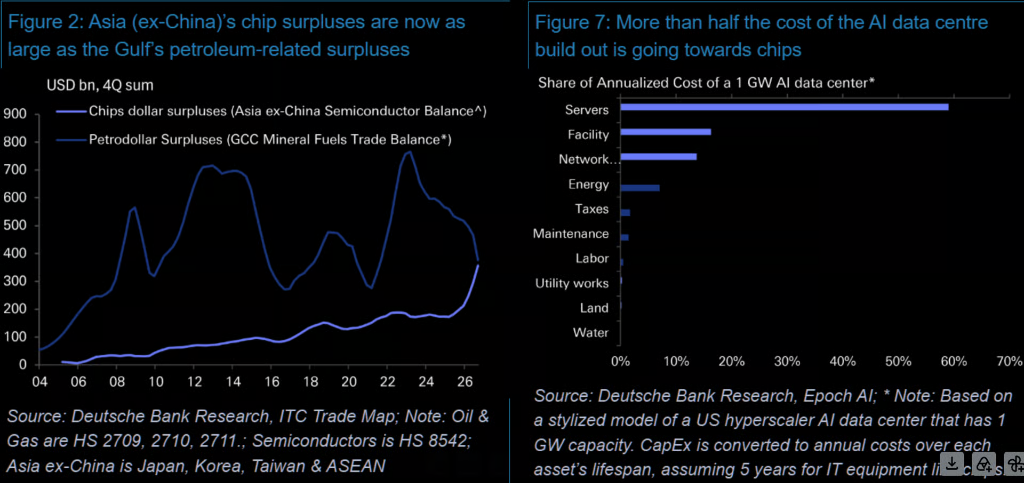
Mallika Sachdeva of Deutsche Bank points out that Asia's booming chip trade is generating massive dollar surpluses, but unlike during the petrodollar era, these dollars are increasingly flowing back into U.S. equities rather than U.S. Treasuries. According to Deutsche Bank data, annual net foreign inflows into U.S. stocks have exceeded $1 trillion, and the AI boom is becoming a major source of external financing for the United States.
However, this mechanism contains inherent instabilities. Deutsche Bank points out that while this capital repatriation supports the dollar, it also provides financing to the AI companies driving the boom itself, creating a self-reinforcing cycle. Yet compared with the old petrodollar system, the assets underpinning this mechanism are far more volatile—the volatility of U.S. equities is three times that of Treasury bonds, and tech stocks can be as much as ten times more volatile. The dollar's dependence on the AI boom is growing ever deeper, and this very dependence represents a potential risk that could undermine the dollar's stability in the future.
Europe's lack of AI exposure may become its greatest advantage.
Against the backdrop of AI-driven narratives steering global capital flows, European equities have long been viewed as a laggard lacking growth catalysts. However, this dynamic is quietly reversing. According to Goldman Sachs estimates, the two-year daily beta coefficient between the Europe Stoxx 600 Index and its U.S. AI basket is below 0.05, implying that European stocks are barely affected by spillovers from AI sector volatility.
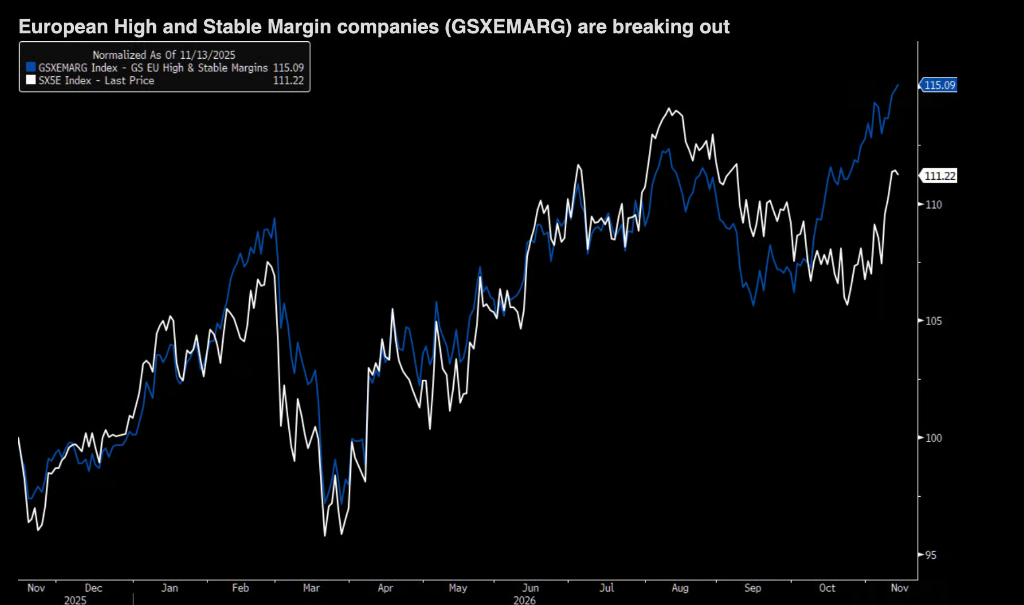
This low correlation is now being reinterpreted as an advantage: as AI-driven trading faces deflationary pressure, global capital seeking to reduce portfolio volatility is turning its attention to Europe. Goldman Sachs notes that European companies with high and stable profit margins have begun to show signs of a technical breakout. AI-powered diversified trading may be gradually evolving into a systematic rally favoring increased allocation to Europe.
Edited by melody