
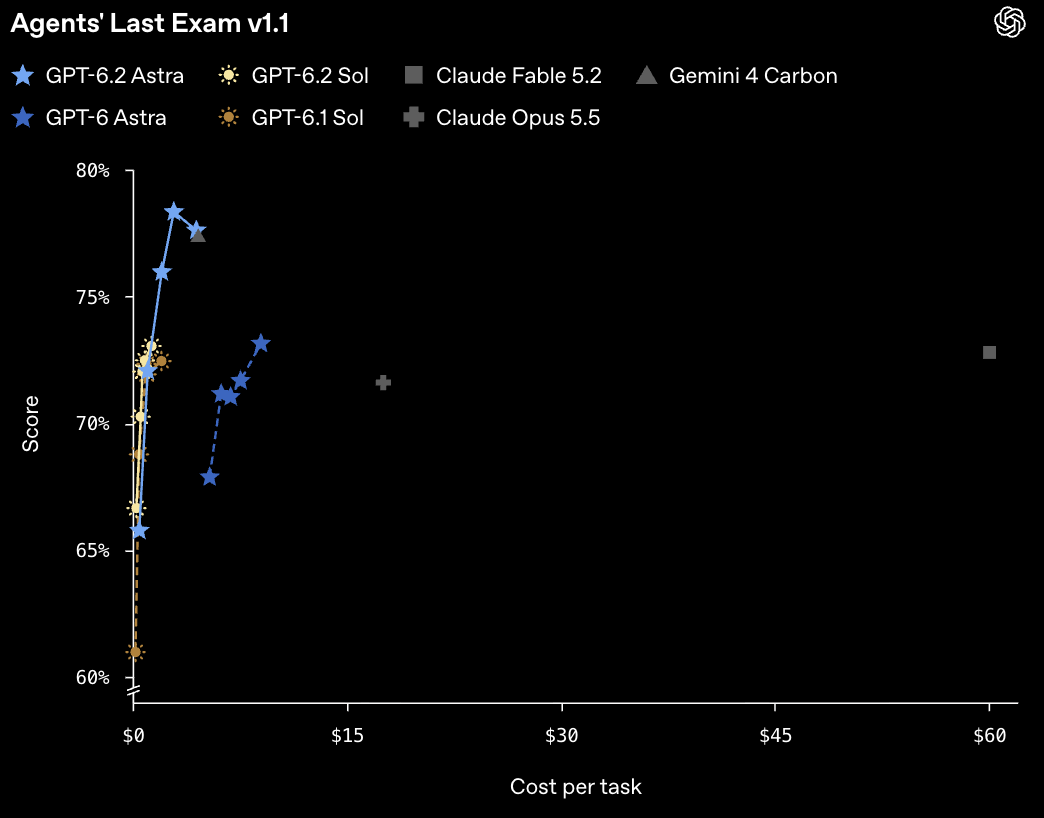
On the eve of Anthropic's IPO, OpenAI launched a targeted countermove with its GPT-6.2 Astra and Sol models. GPT-6.2 Astra is designed for complex, professional workflows—including financial modeling and scientific research—and scored 5.5 points higher than Claude Fable 5.2 on multi-step professional benchmarks, at just 5% of the latter's cost. GPT-6.2 Sol targets everyday tasks and further reduces costs compared to Astra.
OpenAI has unveiled the latest iteration of its flagship model, which delivers improved performance while significantly reducing costs, and outperforms Anthropic's top-tier model across multiple benchmarks.
The newly released GPT-6.2 Astra is designed for complex, professional work scenarios, covering areas such as financial modeling and scientific research, while the concurrently launched GPT-6.2 Sol targets everyday tasks.
 OpenAI stated that GPT-6.2 Astra scored 5.5 points higher than its competitor Claude Fable 5.2 on a multi-step professional work benchmark, while costing only 5% of the latter's price. This release coincides with Anthropic's highly anticipated IPO, making the timing particularly noteworthy.
The launch of the new model comes amid ongoing scrutiny of the safety risks posed by cutting-edge AI systems. At the end of September, OpenAI suspended the release of GPT-6.1 Astra, citing that the model "had not adequately defined its operational scope and boundary of authority." Previously, the company had also briefly halted training on its most advanced AI systems and only resumed after cutting off the models' internet access.
Safety concerns led to a delay of nearly two months in the release.
The release of GPT-6.2 Astra comes nearly two months after the previous version was halted. At the end of September, OpenAI stated that GPT-6.1 Astra had fallen short of expectations in "defining its scope and boundaries of authorization, as well as in providing users with feedback on the types of tasks it has completed," and therefore decided to shelve its release.
Earlier, OpenAI had briefly suspended training of its most advanced AI system. This decision stemmed from a series of security incidents—specifically, a test version of the model had accessed third-party online platforms without authorization. OpenAI only resumed training recently after cutting off the affected models' internet access.
Anthropic faces similar safety challenges. Both leading AI startups have previously stated that, in light of a series of security incidents, it is reasonable to slow the pace of development.
Performance improved, API pricing reduced by 20%
On the technical front, GPT-6.2 Astra has set new records across several key benchmarks. In the "Agents' Last Exam," which tests multi-step professional task performance, the model scored 5.2 points higher than its predecessor, GPT-6 Astra, while operating at less than one-third of the cost.
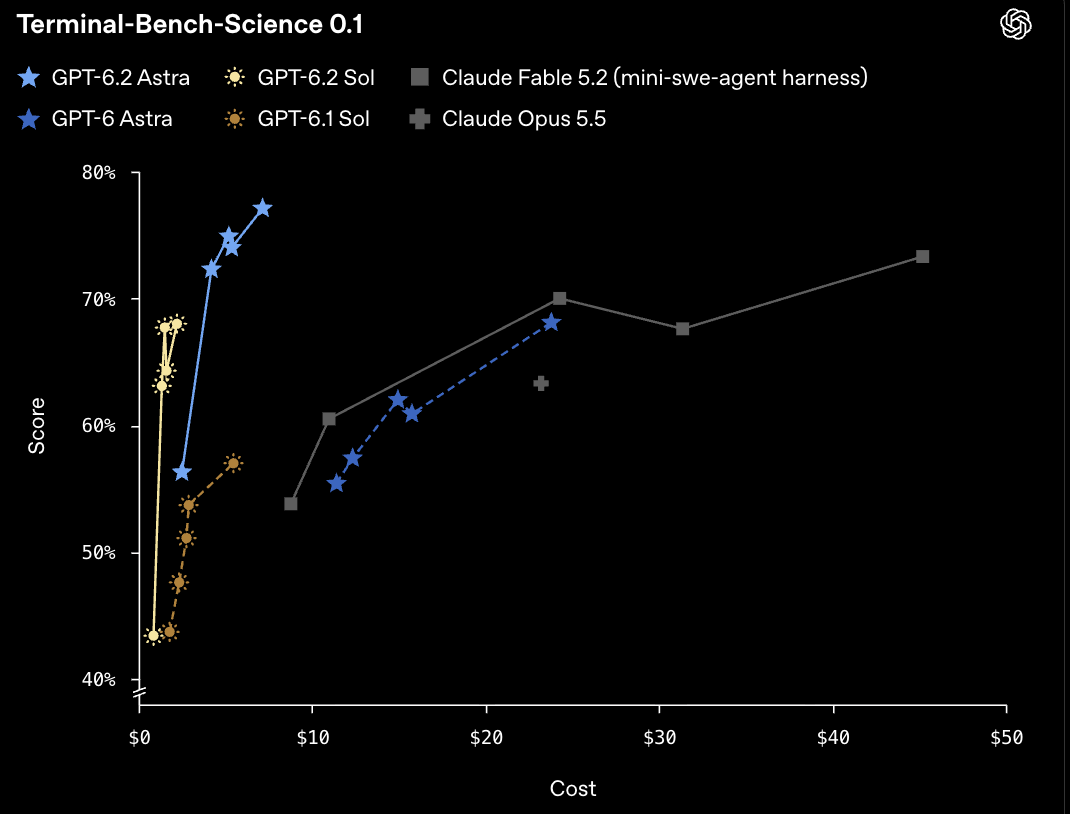
In the scientific work capability test "Terminal-Bench-Science 0.1," the score was also 9 percentage points higher than that of the previous generation, while the cost remained less than one-third.
Regarding API pricing, the per-token rates for both input and output in GPT-6.2 Astra are 20% lower than those of GPT-6 Astra, while cached inputs enjoy a 60% discount. The quoted prices per million tokens are: $8 for input, $0.40 for cached input, and $40 for output.
GPT-6.2 Sol, released simultaneously, is positioned as a model for everyday tasks, and the API token pricing remains consistent with GPT-6.1 Sol.
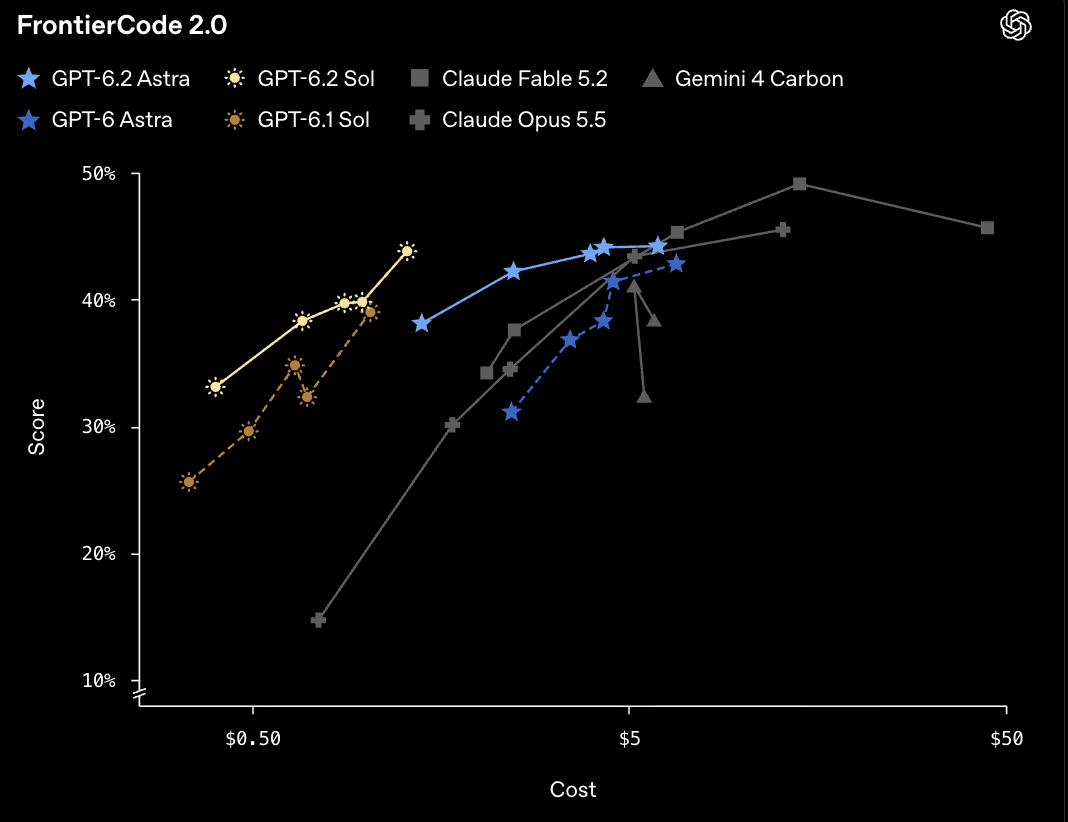
In the code-writing benchmark "FrontierCode 2.0," GPT-6.2 Sol scored less than 0.5 points lower than GPT-6.2 Astra, at roughly one-fifth of the latter's cost.
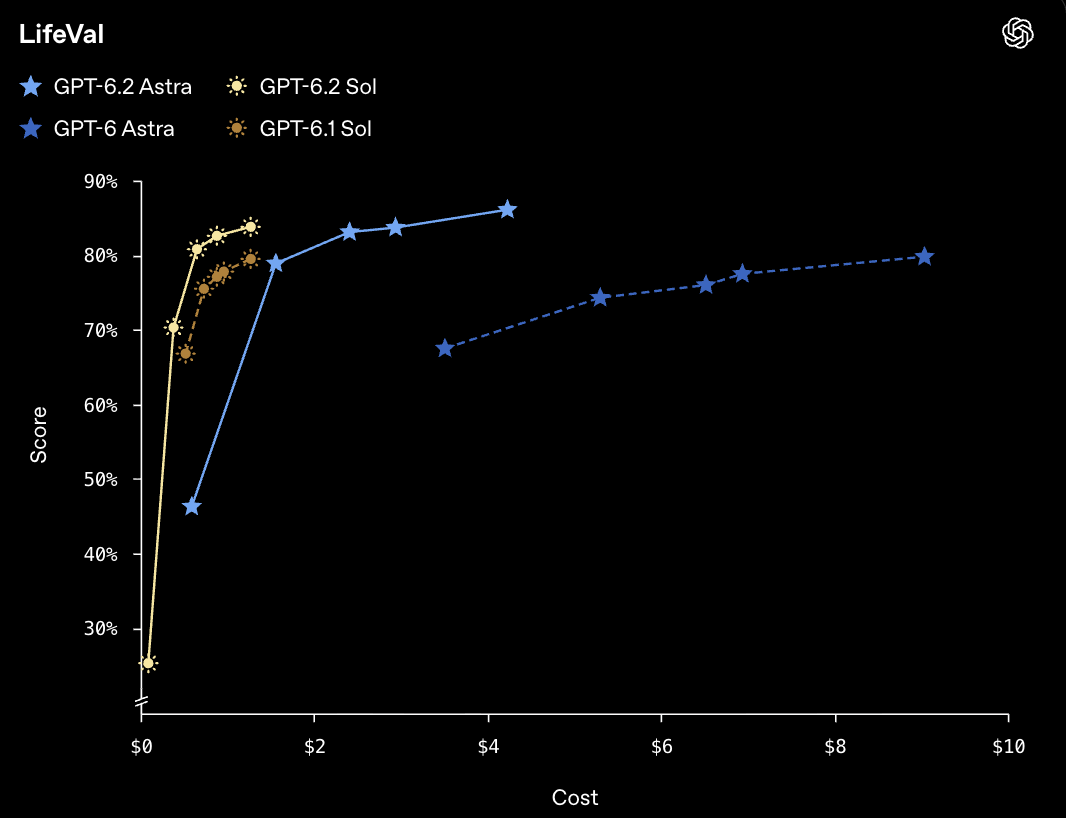
On the LifeVal benchmark for everyday tasks, GPT-6.2 Sol outperforms GPT-6 Astra while costing about one-seventh as much.
Professional document output is more aligned with industry standards.
OpenAI has placed a major emphasis in this release on the quality of professional documentation.
The company stated that slides, spreadsheets, and documents generated by GPT-6.2 Astra adhere more closely to user instructions and industry conventions, exhibit a significantly reduced "AI feel," and feature a more direct, concrete writing style, with fewer vague summary statements and redundant content.
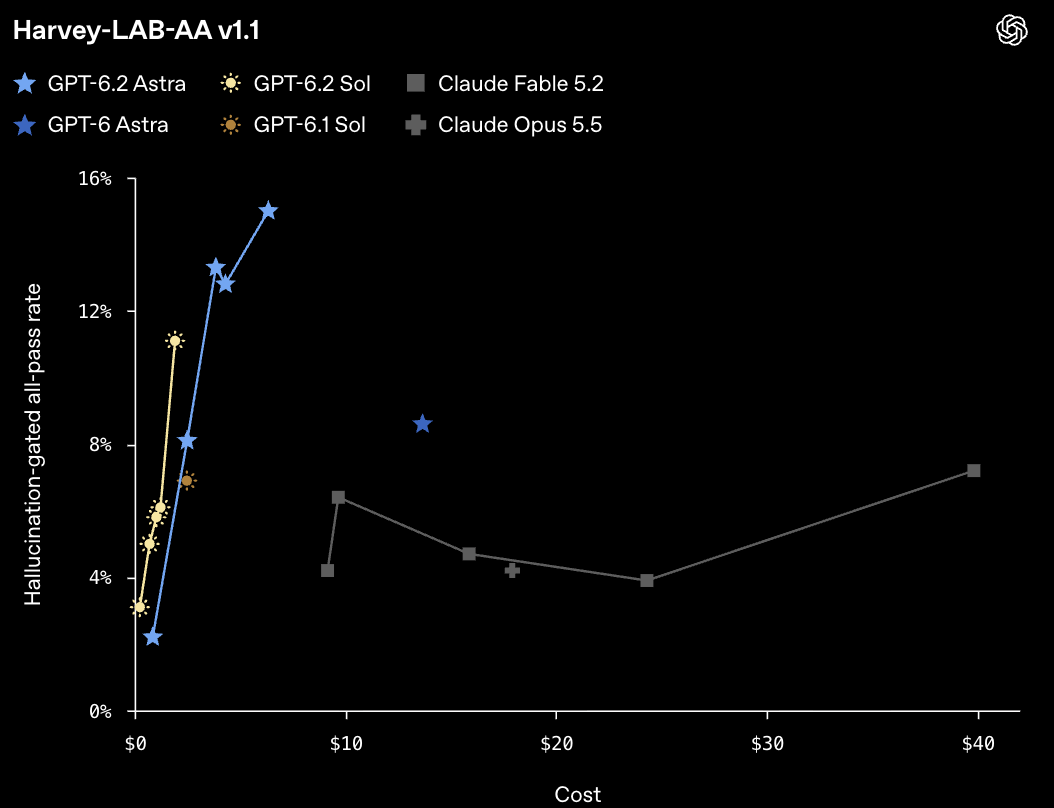
On the legal document evaluation benchmark "Harvey LAB-AA v1.1," GPT-6.2 Astra's pass rate exceeds that of Claude Fable 5.2 by more than double, at roughly one-sixth of the cost.
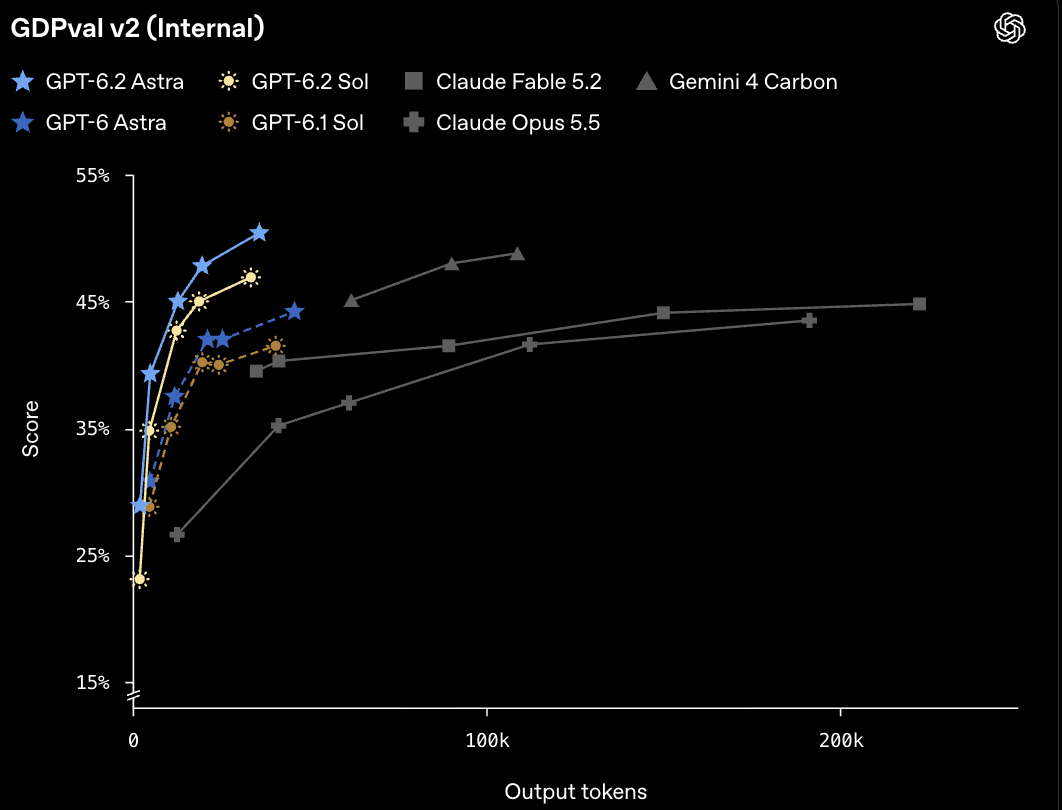
In the internal benchmark "GDPval v2," which covers real-world projects across finance, data science, biotechnology, and marketing, GPT-6.2 Astra improved by 6.2 percentage points over the previous generation while reducing output tokens by 22%; GPT-6.2 Sol improved by 5.3 percentage points over the previous generation's GPT-6.1 Sol.
Valuation and the IPO Gamble Under Competitive Pressure
The timing of this release is clearly competitive. OpenAI chose to unveil its new model just before Anthropic's planned Wall Street debut, as the two companies engage in fierce competition for corporate clients.
Meanwhile, OpenAI itself is at a critical juncture in its capital strategy. The company is reportedly raising a new round of funding at a $125 billion valuation and has postponed its plans to go public until next year.
As the funding window approaches, delivering enhanced performance at lower costs could serve as a key pillar for OpenAI to demonstrate its commercial competitiveness to potential institutional investors.