
Chip financing reached $320 billion, nearly seven times the amount this year, relying heavily on vendor guarantees to hedge against depreciation risk. However,$NVIDIA (NVDA.US)$It is tightening its guarantee commitments, and the $500 billion financing platform it leads has yet to close a single deal.
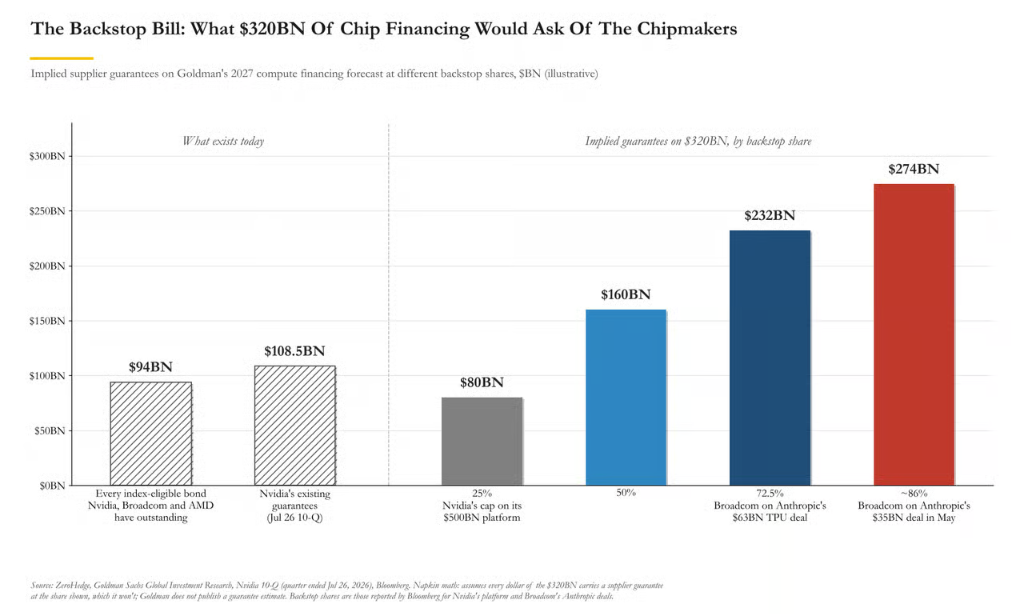
At a 25% guarantee ratio, the 320 billion yuan in financing would require 80 billion yuan in guarantees, yet the outstanding amount of index‑eligible bonds held by the three major chipmakers totals only 94 billion US dollars. With guarantors withdrawing, lenders demanding higher collateral, and the pool of potential buyers shrinking, the risk of a no‑buyer situation is rising.
Goldman Sachs has sharply raised its forecast for global AI project financing in 2027 from $300 billion to $545 billion, but this ambitious projection faces a core contradiction: the key guarantor underpinning the largest portion of that growth—$NVIDIA (NVDA.US)$— is scaling back its financial commitments.
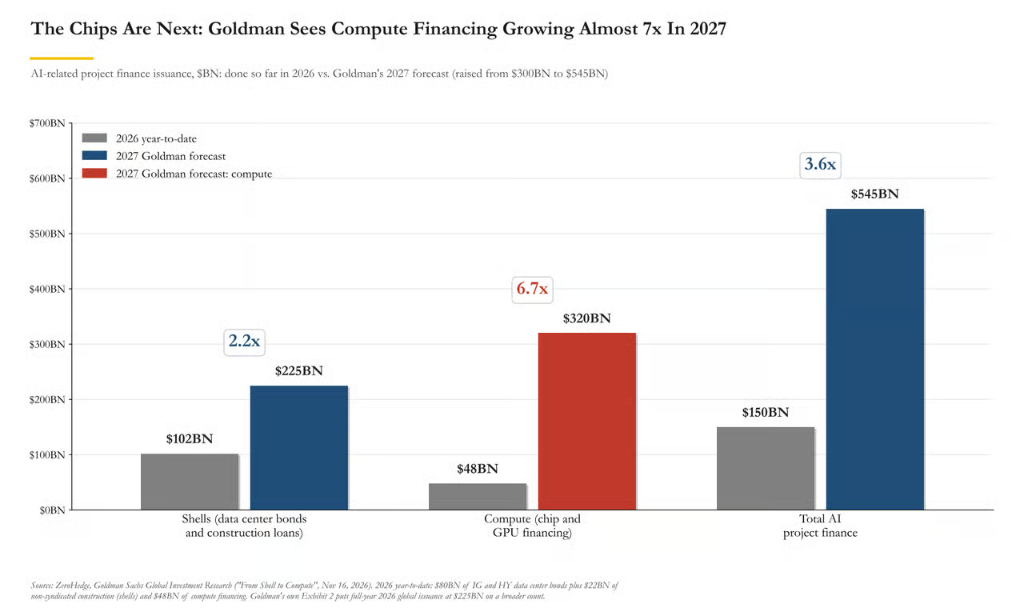
 According to a report released on November 17 by Goldman Sachs' credit team, of the $545 billion forecast, $320 billion comes from chip financing, a figure nearly seven times higher than the $48 billion completed so far this year. However, as reported by The Wall Street Journal, NVIDIA's interim CEO Colette Kress is expected to tighten the company's previous guarantees, buybacks, and investment commitments to customers, while NVIDIA co-founder Jensen Huang had already informed a group of emerging cloud service providers' CEOs in October, requesting that their customers pay in advance.
This shift directly hit market confidence. In August this year, NVIDIA jointly$Apollo Global Management (APO.US)$、$Blackrock (BLK.US)$、$Blackstone (BX.US)$、$Brookfield (BN.US)$、$KKR & Co (KKR.US)$and$Goldman Sachs (GS.US)$The $500 billion chip financing platform jointly launched by NVIDIA and UBS Group has yet to close a single deal, because lenders are demanding that NVIDIA maintain a guarantee coverage ratio of over 25%, which NVIDIA refuses to increase. Meanwhile, according to estimates by UBS Group analyst Tim Arcuri, even a brief suspension of NVIDIA's trading activities could withdraw more than $50 billion from the AI ecosystem.
From 300 Billion to 545 Billion: The Logic Behind the Major Forecast Revision
In its latest report, "The Credit Line: From Shell to Compute: An Update on AI Project Finance," Goldman Sachs' credit strategy team disclosed that global AI project financing has reached $150 billion year-to-date in 2026, including $80 billion in investment-grade and high-yield data center bonds, $22 billion in non-syndicated construction financing, and $48 billion in chip financing. This figure has far exceeded the team's年初 forecast of $76 billion for the full year.
Goldman Sachs has split its $545 billion forecast into two parts: $225 billion for data center "shell" financing and $320 billion for chips (namely GPUs and custom chips). The former is roughly double this year's size, while the latter has grown nearly sevenfold.
Methodologically, Goldman Sachs bases its analysis on planned data center capacity to be commissioned, assuming that the cost of a shell per megawatt in the U.S. is approximately $15 million, while the cost of internal chips is about $25 million. In terms of financing ratios, the shell accounts for 45% to 50%, hyperscalers' compute projects account for 30%, and other projects account for 45%. The chip cost per megawatt is roughly 1.7 times that of the shell, which means that once lenders begin financing internal equipment, the figures will balloon rapidly.
Goldman Sachs equity analysts forecast 113 GW of computing power to be shipped by 2028, but the credit team could only find data center capacity matching 80 GW. At $25 million per megawatt, 113 GW corresponds to roughly $2.8 trillion in chip procurement demand, about one-third of which still lacks a confirmed location.
The operational mechanism of chip financing: guarantees are central
Chip financing is structurally similar to data center bonds: a bankruptcy-remote special purpose vehicle (SPV) holds the GPU assets, customers sign leases or service contracts, and lenders are repaid from the contractual cash flows. Goldman Sachs categorizes existing transactions into two types: equipment leasing (similar to a triple-net lease for buildings, where tenants pay chip rental directly) and hash rate service contracts (where the SPV sells hash rate, and revenue depends on actual service performance).
The rapid depreciation of collateral is the core risk. Goldman Sachs explicitly recommends in its report:
"Credit investors should seek to avoid depreciation and potential obsolescence risks; traditional first-lien financing is generally not well-suited to fund such rapidly depreciating, potentially obsolete assets at this scale."
For this reason, the residual value guarantee provided by chip manufacturers has become pivotal to the entire structure. Under this mechanism, if contract payments are interrupted and the chip's value falls below the committed amount, the guarantor is responsible for covering the shortfall. Goldman Sachs notes that in most transactions, the guarantee amount is close to the sum of the remaining principal and interest—in other words, the lender is effectively conducting a credit assessment of the chip manufacturer, while the chip manufacturer is vouching for its own customers.
Even with collateral backing, the new-issue spreads for investment-grade chip-sector financings remain as high as 150 to 240 basis points, compared with around 100 basis points for typical 5- to 7-year investment-grade bonds; in the leveraged finance space, the most recent deal spread is near 775 basis points, roughly three times that of similarly rated BB/B credits.
NVIDIA's Exit: Who Will Fill the $320 Billion Funding Gap?
Although the Goldman Sachs report is 13 pages long, "$NVIDIA (NVDA.US)$The term appears only once, in the footnote of a single chart. However, NVIDIA's role is precisely the most critical variable in the entire forecast.
According to the Wall Street Journal, Kress is expected to tighten NVIDIA's various financing channels for customers through guarantees, leases, buybacks, and early-stage investments. A Goldman Sachs report shows that NVIDIA's total commitments and guarantees as of the end of July reached $530 billion, including a $105 billion endorsement for OpenAI's Ohio lease.
NVIDIA's $500 billion financing platform launched in August has yet to close any deals, as lenders are demanding a collateral coverage ratio higher than NVIDIA's willingness to offer, which is capped at 25%. By contrast,$Broadcom (AVGO.US)$(Broadcom) provided guarantee coverage for approximately 72.5% of Anthropic's TPU project in May this year, out of a total of $35 billion, and offered similar support in a $63 billion transaction.
According to Reuters, several market participants commented as follows: Erica Spear of JPMorgan expects existing commitments to remain in place, but new deals will require longer terms or higher compensation; Joseph Moore of Morgan Stanley believes that $500 billion in third-party capital is more likely to flow to mature players such as hyperscale cloud service providers; Edwin Wilches of PGIM stated that lenders prefer future financing to be backed by customer contracts or financial guarantees rather than by the chips themselves with limited collateral; Bank of America estimates that, as of August this year, NVIDIA has provided approximately $230 billion in financial guarantees.
Based on a 25% guarantee ratio, $320 billion in chip financing would require $80 billion in guarantees; under Broadcom's terms, it would require $230 billion to $275 billion. And$NVIDIA (NVDA.US)$、$Broadcom (AVGO.US)$and$Advanced Micro Devices (AMD.US)$The three chipmakers combined have only $94 billion in indexable bond outstanding.
Spillover Effects in the Credit Market: The Mid-Section of the Shock Curve
Chip leasing terms typically span less than five years, meaning related financing will be concentrated in the 3- to 7-year segment of the yield curve. According to Goldman Sachs data, over the past two years this segment accounted for 60% of all non-financial investment-grade issuers and 40% of total proceeds, making it the most central borrowing range in the corporate bond market.
Goldman Sachs believes that the short-term impact will remain manageable for the following reasons: structured transactions are not included in mainstream indices, they are relatively difficult to analyze, and the buy-side base is comparatively narrow. However, this also means that the potential buyers of the $320 billion in chip-related debt will exclude index funds, institutions lacking structured credit analysis capabilities, and investors that already hold excessive positions in the relevant tenants.
On the spread front, the CDS premium of chipmakers such as NVIDIA over their cash bonds has risen from negative a year ago to around 75 basis points, above the roughly 45-basis-point level of hyperscale cloud service providers. Goldman Sachs expects this gap to continue widening as chipmakers' credit exposure keeps outpacing the size of their bonds.
Financing for data center "shell" projects is also under pressure.
The $225 billion shell financing segment in Goldman Sachs' forecast also faces challenges. Among the 16 high-yield data center bonds tracked by Goldman Sachs, mutual funds and ETFs hold an underweight position in 13 of them, with an average active weight of -0.07%. Investment-grade data center securities, meanwhile, are not included in the U.S. Aggregate Index or the U.S. Corporate Bond Index; their primary buyers are asset managers who are permitted to deviate from benchmarks (holding about a quarter of each issue on average) and insurance companies (about 10%).
Rising financing costs are also squeezing project viability. In the first half of this year, yields on newly issued data center bonds ranged from 6% to 8%, and recently, high-yield deals have climbed to 8% to 10%. Goldman Sachs estimates that, under assumptions of a 90% loan-to-value ratio and a 1.2x debt service coverage ratio, if coupon rates rise from 8% to 9%, tenants would need to pay an additional 1.4 percentage points in rental yield to maintain the coverage ratio; if coupon rates rise to 10%, the increase would be 2.7 percentage points.
Goldman Sachs concludes that if coupon rates continue to rise, projects will either require more equity, lower leverage, and stricter structuring, or rents must be adjusted upward accordingly—both outcomes imply that the debt size of each project will be lower than expected.
Three paths forward, one unknown.
Goldman Sachs's forecast is essentially an assessment of financing needs, not a guarantee that such financing will be secured. The report itself advises investors to "remain patient and selective," noting that "macro- and technical beta effects are more likely to widen rather than narrow credit spreads."
Regarding the $320 billion chip funding gap, there are currently three potential solutions:
First, Kress has reopened the guarantee window to defend market share (it cannot be ruled out that Broadcom is already offering more favorable terms);
Second, hyperscale cloud providers have brought chips back onto their balance sheets, but their bond issuances have already saturated the investment-grade market;
Third, a new balance sheet has emerged, including support at the government level.
Goldman Sachs also noted in the report that a fourth possibility—chips simply not selling at all—while a scenario that no supply forecast would typically factor in, is becoming increasingly risky given the current backdrop of guarantors withdrawing, lenders demanding higher collateral, and a shrinking buyer base.
 Want to pick stocks or analyze them? Curious about your portfolio's opportunities and risks? For all your investment questions,Just ask Futubull AI!

Edited by melody