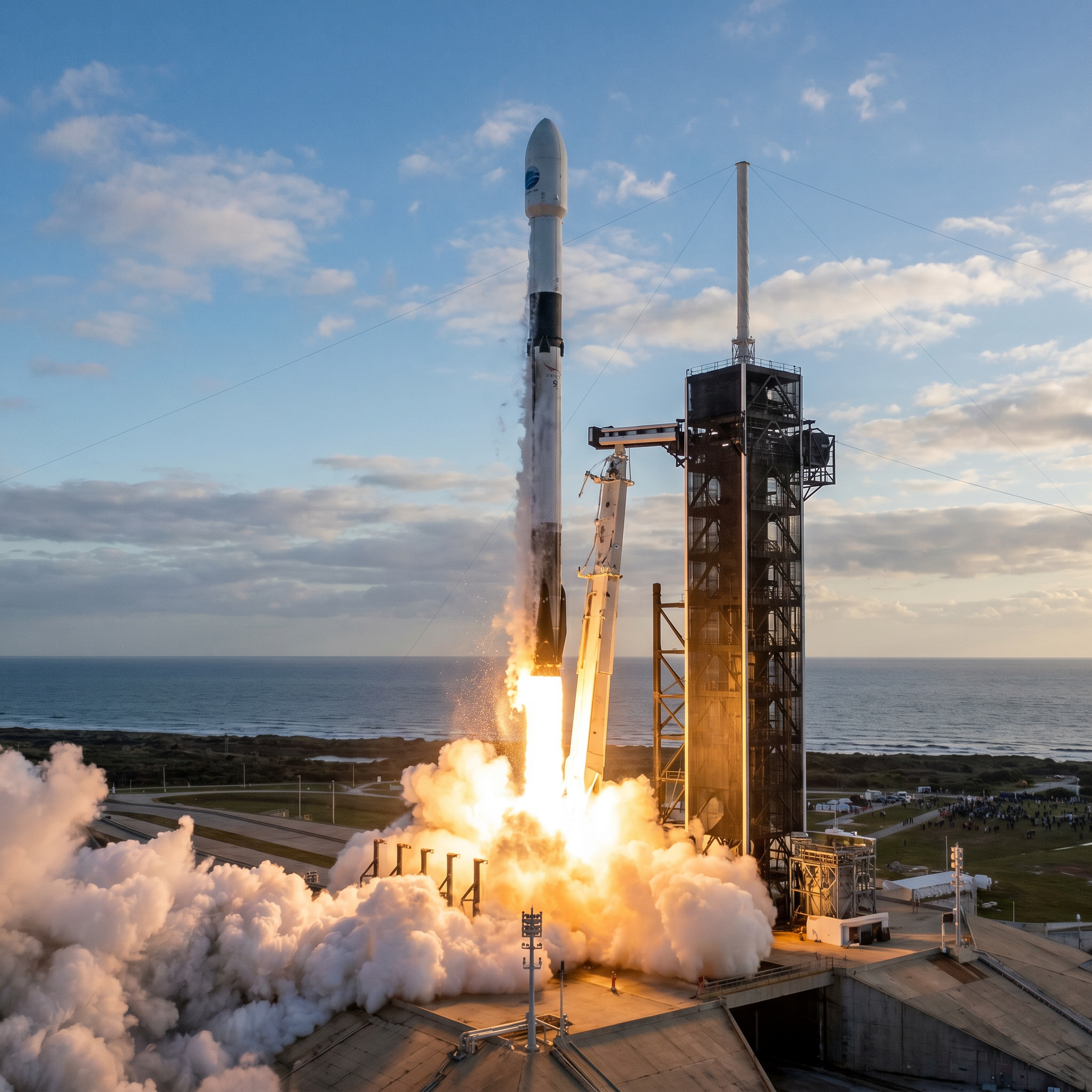
According to Morgan Stanley's estimates, Starship can deploy 50 Starlink V3 satellites per full-load mission, generating approximately $400 million in annualized incremental revenue, with an EBIT payback period of only about 19 weeks. Meanwhile, SpaceX's internal variable launch costs are expected to decline from $1,000 per kilogram in 2026 to $140 per kilogram by 2040, and it could achieve weekly launches by the end of 2027.
SpaceX's Starship is reshaping the business model of satellite internet: by dramatically improving satellite deployment efficiency and reducing per-unit launch costs, it is converting rocket payload capacity into faster revenue growth and higher returns on capital for Starlink.
Morgan Stanley's latest report indicates that a single fully loaded Starship launch could generate approximately $400 million in annualized revenue for Starlink, with a revenue payback period of about 13 weeks and an EBIT payback period of about 19 weeks, surpassing even the profitability efficiency of the emerging neocloud business.
 This calculation is based on each Starship carrying 50 Starlink V3 satellites, with each satellite generating approximately $8 million in annualized incremental revenue. Assuming a variable cost of about $100 million per launch by 2030—comprising $60 million in launch costs and $40 million in payload costs—the payback period for Starship investments would be quite substantial.
The profit potential of Starship has also prompted analysts to raise their earnings forecasts. Morgan Stanley maintained its "Overweight" rating on SpaceX with a price target of $300; since early July, it has raised the company's 2027 and 2028 earnings-per-share forecasts by 80% and 60%, respectively.
Starship boosts deployment efficiency, with its per-launch bandwidth equivalent to two to three months' worth of Falcon 9 launches.
Starship's core advantage lies in its ability to deliver a significantly larger increase in network capacity per launch. Each Starlink V3 satellite offers roughly ten times the downlink capacity of a V2 Mini, and Starship can carry 50 V3 satellites per flight, resulting in additional bandwidth equivalent to 20 to 25 times that of a single Falcon 9 launch—roughly equal to the total Starlink launches Falcon 9 typically conducts over two to three months.
This shift has already begun to affect SpaceX's launch strategy. In late August, the company halted Starlink missions from its two Falcon 9 launch pads in Florida, retaining only Vandenberg Space Force Base in California as the dedicated launch site for such operations.
Lower costs further enhance Starship's commercial viability. SpaceX expects its variable launch cost per kilogram to decline from roughly $1,000 in 2026 to $500 by 2030, and to fall even further to $140 by 2040.
Meanwhile, Starlink V4 satellites are expected to offer ten times the capacity of V3 and roughly a hundred times that of V2 Mini; theoretically, a single V4 satellite could handle the equivalent of about four fully loaded Falcon 9 launches. The company anticipates achieving weekly Starship launches by the end of 2027.
2027 marks a critical validation: reusability and full‑payload launches are the priorities.
The commercialization of Starship still hinges on whether its launch cadence and reusability can be reliably achieved.
The 16th flight is scheduled to launch from the Kennedy Space Center before the end of the year, using Ship 43 and Booster 23. It will once again attempt synchronized recovery of the spacecraft and booster and deploy an additional 26 Starlink V3 satellites. This will also mark the first time a Starship launches from NASA's Kennedy Space Center in Florida, where SpaceX is constructing three Starship launch towers.
As 2027 begins, investors should watch for four key developments: the first reuse of the Starship upper stage, the first reuse of a V3 booster, the first full‑payload deployment of 50 satellites, and an in‑orbit propellant transfer demonstration between spacecraft for deep space and lunar missions. These milestones will determine whether Starship can transition from experimental launches to high‑frequency, low‑cost, large‑scale operations.
Valuation: $300 price target, with enterprise AI contributing the most
Based on the closing price of $141.70 on November 17, SpaceX's stock is only about 5% above its IPO offering price of $135. Using Morgan Stanley's 2028 earnings-per-share forecast (excluding tax benefits), the company's P/E ratio is 17.5x; if we use the consensus analyst estimates compiled by Visible Alpha (excluding tax benefits), the P/E ratio is just 11.2x, below the S&P 500's 2028 forward P/E ratio of around 16x.
The $300 price target is derived using the sum-of-the-parts (SOTP) approach, with contributions of $8 from the space business, $111 from the connectivity business, $11 from X and Grok, and $170 from the enterprise AI business. The valuation forecast period extends to 2040, with a weighted average cost of capital (WACC) of 11.3%.
Notably, the company's AI business accounts for the bulk of the target price, while Starlink connectivity is the second-largest value driver. This implies that, although improving satellite deployment efficiency and Starlink's profitability are crucial, SpaceX's overall valuation remains heavily contingent on the commercialization progress of its enterprise AI segment.