Source: Wall Street News
Buffett stated that Berkshire's investment in five Japanese trading companies (Itochu, Marubeni, Mitsubishi, Mitsui, Sumitomo) is continuously increasing, with plans to Hold these shares long-term and a commitment to support their Board of Directors. Buffett explicitly noted that Berkshire will always invest the majority of its funds in Stocks, primarily in USA Stocks. He believes that businesses and individuals with the necessary skills can usually find ways to cope with currency instability, whereas fixed income Bonds cannot withstand uncontrolled currency.
It is that time of year again for the annual Berkshire shareholder letter, and Warren Buffett has once again delivered a rich report to investors. Although there are no earth-shattering headlines, the information revealed in the letter is still worth savoring.
 Buffett's letter conveys a cautiously optimistic sentiment. Berkshire achieved good results in 2024, but Buffett did not become complacent; he clearly recognizes the challenges and uncertainties ahead. He continues to adhere to the philosophy of value investing, emphasizing the importance of long-term holding and cautious Operation. At the same time, he is full of confidence in the USA economy and the capitalist system, believing that Berkshire's success is inseparable from the 'American Miracle.'
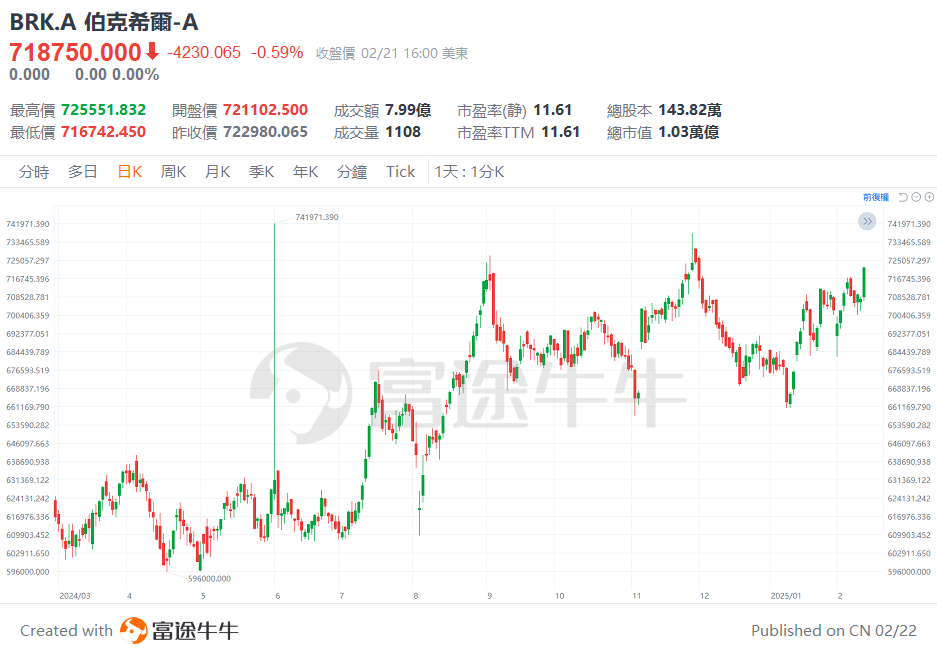
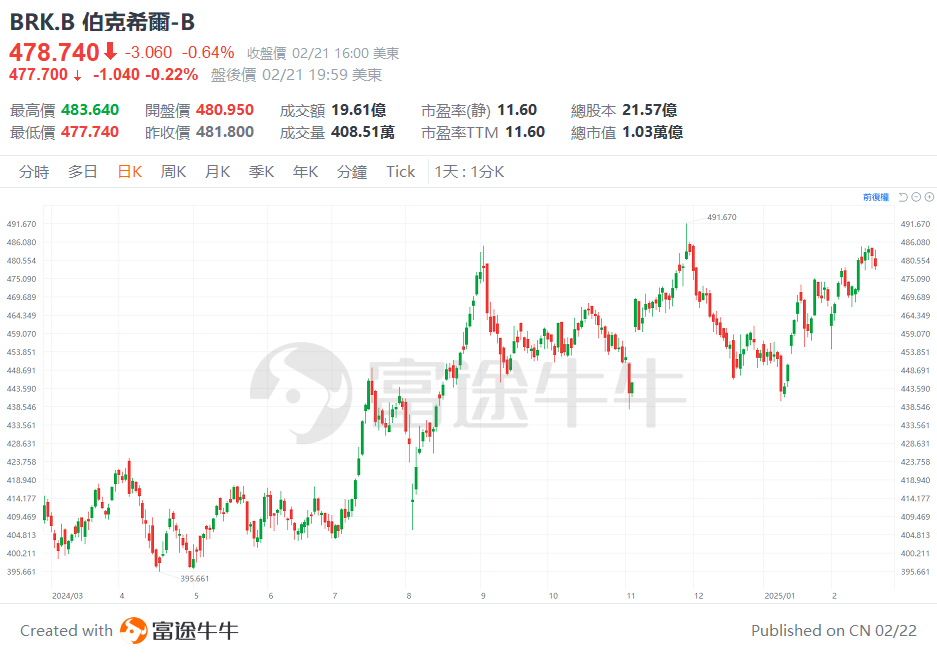
This letter does not contain much sensational content, but for investors who have long been concerned with Berkshire, it is still a 'Bible of Investment' worth serious study. Key points summarized by Wall Street observations are as follows:
1. Performance exceeded expectations, but it was not a smooth journey.
In 2024, Berkshire's operating profit reached $47.437 billion, up from $37.35 billion in 2023. Buffett admitted that this performance exceeded his expectations.
The Insurance business is the main engine of growth, especially GEICO, which has significantly improved efficiency after major reforms.
Investment income also saw a significant increase, thanks to the rise in government bond yields and Berkshire's shareholding in short-term highly liquid securities.
However, not all businesses performed brilliantly, as 53% of the 189 operating companies under Berkshire reported a decline in profits. While profits in Railroads and utilities improved, there is still room for enhancement.
2. Huge taxes showcase the 'American Miracle'.
Buffett proudly announced that Berkshire paid $26.8 billion in corporate income taxes to the U.S. Treasury last year, accounting for about 5% of the total corporate income taxes in the USA.
He emphasized that Berkshire has paid almost no dividends over the past 60 years, with shareholders consistently supporting ongoing reinvestment, enabling the company to generate significant taxable income and contribute to the nation.
Buffett attributes Berkshire's success to the 'American Miracle' and believes that although the American capitalist system has flaws, it still creates miracles that other economic systems cannot compare to.
3. Investment portfolio: heavy positions in stocks, favoring the USA.
Berkshire's investment portfolio is divided into two parts: holding companies and tradable stocks.
The holding company's value amounts to hundreds of billions of dollars, including some 'rare pearls', but also some underperforming 'laggards'.
In terms of tradable Stocks, Berkshire holds a small number of shares in about a dozen large profitable companies, such as Apple, American Express, and others.
Buffett has made it clear that Berkshire will always invest the majority of its funds in Stocks, primarily USA Stocks. He believes that companies and individuals with the necessary skills can usually find ways to cope with currency instability, while fixed income Bonds cannot withstand uncontrolled currency.
4. Insurance Business: Core Pillar, Cautious Operation.
Property and Casualty (P/C) Insurance remains Berkshire's core business.
Buffett explained in detail the P/C insurance 'collect first, pay losses later' business model, emphasizing the importance of cautious underwriting.
He pointed out that climate change could lead to increased insurance losses, but Berkshire has the capacity to withstand extreme losses and does not rely on reinsurance companies.
Under the leadership of Ajit Jain, Berkshire's insurance business has become a global leader.
5. Japan Investment: A Small but Important Exception
Berkshire's investment in five Japanese trading companies (Itochu, Marubeni, Mitsubishi, Mitsui, Sumitomo) continues to increase.
Buffett and Greg Abel both expressed appreciation for these companies' capital allocation, management, and attitude toward investors.
Berkshire plans to hold these shares long-term and has committed to supporting their Board of Directors.
By borrowing in yen, Berkshire achieved a relatively neutral currency position.
6. Annual Shareholders Meeting: Minor Adjustments in Format, Content Remains the Same
This year's shareholders meeting will be held on May 3 in Omaha, with a slight change in the schedule.
The meeting will start at 8 a.m., and Buffett, Greg, and Ajit will jointly answer questions.
This year, instead of screening movies, a new book titled 'Berkshire Hathaway: 60 Years' will be released.
The following is the full translation by AI.
Letter to Shareholders 2024
Performance from Last Year
In 2024, Berkshire's performance was better than I expected, despite 53% of our 189 operating businesses reporting a decline in profits. We benefited from a predictable significant increase in investment income, as yields on Treasury bills have risen, and we greatly increased our holdings of these highly liquid short-term securities.
Our insurance business also realized a substantial increase in profits, with GEICO performing exceptionally well. Over the past five years, Todd Combs has undertaken significant reforms at GEICO, improving efficiency and updating underwriting practices. GEICO is a long-term held gem that requires major renovations, and Todd has been diligently working to accomplish this. Although it is not yet complete, the improvements in 2024 are remarkable.
Overall, pricing in the property and casualty (P/C) insurance sector strengthened in 2024, reflecting a significant increase in losses caused by severe storms. Climate change may have arrived. However, no 'catastrophic' events occurred in 2024. One day, a truly astonishing insurance loss will occur—and it cannot be guaranteed that it will only happen once a year.
The P/C business is crucial to Berkshire, so further discussion will be included later in the letter.
Berkshire's Railroads and Utilities operations – the two significant businesses outside our Insurance division – have seen overall profit improvements. However, there is still much work to be done in both businesses.
By the end of the year, we increased our stake in Utilities from about 92% to 100%, at a cost of approximately 3.9 billion USD, of which 2.9 billion USD was paid in Cash and the remainder with Berkshire 'B' shares.
In 2024, we achieved an operating profit of 47.437 billion USD. We have consistently – perhaps to the annoyance of some readers – emphasized this indicator instead of the profit reported according to GAAP requirements on page K-68.
Our Indicators exclude capital gains or losses from Stocks and Bonds we hold, whether realized or unrealized. In the long term, we believe that earnings are likely to prevail – otherwise, why would we purchase these securities? – although the numbers can fluctuate significantly each year and can be difficult to predict. The time horizon for such commitments is almost always far beyond one year. In many cases, our considerations span decades. These long-term investments sometimes yield substantial returns.
The following are the profit details for 2023-2024, in our opinion. All calculations are made after depreciation, amortization, and income taxes. EBITDA is Wall Street's darling, but we do not agree.
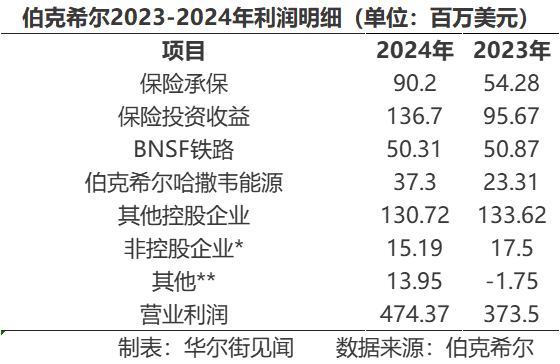
Including certain businesses in which Berkshire holds between 20% and 50%, such as The Kraft Heinz, Occidental Petroleum, and Berkadia.
** Including Forex gains of about 1.1 billion dollars in 2024 and about 0.211 billion dollars in 2023, which arise from our use of non-dollar-denominated debts.
Unbelievable! A significant record in the USA has been broken.
Sixty years ago, the current management team took over Berkshire. This move was a mistake - my mistake - that plagued us for twenty years. Charlie, I must emphasize that he immediately saw my obvious error: although the price I paid for Berkshire seemed cheap, its Business - a large Northern textile company - was doomed to decline.
The US Treasury had received an unspoken warning about Berkshire's fate in advance. In 1965, the company did not pay a dime in income tax, a situation that had been embarrassing for the company for ten years. This economic behavior might be understandable for those dazzling start-ups, but if it happened to a respected American industrial giant, it would be a flashing yellow light. Berkshire was destined to be tossed into the garbage dump of history.
Fast forward sixty years, imagine the surprise of the Treasury Department when the same company - still operating under the name Berkshire Hathaway - paid more corporate income tax than the US government received from any company - even from the US Technology giants with a market cap of trillions.
Specifically, Berkshire paid a total of $26.8 billion to the IRS last year in four payments. This accounts for about 5% of the total amount paid by all US companies. (Additionally, we paid substantial income taxes to foreign governments and 44 states.)
Note a key factor that enabled us to make this record payment: from 1965 to 2024, Berkshire's shareholders received cash dividends only once.
On January 3, 1967, we made the only payment of $101,755, or 10 cents per share of Class A shares. (I can't recall why I suggested the Board of Directors take this action. It now seems like a nightmare.)
For sixty years, Berkshire's shareholders have supported continuous reinvestment, allowing the company to build substantial taxable income. In the first decade, cash income taxes paid to the US Treasury were negligible, but now the total has exceeded $101 billion... and it continues to grow.
Large numbers are difficult to visualize. Let me rephrase the $26.8 billion we paid last year.
If Berkshire sends a check of 1 million dollars to the Treasury every 20 minutes for the entire year of 2024—imagine 366 days of day and night, since 2024 is a leap year— we would still owe the federal government a substantial amount of money by the end of the year. In fact, it wouldn't be until January that the Treasury would inform us that we could take a brief rest, get some sleep, and prepare for the tax payments of 2025.
Where is your money?
Berkshire's Private Equity strategy is two-pronged. On one hand, we control many businesses, holding at least 80% of the shares in these investments. Usually, we hold 100%. These 189 subsidiaries share similarities with publicly traded common stocks, but they are far from identical. This collection is worth hundreds of billions of dollars and includes some rare gems, many good but far from outstanding companies, and some disappointing laggards. None of these is a major burden, but there are indeed some that shouldn't have been purchased.
On the other hand, we hold small stakes in about a dozen large, highly profitable companies that are household names, such as Apple, American Express, Coca-Cola, and Moody's. Many of these companies generate very high returns on the net tangible capital required for operations. By the end of the year, the value of these partial equity holdings was 272 billion dollars. It is understandable that truly outstanding businesses are seldom sold in their entirety, but small portions of these gems can be bought on Wall Street from Monday to Friday, and occasionally they are sold at low stock prices.
We are fair in choosing equity instruments based on where we can best deploy your (and my family's) savings, investing in any form. Many times, nothing appears compelling; it is very rare that we find ourselves deeply immersed in opportunities. Greg has vividly demonstrated his ability to act in such times, just like Charlie.
For publicly traded stocks, it is easier to change direction when I make mistakes. It must be emphasized that Berkshire's current scale diminishes this valuable option. We cannot enter or exit at will. Sometimes it takes a year or more to build or divest an investment. Moreover, when we hold minority stakes, we cannot change management or control capital flows if we are dissatisfied with the decisions made.
For subsidiaries, we can decide these decisions, but our flexibility in disposing of them is much smaller. In fact, Berkshire almost never sells subsidiaries unless we believe we will face endless problems. One compensation is that some business owners seek Berkshire because of our steadfast actions. Occasionally, this is a clear plus for us.
Despite some commentators currently suggesting that Berkshire has a huge cash position, most of your funds are still invested in stocks. This preference will not change.
Despite the value of the traded Stocks we hold decreasing from 354 billion dollars last year to 272 billion dollars, the value of the non-listed Private Equity holdings we possess has increased and still far exceeds the value of the traded portfolio.
Shareholders of Berkshire can rest assured that we will always invest the majority of your funds in Stocks—primarily in USA Stocks, although many will have significant international business. Berkshire will never prefer to Hold Cash / Money Market equivalents over owning good companies' equities, whether they are controlling or partially held.
The value of paper currency can evaporate due to fiscal folly. In some countries, this reckless behavior has become habituated, and in the brief history of our country, the USA has also come close to the edge.
However, businesses and individuals with the necessary skills will typically find ways to cope with currency instability, as long as their products or services are welcomed by the citizens of the nation. The same goes for personal skills. Due to a lack of athletic talent, a wonderful voice, medical or legal skills, or any other special talent, reliance on Stocks has been my lifeline. In fact, I rely on the success of USA businesses and will continue to do so.
In a way, the wise—better yet, imaginative—deployment of savings by citizens is a necessary condition for producing the goods and services society continually needs. This system is called capitalism. It has its downsides and abuses—now more serious in some respects than ever before—but it can also produce miracles unmatched by other economic systems.
The USA is an illustration. The progress our country has made in just 235 years of history is something even the most optimistic colonists at the time of the Constitution's passage in 1789 could not have imagined, as the energy of the nation was unleashed.
Of course, in the infant years of our country, we sometimes borrowed from abroad to supplement our own savings. But at the same time, we need many Americans to continually save, and then those savers or other Americans need to wisely deploy this available capital. If the USA consumes everything it produces, then this country will stand still.
The process in the USA has not always been so beautiful—our country has always had its share of rogues and speculators who try to exploit the savings of those who trust them wrongly. Even with this misconduct—still existing today—alongside many capital deployments that ultimately fail due to fierce competition or disruptive innovation, the savings of Americans have produced quantities and qualities of output that surpassed any colonist's dreams.
Starting from a base of only 4 million population - although a civil war occurred early on, with Americans killing each other - the USA changed the world in the blink of an eye.
To a very small extent, Berkshire's shareholders participated in the American miracle by choosing to reinvest instead of consuming, by giving up dividends. Initially, this reinvestment was trivial and almost insignificant, but over time, it grew rapidly, reflecting a combination of a lasting savings culture and the magic of long-term compounding.
Berkshire's activities now affect every corner of our nation. And we are not done yet. There are many reasons for corporate deaths, but unlike humans, aging itself is not fatal. Today's Berkshire is much younger than it was in 1965.
However, as Charlie and I have always acknowledged, Berkshire could only achieve such success in the USA, and the USA would have been equally successful even without Berkshire.
So, thank you, Uncle Sam. One day, your Berkshire nephews and nieces will hope to pay you more than in 2024. Use it wisely. Take care of those who are disadvantaged in life without any fault of their own. They deserve better. Never forget, we need you to maintain stable currency, and that result requires your wisdom and vigilance.
Property and casualty insurance.
P/C insurance remains Berkshire's core business. The financial model of this industry is extremely rare in large companies.
Typically, companies incur costs for labor, materials, inventory, facilities, and equipment before or simultaneously with the sale of products or services. Thus, their CEOs can have a good understanding of their costs before selling the product. If the sales price is lower than the cost, managers will quickly realize they have a problem. Blood loss is hard to ignore.
However, when underwriting P/C Insurance, payment is received in advance, while the understanding of product costs may come many years later—sometimes the truth may be revealed after a delay of 30 years or even longer. (We are still making significant payments for asbestos exposures that occurred more than 50 years ago.)
One advantage of this business model is that it allows P/C insurance companies to receive cash in advance, before most expenses are incurred, but it also brings the risk that the company may incur losses—sometimes significant losses—before the CEO and Board of Directors realize what has happened.
Certain lines of insurance minimize this mismatch, such as crop insurance or hail damage, where loss reports are quick, and assessment and payment follow swiftly. However, other lines of business can leave company management and shareholders in a state of bliss even when the company goes bankrupt. Think of medical malpractice or product liability insurance. In 'long-tail' lines of business, P/C insurance companies may report substantial but false profits to their owners and regulators for many years—even decades. If the CEO is an optimist or a fraud, this type of accounting treatment is particularly dangerous. These possibilities are not fanciful; history reveals many such figures.
Over the past few decades, this 'collect money first, pay losses later' model has allowed Berkshire to invest significant amounts of money ('float') while generally achieving what we consider to be small underwriting profits. We make estimates for 'unexpected' events, and so far, those estimates have been sufficient.
We are not discouraged by significant increases in losses incurred from our activities. (As I write this, think of wildfires.) It is our job to price to absorb these losses and to calmly endure the strikes when the unexpected occurs. It is also our job to counter 'runaway' verdicts, baseless lawsuits, and blatant fraud.
Under Ajit's leadership, our insurance business has evolved from an obscure Omaha company to a global leader, renowned for its preference for risk and Gibraltar-like financial strength. Moreover, Greg, our Directors, and I have considerable investments in Berkshire relative to any compensation we receive. We do not use Options or unilateral forms of compensation; if you lose, we lose too. This practice encourages prudence but does not guarantee foresight.
P/C insurance growth relies on the increase of economic risk. Without risk—there is no demand for insurance.
Think about just 135 years ago when there were no cars, trucks, or airplanes in the world. Today, there are 0.3 billion vehicles in the USA alone, a vast fleet causing enormous losses every day. Property losses from hurricanes, tornadoes, and wildfires are significant, ever-increasing, and the patterns and ultimate costs are becoming more unpredictable.
Writing a ten-year policy to cover these risks is foolish—one might even say reckless—but we believe that a one-year risk assumption is usually manageable. If we change our minds, we will alter the contracts we offer. In my lifetime, auto insurance companies have generally abandoned one-year policies in favor of six-month policies. This change reduces float, but allows for more prudent underwriting.
No private insurance company is willing to assume the level of risk that Berkshire is able to provide. Sometimes, this advantage is significant. But we also need to scale back when the price is insufficient. We must never underwrite inadequately priced policies just to stay in the game. This policy is corporate suicide.
Correctly pricing P/C insurance is part art, part science, and absolutely not a business for optimists. Mike Goldberg, an executive at Berkshire who recruited Ajit, says it best: "We want our underwriters to feel nervous every day when they come to work, but not paralyzed."
Overall, we like the P/C insurance business. Berkshire can endure extreme losses financially and psychologically without batting an eye. We also do not rely on reinsurance companies, which provides us with a significant and lasting cost advantage. Finally, we have outstanding managers (no optimists) and are particularly adept at investing the large sums of money generated by P/C insurance.
Over the past twenty years, our insurance business has achieved $32 billion in after-tax underwriting profit, about 3.3 cents of after-tax profit for every dollar of insurance sold. Meanwhile, our float has grown from $46 billion to $171 billion. Float may grow slightly over time, and with prudent underwriting (and some luck), there is a reasonable chance of remaining cost-free.
Berkshire increases its investment in Japan.
A small but important exception to our USA-centric investment strategy is our increasing investment in Japan.
Berkshire has been buying shares in five Japanese companies for nearly six years, which operate successfully in their own ways and are quite similar to Berkshire itself. These five companies (in alphabetical order) are: Itochu, Marubeni, Mitsubishi, Mitsui, and Sumitomo. Each of these large enterprises has interests in numerous businesses, many of which are domestic in Japan, but many also operate worldwide.
In July 2019, Berkshire first purchased stocks from these five companies. We simply looked at their financial records and were surprised by the Low Stock Price of their stocks. Over time, our admiration for these companies grew. Greg met with them multiple times, and I regularly followed their progress. We both appreciated their capital allocation, management, and attitude towards investors.
Each of these five companies will increase dividends at the appropriate time, repurchase their own stocks when reasonable, and their executives are far less aggressive in compensation plans compared to their American counterparts.
Our shareholding in these five companies is long-term, and we are committed to supporting their Board of Directors. From the beginning, we agreed to keep Berkshire's shareholding in each company below 10%. However, as we approached this limit, these five companies agreed to moderately relax the cap. Over time, you may see an increase in Berkshire's shareholding in these five companies.
By the end of the year, Berkshire's total cost (in USD) was 13.8 billion USD, and the total Market Cap of the stocks we held amounted to 23.5 billion USD.
Meanwhile, Berkshire has been increasing its borrowings denominated in yen - but not according to any formula. All borrowings have fixed interest rates, with no 'floating rates.' Greg and I have no opinion on the future trends of Forex Exchange Rates, so we seek a roughly currency-neutral position. However, according to GAAP rules, we are required to periodically account for any gains or losses from the yen borrowed in our earnings, and by the end of the year, due to the strong dollar, we had recorded $2.3 billion in after-tax gains, of which $0.85 billion occurred in 2024.
I expect that Greg and his successor will hold this Japanese position for decades, and Berkshire will find other ways to engage in productive cooperation with these five companies in the future.
The mathematical calculation of our current yen balance strategy is also quite satisfactory. As I write this article, the expected annual dividend income from Japanese investments is approximately $0.812 billion, while the interest cost of our yen-denominated debt will be around $0.135 billion.
Annual Omaha Conference.
I hope you can join us for our gathering in Omaha on May 3rd. This year we have followed a slightly adjusted agenda, but the basics remain the same. Our goal is to answer many of your questions, allow you to connect with friends, and ensure you leave with a good impression of Omaha. This city is looking forward to your visit.
We will have the same group of volunteers to provide you with a variety of Berkshire products that will lighten your wallet and improve your mood. As usual, we will be open from 12 PM to 5 PM on Friday, offering lovely Squishmallows, Fruit of the Loom underwear, Brooks running shoes, and many other appealing commodities.
Similarly, we will only sell one book. Last year, we sold 'Poor Charlie’s Almanack' and it quickly sold out—5,000 copies were snapped up before the market closed on Saturday.
This year, we will introduce 'Berkshire Hathaway 60 Years.' In 2015, I asked Carrie Sova (who has many responsibilities at Berkshire, including managing most of the annual meeting activities) to try and write a light history of Berkshire. I gave her the freedom to use her imagination, and she quickly created a book that amazed me—its creativity, content, and design are all impressive.
After that, Carrie left Berkshire to start a family, and now she has three children. However, every summer, the Berkshire office team gathers to watch the Omaha Storm Chasers play a baseball game against a Triple-A team. I invite some of the long-time employees to join, and Carrie usually brings her family too. At this year's event, I shamelessly asked her if she would be willing to create a 60th-anniversary edition that includes photos, quotes, and some rarely shared stories of Charlie.
Despite having to take care of three young children, Carrie readily agreed with a "sure." Therefore, we will have 5,000 new books available for sale on Friday afternoon and Saturday from 7 AM to 4 PM.
Carrie refuses to accept any payment for her significant work on this 'Charlie' special. I suggested that she and I jointly sign 20 copies to give away to any shareholder who donates $5,000 to the Stephen Center in South Omaha. The Stephen Center has been helping homeless adults and children for many years. The Kizer family, beginning with my long-time friend and Carrie’s grandfather, Bill Kizer Sr., has supported this worthy institution over the years. Any funds raised from selling these 20 signed books will be matched by me.
Becky Quick will be responsible for covering our slightly adjusted gathering this year. Becky is very familiar with Berkshire and always arranges interesting interviews with managers, investors, shareholders, and occasional celebrities. She and her CNBC team not only broadcast our meeting worldwide but also archive a lot of related material about Berkshire. Thanks to our Director, Steve Burke, for suggesting the idea of archiving.
This year there will be no Theater Chain showing; instead, the meeting will start at 8 AM. There will be some opening remarks, followed by a quick transition to a Q&A session with Becky alternating questions with the audience.
Greg and Ajit will join me in answering questions, and we will take a half-hour break at 10:30 AM. After resuming at 11:00, only Greg will be on stage with me. This year, we will end the meeting at 1:00 PM, but the exhibition hall will remain open for shopping until 4:00 PM.
You can find details about the weekend activities on page 16. Please note that the Brooks running event on Sunday morning is always very popular. (I will be sleeping that day.)
My smart and beautiful sister Bertie (whom I mentioned in last year's letter) will be attending the meeting, and her two daughters will also come, both of whom are also very beautiful. Everyone agrees that this charming gene flows solely in the women of the family. (Sigh.)
Bertie is now 91 years old, and we talk every Sunday using an old-fashioned telephone. We discuss the joys of old age, as well as some exciting Topics, such as the pros and cons of our canes. In my case, the cane is only used to prevent me from falling.
But Bertie is always one step ahead of me; she claims that the cane has an additional benefit: when a woman uses a cane, men no longer 'pursue' her. Bertie explains that male ego is quite strong, and older women with canes are clearly not appropriate targets for pursuit. Currently, I have no data to refute her statement.
However, I have my doubts. At the meeting, I won't be able to see much from the stage, so I hope everyone can keep an eye on Bertie. If her cane really works, please let me know. My guess is that she will still be surrounded by men. For people of a certain age, this scene might remind them of Scarlett O'Hara and her suitors in 'Gone with the Wind.'
The Directors of Berkshire and I are very much looking forward to your arrival in Omaha. I predict you will have a great time and may even make some new friends.
February 22, 2025.
Warren E. Buffett.
the Chairman of the Board of Directors
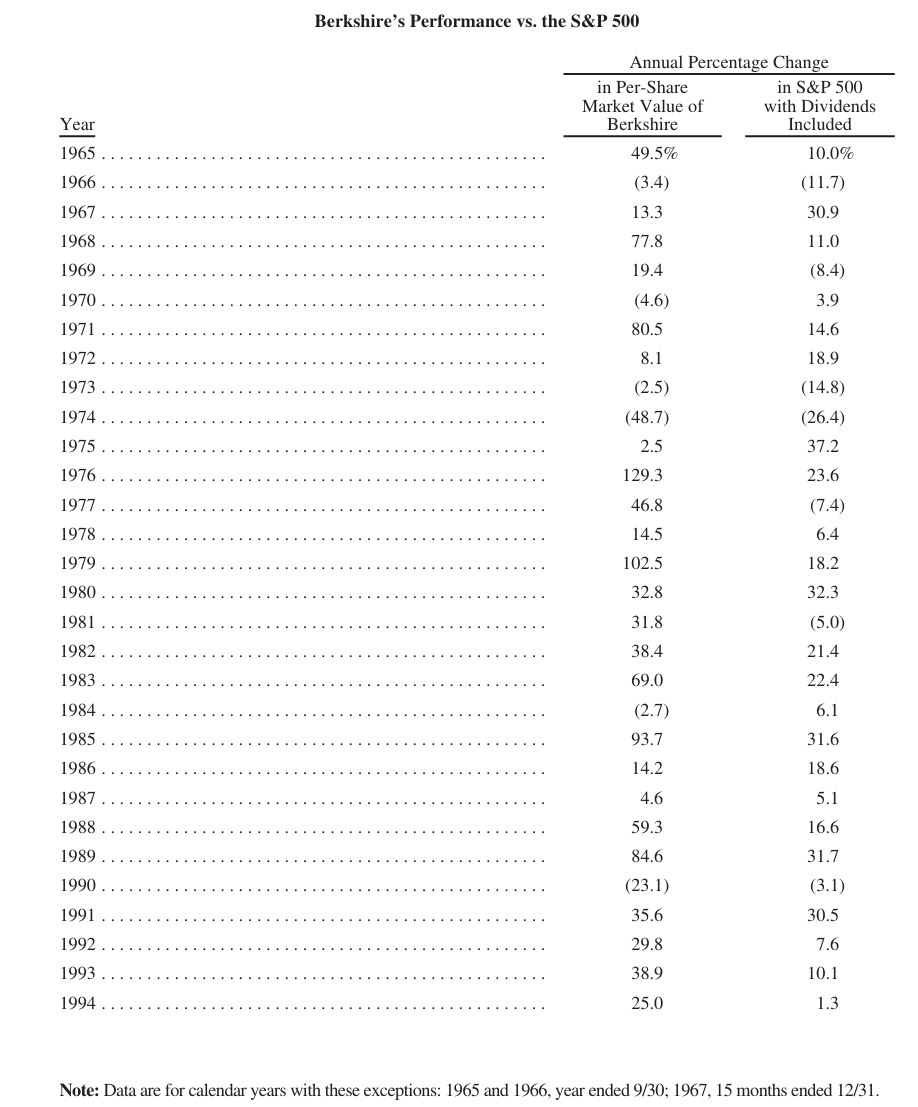
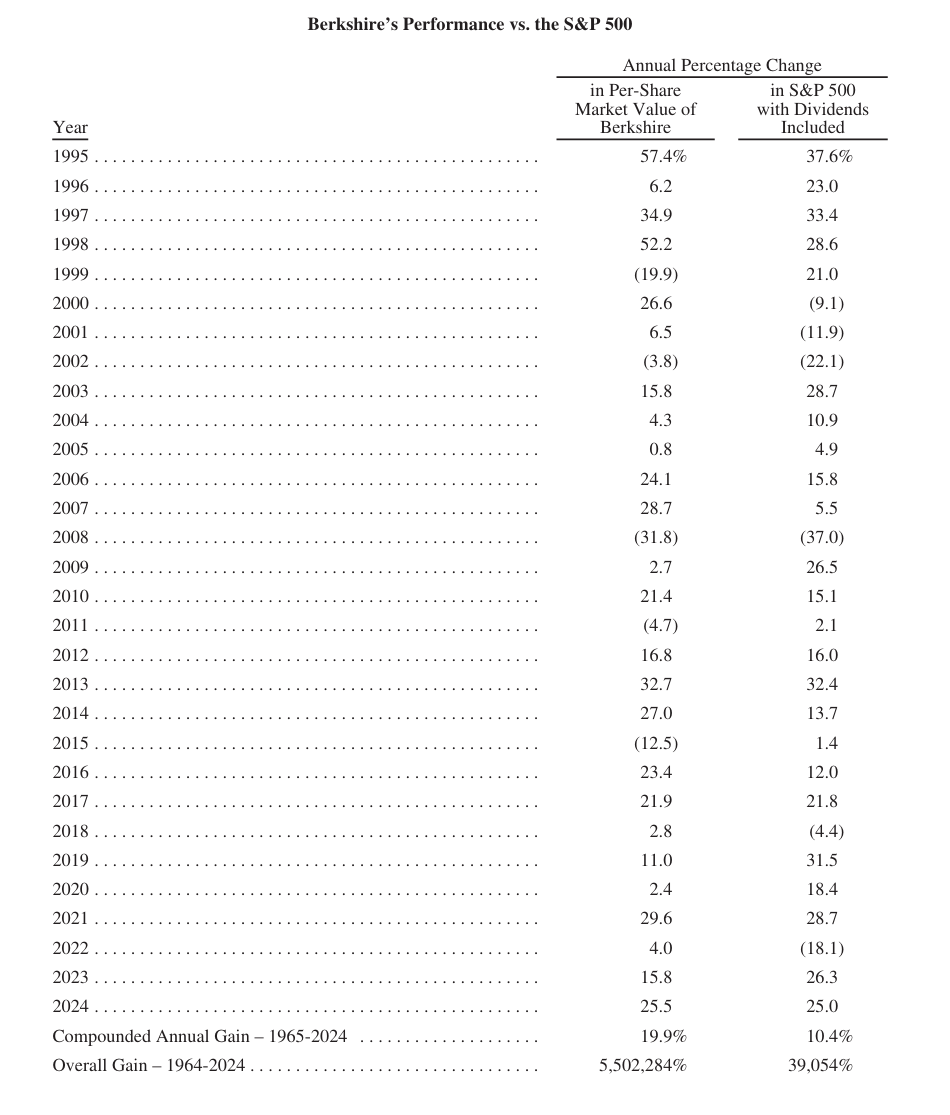
The following are the historical investment performance of Berkshire and the S&P 500 Index:
Want to quickly find the key points of the performance? Mooers can do this throughMarket > USA > Earnings > Earnings Express.Earnings Express helps you capture everything in one go!

Editor/Rocky