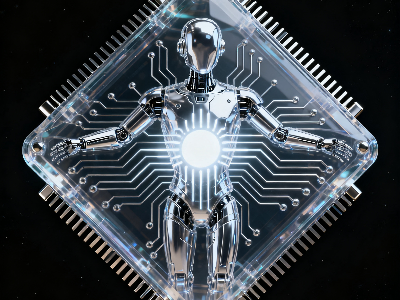
①Morgan Stanley forecasts that the semiconductor market for humanoid robots will reach US$305 billion by 2045, with demand growing by approximately 15% from 2025 to 2030, followed by an additional 40% increase thereafter;
②This forecast is based on the world’s shift toward “physical intelligence,” emphasizing the value created by the semiconductor industry in the field of humanoid robots.
Morgan Stanley anticipates that the semiconductor market focused on humanoid robot technology will experience significant growth over the next two decades, reaching a total potential market size of US$305 billion by 2045.
 This forecast comes from Morgan Stanley analyst Shawn Kim, who bases it on what the firm calls the world’s 'structural shift toward physical intelligence,' describing it as 'an important chapter in human history.'
The humanoid robotics chip market will expand at an accelerated pace.
In his latest research report titled 'Humanoid Robotics Technology: Seizing the Future,' Shawn Kim notes that embodied artificial intelligence capable of understanding and interacting with the physical world is accelerating due to declining costs of intelligence and computing.
The report highlights that by 2050, the global humanoid robotics market could reach USD 5 trillion, with cumulative deployments hitting 1 billion units. Over this multi-decade growth period, the semiconductor industry will encounter new growth opportunities.
“The pace of change is incredible, favoring those companies best able to adapt,” writes Shawn Kim, adding that humanoid robotics will bring structural changes and robust demand to the semiconductor industry.
The report estimates that as the Bill of Materials (BOM) cost per robot decreases from approximately USD 131,000 to USD 23,000 by 2045, the share of semiconductors in the BOM will rise significantly against the trend.
“We project that by 2045, the semiconductor market related to humanoid robotics will reach USD 305 billion,” the analyst writes, adding that the estimate includes 'key AI processors and sensors.'
Morgan Stanley forecasts that from 2025 to 2030, the semiconductor costs within the BOM for humanoid robots will grow by approximately 15%, and by 2045, they will increase by another 40% as computational demands continue to rise.
Who stands to benefit?
Morgan Stanley noted that physical AI chips differ from traditional AI processors as they must provide real-time support for 'perception, reasoning, and control' on edge devices.
To help investors better understand this emerging ecosystem, Morgan Stanley has introduced the 'Top 25 in Humanoid Technology' list, which highlights companies it considers leaders in enabling technologies.
The companies on the list include$NVIDIA (NVDA.US)$、$Advanced Micro Devices (AMD.US)$、$STMicroelectronics (STM.US)$、$Samsung Electronics Co., Ltd. (SSNLF.US)$、$Sony (SONY.US)$、$INFINEON TECHNOLOG (IFNNY.US)$and$Alibaba (BABA.US)$and others.
The bank emphasized that the value of humanoid robot semiconductors is concentrated in three main areas: 'AI brain technology,' 'AI vision,' and 'analog chips for sensing.'
Editor/melody