
Morgan Stanley forecasts that 2026 will be the pivotal turning point for the commercialization of autonomous driving, with services expected to launch in 33 U.S. cities, marking the onset of a market boom.
The report suggests that the future will be dominated by Waymo and Tesla, forming a duopoly focused on safety and cost, while warning that this trend will directly impact the ride-hailing businesses and valuations of Uber Technologies and Lyft Inc.
According to the latest research report released by Morgan Stanley, 2026 will be a pivotal "inflection point" for the autonomous driving industry.
 On December 7, Morgan Stanley noted that for investors, this signifies a harsh transition from conceptual hype to commercial implementation. Below are the core impacts of this transformation on the capital markets:
Explosive market growth: The mileage of autonomous driving in the United States is projected to increase 140-fold from 2025 to 2032, reaching 16 billion miles.
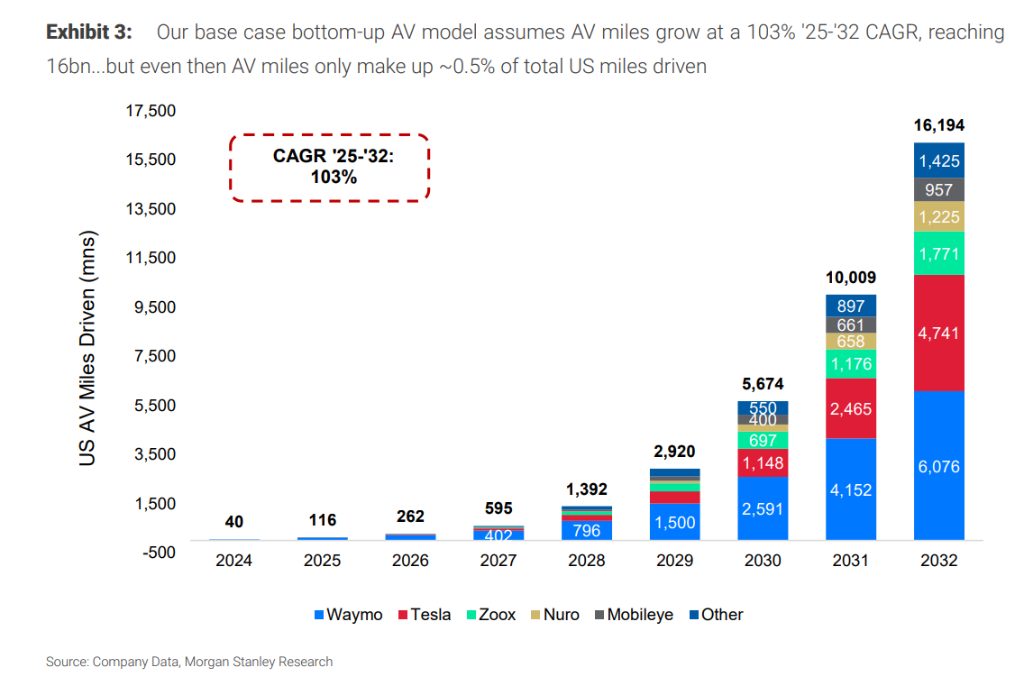
Establishment of a duopoly: Waymo and $Tesla (TSLA.US)$are projected to collectively account for approximately 70% of the U.S. autonomous driving mileage market share by 2032. This will be the ultimate showdown between 'cost' and 'safety'.
$Uber Technologies (UBER.US)$/$Lyft Inc (LYFT.US)$The darkest hour? As autonomous driving technology companies rise, traditional ride-hailing platforms face severe challenges to their competitive moats. Morgan Stanley predicts that Uber Technologies and Lyft Inc's market shares in the autonomous driving sector will significantly shrink, leading to a reduction in their valuation multiples by approximately 10%.
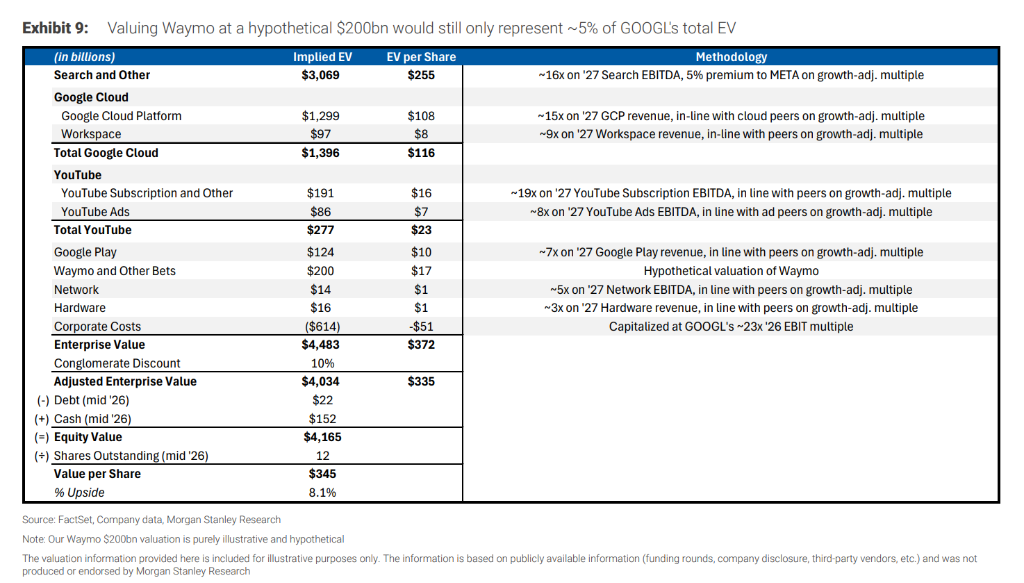
Valuation logic redefined: Even if Waymo’s valuation reaches USD 200 billion, it would only represent about 5% of $Alphabet-A (GOOGL.US)$the enterprise value, making it unlikely to significantly boost Alphabet's stock price in the short term; whereas $Tesla (TSLA.US)$Tesla's cost advantage will become its core competitive moat.
2026: The "singularity" moment for autonomous driving
The market is poised to bid farewell to a prolonged testing phase and enter an explosive growth period. Morgan Stanley forecasts that 33 U.S. cities will launch autonomous driving services in 2026 (17 have been announced, with nine highly likely to be introduced).
From a data modeling perspective, the growth curve is extremely steep:
In 2025, the total autonomous driving mileage in the U.S. is expected to be only 116 million miles.
Under the baseline scenario, the compound annual growth rate (CAGR) for 2025-2032 is projected to reach as high as 103%.
By 2032, autonomous driving mileage is expected to reach 16 billion miles.
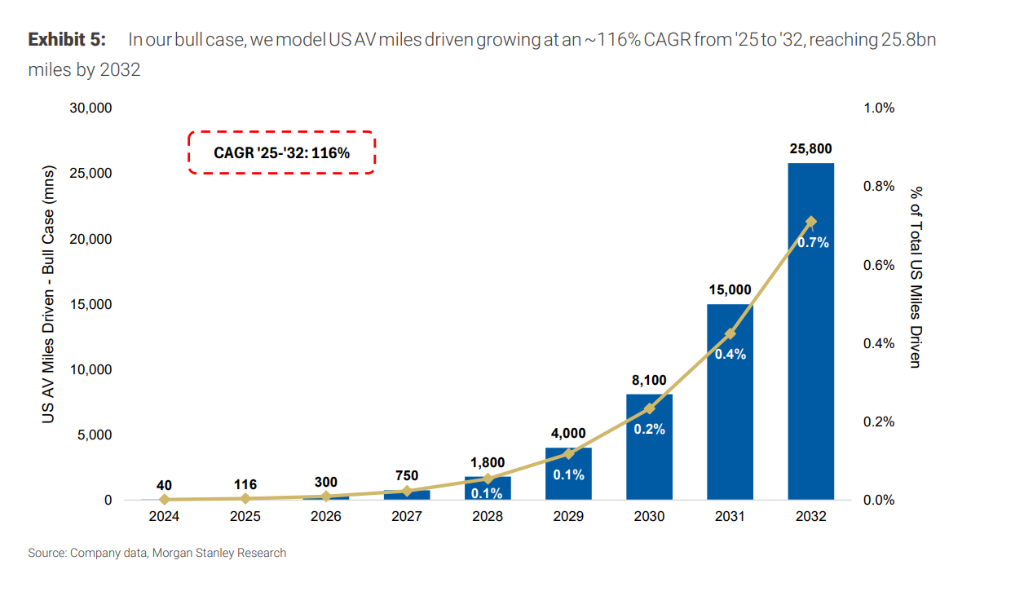
Despite this impressive figure, it will account for only 0.5% of the total vehicle miles traveled in the United States, yet it could represent 30% of the mileage in the U.S. ride-hailing industry. This suggests that autonomous driving will first disrupt the ride-hailing market rather than the personal car ownership market.
Waymo vs Tesla: The Trade-off Between Safety and Cost
The future autonomous driving market will be led by Waymo and $Tesla (TSLA.US)$The competitive logic of the two is fundamentally different: Waymo relies on safety to build barriers, while Tesla relies on cost to break through the bottom line.
1. Safety Data: Waymo Takes a Clear Lead
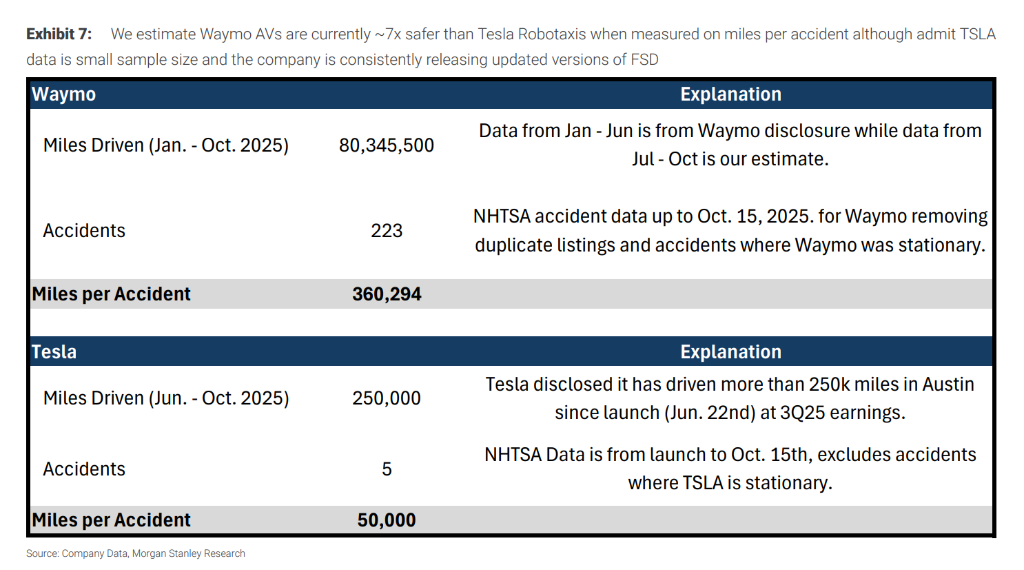
According to NHTSA estimates, Waymo’s current average accident-free mileage is approximately 360,000 miles.
Data from Tesla’s Robotaxi operations in Austin show an average accident-free mileage of approximately 50,000 miles.
Conclusion: Waymo’s safety performance is currently about seven times higher than Tesla’s. Tesla needs to significantly enhance the safety of its Full Self-Driving (FSD) system to close the gap.
2. Cost Data: Tesla Holds an Overwhelming Advantage
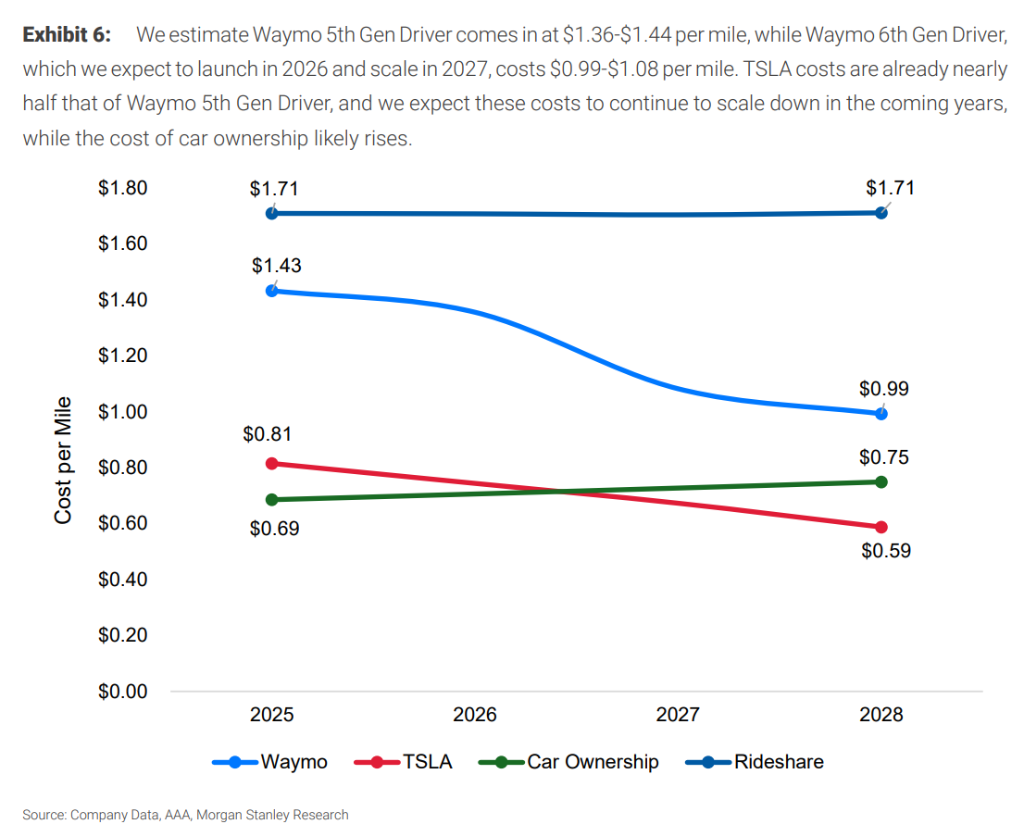
Waymo: The current cost per mile for the fifth-generation model is as high as USD 1.36-1.43. Even for the sixth-generation model, which is expected to be launched in 2026 and scaled up in 2027, the cost is projected to decrease only to USD 0.99-1.08.
Tesla: The estimated current cost per mile is only USD 0.81.
Comparison: Tesla’s current cost is already approximately 40%-43% lower than Waymo's existing models and is close to the cost of private car ownership in the U.S. (around USD 0.70 per mile).
Key Point: Whoever can address their weaknesses faster (Waymo reducing costs vs. Tesla improving safety) will emerge as the ultimate winner.
Uber Technologies and Lyft: Face 'cannibalization' risk, with valuation under pressure
For ride-hailing platforms,$Uber Technologies (UBER.US)$and$Lyft Inc (LYFT.US)$autonomous driving represents both an opportunity and a significant survival threat. The key variable lies in 'incremental growth'—whether autonomous driving generates new travel demand or merely takes away business from existing human drivers.
Warning of significant share erosion:
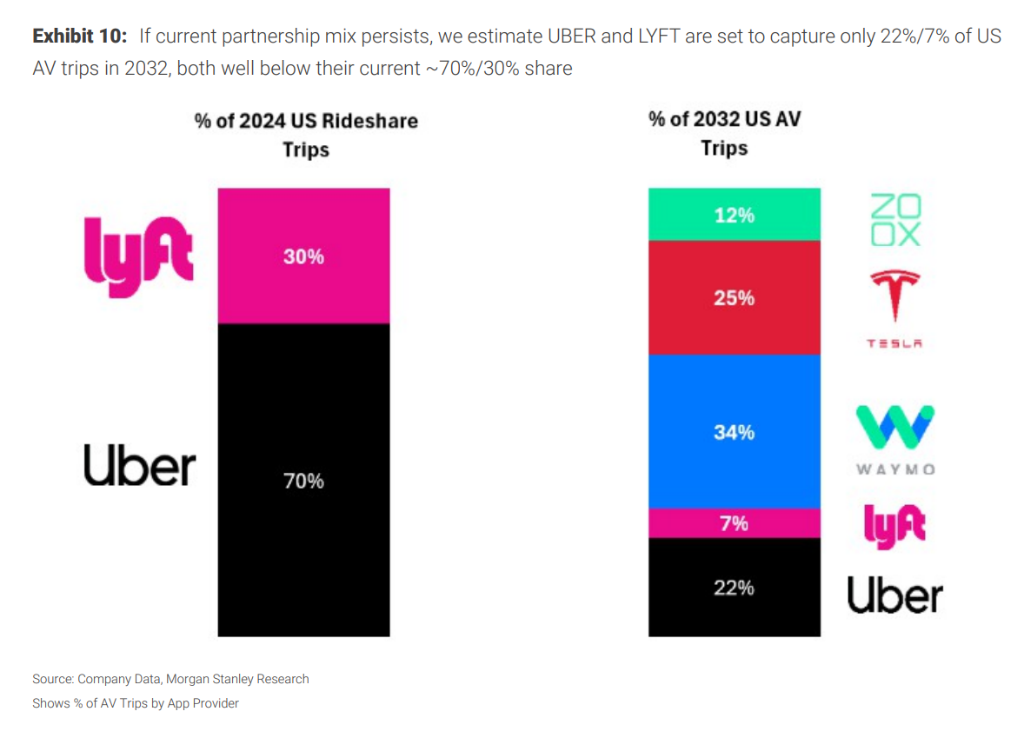
Currently, Uber Technologies and Lyft hold approximately 70% and 30% of the ride-hailing market share, respectively.
However, in Morgan Stanley's model, by 2032, Uber Technologies and Lyft are projected to capture only 22% and 7% of autonomous rides in the U.S., respectively (assuming companies like Waymo operate some rides through their own apps and Tesla does not partner with them).
Profitability impact:
If autonomous driving were to completely 'cannibalize' existing operations, it is expected to result in a 4% decline in Uber's EBITDA by 2030 and a 16% decline for Lyft.
A positive contribution to EBITDA (Uber +1%, Lyft +3%) would only be possible if autonomous driving generates entirely 'incremental' growth.
Valuation Downgrade:
Given the long-term uncertainty posed by autonomous driving, Morgan Stanley reduced the target valuation multiples for Uber and Lyft by approximately 10%. Uber’s target price was lowered from $115 to $110.
Google (Alphabet): Waymo is impressive, but only a drop in the ocean
Despite Waymo's leadership in technology and city deployment, and achieving a valuation exceeding USD 450 billion in its financing round at the end of 2024, the impact on the overall market value of its parent company$Alphabet-A (GOOGL.US)$remains limited.
Valuation Estimate: Even under an assumption that lifts Waymo’s valuation to $200 billion (equivalent to the combined value of Uber's global ride-hailing and food delivery businesses), this would still account for only about 5% of Alphabet’s current enterprise value.
Investment Implication: The success of Waymo reflects Google’s long-term technological reserves, but it is unlikely to become a core driver of Google’s stock price increase in the short term.
AI Agents: The Overlooked Accelerator
Morgan Stanley has identified a catalyst overlooked by the market: AI agent integration.
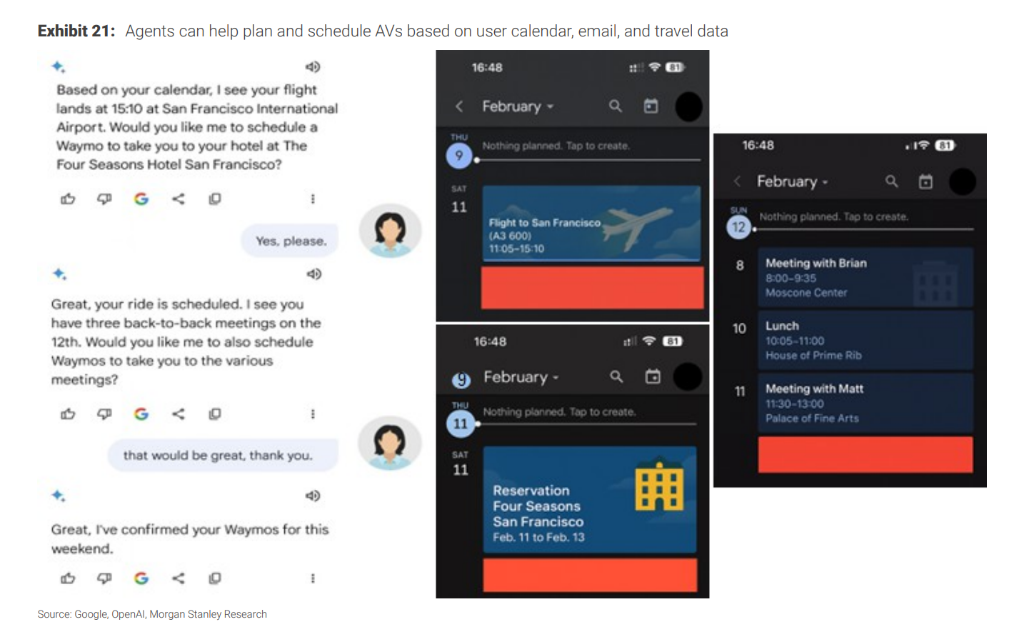
Future AI agents will be able to access users' calendars, emails, and travel plans to automatically and seamlessly schedule autonomous vehicles.
Google's advantage: with vertical integration capabilities across search, G-suite, Google Calendar, and Waymo, Google is best positioned to provide this kind of 'proactive' mobility service experience, thereby lowering user barriers and accelerating the adoption of autonomous driving. This will be another strong card for Google in the autonomous driving race, in addition to Waymo.
Editor/melody