
There is even greater growth potential after Christmas! Analysts at UBS Group are betting on a revaluation process for softline retail to begin in early 2026, naming these "winner stocks."
Global major banks$UBS Group (UBS.US)$recently released a 2026 investment outlook report on the US stock market's retail sector. Analysts from UBS Group stated that the US 'softlines retail' segment performed above expectations during the 2025 'Thanksgiving + Black Friday' holiday shopping season. Additionally, they anticipate further strengthening in consumer sentiment for the upcoming Christmas shopping season and into early 2026.
Based on monthly consumer surveys, macro dashboard data, and the overall valuation/fundamentals of the retail stocks covered by UBS, the firm has maintained its bullish stance on the softlines retail segment and is now 'more optimistic' compared to last month. A new round of 'valuation expansion' bull market trends is expected for softlines retail.
 The 'softlines retail' highlighted by UBS in the report represents a detailed classification of product categories within the retail industry. It typically refers to the segment focused on textile/flexible materials, leaning towards 'wearable/home soft goods,' including apparel, footwear, accessories, as well as home textiles such as bedding, towels, and linens (depending on the criteria used, some institutions may also include categories like underwear and certain personal care items under 'soft consumables').
In contrast, the opposite of 'softlines retail' is 'hardlines,' which generally refers to more durable goods/hardware categories such as appliances, electronics, furniture, tools, and sporting equipment.
2025 holiday season exceeds expectations, with strong growth anticipated in early 2026
Statistical data compiled by UBS shows that the Thanksgiving holiday shopping season was a 'solid finish': the latest media survey indicates a higher proportion of shoppers spending 'more' year-over-year during the Thanksgiving shopping period than those spending 'less.' UBS also reported that approximately 70% of respondents plan to participate in retailers' post-Christmas holiday promotions, and about 44% said they have already completed their holiday shopping (faster than the same period last year).
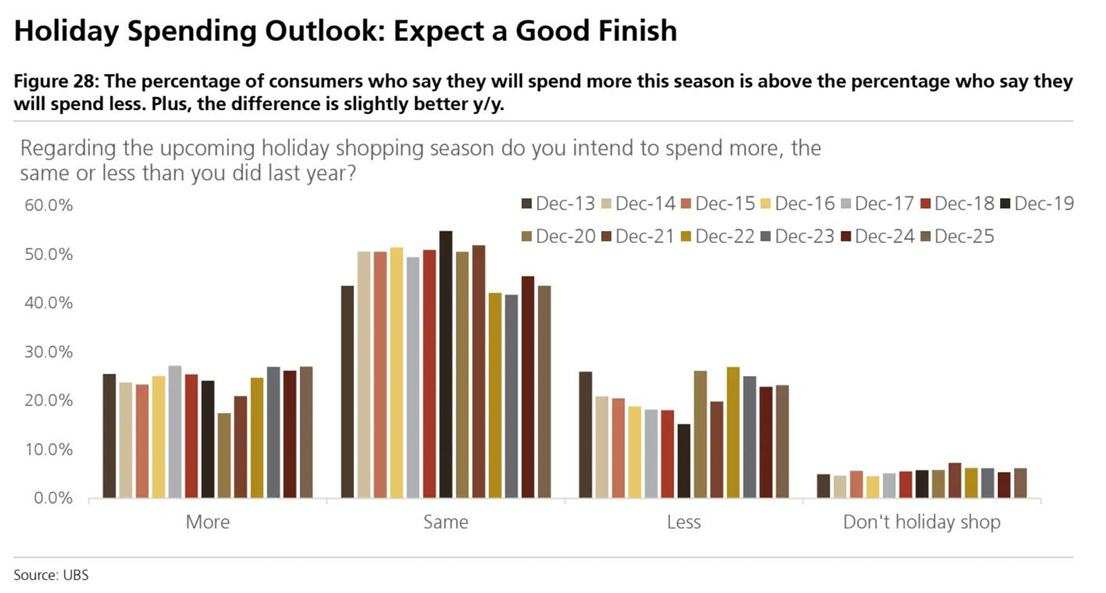
An exclusive survey conducted by UBS in December showed that up to 27.0% of respondents plan to spend more this holiday season compared to the previous year, while about 23.2% plan to spend less. This strongly validates the significant growth data from the holiday shopping season. UBS noted that the net difference between these expectations is approximately +380 basis points ('net bullish'), which is better than the average of the past 11 years (about +300 basis points) and reflects a month-on-month improvement.
UBS stated that After-Christmas sales will extend the 'tail' of the Christmas holiday consumption season. Statistical data shows that as many as 70.1% of consumers plan to participate in retailers' post-Christmas sales, which is +230 basis points higher than the 10-year average, providing substantial support for the conclusion of the softlines retail holiday shopping season.
Regarding the trends of this year’s Christmas holiday shopping season, UBS stated that 'shopping is being completed earlier, and demand realized faster.' As of the survey date around December 20, 44.2% of consumers indicated that their holiday shopping was complete, which UBS emphasized is +160 basis points higher than the same period last year. Highlighting this year's holiday shopping season, UBS noted that apparel in the softlines category remains the largest gift category, while jewelry has shown increasingly robust year-over-year growth momentum.
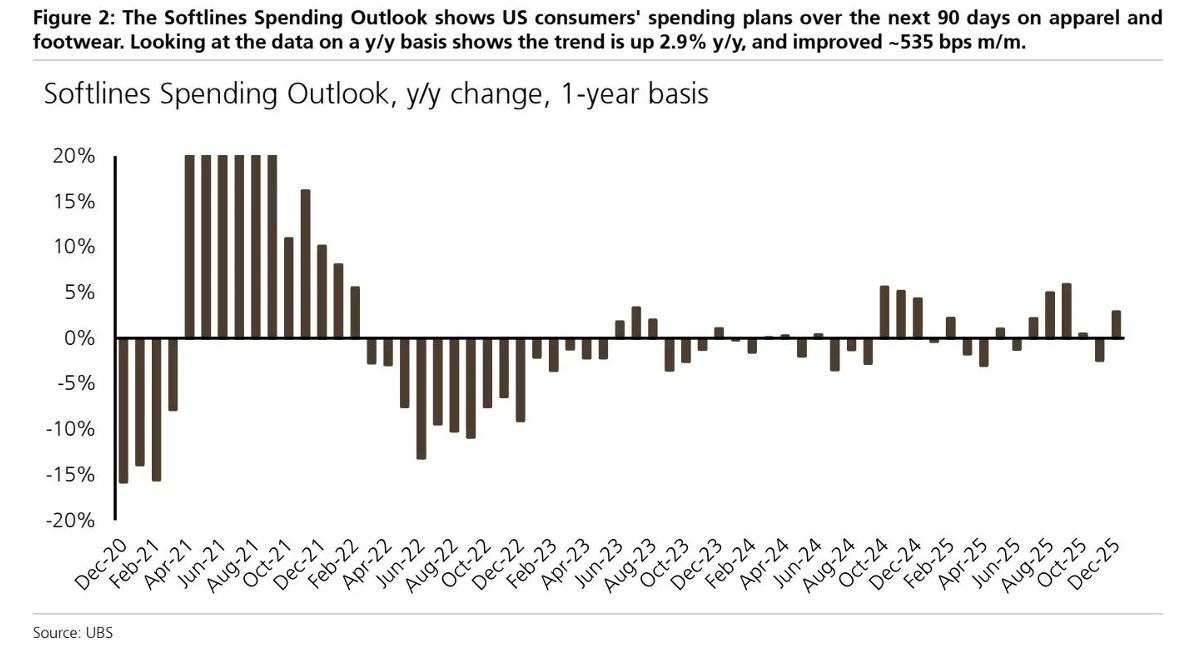
On the outlook for the start of North American shopping in 2026, UBS directly stated in the executive summary: 'We forecast a fairly good start to 2026.' First, UBS cited the intention to consume softlines over the next 90 days: it is projected to be positive year-over-year and significantly accelerate month-over-month. A UBS survey in December showed that the intention to consume softlines over the next 90 days increased significantly by 2.9% compared to the December 2024 survey, representing a 535-basis-point month-over-month acceleration. Moreover, compared to the stronger December 2023 survey, it rose by 7.4%. UBS emphasized that markets are highly focused on the 'rate of change' in the softlines consumption environment, and when the rate improves, the valuations (P/E) of softlines retail stocks typically expand significantly, leading to a new round of valuation expansion.
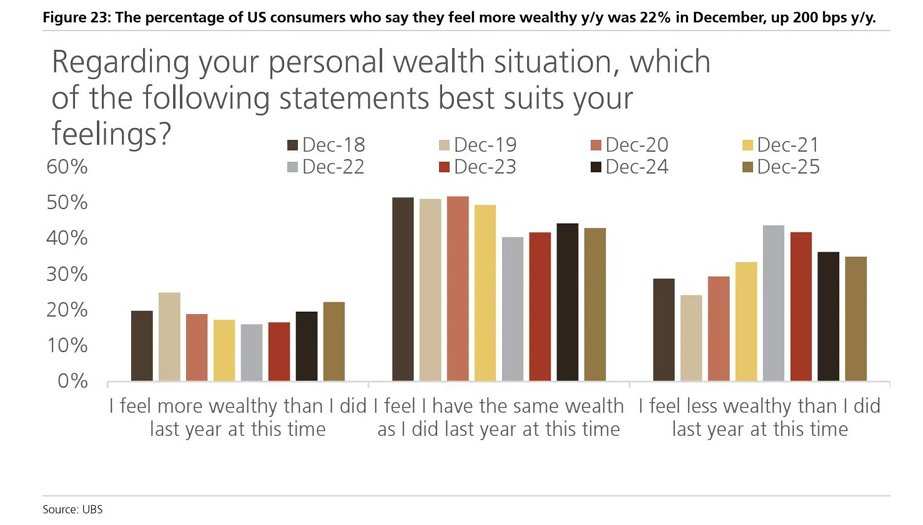
Additionally, UBS emphasized significant improvements in the balance sheets of US consumers and their 'financial security/sense of wealth.' A UBS survey in December showed that 42% of respondents reported having 'enough cash saved to meet future consumption needs,' an increase of +120 basis points month-over-month; 31.2% considered it 'insufficient,' down 110 basis points month-over-month; 38.1% self-assessed as 'financially secure,' up +50 basis points month-over-month; 38.5% self-rated as 'insecure,' down -50 basis points month-over-month. On a year-over-year basis, 22% said they 'feel richer,' the highest percentage since 2019.
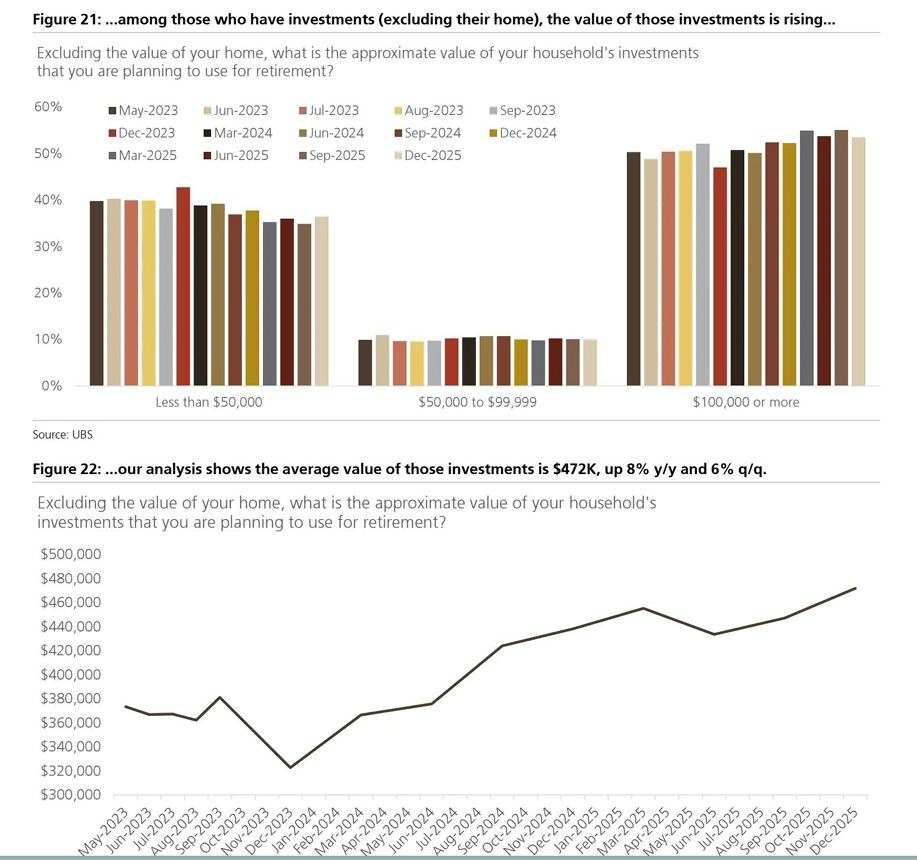
The UBS survey also showed that respondents estimated the average value of their 'financial assets excluding housing' to be approximately USD 472,000, implying a year-on-year increase (+8%) and a quarter-on-quarter (q/q) rise of +6%. Based on this, UBS concluded that the market might be underestimating the 'wealth effect' of the US stock market on the optimistic outlook for American consumption — which is also a significant support for robust growth in US GDP. Consumer spending accounts for about 70% of the US GDP statistics.
In 2026, the 'softline retail style' preferred by UBS analysts
Overall, the softline retail sectors/styles favored by UBS analysts for 2026 can be summarized into three sub-sectors, which are expected to generate stronger 'stock market alpha excess value' compared to the broader US retail market sector.
The first category is apparel and footwear driven by brand power and trends — those better positioned to benefit from demand recovery and premium pricing, leaning towards companies with 'strong brands and strong product cycles.'
The second category is discount/off-price retailers — those capable of maintaining both defensive positioning and market share gains in uncertain market environments, tending to offset any macroeconomic fluctuations with stable foot traffic and cost-effectiveness.
The last category includes segments benefiting from holiday seasons and gifting attributes — mainly apparel but with stronger marginal growth momentum in jewelry. In this outlook report, UBS explicitly mentioned that 'apparel remains the most mainstream gift category during the holiday shopping season, while jewelry shows stronger year-on-year momentum during the holiday shopping period.'
UBS's list of core softline retail stocks given a 'Buy' rating
UBS noted market concerns over weakening low-income consumer spending, but its survey showed that low-income indicators were mixed, with some weak and others strong. More importantly, according to BLS data, middle- and high-income groups contribute about 90% of industry spending, and most publicly traded softline companies primarily target middle- and high-income customers. Therefore, their 'willingness to spend' is more critical for pricing in the softline retail sector.
For instance, UBS emphasized that middle- and high-income consumers are showing an increased willingness to pay for 'emotion and mood satisfaction' products (such as athleisure at the forefront of trends and designer collaborations), with premium rates rising from 15% in 2024 to 20%. Therefore, brands focusing on functionality combined with fashion,$On Holding (ONON.US)$as well as those centered around the revival of classic brands,$Ralph Lauren (RL.US)$are the core beneficiaries.
Overall, UBS stated that the December survey showed consumers feeling better overall, anticipating robust growth for the holiday season and a very optimistic start to 2026. They also believed that fiscal stimulus expectations driven by Trump’s 'Big and Beautiful Act' could accelerate sales growth in the softline retail sector in early 2026. Although the P/E ratio of the softline sector as a whole is already above historical averages, UBS analysts still see significant upside potential. They expect further P/E expansion for softline retail stocks driven by sustained expansion in consumer confidence and deposits, growth acceleration among middle- and high-income consumers, and fiscal stimulus. Thus, they remain bullish and prefer these Buy-rated stocks.
List of 'Buy' US stocks in brand/apparel trend sub-sectors (alphabetical codes represent specific US stock tickers):$On Holding (ONON.US)$、$Deckers Outdoor (DECK.US)$、$Birkenstock (BIRK.US)$、$Under Armour-A (UAA.US)$、$PVH Corp (PVH.US)$、$Kontoor Brands (KTB.US)$、$Levi Strauss & Co. (LEVI.US)$、$Ralph Lauren (RL.US)$、$Abercrombie & Fitch (ANF.US)$、$American Eagle Outfitters (AEO.US)$、$ARITZIA INC (ATZAF.US)$、$Victoria's Secret (VSCO.US)$
Off-price/Discount type: $TJX Companies (TJX.US)$、$Burlington Stores (BURL.US)$; Gift attribute/Jewelry type: $Signet Jewelers (SIG.US)$
Editor/melody