
①Has the competitiveness of Chinese pharmaceutical companies shifted towards R&D efficiency? ②How can small and medium-sized Biotech firms seize the opportunity of global revaluation?
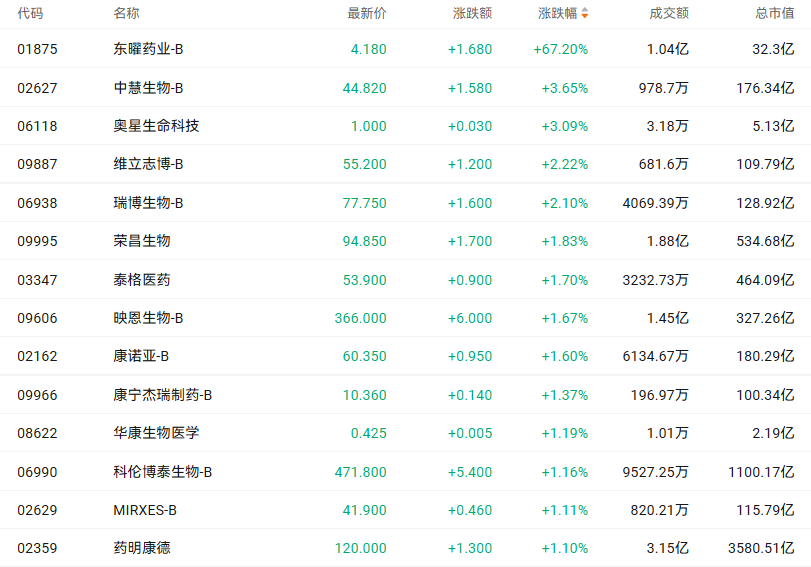
Cailian Press reported on January 15 (Editor: Hu Jiarong) that the pharmaceutical sector of Hong Kong stocks experienced a strong rebound today, with multiple stocks showing outstanding performance. As of press time, $BIODLINK-B (01875.HK)$ surged nearly 70%, $AB&B BIO-TECH-B (02627.HK)$ rose nearly 4%, $LEADS BIOLABS-B (09887.HK)$、 $RIBOLIFE-B (06938.HK)$ Up more than 2%, $REMEGEN (09995.HK)$ increased by nearly 2%. The sector as a whole demonstrated robust activity.
Wuxi XDC initiates a takeover offer for TOT Biopharm at a 99% premium
 As shown in the chart above, TOT Biopharm leads in terms of gains. The company, along with the offeror, $WUXI XDC (02268.HK)$ jointly announced that Citi will represent Wuxi XDC to initiate a voluntary conditional cash offer for TOT Biopharm at HKD 4 per share, representing a premium of approximately 99.00% over the closing price of HKD 2.01 on the last undisturbed trading day. This offer covers all issued shares (excluding those already owned or agreed to be acquired by Wuxi XDC) and the cancellation of all unexercised stock options.
The announcement stated that Wuxi XDC will utilize internal resources to fund this acquisition. Based on several assumptions, including full acceptance of the offered shares and full exercise of share options, the maximum consideration for this offer is approximately HKD 2.79 billion. Notably, Wuxi XDC plans to maintain TOT Biopharm's listed status post-transaction. Trading of TOT Biopharm’s shares resumed at 9:00 AM today.
Breakthrough progress in China's innovative drug development
In the R&D field, Chinese innovative pharmaceutical companies have been reporting frequent successes. On January 14, Vibe Bio announced that its self-developed PD-L1/4-1BB bispecific antibody LBL-024 received Fast Track designation from the U.S. FDA. This marks the third significant regulatory recognition for the drug after obtaining Breakthrough Therapy Designation from China's National Medical Products Administration and Orphan Drug Designation from the U.S. FDA in 2024, highlighting its global R&D value.
During the 2026 JPMorgan Healthcare Conference, $HENLIUS (02696.HK)$announced an exclusive global licensing agreement with Youmai Bio to acquire global rights to a monoclonal antibody targeting interleukin-1 receptor accessory protein (IL-1RAP). This collaboration marks Fosun Henlius' active expansion into the field of immune-inflammatory diseases while deepening its oncology immunotherapy portfolio.
In addition,$BioNTech (BNTX.US)$At the 44th JPMorgan conference, the 2026 R&D plan was disclosed, announcing the initiation of six new Phase III clinical trials, including a pivotal clinical study for BNT324/DB-1311, a B7H3 ADC novel drug developed in collaboration with Yingen Biotech, intended for first-line treatment of metastatic castration-resistant prostate cancer (mCRPC).
Global pharmaceutical companies reassess the value of China’s innovative drug assets
JPMorgan noted in its latest industry report that this year's JPMorgan Global Healthcare Conference has sent a clear signal: innovative drug assets from China are gradually evolving from being an "optional allocation" in multinational pharmaceutical companies' R&D pipelines to becoming a "core source requiring systematic evaluation." However, this shift is not a universal trend but rather highly dependent on the quality of specific clinical data, the pace of development progress, and global capabilities.
The report particularly emphasized that multinational pharmaceutical companies' focus on China's innovative drugs does not stem from cost advantages or "low valuations," but rather from their demonstrated time efficiency and certainty in critical indications. In specific fields such as oncology, autoimmune diseases, and metabolic disorders, some Chinese pharmaceutical companies have advanced to the forefront of global competition for the same targets. Their advantages primarily lie in clinical execution efficiency, patient enrollment speed, and the rhythm of indication development. When an asset can enter the pivotal clinical stage earlier, its commercial value naturally receives an early reassessment.
Editor/Jayden