
①According to a survey of economists by the media, economists expect that the price report scheduled for release on Friday will show a 0.9% month-over-month increase in the US CPI in March; ②Notably, since 1981, there have only been 16 instances where the monthly price increase reached 0.9% or more, and this would also represent the largest month-over-month increase since June 2022.
Just as Trump agreed to a two-week ceasefire with Iran, the US economy may also send a series of alarming signals later this week. For Trump and his White House aides, amid declining poll ratings, "TACO" itself may have become the only viable path forward…
Industry insiders indicate that due to the rise in gasoline prices caused by the war in Iran, the US CPI in March may see a significant increase, becoming one of the months with the largest inflation spikes in history.
 According to a survey of economists by the media, economists expect that the US CPI report, scheduled for release on Friday, will show a 0.9% month-over-month increase in the US inflation rate in March.
This expected month-over-month increase is itself a rather astonishing figure. Notably, since 1981, there have only been 16 instances where the monthly price increase reached 0.9% or more, and this would also represent the largest month-over-month increase since June 2022—when the year-over-year increase in the US CPI once exceeded 9%.
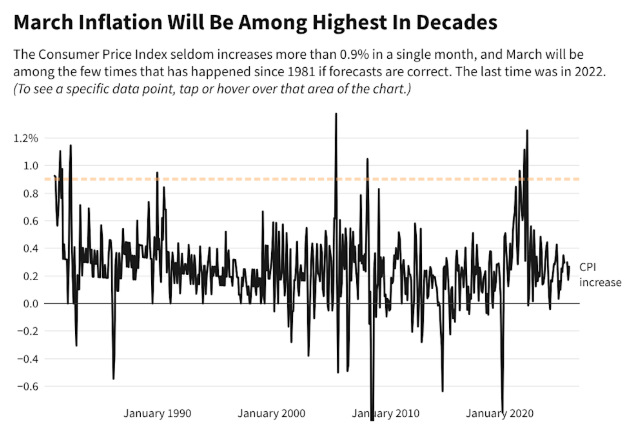
On a year-over-year basis, economists predict that this month-over-month increase will lead to a 3.3% year-over-year rise in the CPI in March, which would also mark the highest level since April 2024.
If the CPI report released on Friday ultimately aligns with these expectations, it will underscore the economic costs of the US-Iran war to the United States, a conflict that has already driven up energy prices sharply. The conflict led to the closure of the Strait of Hormuz between Iran and Oman, a key waterway that typically carries 20% of the world's oil supply.
Over the past month, this geopolitical conflict has caused crude oil prices around the world to soar, driving up gasoline and diesel prices. In the five weeks since the outbreak of the war, the price of gasoline in the United States has risen by more than $1 per gallon. Economists noted that as the war continues, rising energy prices will intensify and may spread to other products, as transportation companies pass on higher fuel costs to customers.
Currently, the surge in gasoline prices has squeezed household budgets in the United States, forcing funds to be redirected to other areas and harming consumer spending. Meanwhile, higher inflation is compelling the Federal Reserve to keep key interest rates at elevated levels for a longer period, thereby raising borrowing costs across various types of loans. Both trends are weighing on economic growth.
Jim Reid, head of macro research at Deutsche Bank, wrote in a commentary, "The impact of the energy price shock will be fully felt."
Inflation expectations rise in tandem.
Perhaps more unsettling is the concurrent rise in inflation expectations. According to a survey released by the Federal Reserve Bank of New York on Tuesday, as the war in the Middle East erupted, consumers anticipated increases in gasoline and food prices, leading to the largest jump in short-term inflation expectations in March in a year.
Based on the median responses from the Federal Reserve Bank of New York's monthly Survey of Consumer Expectations, American consumers expect an inflation rate of 3.4% over the next 12 months, up 0.4 percentage points from February. Three-year inflation expectations rose slightly to 3.1%, while five-year inflation expectations remained unchanged at 3%.
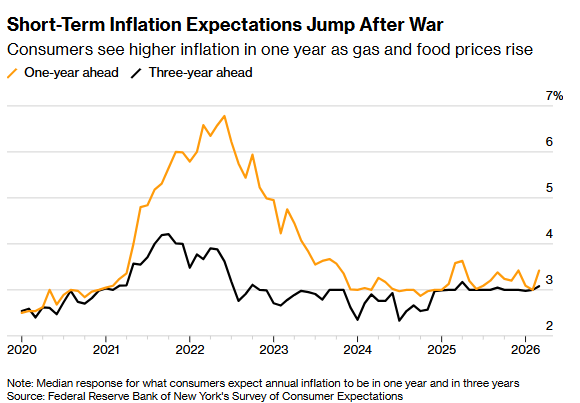
The survey, conducted from March 2 to 31, reflects increased consumer pressure following the first airstrikes by the United States and Israel against Iran. This conflict has caused oil prices to surge and introduced new upward pressure on inflation — over the past five years, U.S. inflation has consistently exceeded the Federal Reserve’s 2% target.
Respondents indicated that they expect gasoline prices to rise by 9.4% over the next year, up 5.3 percentage points from before the conflict, reaching the highest level since March 2022. They also anticipate food prices to increase by 6% over the next year, up 0.7 percentage points from the February survey.
Households have become more pessimistic about their financial situation, with an increasing proportion reporting that their financial conditions have worsened compared to a year ago. The percentage of households expecting their financial situation to deteriorate over the next year also rose to the highest level since April 2025.
So far this year, Federal Reserve officials have kept benchmark interest rates unchanged, with several policymakers indicating that the current rate helps balance risks related to employment and inflation. According to Labor Department data released last week, U.S. nonfarm job growth rebounded in March after a sharp decline in February.
However, the survey showed mixed views among consumers regarding the labor market. On one hand, respondents believed there was a higher likelihood of unemployment rising a year from now, with perceived unemployment risk slightly increasing over the next year. On the other hand, people felt that opportunities to find a job after becoming unemployed had improved.
Some Fed officials who are concerned about persistently high inflation believe the labor market is stabilizing and have suggested that if inflation remains stubbornly above the target level, the Fed may need to raise interest rates. However, such views remain a minority among Fed policymakers. Based on pricing in federal funds futures contracts, investors widely expect the Fed to keep benchmark interest rates unchanged this year.
Editor/KOKO