
①Tai Guangdian, Taiyao, and Lienmao have recently communicated with customers about the price increase of high-end CCL; ②Wanlian Securities pointed out that driven by the explosive demand for AI servers and 800G switches, high-end materials are in short supply; ③In the past six months, the CCL industry has undergone several rounds of price increases, closely resembling the limited supply characteristics of CCL in 2020.
According to a report by Taiwan's Business Times on April 15th from The STAR Market Daily, high-end PCB material suppliers such as Tai Guangdian, Taiyao, and Lienmao have recently been communicating with customers about raising the prices of high-end CCL.
It is reported that Taiyao has notified its customers that due to the continuous rise in raw material costs like copper foil, fiberglass cloth, epoxy resin, and processing fees, along with some suppliers halting certain product supplies, CCL quotations will be raised starting April 25th. Some series products will see price hikes of 20% to 40%. Meanwhile, Tai Guangdian and Lienmao announced they will initiate a new round of price adjustments for high-end materials beginning in the second quarter, with an increase of 10%, targeting applications such as AI servers and switches.
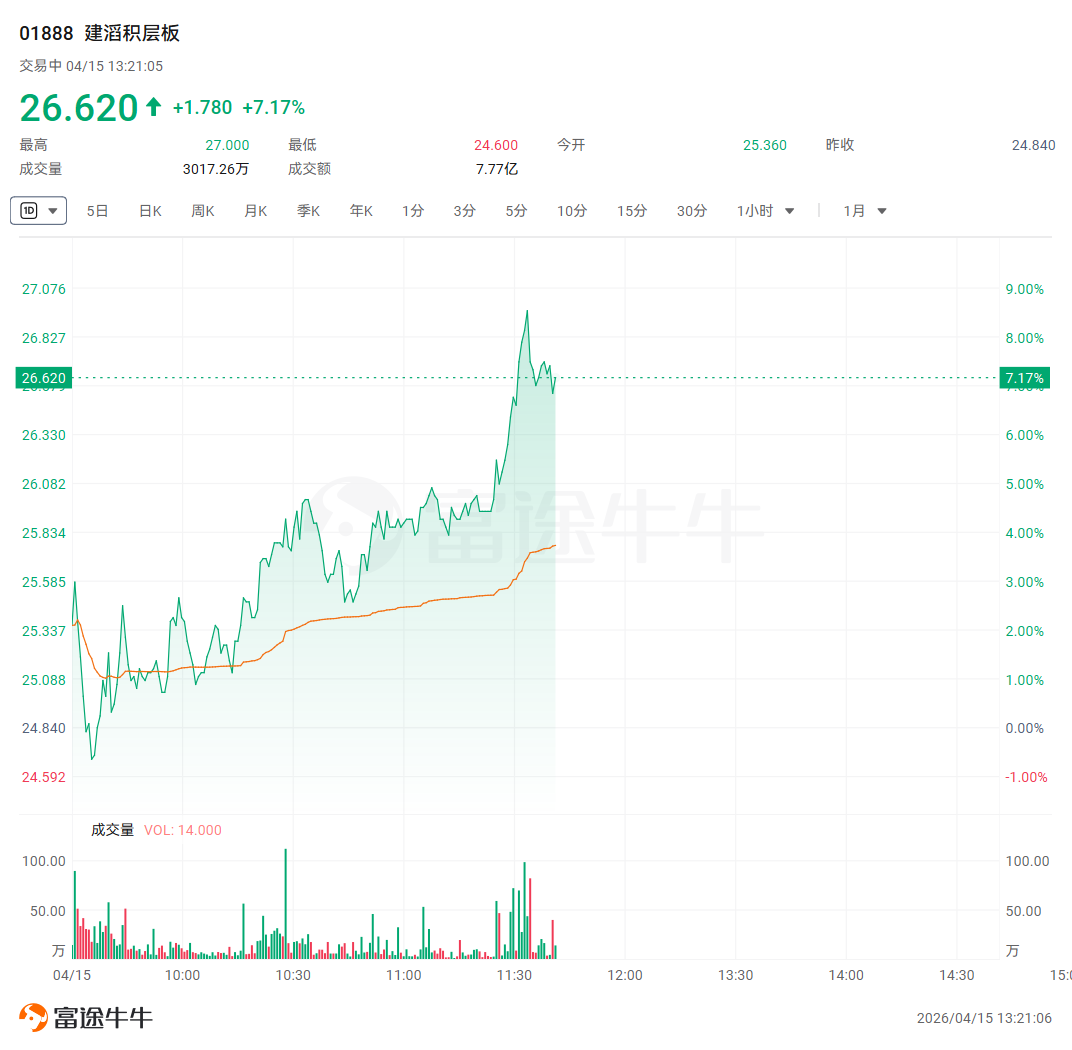
 H-share CCL leader $KB LAMINATES (01888.HK)$ The stock price rose again today, surging over 8% at one point during trading and hitting a record high of HKD 27. It is currently up more than 7%.
CCL refers to copper-clad laminate (CCL), a key component that supports the overall structure of PCBs. Wanlian Securities pointed out that driven by the explosive demand for AI servers and 800G switches, high-end materials are in short supply. Stable growth in traditional server demand remains the foundational application supporting high-end CCL. Industry insiders judge that this synchronized price increase reflects a clearer upward trend in high-end CCL pricing.
It is worth noting that over the past six months, the CCL industry has experienced multiple rounds of price increases: Starting December 2025, mainstream manufacturers such as Jiapo and Nanya have issued frequent price adjustment notices, with the maximum weekly increase in CCL prices reaching 10%-20%. Institutions believe this market trend highly resembles the limited supply characteristics of CCL in 2020. Since this year, Japan’s semiconductor materials manufacturer Resonac has raised prices starting March 1st, while Mitsubishi Gas Chemical also increased prices across all its products by up to 30% starting April 1st.
A research report by Western Securities on April 8 stated that from the demand side, high-end application sectors exhibit extremely strong growth momentum: High-end HDI benefits from integrated AI terminal requirements, with the global market size projected to reach $16.9 billion by 2029; the global automotive PCB market is expected to grow to $12.2 billion by 2030; meanwhile, IC substrates benefit from downstream memory prosperity, extending BT substrate lead times to 16-20 weeks, creating opportunities for domestic manufacturers.
Open Source Securities believes that the fundamental driver behind this round of price increases in the CCL industry lies in the comprehensive and sustained cost pressures exerted by its core raw materials.
In the traditional cost structure of CCL, copper foil, resin, and fiberglass cloth have long accounted for a significant proportion as the three main components. With the surge in demand for AI servers and high-speed communications, base materials are evolving towards high-frequency, high-speed levels (M9 or higher). The physical modification space for the three main materials in terms of low dielectric constants (Low Dk/Df) and ultra-low coefficients of thermal expansion (CTE) is gradually approaching physical limits.
Northeast Securities noted that during the pursuit of ultra-low dielectric loss and thermal expansion coefficients, silicon micro-powder (with a filling ratio of approximately 15%), previously regarded merely as a cost-reducing filler, is expected to increase its filling ratio to 40% annually. As demand for high-performance base materials grows, spherical silicon micro-powder produced via physical flame methods, known for its high fluidity and high filling rate, has seen its per-ton price gradually rise to tens of thousands of yuan. For AI chip-compatible substrates and M8-level applications or above, premium-grade powder prices per ton are expected to rise significantly.
The institution further indicated that global high-end CCL silicon micro-powder markets have long been dominated by manufacturers like Denka and Nippon Steel. Currently, domestic localization efforts have shifted from purely low-cost strategies toward supply chain security and synchronized development. For example, Lianrui New Materials has achieved key breakthroughs in spheroidization technology and low alpha-ray control, successfully entering the supply chains of leading CCL suppliers such as Shengyi Technology and Nanya New Materials. Lingwei Technology is accelerating its extension into high-purity electronic-grade silicon micro-powder, aligning well with the stringent requirements of ultra-high-frequency base materials like M8 and M9. With gradual chemical production capacity rollouts domestically, Chinese-made silicon micro-powder is expected to achieve full positioning as a core supplier within three years, transitioning from a marginal filler role.
Editor/Jayden