
South Korea has ensured the transportation of 273 million barrels of crude oil through routes outside the Strait of Hormuz.
Kang Hoon-sik, Chief Secretary to the President of South Korea, formally announced in Seoul on Wednesday that through last week's special envoy visits to four countries in the Middle East and Central Asia, South Korea has successfully secured a total supply guarantee of 273 million barrels of crude oil and 2.1 million tons of naphtha. The most critical breakthrough is that the aforementioned energy supplies will all be delivered to South Korea via alternative routes bypassing the Strait of Hormuz before the end of the year. This move signifies that, against the backdrop of persistently high geopolitical risks in the Strait of Hormuz, Asia's fourth-largest economy has gained a precious strategic buffer for its industrial lifeline.
The supply volume can sustain normal operations nationwide in South Korea for over three months.
According to detailed explanations provided by Kang Hoon-sik at the press conference, the locked-in energy imports secured this time are sufficient to cover South Korea’s basic needs in the medium to short term. Based on last year’s average daily energy consumption levels in South Korea, 273 million barrels of crude oil are enough to power the South Korean economy for more than three months, while 2.1 million tons of naphtha equates to approximately one month’s worth of imports.
 Since about 61% of South Korea's crude oil imports and 54% of its naphtha imports have long relied on the Strait of Hormuz as the sole maritime chokepoint, the implementation of this bypass route was described by Kang as “a direct and tangible contribution to stabilizing domestic supplies.”
Country-specific supply details: Saudi Arabia takes the lead, with coordinated land and sea efforts to mitigate risks.
Kang stated that Saudi Arabia has agreed to use alternative ports near the Red Sea to deliver approximately 50 million barrels of crude oil to South Korean companies in April and May, which were previously allocated to South Korean firms. He also mentioned that Riyadh has committed to prioritizing the allocation and delivery of 200 million barrels of crude oil to South Korean companies from June until the end of the year, and pledged to supply as much naphtha as possible before the end of the year, including the 500,000 tons requested by the South Korean government. Kang noted that Kazakhstan will supply 18 million barrels of crude oil, while Oman has committed to delivering 5 million barrels of crude oil and 1.6 million tons of naphtha.
The success of this energy diplomacy stems from Kang’s emergency mediation visits as a presidential envoy to Kazakhstan, Oman, Saudi Arabia, and Qatar. Specific supply allocations and route arrangements are as follows:
Saudi Arabia (largest supplier): Committed to delivering approximately 50 million barrels of already-allocated crude oil to South Korean companies between April and May using alternative ports near the Red Sea; from June to the end of the year, it will prioritize allocating and transporting 200 million barrels of crude oil to South Korean companies. In terms of petrochemical feedstock, Riyadh has pledged to meet South Korea's request for 500,000 tons of naphtha supply as much as possible.
Kazakhstan (land-based assurance): Committed to supplying 18 million barrels of crude oil, which will be transported via the Caspian Pipeline Consortium and the railway system, completely avoiding maritime chokepoint risks.
Oman (regional pivot): Committed to supplying 5 million barrels of crude oil and 1.6 million tons of naphtha, leveraging its port advantages along the Arabian Sea coast to achieve the bypass.
Strategic Depth: Exploring the Construction of Bypass Pipelines and Joint Oil Storage Facilities
In addition to addressing immediate supply shortages, South Korea is seeking to structurally reduce its reliance on the Strait of Hormuz. Kang revealed that in consultations with Saudi Arabia and Oman, both parties have engaged in in-depth discussions regarding the construction of bypass pipelines outside the Strait of Hormuz and oil storage facilities. Once the relevant infrastructure is completed, Persian Gulf crude oil can be transported directly via land-based pipelines to the coast of the Gulf of Oman or the Red Sea, thereby completely avoiding the risk of strait blockades.
Moreover, the South Korean government has allocated additional budgetary funds to expand domestic oil storage facilities. By deepening 'joint reserve' agreements with major oil-producing countries, South Korea aims to attract Middle Eastern nations to store their commercial inventories within its territory. This move not only generates storage revenue but also enhances priority access rights during emergencies.
Kang stated that as more funding is allocated to expand domestic oil storage facilities, joint reserves with key oil-producing countries can be expanded, which will help ensure a stable supply.
Economic and Market Impact: Lifting Macroeconomic Alarms, Easing Pressure on South Korean Assets
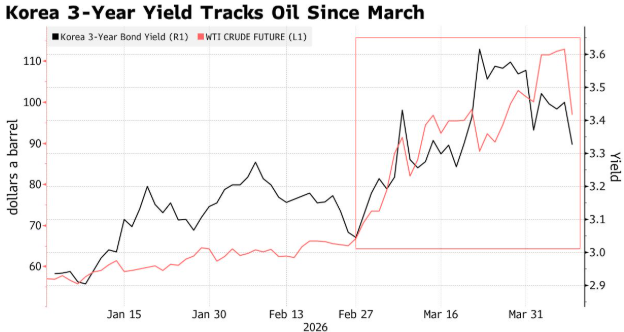
The Iran conflict drove up international crude oil prices, not only raising import costs but also adding inflationary risks to Korea, which heavily relies on overseas energy. Energy shocks have forced the Korean government to adopt increasingly stringent measures, including imposing caps on fuel prices, to protect the economy. Authorities also announced plans to develop contingency measures to curb energy demand and stabilize prices, highlighting the immense pressure faced by Korea’s economy due to its heavy reliance on imported oil.
Prior to this announcement, South Korea's financial markets were experiencing significant volatility due to the ongoing tensions in the Middle East. As a typical 'high-beta, net oil-importing economy,' the continuous outflow of foreign capital had pressured the Korean won, causing the KOSPI index to fluctuate sharply.
Analysts believe that the implementation of this energy security agreement will bring direct benefits:
Eliminating short-term supply disruption risks; previously, if the Strait of Hormuz were fully blocked, South Korean refineries would face shutdown risks within two weeks. Now, a three-month buffer period provides crucial time for subsequent diplomatic negotiations.
Curbing imported inflation; locking in price formulas through intergovernmental agreements helps hedge against high oil prices caused by war premiums in the spot market, alleviating inflation pressures faced by the Bank of Korea.
Stabilizing the stock market and exchange rate; correcting the logic of raw material shortages in the petrochemical and refining sectors, reducing macroeconomic uncertainties in technology manufacturing, which is expected to attract foreign capital inflows and support the stabilization of the Korean won’s exchange rate.
In a letter to the leaders of the visited country, South Korean President Lee Jae-myung pointed out that the protracted Middle East conflict calls for joint efforts from all parties to address the energy security crisis. Through this special envoy diplomacy, South Korea has sent a clear signal to the outside world: instead of passively waiting for regional tensions to improve, it is better to proactively reconstruct energy transportation routes away from the storm.
Editor/Doris