
① Iranian Foreign Minister Araghchi announced that the Strait of Hormuz is open to all merchant ships during the ceasefire, boosting the three major US stock indices and causing international crude oil prices to plummet; ② Trump quickly responded, thanking Iran for opening the Strait of Hormuz.
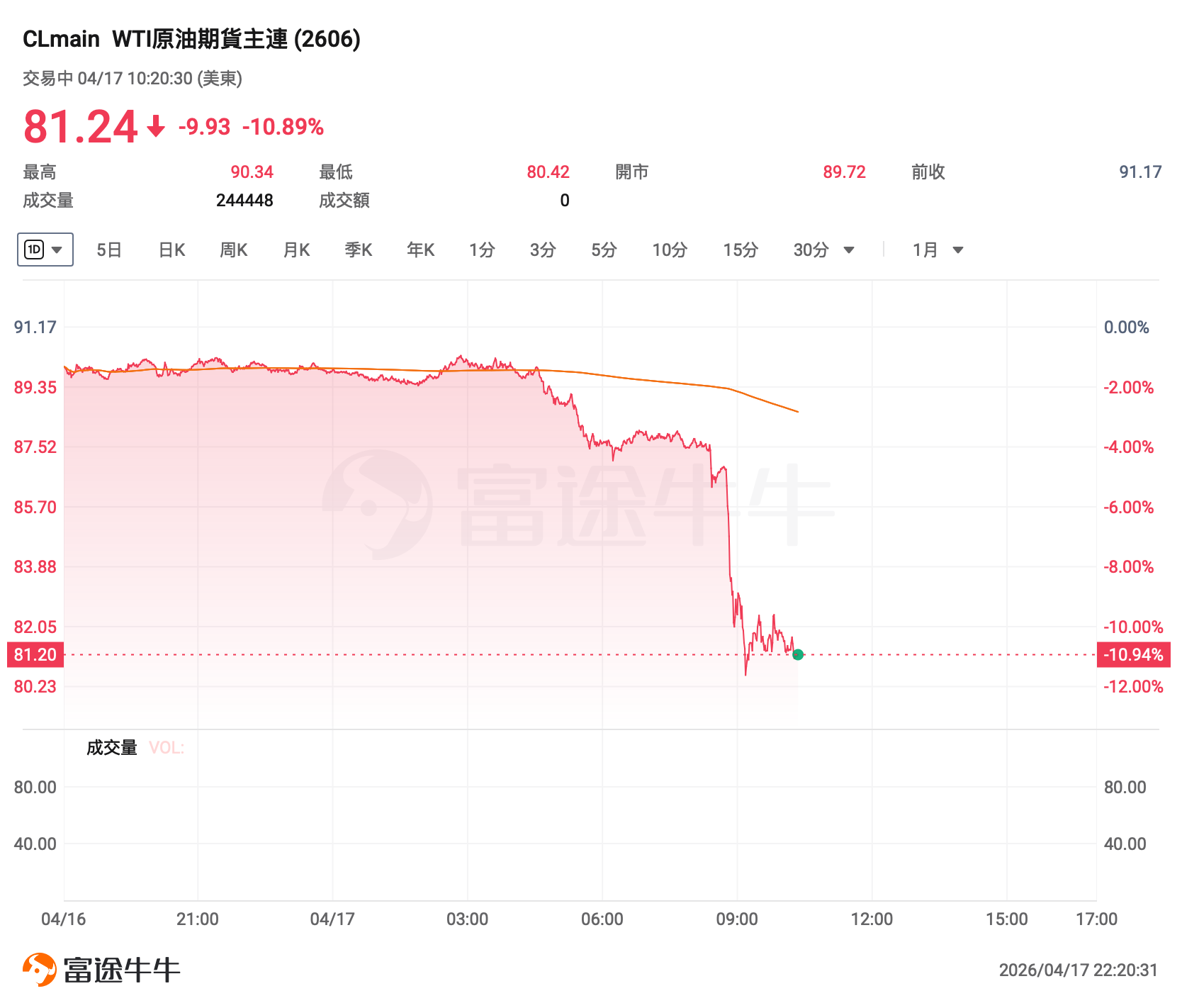
About 45 minutes before the US stock market opened on Friday (April 17), the Iranian foreign minister announced that the Strait of Hormuz would be open to all merchant ships during the ceasefire. Following this news, the three major US stock indices rose significantly, while international crude oil prices plummeted.
As of the time of writing, both Brent crude oil and US WTI crude oil futures fell more than 10%. Brent crude oil once dropped to $87.74 per barrel, and WTI hit a low of $80.42 per barrel, both reaching their lowest levels since March 11.
 The three major US stock indices collectively rose, each gaining over 1%.

At 20:45 Beijing time on Friday evening, Iranian Foreign Minister Araghchi stated on social media that in light of the ceasefire agreement between Lebanon and Israel, Iran would open the Strait of Hormuz to all merchant ships during the ceasefire period.
Araghchi said that the Strait of Hormuz would be fully open to all merchant ships during the ceasefire, with navigation routes following the coordinated routes previously published by Iran's Ports and Maritime Organization.
Trump quickly responded, thanking Iran for opening the Strait of Hormuz. He wrote on social media, “Iran has just announced that the Iranian strait is fully open and accessible. Thank you!”
These latest developments have boosted market optimism, with some investors believing that what could be the most severe global energy supply disruption in history may be coming to an end. The day before, Trump had suggested that the conflict with Iran “should end soon.”
Arne Lohmann Rasmussen, Chief Analyst at Global Risk Management, stated, “The market believes that the war and the blockade of the strait have ended. However, we noticed that this only applies to vessels sailing along Iran’s coastline. Therefore, the strait may not yet be fully open.”
Earlier in the day, American media, citing two US officials and two sources familiar with the negotiations, reported that the US and Iran were in communication regarding a plan aimed at ending the war.
One of the key issues is that the United States will unfreeze 20 billion US dollars of Iran's frozen funds in exchange for Iran giving up its stockpile of enriched uranium. The report also cited another source familiar with the mediation efforts as saying that the negotiations are expected to take place this Sunday in Islamabad, the capital of Pakistan.
Priyanka Sachdeva, senior market analyst at Phillip Nova Pte, stated, 'The current theme dominating the market is not escalation but stabilization. The oil market has sent a clear message: fear drove the rally, diplomatic efforts drove the pullback, and uncertainty will lead to future volatility.'
Daniel Murray, deputy chief investment officer at EFG Asset Management, stated, 'As tensions in the Middle East gradually ease, market focus will return to fundamentals, particularly the earnings performance of listed companies. The earnings season has just begun, with optimistic profit expectations consistent with robust macroeconomic trends.'
On the day, the Nasdaq Composite Index will challenge a '13-day winning streak.' Scott Rubner, head of equity and equity derivatives strategy at Citadel Securities, stated, 'The previous correction provided a constructive entry point for the stock market, especially in high-quality large-cap growth stocks.'
Editor/Doris