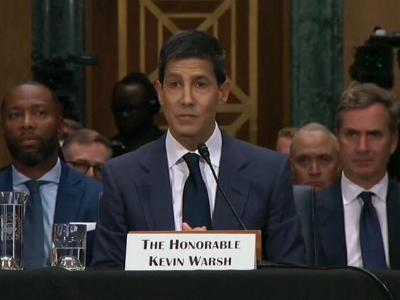
Wash said that statements by the president and lawmakers on interest rates would not threaten the Fed's independence. The Fed must adhere to its functional boundaries, and if it ventures into fiscal and social policies beyond its legal authority, its independence will face the greatest risk. He expressed hope for 'institutional reform' of the Fed, advocating for a new inflation framework and communication methods. He criticized Fed officials for making excessive public comments and argued that four interest rate meetings per year are too few. AI could boost economic productivity without triggering inflation, creating room for interest rate cuts. The Fed is 'hardly blameless' for the expansion of the U.S.'s 'K-shaped economy,' as its large balance sheet amplifies its impact on the economy. Senator Tillis insisted he would not support Powell’s renomination unless the Department of Justice concludes its investigation into him. According to the 'New Fed Wire,' whether Wash will be nominated hinges on who concedes first regarding the investigation into Powell—Trump or the lawmakers.
On Tuesday, the 21st Eastern Time, the U.S. Senate Banking Committee held a hearing regarding the nomination of the Federal Reserve Chair. Facing questioning from senators of both parties, nominee Kevin Warsh emphasized maintaining the independence of monetary policy, stating the need for comprehensive reforms at the Federal Reserve and affirming that he would never act under the orders of U.S. President Trump.
In his prepared opening remarks, Warsh pledged to 'ensure that the implementation of monetary policy always maintains strict independence,' while also stating that 'the independence of the Federal Reserve primarily depends on the Fed itself.' The Fed should stay within its bounds, and if it extends its functions into areas of fiscal and social policy where it lacks statutory authority, 'its independence would face the greatest risk.'
 Warsh said, 'The independence of monetary policy is crucial. In my view, when elected officials—whether the president, senators, or members of the House—comment on interest rates, it does not pose a particular threat to the operational independence of monetary policy.'
Believing that the Federal Reserve should adhere to its functional boundaries, Warsh stated that he was not in a position to comment on Trump's dismissal of Fed Governor Lisa Cook. The commentary noted that the crux of the case lies in determining the extent of presidential authority to exert influence over the independent institution of the Federal Reserve.
Nick Timiraos, a journalist known as the 'new Fedwire,' commented that during the hearing where Warsh outlined his proposals for 'reforming' the Federal Reserve, he largely adhered to viewpoints he has repeatedly emphasized over the past few years—namely, replacing the Fed’s inflation forecasting models, reducing the frequency of external communications, and gradually shrinking its $6.7 trillion balance sheet over time.
Timiraos argued that the key to whether Warsh's nomination would be confirmed does not lie in whether he can garner enough supporting votes but rather in who will make concessions first regarding the criminal investigation into Fed Chair Powell—whether it will be Trump or Republican Senator Thom Tillis.
Timiraos pointed out that several notable aspects emerged during the two-and-a-half-hour hearing:
Warsh avoided all attempts to distance himself from Trump.
Warsh pledged to uphold the independence of the Federal Reserve while skillfully sidestepping the most challenging tests, such as refusing to take a stance on Trump's attempt to dismiss Governor Cook or the criminal investigation into Powell concerning renovations at the Fed headquarters, citing ongoing legal proceedings.
Warsh's rhetoric on independence is likely to cause dissatisfaction within the Fed, as his main argument is that the recent difficulties faced by the Fed are entirely self-inflicted.
Timiraos also noted that while Warsh did not call for interest rate cuts, he did not undermine the rationale for supporting such measures. He advocated that the Fed should focus on core inflation and cited metrics such as the 'trimmed mean,' which excludes outliers. These indicators show that inflation levels are actually closer to the Fed's target of 2%. Warsh also challenged the view held by several current Fed officials that tariffs have driven up recent inflation data. However, he did not declare victory over inflation, stating instead: 'Inflation trends are improving, but more work remains to be done.'
Warsh stated that Trump never requested, nor would he ever agree, to commit to interest rate cuts.
During the Q&A session of the hearing, when Senator John Kennedy asked Warsh whether he would become Trump's 'puppet,' Warsh responded, 'Absolutely not.'
Representative Ruben Gallego cited a report from The Wall Street Journal, which claimed that Trump had pressured Warsh to cut interest rates after receiving confirmation of his nomination, suggesting that someone was lying—either Trump or Warsh.
Warsh contested the aforementioned report and suggested that its author needed to 'find more reliable sources or adhere to stricter journalistic standards.' He said, 'I stand by every word I’ve said. The president has never asked me to make any such commitment, and I would never make such a commitment.'
Senator Jack Reed asked Warsh if he would yield to Trump’s demand for interest rate cuts. Trump had previously stated that he would not choose someone who opposed rate cuts as the Fed chair. Warsh responded that he had made no commitments to Trump.
Senator Elizabeth Warren described Warsh as 'highly unsuitable' to serve as the Fed chair. She repeatedly asked if Trump would lose the 2020 election. Warsh declined to answer, saying, 'If I am confirmed, we will strive to keep politics out of the Federal Reserve.'
Warren repeatedly pressed Warsh to disclose more details about his approximately $100 million in assets, asking whether these included entities related to Trump and his family or investments linked to the convicted Epstein.
Warsh reiterated that he had collaborated with the Office of Government Ethics (OGE) to divest his relevant personal assets. He agreed that upon confirmation of his nomination, he would 'sell all my financial assets,' without ever providing specific asset details.
A desire for systemic reform at the Federal Reserve necessitates new communication methods; four interest-rate meetings per year are insufficient.
Warsh previewed that if his nomination is confirmed, he hopes to implement comprehensive reforms at the Federal Reserve. These reforms include 'changes in the policy implementation system' and establishing a completely new 'inflation framework.' Warsh believes the Federal Reserve needs a new inflation framework but did not disclose what form his envisioned new framework might take.
Warsh told Senator Tim Scott, the chairman of the Senate Banking Committee, 'We need a new framework, new tools; Mr. Chairman, I’d like to add—one more thing—we need a new way of communicating.'
On communication, Warsh noted that he believed there was an 'over-communication' problem among Fed officials regarding interest rates, specifically manifested in the quarterly economic projections. In these projections, officials are required to anonymously predict what they consider to be appropriate interest rate levels, including the so-called dot plot of interest rates.
When subsequently asked how many monetary policy meetings he would hold annually if confirmed as Fed Chair, Warsh did not provide a direct answer. He noted that according to the Federal Reserve Act, the minimum requirement is four meetings per year, but this is clearly too few. Warsh remarked, 'Four meetings are obviously insufficient, so holding more than that would be appropriate.'
As for whether post-monetary policy meeting press conferences would continue, Warsh did not give a definitive response, saying, 'If press conferences are held, I believe it would be an indispensable responsibility to listen to the concerns and questions journalists have at the moment.' However, he reiterated his previous criticism that Fed officials speak too frequently.
AI may enhance economic productivity without triggering inflation, creating room for interest rate cuts.
Senator Van Hollen expressed concern about Wash’s shifting stance on whether interest rate cuts are beneficial. 'What worries me is that your position on interest rates seems to sway with political convenience rather than being based on sound economic judgment,' he said, asking Wash why he favored rate cuts during a period when inflation remains high.
Wash stated that if the pace of potential economic growth accelerates – for instance, due to advancements in artificial intelligence (AI) – then inflation concerns might diminish, thereby creating space for interest rate reductions.
The media noted that although Warsh did not explicitly mention the term 'productivity' in his response, this concept lies at the heart of his argument. Nevertheless, many economists remain skeptical of the view that AI could help lower inflation, pointing out that, at least in the short term, AI might instead exacerbate inflationary pressures.
Wash elaborated on his thoughts about how AI will impact the economy. He noted that on one hand, the massive investments companies are making in AI infrastructure will boost demand in the short term, indirectly pushing inflation higher. On the other hand, in the long run, AI technology has the potential to enhance the productive capacity of the economy, enabling faster economic growth without triggering inflation.
When asked about AI-related topics, Wash said, 'In terms of modern economic history for the U.S. and globally, we are at one of the most disruptive moments.'
Senator John Kennedy expressed deep skepticism about this. He stated that the various promises suggesting AI will significantly boost productivity are, in his view, merely 'hype' fabricated by certain individuals to drum up support for an upcoming IPO.
The Federal Reserve cannot shirk responsibility for the expansion of the U.S. 'K-shaped economy.'
During the hearing, Warsh stated that the Federal Reserve 'cannot shirk responsibility' for the growing wealth inequality—now widely known as the 'K-shaped economy' phenomenon—and noted that the Fed’s large balance sheet has amplified its influence over the economy.
In response to a question from Senator Raphael Warnock, Warsh said, 'I believe the Fed cannot shirk responsibility for the divergence you described between those who own financial assets and those who do not—after all, the Fed’s balance sheet has expanded from $800 billion when I joined in 2006 to a level now an order of magnitude higher.'
He continued, 'If the Fed had maintained a smaller balance sheet… I believe interest rates could have been lower, inflation could have been better managed, and the economy could have been stronger.'
Wash declined to specify an appropriate size for the Federal Reserve's balance sheet. However, he stated that the scale of the balance sheet should be reduced and that the Federal Reserve should no longer hold long-term government bonds.
In February this year, Xinhua News Agency cited US media reports stating that wealth inequality in American society is continuing to intensify, with structural divides accelerating and the characteristics of a 'K-shaped economy' becoming increasingly prominent. According to data cited by Xinhua, in the third quarter of 2025, the wealthiest 1% of Americans owned nearly 32% of the nation’s total net assets, a record high, while the bottom 50% of income earners held only 2.5% of the country’s wealth.
Cryptocurrencies should be integrated into the financial system.
Senator Cynthia Lummis asked Wash whether he believed that crypto-assets should be incorporated into the financial system so that consumers could enjoy a broader range of investment options and enhanced consumer protection.
Wash responded affirmatively: 'Digital assets have already become deeply embedded as part of the fabric of our financial industry; therefore, my answer is yes.'
Warsh also remarked that the Fed has no authority to issue a digital currency, calling it a poor policy choice. The Fed should indeed avoid adopting a central bank digital currency (CBDC).
Senator Tillis insists he will not support the nomination unless the Department of Justice ends its investigation into Powell.
During the hearing, key Senator Thom Tillis stated that he would not question Wash on his views but instead use the opportunity to explain why he intends to block the nomination for the position of Federal Reserve Chairman. Tillis had previously pledged to obstruct any nominee put forward by the Federal Reserve until the US Department of Justice dropped its criminal investigation against Powell.
The Department of Justice’s investigation focuses on the multi-billion-dollar renovation project of the Federal Reserve’s Washington, D.C., headquarters and Powell’s testimony to the Senate Banking Committee last year regarding the matter. Tillis displayed a series of posters detailing the chronology of the Fed’s renovation project. He noted that while the cost overruns were 'unfortunate,' they seemed 'compliant and justified.'
Tillis told Wash, 'Let’s resolve this (Powell’s) investigation first so I can then support your nomination.'
Editor/Liam